Zuckerberg's $500M AI Cell Initiative Explained
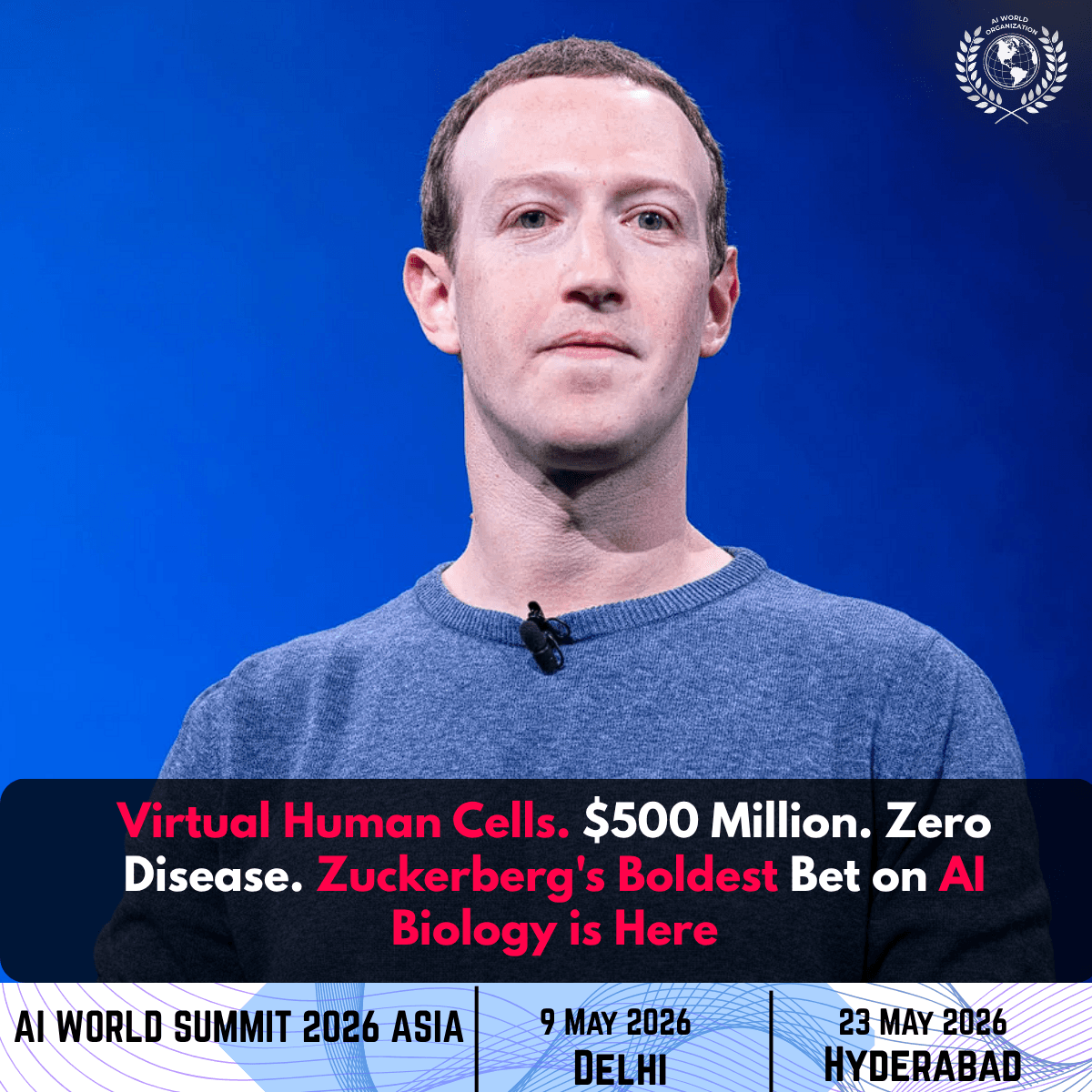
Mark Zuckerberg and Priscilla Chan's Biohub launches a $500M Virtual Biology Initiative using AI to build predictive human cell models and fight all diseases.
TL;DR
Mark Zuckerberg and Priscilla Chan's nonprofit Biohub is putting $500 million into a five-year Virtual Biology Initiative to build AI-powered models of human cells. The goal is to predict how diseases develop and find ways to stop them. Partners include MIT, Harvard, Nvidia, and the Wellcome Sanger Institute, with all generated datasets made freely available to researchers worldwide.
The world of AI funding news is witnessing one of its most consequential moves yet — not from the corridors of a tech giant racing to ship the next chatbot, but from a philanthropy with a vision far grander than quarterly earnings. Mark Zuckerberg and Priscilla Chan, through their nonprofit research organization Biohub, have announced a staggering $500 million commitment to what they are calling the Virtual Biology Initiative. Announced on April 29, 2026, this five-year program is aimed squarely at one of humanity's oldest and most humbling challenges: understanding how disease begins and how we can stop it — right at the level of individual cells. This is not a minor research grant or a speculative technology bet. It is a structured, multi-partner, globally coordinated effort to fundamentally change what artificial intelligence can do inside a living body.
At its heart, the initiative is built on a deceptively simple idea — that if we can teach AI to truly understand how human cells behave, predict how they malfunction, and simulate what happens when diseases take hold, we will have cracked one of the most difficult problems in modern science. The scale of ambition is breathtaking. But so is the funding behind it. This AI funding commitment places Biohub among the most serious non-government investors in biological AI research anywhere in the world, and it signals a clear pivot: the next frontier of artificial intelligence is no longer just language, images, or code — it is life itself.
What Is the Virtual Biology Initiative?
The Virtual Biology Initiative is a five-year program that Biohub is anchoring with $500 million to build open, global datasets designed to power predictive models of the human cell. These models — what Biohub scientists call "virtual cells" — are AI systems trained to simulate how cells work, how they respond to different biological environments, how they malfunction under the pressure of disease, and how they might be reprogrammed or treated. Think of it less like a traditional drug discovery program and more like building a flight simulator for biology — one where researchers from anywhere in the world can run experiments at the molecular and cellular level without ever needing a physical lab.
The initiative is structured around two major funding streams. Of the $500 million, $400 million will be directed inward — toward Biohub's own internal research capabilities. This includes developing next-generation imaging technologies that can capture biological processes at unprecedented resolution, engineering tools for manipulating molecular structures, and building the data infrastructure needed to store, organize, and share vast biological datasets at global scale. The remaining $100 million will flow outward, designed specifically to bring in the wider scientific community and fund external organizations working on data generation efforts that no single institution could realistically undertake on its own.
Alex Rives, a key scientific leader at Biohub, has been candid about the ambition driving the initiative. Today's AI biology datasets include roughly one billion cells — which sounds like an enormous number until you realize it may be an order of magnitude or more below what is actually needed to build models that can genuinely predict cellular behavior across the full spectrum of human health and disease. The Virtual Biology Initiative is designed to close that gap in a deliberate, structured way. And importantly, all the datasets generated through this effort will be made openly available to the global scientific community — a significant commitment in an era when proprietary data has become one of the most contested assets in technology.
Who Is Joining Biohub in This Effort?
One of the most distinctive aspects of this AI funding initiative is the extraordinary coalition of scientific and technological partners that Biohub has assembled. This is not a solo venture. Collaborating institutions include the Broad Institute of MIT and Harvard, the Allen Institute, the Arc Institute, and the Wellcome Sanger Institute — all of them recognized globally as leaders in genomics, cell biology, and biomedical research. Alongside these research heavyweights, the initiative has also pulled in two major international data consortia: the Human Cell Atlas and the Human Protein Atlas, both of which have been building comprehensive biological reference maps for years and will now contribute their expertise to the virtual cell modeling effort.
Perhaps most striking from a technology standpoint is the involvement of Nvidia. The chip manufacturer needs little introduction in the world of AI — its graphics processing units have become the de facto engine of modern machine learning, and its role in the Virtual Biology Initiative underscores just how computationally demanding this kind of research will be. Processing datasets of the scale Biohub is aiming to generate — going potentially ten times beyond the one billion cell benchmark that currently represents the state of the art — will require extraordinary computing infrastructure, and Nvidia's participation signals that the hardware side of this equation is being taken as seriously as the biology. Renaissance Philanthropy is also among the collaborating partners, further broadening the coalition beyond purely scientific institutions.
This level of cross-sector partnership — spanning academic research institutions, international scientific consortia, commercial technology companies, and philanthropic organizations — is relatively rare in biomedical science. It reflects both the scale of the challenge and the growing recognition that AI funding news in biology is no longer confined to small pilot programs or niche academic grants. The Virtual Biology Initiative represents a genuine attempt to build shared scientific infrastructure, and the breadth of its partnerships is one of the clearest signals of how seriously the global research community is taking it.
The Bigger Goal: Can AI Actually Cure All Disease?
To understand why this AI funding commitment is generating so much attention, it helps to step back and look at the long-term ambition driving it. Zuckerberg has previously stated — without any apparent hesitation — that Biohub's ultimate goal is to cure all human disease. That statement, which might sound like hyperbole coming from almost anyone else, carries a different weight coming from the co-founder of one of the world's most powerful technology companies and one half of a philanthropy that has already committed tens of billions of dollars to science and education over its lifetime.
The theoretical foundation behind the initiative draws from a thesis that has been gaining traction in AI research circles for several years: that as biological data and computational power both scale up dramatically, AI models will begin to make genuinely predictive leaps rather than simply recognizing patterns in existing data. DeepMind's Demis Hassabis has made similar predictions, arguing that AI could eventually put an end to disease as we know it. The Virtual Biology Initiative is arguably the most concrete, funded, and operationally structured attempt to test that thesis — to move from prediction to proof.
Of course, it would be naive to suggest that $500 million and five years will deliver all of this. Rives himself has acknowledged that achieving the full ambition of the initiative will require far more than the resources Biohub alone is committing. The $100 million earmarked for external research is partly designed with this in mind — to seed the kind of collaborative, open-data ecosystem that could attract additional investors, governments, and institutions over the coming decade. Biohub is essentially trying to prove enough of the model that others are compelled to build on top of it, in much the same way that foundational research in genomics eventually drew in pharmaceutical companies, technology firms, and national health agencies from around the world. In that sense, this is as much a strategic bet on the future of AI funding in biomedicine as it is a scientific research program.
What This Means for the Future of AI in Healthcare
From the perspective of AI funding news, the Virtual Biology Initiative is significant not just because of its size, but because of what it represents directionally for the entire field. For years, AI in healthcare has been dominated by relatively narrow applications: diagnostic imaging tools that detect tumors from scans, predictive models for hospital readmission, natural language processing tools that parse clinical notes. These are valuable, but they operate on the surface layer of medicine. What Biohub is attempting is something categorically different — AI that understands biology at the molecular and cellular level, that can model what happens inside a living cell with enough fidelity to make genuine predictions about how disease starts, progresses, and could be interrupted.
If even a fraction of that ambition is realized, the downstream implications for drug discovery, personalized medicine, and preventive healthcare are enormous. Drug discovery today is extraordinarily slow and expensive partly because researchers have limited tools for predicting how candidate molecules will interact with biological systems. A mature virtual cell model would give scientists a simulation environment to test ideas rapidly, cheaply, and at scale — before a single compound is synthesized or a single clinical trial is launched. That kind of acceleration could compress drug development timelines from decades to years, with compounding benefits for patients, healthcare systems, and the global economy.
It is also worth noting the broader context in which this AI funding announcement arrives. Meta — the company Zuckerberg leads — has faced scrutiny over its tax practices, and critics have been quick to observe that private philanthropic initiatives like Biohub can sometimes fill gaps left by underfunded public science. That tension is real and worth acknowledging. But it does not diminish the scientific significance of what is being built here. If the Virtual Biology Initiative delivers open datasets that any researcher in the world can access and build upon, it will have made a contribution to global science that goes well beyond the balance sheet of any individual donor. The AI World Organization continues to track and analyze significant developments like these at the intersection of AI funding, biological research, and global technological progress — because these are precisely the kinds of inflection points that define the trajectory of the field for years to come.


