Sierra Raises $950M to Lead Enterprise AI Race
Sierra secures $950M in fresh AI funding, valuing it at $15B+. Led by Tiger Global & GV, the raise signals a new era in enterprise AI agent deployment and growth.
TL;DR
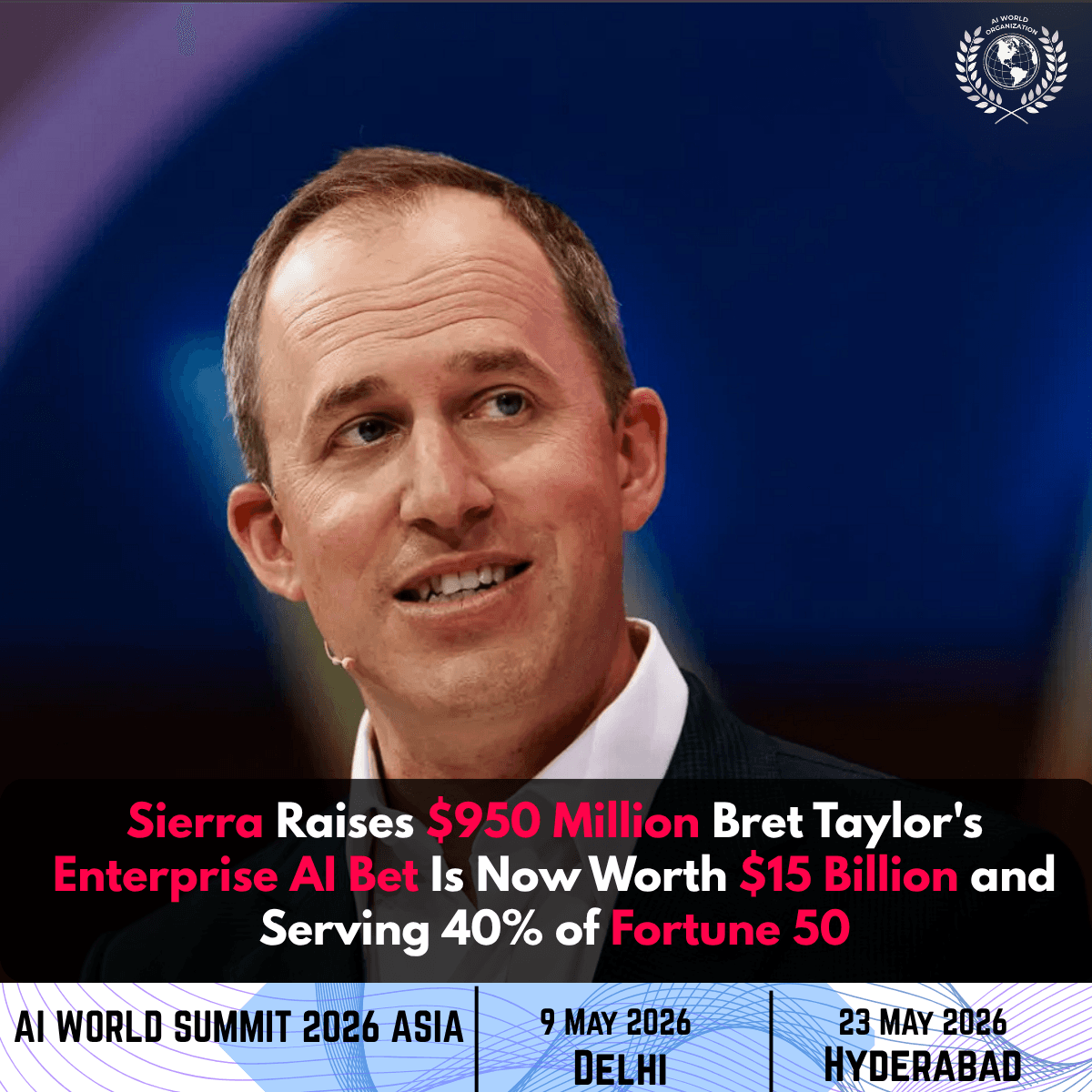
Sierra, founded by former Salesforce co-CEO Bret Taylor, raised $950 million in fresh funding led by Tiger Global and GV, pushing its valuation past $15 billion. The company now serves over 40% of Fortune 50 firms with AI agents handling customer tasks like mortgage processing and insurance claims. Sierra hit $150 million in annual revenue this year and recently launched Ghostwriter, letting businesses build custom agents without coding expertise.
Sierra Secures $950 Million in Funding as Enterprise AI Race Enters a New, High-Stakes Phase
The enterprise AI landscape just witnessed one of its most significant financial milestones of 2026. Sierra, the AI startup founded by former Salesforce co-CEO and OpenAI Chairman Bret Taylor, has closed a massive $950 million funding round led by Tiger Global and GV (formerly Google Ventures). The deal pushes Sierra's post-money valuation past $15 billion, and when combined with previously held capital, gives the company over $1 billion in total working funds. This landmark AI funding news is not just a headline about dollars raised — it is a signal of just how fiercely competitive, and consequential, the race to dominate enterprise AI has become.
At The AI World, we have been closely tracking how AI funding is reshaping the global technology industry, and Sierra's latest raise stands out not only for its size but for what it reveals about where enterprise software is heading next. As AI agents move from pilot projects to core business infrastructure, the companies that can credibly claim enterprise-grade reliability, scale, and measurable ROI are now the ones attracting the most serious investment capital. Sierra, by all current indicators, is one of those companies.
From Four Design Partners to Fortune 50 Dominance
Sierra's growth trajectory over the past two years is the kind that investors dream about and competitors dread. The company started with just four design partners, carefully selected enterprises willing to test its AI-powered customer experience platform before it was ready for the broader market. From that modest beginning, Sierra has scaled to a point where it now counts more than 40% of the Fortune 50 among its active customers — a claim that, if accurate, places it among the most rapidly adopted enterprise AI platforms in history.
What makes this growth even more striking is the breadth of use cases Sierra's platform now handles. Its AI agents are not confined to one or two narrow workflows. They are out in the real world refinancing mortgages, processing insurance claims, managing e-commerce returns, and even powering nonprofit fundraising campaigns. The sheer variety of these deployments speaks to a platform that has achieved genuine horizontal applicability — not a niche solution, but a foundational layer for enterprise customer interaction. This depth of deployment is precisely what separates real AI funding news from the kind that only looks good on a press release.
The revenue numbers back the story up. Sierra publicly confirmed it crossed $100 million in annual recurring revenue in late November 2025. Just a few months later, in early February 2026, the company announced it had already surpassed $150 million in ARR. That pace — $50 million added to the run rate in under three months — reflects both the hunger enterprises have for working AI solutions and the speed at which Sierra has been converting that hunger into signed contracts.
Why Enterprises Are Betting Big — and Spending More Than Expected
One of the most revealing dimensions of the Sierra story is what it tells us about how enterprises are actually experiencing the transition to agentic AI. The optimistic narrative is well known: AI agents reduce costs, improve efficiency, and ultimately drive higher revenue. Bret Taylor himself has articulated this vision publicly, describing the best-case outcome for agentic AI as a situation where clients see simultaneously lower operational costs and higher top-line growth.
But the honest version of that story also includes a difficult ramp-up phase, and that reality played out in plain sight just last week. At a StrictlyVC event, Uber's Chief Technology Officer Praveen Neppalli Naga spoke candidly about the company's early experience with agentic AI tools. He acknowledged that Uber "blew through" its AI budget shortly after opening the door to these tools in late 2025. It was not a cautionary tale, exactly — Naga was clear that the company is now beginning to see meaningful results — but it was a reminder that the transition from AI experimentation to AI execution carries real financial costs that enterprises need to plan for.
The Uber example also illustrated what genuine AI adoption at scale looks like when it starts working. Across a technical workforce of roughly 8,000 engineers and developers, Uber found that approximately 10% of all code being produced internally is now generated autonomously by AI. Naga was direct about the significance of that figure at Uber's scale: 10% is enormous. As a more vivid proof of concept, the company tasked a dedicated team with building a new hotel-booking integration using only agentic workflows, no traditional development process. Work that would normally take a full year was completed in six months. That kind of result is what enterprise AI investment is ultimately chasing — and it is what makes the current wave of AI funding so rational, even at figures that would have seemed staggering just three years ago.
Ghostwriter and the Next Frontier: Agents That Build Agents
While Sierra's existing platform has been enough to attract a Fortune 50 client base and sustain explosive ARR growth, the company is clearly not content to stay in its current lane. In April 2026, Sierra launched a new product called Ghostwriter — a tool that represents a meaningful expansion of what the platform can do and, more broadly, of what enterprise AI software is becoming.
Ghostwriter is described as an "agent as a service" product, and its core functionality is both simple to explain and genuinely transformative in its implications. Rather than requiring enterprises to rely on specialized AI engineers to build and deploy custom agents, Ghostwriter allows business users to describe in plain natural language what they need a new agent to do. The system then autonomously creates that agent and deploys it, without the user needing to write a single line of code or navigate a complex configuration interface. In effect, it is a tool designed to build other tools — and it lowers the barrier to enterprise AI adoption dramatically.
This move fits squarely into the broader thesis that Bret Taylor has been articulating in public forums throughout 2026. At the HumanX conference in San Francisco last month, he made a pointed observation about the current state of enterprise software: most of it simply is not used. Employees interact with systems like Workday only at mandatory moments — onboarding, open enrollment — and then largely ignore them. The future Sierra is building toward, and which its latest round of AI funding is designed to accelerate, is one where no employee ever needs to manually navigate a complex enterprise software system again. Agents do it for them.
That vision is ambitious, and it is one that Sierra's investors — Tiger Global and GV, alongside whoever else participated in this round — are clearly willing to back with serious capital. The fact that AI funding of this magnitude is flowing into a company focused specifically on the interface between AI agents and enterprise workflows tells us something important about where the smart money currently sees the biggest opportunity in the AI stack.
What Sierra's Raise Means for the Broader Enterprise AI Market
Sierra's $950 million round does not exist in isolation. It is part of a broader pattern of accelerating AI funding that The AI World has been monitoring closely across the global technology ecosystem. Enterprise AI, in particular, has moved to the centre of the venture capital conversation in 2026, as the initial hype around large language models has given way to a more grounded focus on which companies can actually deliver measurable business outcomes for paying enterprise customers.
The competitive dynamics in this space are intensifying quickly. Sierra is not the only company trying to establish itself as the default AI platform for Fortune 500 enterprises. A growing number of startups and established software players are making similar bets — that the companies which win the agentic AI layer of enterprise software will occupy a position of extraordinary strategic and commercial value for years to come. The race, as the AI funding news around Sierra's round makes clear, is getting very serious indeed.
What distinguishes Sierra's position, at least for now, is a combination of factors that are difficult to replicate quickly: a founder with deep enterprise credibility who sits at the intersection of OpenAI, Salesforce's legacy, and Silicon Valley's most influential networks; a customer base that already includes a majority of the world's largest companies; and a revenue trajectory that demonstrates genuine product-market fit rather than speculative future potential. Sierra's claim that it intends to become the "global standard" for AI-powered customer experiences is a bold one — but it is not an implausible one, given everything the company has built and the capital it now has available to accelerate further.
For enterprise technology leaders and investors watching the AI funding landscape in 2026, Sierra's raise is a data point worth taking seriously. It suggests that the window for establishing category leadership in enterprise agentic AI may be shorter than many assumed — and that the cost of not moving quickly is rising. For the enterprises still sitting on the sidelines, the message from the AI funding news coming out of Sierra this week is unambiguous: the transition to AI-powered operations is no longer something to plan for in the abstract. It is happening now, it is being funded at historic scale, and the companies setting the standards are doing so at speed.