Tsavorite Raises $5M in AI Funding Led by Pavestone
AI compute startup Tsavorite secures $5M in fresh AI funding from Pavestone VC to scale its revolutionary Omni Processing Unit and full-stack AI platform.
TL;DR
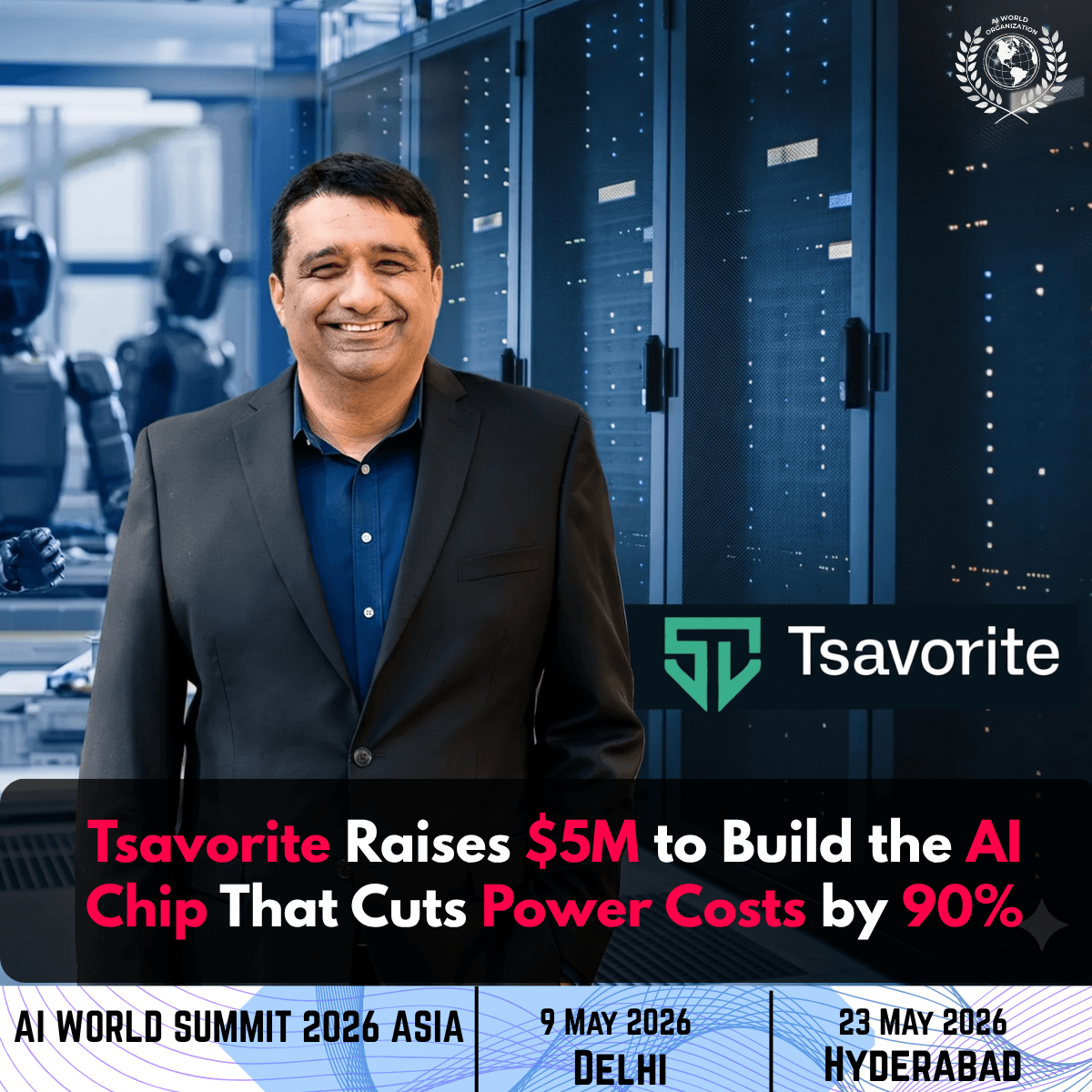
Tsavorite Scalable Intelligence, an AI computing startup with roots in India and the US, has raised $5 million from Hyderabad-based Pavestone VC. The company builds the Omni Processing Unit — a single chip that combines CPU, GPU, and memory — promising 90% lower power and cost compared to existing solutions. With $100M+ in pre-orders already locked in, this fresh AI funding will push the startup closer to its first full chip production milestone.
Tsavorite Scalable Intelligence Raises $5 Million in Fresh AI Funding Round Led by Pavestone VC
The deep-tech artificial intelligence landscape is witnessing a decisive shift, and the latest confirmation of this movement comes from an ambitious semiconductor startup that is quietly redefining the rules of AI computing. Tsavorite Scalable Intelligence, a cutting-edge AI compute company operating across India and the United States, has secured $5 million — approximately Rs 46.65 crore — in a fresh funding round led by Hyderabad-based venture capital firm Pavestone VC. This latest AI funding news signals not just another investment headline, but a deeper vote of confidence in the belief that the future of artificial intelligence will be determined not just by software, but by the raw efficiency and architecture of the hardware running beneath it.
The announcement, made on May 4, 2026, arrives at a time when the global appetite for high-performance, energy-efficient AI infrastructure is growing faster than existing chip architectures can reliably serve. Enterprises across verticals are struggling with the twin challenges of scaling AI workloads without multiplying their energy bills and capital expenditure. It is precisely this pain point that Tsavorite has set out to solve, and Pavestone's backing is a clear signal that the startup's approach is gaining serious traction in the market.
This round adds to Tsavorite's existing financial momentum. The company had earlier raised $17.9 million in a Series B round on February 14, 2025, marking a strong trajectory for a startup that was founded just two years prior in 2023.
Inside Tsavorite: The Startup Building a New Brain for AI
To understand why this AI funding news matters, you first need to understand what Tsavorite is building — and why it is unlike nearly anything else in the semiconductor space right now. Founded in 2023 by Shalesh Thusoo, a seasoned technologist with a bold vision for composable AI infrastructure, Tsavorite Scalable Intelligence has been on a mission to rethink how AI workloads are processed at the hardware level.
The company's flagship product is the Omni Processing Unit, or OPU — a revolutionary chip architecture that integrates a Central Processing Unit (CPU), Graphics Processing Unit (GPU), memory, and high-speed connectivity into a single, unified device. Traditional AI infrastructure often relies on a fragmented stack of components that must constantly pass data back and forth between processing units, consuming both time and energy in the process. Tsavorite's OPU collapses this entire ecosystem into one composable, efficient unit that dramatically reduces data movement overhead.
What makes the OPU particularly compelling is its versatility. It can be configured for a wide range of power and performance profiles, making it equally relevant for edge computing environments, enterprise deployments, and large-scale data centre operations. This flexibility is rare in semiconductor design, where chips are typically engineered for one specific use case at the cost of others. Tsavorite's approach essentially gives customers a single hardware platform that scales intelligently — from compact edge installations to hyperscale AI clusters capable of supporting thousands of interconnected OPUs.
The company's engineering is underpinned by a proprietary interconnect fabric called MultiPlexus, which enables the OPU's composable architecture. The MultiPlexus technology allows individual OPU units to be combined into what the company calls "OmniClusters," which can be further chained into larger systems with PetaByte-scale memory bandwidth. According to Tsavorite's founder and CEO Shalesh Thusoo, this combination of hardware innovation and developer-friendly software is what truly differentiates the company.
The Agentic Operating Stack: AI Computing Made Developer-Friendly
One of the most often overlooked challenges in enterprise AI deployment is not the hardware itself — it is the friction between powerful chips and the software developers actually have to write. Proprietary AI systems frequently force engineering teams to rewrite their models, retrain their pipelines, or navigate vendor lock-in that makes future switching costly. Tsavorite has built its strategy with this frustration explicitly in mind.
Alongside its OPU hardware, the company has developed an integrated software layer known as the Tsavorite Agentic Operating Stack, or TAOS. This open software platform is designed to abstract away the complexity of hardware deployment, allowing AI developers to run their models directly on Tsavorite's compute infrastructure without requiring code rewrites or dependence on proprietary libraries. This is a significant differentiator in a market where many chip vendors compete on raw performance benchmarks but ignore the real-world developer experience that determines actual adoption.
The combination of the OPU and TAOS effectively positions Tsavorite as a vertically integrated AI compute company — one that controls the full stack from silicon architecture to the software interface that developers interact with. This kind of end-to-end ownership of the value chain is increasingly seen as a critical competitive advantage in the AI infrastructure space, where fragmented ecosystems create bottlenecks and inefficiencies that erode the benefits of raw compute performance.
For enterprises evaluating AI infrastructure investments, the TAOS proposition is particularly attractive. The ability to deploy AI models without vendor lock-in reduces long-term operational risk, while the unified hardware-software platform lowers the total cost of ownership compared to stitching together components from multiple vendors. As organisations across sectors accelerate their AI adoption journeys, solutions that reduce this kind of friction are likely to find rapidly expanding demand.
Pavestone VC's Strategic Conviction in Deep-Tech AI Funding
The choice of investor in this round is itself worth noting closely. Pavestone VC is a Hyderabad-based venture capital firm that invests through its Rs 816-crore technology fund, with a deliberate focus on early growth-stage B2B startups that have demonstrated meaningful product-market fit and early enterprise adoption. The firm is not a generalist investor chasing trends — it has a clear mandate to back companies working on foundational technologies with real commercial traction.
Sridhar Rampalli, Managing Partner at Pavestone, spoke about the firm's rationale for backing Tsavorite in no uncertain terms. "Tsavorite is developing a differentiated, full-stack AI compute platform designed to address the growing need for power-efficient, scalable, and enterprise-ready systems," he said, adding that the company had already demonstrated meaningful market validation through strategic customers, ecosystem partnerships, and pre-orders that collectively exceed $100 million in value.
That figure — $100 million in pre-orders — deserves particular attention. It means that at the time of this AI funding news, Tsavorite is not merely a concept-stage startup pitching a vision. It is a company with real customers — enterprises and cloud service providers across the United States, Asia, and Europe — who have placed advance commitments on its technology. This kind of market pull is exceptional for a company that has yet to complete a full silicon tape-out, and it speaks to both the quality of the OPU's architecture and the hunger in the market for alternatives to incumbent AI chip providers.
Thusoo himself expressed enthusiasm about the partnership: "We are delighted to welcome Pavestone as our investment partner. Their conviction in deep-tech innovation aligns closely with our vision as we scale next-generation AI compute hardware." The language here is carefully chosen — this is not a transactional capital raise. It is the beginning of a strategic relationship that both sides clearly see as foundational to Tsavorite's next phase of growth.
What This AI Funding News Means for the Global Semiconductor Race
Stepping back and viewing this development through a wider lens, Tsavorite's latest funding round arrives at a moment of extraordinary dynamism in the global AI chip market. The dominance of a small number of incumbent players has created a structural bottleneck in AI compute supply chains, and customers — from hyperscalers to mid-market enterprises — are actively searching for credible alternatives that offer comparable or superior performance at lower power envelopes and price points.
Tsavorite's bold performance claims are central to this conversation. The company has asserted that its T3 package — consisting of four OmniFlex AI dies and twenty SkyFlex MemoryAI dies — can outperform current top-tier competing systems while simultaneously delivering a 90% reduction in both power consumption and cost. If these claims bear out through silicon validation and customer deployment, they represent a genuinely disruptive value proposition that could accelerate the diversification of the global AI compute supply chain.
The company's dual geography — with operations in both the United States and India and a design centre anchored in Bengaluru — gives it a structural advantage as well. India's deep pool of semiconductor engineering talent, combined with the strategic importance of the US market for enterprise AI deployment, positions Tsavorite to execute on both product development and commercialisation simultaneously. The Bengaluru design centre, in particular, plays a central role in the company's hardware and software development roadmap, and its expansion will likely be a key use case for this new capital.
Tsavorite is also currently working towards an advanced-node chip tape-out — the critical engineering milestone in which a chip design is sent to a semiconductor foundry for physical manufacturing. Successfully completing a tape-out at an advanced process node would mark Tsavorite's transition from prototype-validated architecture to production-ready silicon, a step that would substantially increase its credibility and commercial momentum in the global market. The fresh AI funding secured from Pavestone is expected to play a direct role in accelerating this milestone.
The broader context is equally important. At The AI World, we have consistently covered how the real battle in artificial intelligence is increasingly being fought at the infrastructure layer. The companies that control the compute — the chips, the interconnects, the software stacks — will ultimately shape what kinds of AI applications are possible and at what cost. Tsavorite's OPU architecture, if it delivers on its promise, represents exactly the kind of foundational innovation that can shift the balance of power in this race.
For the Indian deep-tech ecosystem specifically, this AI funding news is a meaningful signal. Tsavorite's success in attracting not just Indian VC capital but also validating its technology with international enterprise customers reflects the growing sophistication and global ambition of Indian deep-tech startups. It adds to a growing narrative that India is not just a services economy for global tech companies, but an origin point for foundational technological innovation with global relevance.
As AI workloads continue to grow exponentially in complexity and scale, the demand for compute infrastructure that is simultaneously powerful, efficient, flexible, and developer-friendly will only intensify. Tsavorite's OPU architecture, backed now by Pavestone's capital and conviction, is positioned to be a serious answer to that demand. With over $100 million in pre-orders already secured, a full-stack hardware-software platform in active development, and a clear commercial roadmap, the company is moving with real urgency toward a market opportunity that is measured in hundreds of billions of dollars.
The next few months will be pivotal. As Tsavorite deploys this new AI funding toward product development and go-to-market execution, the technology community will be watching closely to see whether its ambitious claims translate into silicon reality. If they do, the ripple effects will be felt across the entire AI infrastructure landscape — and Tsavorite will have established itself as one of the most consequential deep-tech startups of this decade.