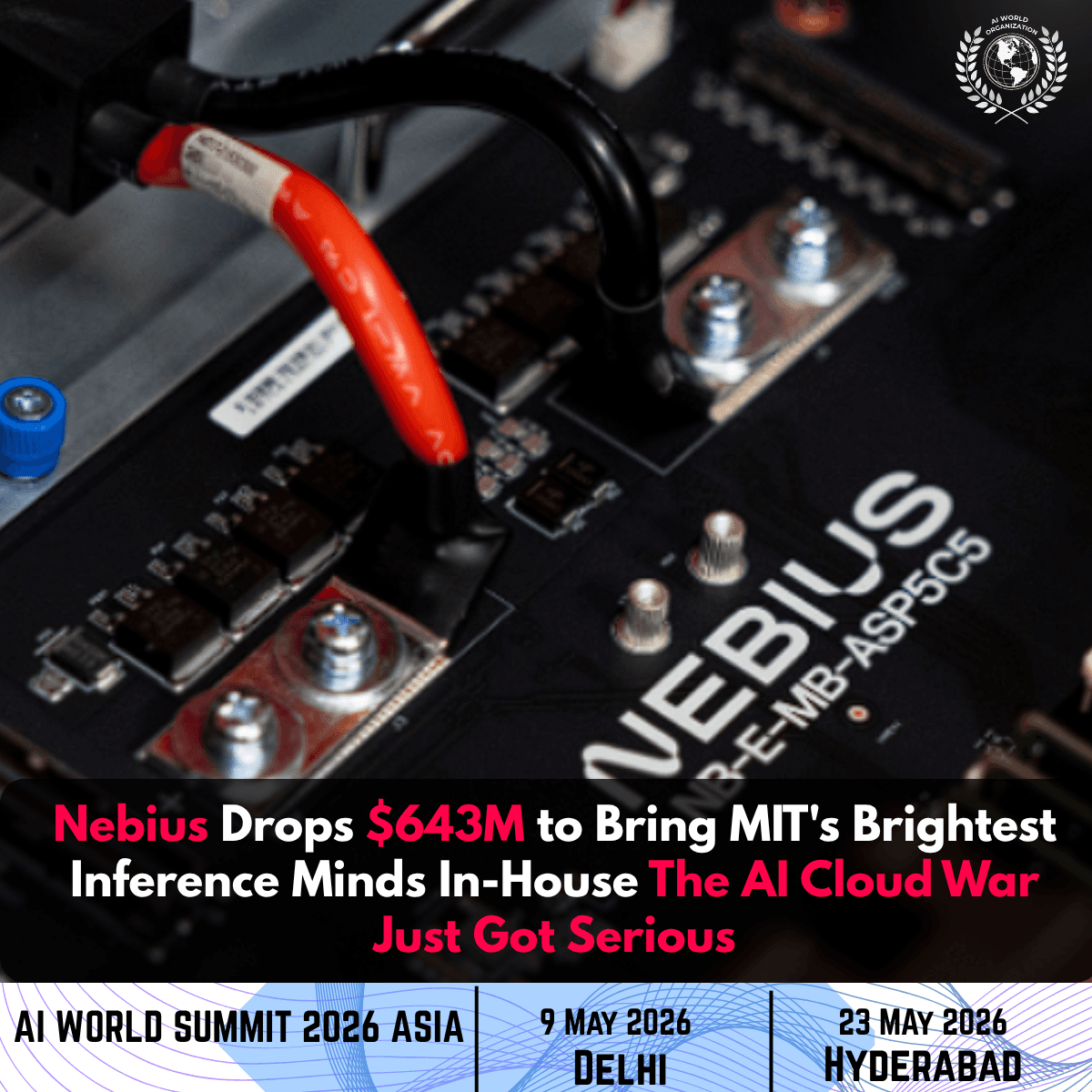
Nebius Acquires Eigen AI for $643M to Lead AI Inference
Nebius acquires Eigen AI for $643M, integrating MIT's top inference talent into Token Factory to redefine AI cloud performance for enterprises.
TL;DR
Nebius has acquired Eigen AI, a Bay Area inference startup founded by MIT and Meta alumni, for $643 million. The deal brings cutting-edge model optimisation talent directly into Nebius's Token Factory platform, helping enterprises run AI models faster and cheaper. This follows Nebius's earlier acquisition of Tavily and multi-billion dollar deals with Microsoft, Meta, and Nvidia — painting a clear picture of a company building the most capable AI cloud stack in the market today.
The AI infrastructure race is no longer just about who has the most GPUs — it is increasingly about who can make those GPUs work smarter. In one of the most closely watched AI funding moves of 2026, Nebius, the Amsterdam-headquartered AI cloud company, has announced a definitive agreement to acquire Eigen AI, a Bay Area-based inference and model optimisation startup, for a staggering $643 million in a blend of cash and Nebius Class A shares. The deal is expected to close within the next few weeks, subject to routine antitrust clearance, and it signals a decisive strategic shift in how AI cloud providers are thinking about competitive differentiation going forward.
This AI funding news comes at a time when the broader industry is grappling with a very real tension: compute capacity is exploding, but raw scale alone is no longer enough. Enterprise customers building and deploying large language models are demanding not just horsepower, but efficiency — the ability to serve more requests per second, at lower cost, with greater reliability. Nebius clearly understood that challenge, and rather than waiting for the market to catch up, it chose to buy the solution outright.
At The AI World, we have been tracking the rapid consolidation of AI infrastructure players throughout this year, and this acquisition stands out as a particularly well-calculated bet on the future of inference optimisation.
What Is Eigen AI and Why Does It Matter?
Eigen AI is not a household name yet, but the people behind it most certainly carry weight in the AI research community. The startup was founded in 2025 by Ryan Hanrui Wang and Wei-Chen Wang, both alumni of MIT's renowned HAN Lab — a research group that has consistently pushed the boundaries of efficient deep learning, hardware-aware neural architecture design, and inference acceleration. Joining them as a co-founder was Di Jin, who previously worked on some of Meta's most ambitious language model projects, including the development and post-training phases of Llama 3 and Llama 4.
Despite being less than a year old at the time of acquisition, Eigen AI had already established itself as a serious technical player. The company's core focus was on a problem that sounds deceptively simple but is enormously complex in practice: how do you make AI inference — the process of running a trained model to generate an output — as fast and as energy-efficient as possible, without compromising on output quality? This is the kind of engineering challenge that can make or break the economics of deploying AI at enterprise scale, and it is precisely where Eigen AI had carved out a notable edge.
In fact, Nebius and Eigen AI had already begun collaborating before the acquisition announcement. Their joint work had produced optimised model implementations that ranked among the fastest available on Artificial Analysis — a widely respected independent benchmarking platform that evaluates AI model performance across speed, throughput, and cost metrics. That demonstrated track record gave Nebius confidence that this was not just a talent acquisition story, but a genuine product and capability uplift.
Nebius's Rapidly Expanding AI Infrastructure Empire
To fully appreciate the significance of this AI funding deal, it helps to understand just how quickly Nebius has been building out its position in the global AI cloud market since its founding in 2024 by Arkady Volozh. The company has executed a series of moves that, taken together, paint a picture of extraordinary ambition backed by extraordinary capital.
In the past twelve months alone, Nebius signed a $17.4 billion GPU infrastructure deal with Microsoft, establishing itself as a key compute partner for one of the world's largest technology companies. It followed that with a $27 billion agreement with Meta, further cementing its role as a foundational layer of the AI cloud ecosystem. Nvidia, the company that makes the chips powering most modern AI workloads, invested $2 billion directly into Nebius — a vote of confidence that few startups could ever claim. And to fuel its ongoing data centre expansion, Nebius raised $4.3 billion in convertible notes, giving it the financial runway to pursue an aggressive growth strategy without depending on traditional equity dilution.
The acquisition of Eigen AI fits squarely into this broader story. While the headline deals with Microsoft, Meta, and Nvidia were largely about building the raw infrastructure backbone — the data centres, the GPU clusters, the network fabric — the Eigen AI acquisition is about the intelligence layer that sits on top of that infrastructure. It is about ensuring that the compute Nebius has painstakingly assembled and financed is actually being used in the most effective way possible.
The Strategic Heart of the Deal: Nebius Token Factory
The operational centre of gravity for this acquisition is Nebius Token Factory, the company's flagship managed inference platform. Token Factory is designed to give enterprise customers a production-ready environment for deploying large language models at scale. It offers features including enterprise-level autoscaling endpoints — meaning the system dynamically adjusts compute resources based on real-time demand, so companies are not paying for idle capacity during off-peak hours — as well as fine-tuning pipelines for major open-source models.
For any organisation looking to deploy AI in a serious commercial context, these capabilities matter enormously. Building and managing this kind of infrastructure in-house requires deep specialised expertise and significant ongoing engineering investment. Nebius Token Factory effectively abstracts that complexity away, giving enterprise teams access to best-in-class inference infrastructure without needing to build it from the ground up themselves.
With Eigen AI's team and technology now folded into the Token Factory roadmap, Nebius expects to push that platform's performance metrics meaningfully higher. Roman Chernin, co-founder and Chief Business Officer of Nebius, described the strategic rationale with notable clarity: "We are operating in a capacity-scarcity world where AI builders need optimised inference and infrastructure scale. The integration of Eigen AI's optimisation capabilities and founding team will establish Nebius Token Factory at the frontier of inference, offering customers market-leading model performance and unit economics with massive compute capacity to back it at scale."
That phrase — "capacity-scarcity world" — is worth lingering on. It captures something important about the current AI landscape. Even as investment in GPU infrastructure reaches historic highs, the demand from AI developers, researchers, and enterprise customers is outpacing supply. In that environment, the companies that can extract more useful work from every chip they operate will have a meaningful structural advantage. Eigen AI's inference optimisation capabilities are exactly the kind of differentiator that could help Nebius widen that gap over its competitors.
A Pattern of Strategic Acquisitions Taking Shape
This is not the first time in recent months that Nebius has moved to expand its capabilities through acquisition, and the pattern is becoming instructive. Back in February 2026, Nebius acquired Tavily — an agentic search platform — for $275 million. That deal brought a fundamentally different kind of capability into the Nebius ecosystem: the ability for AI agents to search, retrieve, and reason over real-time information from the web, rather than being limited to what was baked into a model's training data at a fixed point in time.
Taken together, the Tavily acquisition and the Eigen AI deal reveal a coherent strategic thesis. Nebius is not simply trying to be the biggest AI cloud provider by raw compute count. It is trying to be the most capable one — the platform that enterprise AI builders choose not just because of scale, but because of the depth of the software, tooling, and optimisation capabilities layered on top of that scale. In an industry where differentiation is increasingly difficult at the hardware level — because most providers are running the same Nvidia chips — competing on the software and intelligence layer is a smart and defensible strategy.
This is worth noting in the context of broader AI funding news trends. Across the industry, there is a growing recognition that the "picks and shovels" plays in AI are no longer just about hardware. The companies that will command premium valuations and enterprise loyalty in the next phase of AI's evolution are those that can deliver a complete, vertically integrated solution — from raw compute all the way up to optimised inference, agentic capabilities, and enterprise-grade reliability.
Competitive Landscape: Nebius vs. CoreWeave and Beyond
The acquisition also has clear competitive dimensions. CoreWeave, widely seen as Nebius's primary rival in the AI cloud space, has pursued a strategy focused predominantly on scale — building out massive GPU clusters and positioning itself as the go-to provider for raw AI compute. CoreWeave recently secured a $6 billion cloud deal alongside a $1 billion equity investment from Jane Street, underscoring the continued appetite among investors and enterprise customers for large-scale AI infrastructure.
But Nebius is making a different bet. Rather than simply matching CoreWeave's scale expansion moves, Nebius is betting that the enterprise market will increasingly reward providers who can offer both scale and sophisticated software. In other words, it is not enough to have a lot of chips — you need to be able to run models on those chips faster, cheaper, and more reliably than anyone else. That is the argument Eigen AI's integration is designed to prove.
For enterprises evaluating AI cloud providers, this distinction matters in very practical terms. Unit economics — the cost per thousand tokens generated, for instance — can vary significantly based on how well inference is optimised. A provider that can deliver the same model performance at 20 or 30 percent lower cost per inference has a very compelling pitch, particularly for customers running AI workloads at scale where those percentages translate into millions of dollars in annual savings.
This kind of AI funding news signals not just corporate deal-making, but a fundamental restructuring of how the AI industry thinks about value creation. The race is shifting from who can deploy the most hardware to who can build the most intelligent and efficient software layer on top of that hardware.
What This Means for the AI Ecosystem
Beyond the specifics of the Nebius-Eigen AI transaction, this deal carries broader implications for the AI ecosystem at large. First, it underscores the premium that the market is placing on inference optimisation talent — the fact that a team of researchers with deep MIT and Meta backgrounds commands a $643 million acquisition price less than a year after founding their company is a remarkable data point about where value is concentrating in AI today.
Second, it highlights the accelerating pace at which AI infrastructure is maturing. We are moving quickly from a phase where simply having access to large amounts of compute was itself a competitive advantage, to a phase where the intelligence and efficiency of the software running on that compute is the real differentiator. Companies, researchers, and developers who understand this shift early — and who invest accordingly — will be the ones best positioned to thrive in the next chapter of AI's evolution.
Third, from an AI funding news perspective, this deal reinforces that the AI sector's consolidation phase is well underway. Larger, better-capitalised platforms are systematically acquiring smaller startups with specialised capabilities, rolling them into integrated offerings, and using that integration to compete for enterprise customers who want fewer vendors, not more. For startups working in the AI infrastructure space, the message is clear: build something genuinely differentiated, and the acquirers will come.
At The AI World, we believe deals like these serve as critical market signals for developers, investors, and enterprise technology leaders alike. The convergence of scale, software intelligence, and efficiency-first engineering is defining the next frontier of AI infrastructure — and Nebius, with its string of bold moves, is positioning itself right at that frontier.


