Banza Raises $1M Pre-Seed for Personal AI Twin
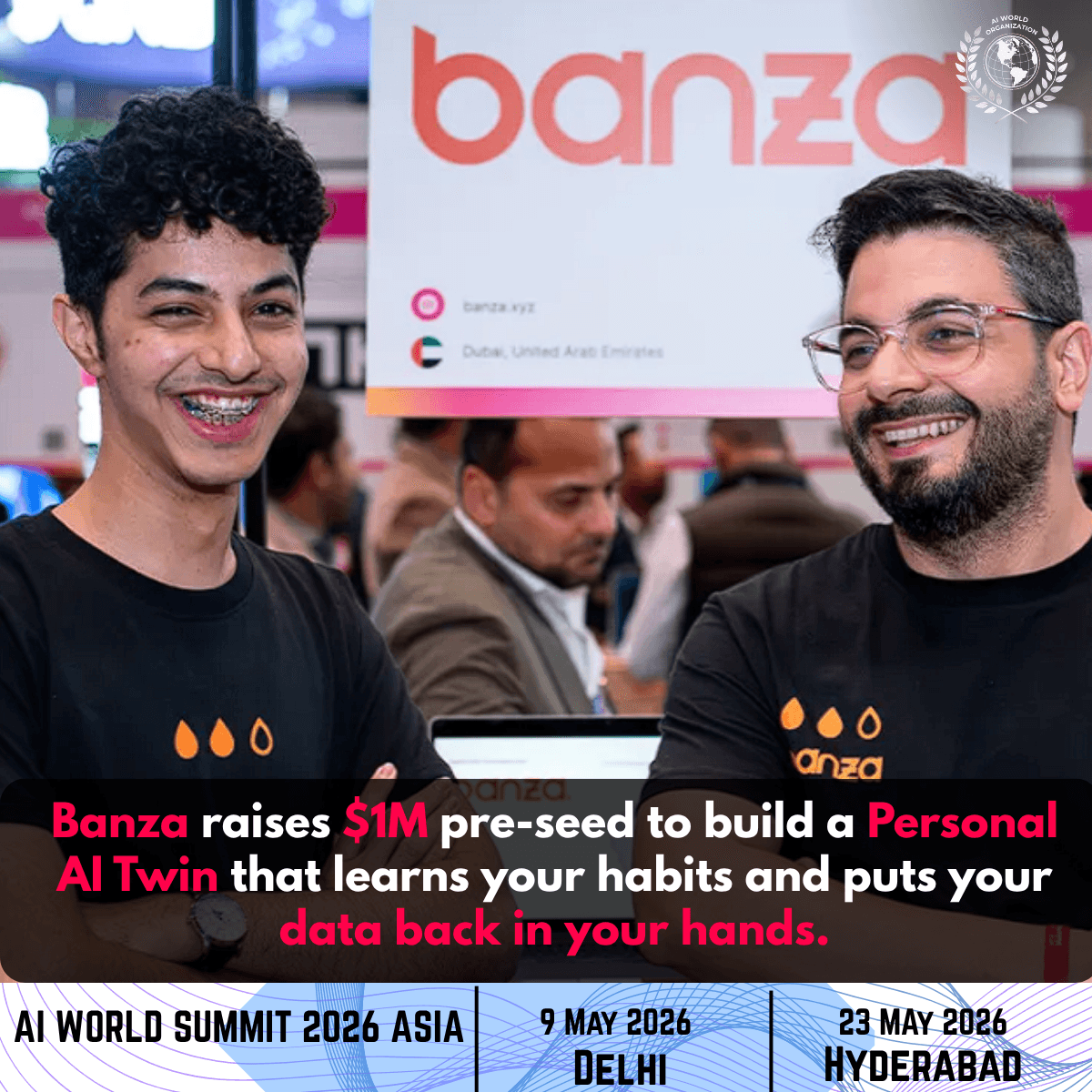
Bengaluru's Banza secures $1M pre-seed funding led by Campus Fund to build a Personal AI Twin that learns user habits and unifies data.
TL;DR
Bengaluru-based Banza has raised $1M in pre-seed AI funding led by Campus Fund, with backing from Avalanche and angels, to build a Personal AI Twin that unifies fragmented user data and helps people make smarter everyday decisions. This AI funding news highlights growing investor confidence in user-first, privacy-focused data platforms.
Banza Raises $1 Million in Pre-Seed Funding to Build a Personal AI Twin That Learns You
In an era where artificial intelligence is steadily reshaping how people interact with the digital world, a new wave of startups is moving beyond generic recommendations and one-size-fits-all algorithms. Bengaluru-based Banza is one such company — and it just made a significant move in the Indian startup ecosystem. The AI-driven data-sharing startup has successfully closed a $1 million pre-seed funding round, marking an important milestone not just for the company, but for the broader personal AI category in India. This latest AI funding news signals growing investor confidence in intelligent, user-centric data platforms that prioritize personalization without sacrificing privacy.
The round was led by Campus Fund, with co-participation from Avalanche and a group of carefully selected angel investors. The fresh capital will be directed toward accelerating product development, improving user experience, growing the core team, and reinforcing the foundational infrastructure required to scale Banza's vision of a personal AI category — one that places the individual squarely at the center of their own data economy.
What Is Banza and What Problem Does It Solve?
Banza was founded earlier in 2026 by Mehdi Abdi, Suraj R. Mulla, and Aditya Vijaykumar — a founding team that combines deep technical expertise with an understanding of consumer behavior in the digital age. The startup operates with a sharp focus on a problem that, despite being pervasive, has received surprisingly little attention in the mainstream technology conversation: the fragmentation of personal data across digital services.
Think about it — every streaming platform you use knows what you watch. Every food delivery app tracks what you order. Every e-commerce site knows what you browse and buy. But none of these platforms talk to each other. The result is that even after years of digital engagement, your experiences across apps remain siloed, repetitive, and oddly impersonal. You get recommendations, sure, but they are often tone-deaf — missing the full context of who you are, what you're going through, and what you actually need in that moment.
Banza's answer to this deeply entrenched problem is the concept of a Personal AI Twin — a digital counterpart that learns from your actual behavior across apps, unifies that data in a privacy-preserving manner, and then uses it to make genuinely relevant decisions on your behalf. This is not just a recommendation engine dressed up in new language. It is an attempt to build a fundamentally different relationship between users and their data — one where the user is in control and the AI is truly working for them, not for advertisers.
The platform currently has over 2 lakh users onboard, which speaks to early organic traction even before the pre-seed capital came in. For a startup that is just months old, this user base reflects genuine market interest in what Banza is building.
How the Personal AI Twin Actually Works
At its core, Banza operates on a simple but powerful premise: your digital behavior tells a coherent story about who you are, and that story should be used to help you — not sold to the highest bidder. The platform works in a few structured steps. First, users connect the apps they already use in their daily lives — be it food apps, content platforms, shopping sites, or travel tools. The AI Twin then begins learning the user's preferences, habits, and patterns from this connected data. Over time, it builds a rich, multi-dimensional understanding of the user that goes far beyond surface-level demographics.
What makes this approach distinctive is the combination of zero-party data — data that users consciously and willingly share — with behavioral signals drawn from actual app usage. Banza's platform layers state-of-the-art encryption and self-custodial control onto this data architecture, ensuring that users retain ownership over their most sensitive digital information. This is a meaningful differentiator in a landscape where data privacy has become both a regulatory imperative and a consumer concern.
The practical applications of the AI Twin span a wide range of everyday decisions. Whether you are figuring out what to eat, choosing what to watch next, planning a weekend trip, or deciding what to buy, the AI Twin is designed to offer contextually aware suggestions that feel intuitive rather than algorithmic. Beyond utility, Banza also features a Liquid Rewards Marketplace, through which users can monetize their own data on their own terms — a feature that transforms personal data from something that is passively extracted into something that is actively owned and traded.
This positions Banza not just as an AI assistant, but as an infrastructure play for what the founders call the "user-first data economy" — a paradigm where the value generated from personal data flows back to the individual, not just the platform.
The Investors Behind This AI Funding Round
The fact that this AI funding round was led by Campus Fund is itself a noteworthy detail. Campus Fund has a specific mandate of backing startups that emerge from India's top college campuses — and Banza's founding story fits neatly into that thesis. The fund has been known for identifying early-stage bets in emerging technology categories, and its decision to lead this round suggests a strong belief in both the founding team and the market timing of Banza's product.
Alongside Campus Fund, Avalanche participated in the round as a co-investor. Avalanche's involvement is particularly interesting given its blockchain and decentralized technology orientation, which aligns well with Banza's emphasis on data sovereignty, self-custodial data control, and the Liquid Rewards Marketplace model. The decentralized angle of Banza's data architecture — where users own and control their digital footprint rather than surrendering it to a centralized platform — resonates strongly with the ethos that Web3-adjacent investors like Avalanche tend to back.
The participation of a curated group of angel investors rounds out the funding table. While the names of individual angels have not been disclosed, angel participation at the pre-seed stage often brings strategic mentorship and sector-specific domain knowledge, in addition to capital. For a company at Banza's stage, this combination of institutional backing and angel support creates a strong foundation for the next phase of growth.
This AI funding news also comes at a time when the broader Indian startup ecosystem has been seeing renewed investor appetite for AI-native companies — particularly those that are building for the consumer segment with a differentiated data or privacy-first approach.
India's Growing Role in the Global Personal AI Category
Banza's raise is not happening in isolation. It is part of a broader shift in how Indian startups are positioning themselves within the global AI landscape. For years, India's startup ecosystem was primarily associated with SaaS companies, fintech platforms, and e-commerce marketplaces. But in 2025 and 2026, a new generation of AI-native startups has emerged — companies that are building foundational AI infrastructure, personal intelligence layers, and data-driven platforms that have the potential to compete on a global scale.
What is particularly compelling about Banza's story is the founders' ability to identify a white space that global tech giants have largely overlooked. While companies like Google, Meta, and Amazon sit on enormous amounts of user data, none of them have given users meaningful control over that data or used it to build a truly unified, cross-platform intelligence layer on the user's behalf. Banza is betting that this gap represents a massive opportunity — and the early user traction suggests the bet has merit.
From an AI funding perspective, the personal AI category is one that has attracted significant global attention in recent months. Startups building AI companions, personal data layers, and intelligent agents have raised hundreds of millions of dollars across the US, Europe, and Southeast Asia. India, until recently, had relatively few serious players in this space. Banza's emergence, backed by credible investors and with real user adoption, signals that India is ready to stake a claim in this category.
The timing also aligns with a broader cultural shift in how consumers relate to technology. There is growing awareness — and growing discomfort — with the way big tech platforms have monetized personal data without meaningful consent or compensation. Banza's value proposition speaks directly to this sentiment, offering not just a smarter AI, but a fairer deal for users who are increasingly conscious of their digital rights.
What's Next for Banza?
With $1 million in the bank and a clear product vision, the immediate priorities for Banza are well-defined. The company has stated that the fresh AI funding will be used to accelerate product development — which likely means deepening the AI Twin's learning capabilities, adding more app integrations, and refining the personalization engine. Enhancing user experience will also be a key focus area, as consumer AI products live and die by how intuitive and frictionless they feel in everyday use.
Team expansion is another critical lever. Building a personal AI platform of the kind Banza envisions requires a blend of machine learning expertise, data engineering, product design, and consumer psychology. Recruiting the right talent across these disciplines will be essential to executing on the roadmap.
Perhaps most importantly, Banza will be working to strengthen the foundational architecture of its Verifiable Intelligence Layer — the technical backbone that allows data from disparate sources to be unified, enriched, and made actionable for the AI Twin while preserving user privacy. This is the hard, unsexy infrastructure work that will determine whether Banza's product can scale from 2 lakh users to 20 lakh and beyond.
For the AI World community, Banza is a company worth watching closely. It represents a thoughtful, principled approach to personal AI — one that takes seriously the questions of data ownership, user agency, and genuine intelligence, rather than settling for the shallow personalization that currently passes for AI in most consumer apps. As AI funding news continues to pour in from across the Indian startup ecosystem, Banza's story stands out for its clarity of vision and the real problem it is setting out to solve.