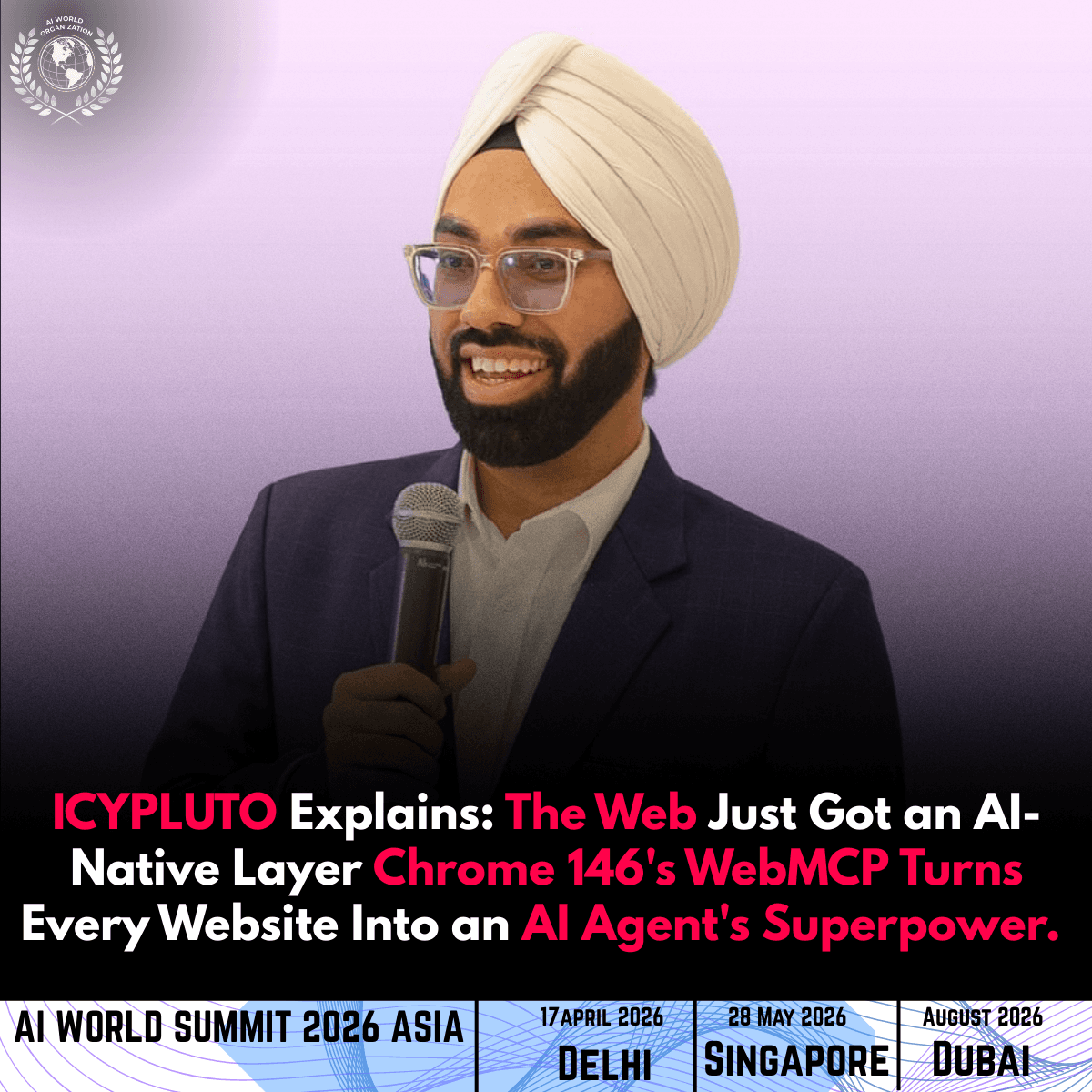
WebMCP & Chrome 146: Build an AI-Agent Ready Site
Chrome 146 ships WebMCP, letting websites expose structured tools to AI agents. Discover how it works, why it matters, and how to future-proof your site today.
TL;DR
Google quietly rolled out WebMCP in Chrome 146 — a new web standard that lets websites expose structured tools directly to AI agents, ditching the old screenshot-and-scrape method entirely. The result? Tasks complete 6x faster, success rates hit 97.9%, and costs drop by over 50%. In short, the web is getting its first real AI-native layer — and developers who adopt it early will have a serious edge.
WebMCP and Chrome 146: How the Web Is Being Rebuilt for the Age of AI Agents
The internet has always been designed for human eyes. Every button, form, drop-down menu, and input field was crafted with a human user in mind — someone who can read, interpret, and interact with a visual interface. But the digital landscape is transforming at an extraordinary speed, and the next wave of internet users are not human at all. They are AI agents — intelligent, autonomous systems capable of browsing, clicking, filling forms, and completing tasks on behalf of people. The only problem? The web was never built for them.
That is precisely the challenge that WebMCP — the Web Model Context Protocol — is now beginning to solve. With the rollout of Chrome 146, Google has introduced an early preview of WebMCP, a groundbreaking W3C standard that fundamentally changes the way AI agents interact with websites. Rather than forcing AI systems to squint at screenshots, laboriously parse complex DOM trees, and simulate mouse clicks like confused interns, WebMCP allows websites to directly expose structured, callable tools that agents can discover, understand, and invoke with precision. It is a paradigm shift that redefines what the web is — not just a collection of pages for people to browse, but a network of callable services for AI systems to execute tasks through.
For organisations operating at the frontier of artificial intelligence — including those driving AI funding news, AI summits, and global technology initiatives — this development has massive strategic implications. Understanding what WebMCP is, how it works, and what it means for the future of the internet is no longer optional. It is essential.
The Core Problem: Why AI Agents Struggle With the Web Today
To truly appreciate the significance of WebMCP, it is important to understand just how broken the current model of AI-web interaction really is. Today, when an AI agent needs to complete a task on a website — say, booking a flight or submitting a support ticket — it goes through a painfully inefficient process. First, it loads the page. Then, it captures a screenshot of the interface. Next, it tries to interpret the visual layout, identify the correct input fields, guess at the right data format, locate the appropriate button, simulate a click, wait for the page to respond, and then repeat the whole cycle again.
This approach is not just slow. It is fundamentally fragile. UI changes break agents without warning. Different websites present information in wildly inconsistent ways. The computational cost of processing screenshots and DOM trees is enormous — and the failure rates are significant. Developers building AI-powered workflows have long complained that browser automation feels like a game of whack-a-mole: fix one thing, and something else breaks.
The numbers make the problem impossible to ignore. Traditional screen-scraping-based agents consume dramatically more tokens, face frequent task failures, and cost significantly more to operate at scale. A task that a WebMCP-enabled site can complete in five seconds — such as creating a new store and adding a product to inventory — can take a conventional browser agent anywhere from 30 to 60 seconds, with a meaningful failure rate attached. This is not a minor inconvenience. For businesses deploying AI agents at scale, it translates into real cost, real inefficiency, and real lost value.
The web needed a smarter architecture. WebMCP is the answer.
What Is WebMCP and How Does It Actually Work?
WebMCP, short for Web Model Context Protocol, is a modern browser-native standard that enables websites to register structured "tools" directly within the page — tools that AI agents can discover, read, and invoke without any need for screen-scraping or DOM parsing. Think of it as giving every website a native API layer that is specifically designed for AI interaction.
At its core, WebMCP operates through a new browser JavaScript interface called navigator.modelContext. This interface allows web developers to expose actions and capabilities from their frontend code — with no backend server required. For the first time, a website can tell an AI agent exactly what it can do, what inputs those actions expect, and what outputs they will return. The agent no longer has to guess. It knows.
WebMCP supports two distinct implementation approaches. The first is declarative, using standard HTML meta tags to describe the website's capabilities in markup. Agents read these tags, understand what the site can do, and act accordingly. This approach is simple, lightweight, and accessible to any developer who can write basic HTML. The second approach is imperative, using JavaScript to register more complex tools that involve dynamic application logic, conditional flows, or real-time data. This is particularly powerful for web applications where tasks require multi-step interactions or deep integration with the application state.
It is worth noting that WebMCP is being co-developed by some of the most influential names in the browser and AI space. Google's Chrome team and Microsoft's Edge team are both actively involved, as is Alex Nahas, who built the precursor protocol — known as MCPB — during his time at Amazon. The standard is currently in W3C incubation, with broader browser support expected across Chrome and Edge by mid-to-late 2026. Khushal Sagar, an engineer from Google's team, has described the vision behind WebMCP in terms that capture the scale of its ambition: the goal is to make WebMCP the "USB-C of AI agent interactions with the web" — a single, universal interface that any agent can plug into, regardless of the underlying model or platform.
The Performance Leap: Numbers That Demand Attention
The impact of WebMCP on AI agent performance is not speculative. Early results from implementations and developer tests have produced metrics that are difficult to overstate. Websites implementing WebMCP have reported 89% fewer tokens consumed per task compared to screen-scraping approaches. Task success rates have climbed to an extraordinary 97.9%, compared to the much lower reliability typical of DOM-based agents. Operational costs have dropped by approximately 53%. And computational overhead — the sheer processing power required to complete tasks — has been reduced by 67% compared to traditional screen scraping.
These figures represent more than incremental improvements. They represent a categorical difference in how AI agents function. When an agent can call a structured tool directly — receiving validated JSON schema responses instead of having to interpret messy visual data — everything about the interaction becomes faster, cheaper, and more reliable. This has enormous implications for the AI funding landscape as well, because it dramatically lowers the infrastructure cost of deploying AI agents in production environments. For investors and founders following AI funding news, WebMCP opens up a new category of viable, scalable agentic applications that simply were not economical before.
In a live demonstration that has circulated widely among developers, a user simply typed the instruction: "Add a new store called Drugstore. Add lip balm." Through WebMCP tool calls, a new store was created and the product was added within five seconds. No button hunting. No screenshot parsing. No repeated retries. Just a natural language instruction, a structured tool call, and an immediate result. This kind of experience — seamless, reliable, fast — is what the agentic web needs to look like at scale.
How Developers Can Enable and Implement WebMCP Today
WebMCP is currently available as a flag-gated early preview in Chrome 146, also known as a DevTrial. This means it is not yet enabled by default, but developers can access it today for testing, experimentation, and early implementation. Enabling it requires just a few steps.
Open Chrome and navigate to chrome://flags/#enable-webmcp-testing. Find the flag labelled "WebMCP for testing" and set it to "Enabled." Relaunch the browser to apply the changes. From there, developers can install the Model Context Tool Inspector Extension, which allows them to inspect registered tools on any WebMCP-enabled page, execute those tools manually with custom parameters, and test them against an AI agent using Gemini API support. Google has also published a live travel demo that demonstrates the full workflow — from discovering tools through natural language prompts to invoking them with precision.
For developers who want to start preparing their websites for WebMCP compatibility, the implementation path is surprisingly accessible. Simple use cases — contact forms, search bars, newsletter signups, product catalogues — can be made agent-ready using declarative HTML meta tags alone, with no JavaScript required. More complex workflows, such as multi-step checkout processes, dynamic dashboards, or account management flows, can be exposed through the imperative JavaScript API. The standard is designed to be progressive, meaning teams can adopt it incrementally without needing to rebuild their entire application architecture.
It is also worth highlighting the availability of the WebMCP Validator extension on the Chrome Web Store. This tool allows developers and marketers to instantly check any website's WebMCP and AI agent readiness as they browse, auto-scanning pages and generating full compatibility reports. For organisations that are actively investing in AI strategy — particularly those watching AI funding trends and building next-generation digital products — this validator is an invaluable first step in assessing where they stand.
Why WebMCP Is the Foundation of the Agentic Web — and What It Means for Your Business
The launch of WebMCP through Chrome 146 is not just a technical update. It is a signal that the architecture of the internet is changing, and changing fast. For years, the conversation around AI on the web has focused on search — on how AI models are changing the way people find information, and on what that means for SEO. WebMCP changes the terms of that conversation entirely.
The relevant concept going forward is not just SEO — Search Engine Optimisation. It is AEO — Agent Experience Optimisation. The question is no longer simply "how do I rank on Google?" It is "how does my website appear, function, and perform when an AI agent is the one interacting with it?" Websites that are not WebMCP-ready are, in a very real sense, invisible to AI agents. They cannot be reliably automated. They cannot be efficiently queried. And as AI agents become an increasingly common interface through which people interact with digital services, being invisible to those agents means being inaccessible to a growing segment of users.
This makes WebMCP adoption a strategic business priority, not just a developer task. For companies driving AI product development, for startups currently seeking AI funding, and for enterprises tracking the latest AI funding news to benchmark their investment decisions, WebMCP represents a foundational layer of the next internet. The organisations that move early — that instrument their websites with structured tools, that make their capabilities legible to AI systems, that embrace the agent-first design philosophy — will be the ones that thrive in the agentic era.
From the perspective of The AI World Organisation, which works at the intersection of global AI leadership, investment ecosystems, and enterprise technology adoption, WebMCP represents exactly the kind of transformational infrastructure shift that defines the moments where AI strategy and AI funding converge. As governments, enterprises, and technology leaders gather at AI summits around the world to discuss the future of artificial intelligence, the conversation must include not just the models and the data — but the infrastructure of the web itself. Because the next great platform is not a new app or a new model. It is the agent-ready web, and WebMCP is its foundation.
The transition is already underway. Chrome 146 is the starting gun. The question for every digital organisation is the same: is your website ready for the AI agents that are already on their way?