Anthropic Opens Milan Office: Six Cities in One Year
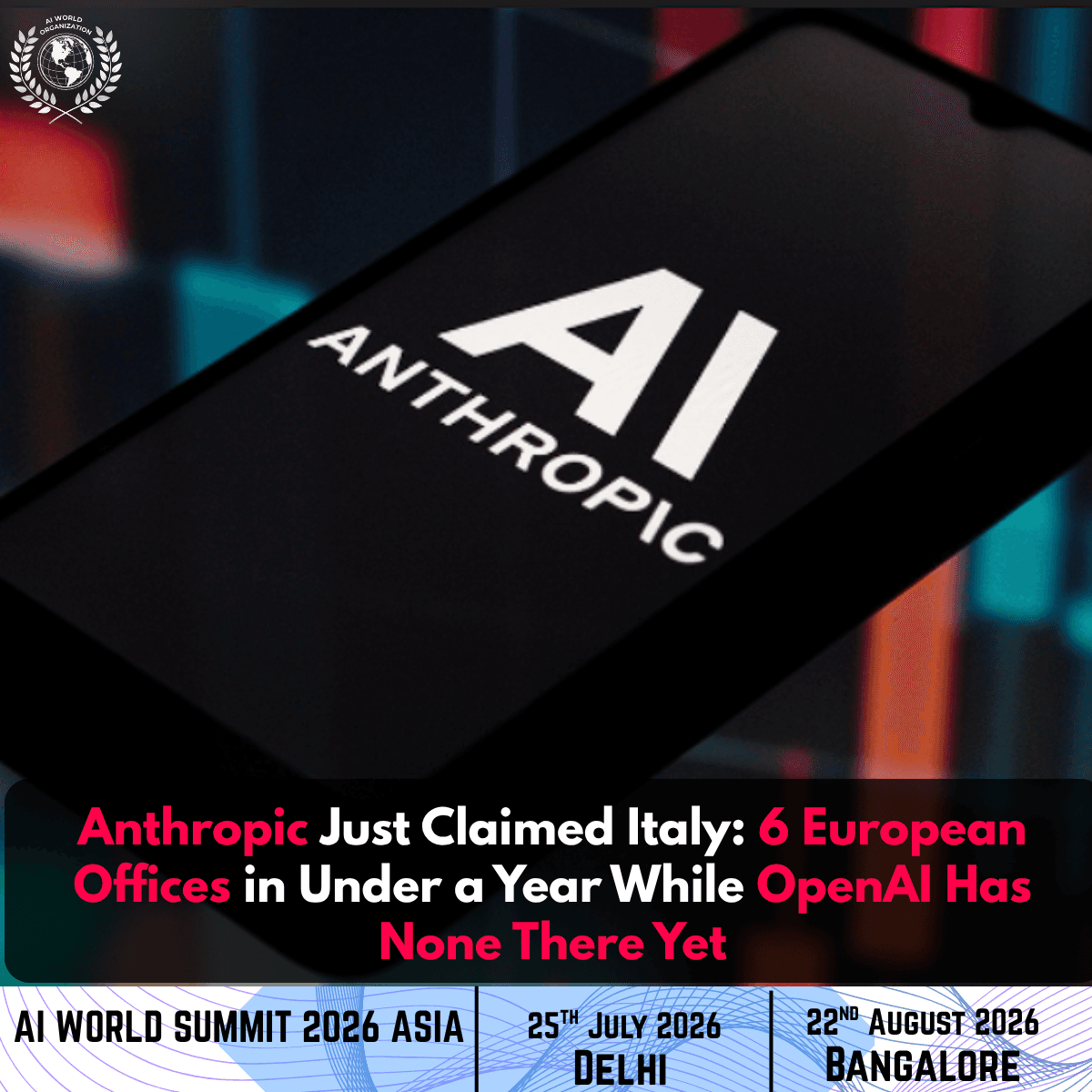
Anthropic opens its sixth European office in Milan, signalling a massive push into Southern Europe as EMEA revenue grows 9x. Here's what it all means for global AI.
TL;DR
Anthropic has opened its sixth European office in Milan, completing a remarkable run of expansion across London, Dublin, Zurich, Paris, and Munich — all within a year. With EMEA revenue growing over 9x and enterprise accounts up 10x, Europe is now its fastest-growing region. The Milan move targets Italy's finance, manufacturing, and consumer sectors, where OpenAI has no dedicated presence yet.Anthropic has opened its sixth European office in Milan, completing a remarkable run of expansion across London, Dublin, Zurich, Paris, and Munich — all within a year. With EMEA revenue growing over 9x and enterprise accounts up 10x, Europe is now its fastest-growing region. The Milan move targets Italy's finance, manufacturing, and consumer sectors, where OpenAI has no dedicated presence yet.
Anthropic's Milan Move: What Six European Offices in Less Than a Year Really Signals for the Future of AI
There is a particular kind of momentum in the AI industry that does not announce itself loudly. It builds through quiet decisions — a lease signed in a new city, a hiring push in a foreign market, a CEO boarding a flight to meet government ministers. When you step back and look at the pattern those decisions form together, the picture that emerges is far bigger than any single headline. Anthropic's decision to open a Milan office this month is exactly that kind of move. On the surface, it is one more address added to a growing list. Dig a little deeper, and it tells you something profound about where the global AI race is headed — and why Europe, long seen as a regulatory battleground rather than a commercial prize, is rapidly becoming the most strategically important geography in the entire industry.
Six months ago, Italy was not part of Anthropic's named-office footprint. Today it is. The company behind the Claude family of AI models will establish its Milan presence this month, bringing its total European office count to six cities — London, Dublin, Zurich, Paris, Munich, and now Milan — all opened in under twelve months. For a company that was, until recently, largely focused on building its foundation in San Francisco, that is a remarkable pace of geographic expansion. But the pace only makes sense once you understand the numbers sitting behind it.
Anthropic's EMEA region — which encompasses Europe, the Middle East, and Africa — has seen its run-rate revenue grow by more than nine times in a single year. The number of large business accounts across the region has expanded more than tenfold in the same period. No other part of the world in Anthropic's go-to-market operation is growing at anywhere near this velocity. The company has publicly committed to tripling its international workforce to keep up with the demand surge, and its London hub alone, which currently employs roughly 200 people, is being scaled toward 800 staff. To attract the engineering talent needed to sustain that growth, Anthropic is offering compensation packages in London that reach up to £630,000 per year — a figure that has already sent shockwaves through European startup hiring pipelines and forced even well-funded competitors to revisit their pay structures. These are not the actions of a company dipping its toes into international expansion. This is full-scale commitment.
As we follow these developments closely at The AI World, the Milan announcement represents a defining moment — not just for Anthropic, but for the shape of global AI deployment and governance in 2026 and beyond.
Why Milan, and Why Now
When Anthropic's managing director of international, Chris Ciauri, explained the reasoning behind the Italian expansion in an interview with a leading Italian newspaper, he framed it simply: after France and Germany, Italy was the natural next step. That framing is accurate but deliberately understated. The decision to plant a flag in Milan is rooted in a very specific commercial logic that goes beyond geographical adjacency.
Italy's economy is the third largest in the eurozone. Its industrial base spans sectors — financial services, luxury consumer goods, advanced manufacturing, pharmaceuticals, and food technology — that are precisely the verticals where AI adoption is moving fastest in 2026. These industries are also among the most compliance-sensitive on the continent, which matters enormously in the current regulatory environment. The EU AI Act is now moving from legislation into enforcement reality, and European enterprises in regulated sectors are under pressure to demonstrate that the AI systems they deploy meet the continent's evolving legal standards. Many of them have been cautious about committing to US-developed frontier models precisely because of concerns that those models were built with American legal and regulatory frameworks in mind, not European ones.
Anthropic has been deliberately positioning Claude as the enterprise AI model that takes governance seriously — not as a marketing claim, but as a structural feature of how the product is built and how the company operates. That positioning resonates strongly with European compliance teams, and Italy's business community is no exception. The Milan office gives Anthropic local relationship capacity to make that case directly to Italian enterprises in their own language, within their own regulatory context, and with the kind of in-person trust-building that large institutional deals in Southern Europe typically require.
There is also a competitive dimension that cannot be ignored. OpenAI — Anthropic's most direct rival — does not currently have a dedicated office in Italy. While OpenAI has been aggressively expanding its own European footprint and is reportedly exploring a massive AI infrastructure rollout across the continent, the Italian market remains formally unoccupied from a dedicated presence standpoint. Anthropic is moving to claim that ground first, and in the enterprise AI market, being first through the door with a local team tends to produce durable advantages.
The Vatican Week: When Commerce and Governance Converge
The timing of the Milan announcement carried an additional layer of significance that went beyond commercial strategy. In the same week that Anthropic confirmed its Italian office, two other events unfolded in Rome that placed the company at the centre of one of the most symbolically charged moments in the global AI governance conversation.
On May 25th, Anthropic co-founder Christopher Olah appeared in the Synod Hall at the Vatican alongside Pope Leo XIV for the presentation of Magnifica Humanitas, the Catholic Church's first major teaching document — known as an encyclical — addressing the ethical dimensions of artificial intelligence. The audience included cardinals, theologians, and diplomatic representatives from around the world. Within days, CEO Dario Amodei was in Rome for meetings with senior Italian government officials. The commercial office launch, the papal encyclical event, and the CEO's diplomatic engagements all compressed into a single week — a convergence that was clearly orchestrated rather than coincidental.
Understanding why Anthropic would invest this kind of leadership attention in a papal encyclical requires understanding how the company thinks about AI governance as a strategic asset. Unlike some of its competitors, Anthropic has consistently treated safety and governance not as regulatory burdens to be managed at minimum cost, but as differentiating features that justify premium enterprise pricing and build the kind of institutional trust that sustains long-term commercial relationships. The Vatican's engagement with AI ethics carries enormous symbolic weight across Catholic-majority European and Latin American markets. Being present at the launch of the Church's first formal AI teaching document puts Anthropic in a category of its own when it comes to demonstrating that it engages seriously with the moral and societal dimensions of the technology it is building.
There is also a geopolitical subtext worth noting. Anthropic has faced scrutiny in the United States, including a notable designation as a "supply chain risk" by the Pentagon — an unprecedented label for an American company. In Rome, Anthropic was doing something it currently cannot do in Washington: positioning itself as a trusted, values-aligned actor in the global debate about how AI should be developed and governed, and doing so through institutions that carry credibility precisely because they sit outside the commercial technology ecosystem.
Enterprise Traction and the Broader Market Picture
Anthropic's European push is backed by enterprise numbers that validate the investment thesis in concrete terms. The company already works with major European enterprises across multiple sectors — partnerships spanning automotive, beauty, financial services, and enterprise software — and has embedded Claude into large-scale operations across the continent through a significant joint venture with major financial and investment institutions focused on deploying AI across enterprise workflows.
The competitive landscape in the enterprise AI market has shifted significantly in Anthropic's favour over the past eighteen months. According to market research published at the end of 2025, Anthropic has grown its share of the enterprise large language model market from approximately 12 percent in 2023 to around 40 percent by late 2025. Over the same period, OpenAI's enterprise market share fell from roughly 50 percent to around 27 percent. These are extraordinary shifts in a market that barely existed three years ago. They reflect both the rapid maturation of enterprise AI procurement and the degree to which Claude has become the model of choice for organisations that prioritise reliability, governance, and compliance alongside raw capability.
The financial picture underpinning this expansion is equally striking. Anthropic crossed a $30 billion annualised revenue run rate as of April 2026 and closed a Series G funding round in February 2026 at a $380 billion valuation — a figure that would make it one of the most valuable private companies ever created. CEO Dario Amodei has stated publicly that the first quarter of 2026 saw annualised revenue growth of eighty times over the same period the previous year, outstripping the company's own forecasts by a factor of eight. Enterprise customers spending more than one million dollars annually reportedly doubled in under two months to surpass one thousand accounts. Europe is a meaningful contributor to all of these numbers, and the Milan office is designed to deepen that contribution specifically through Southern European market penetration.
What This Means for Europe's AI Ecosystem
The picture that emerges from Anthropic's European expansion is one that raises genuinely important questions for the continent's technology ecosystem — questions that go beyond the fortunes of any single American AI company.
Europe's most prominent homegrown frontier AI company, Paris-based Mistral, has been pursuing its own aggressive growth trajectory, raising over €1.7 billion and breaking ground on a dedicated AI data centre south of Paris. But Mistral does not have an Italian office, and its enterprise market penetration outside France and Germany remains limited relative to its ambitions. The arrival of well-resourced, safety-branded American incumbents like Anthropic in Southern European markets raises a legitimate question: does this kind of US expansion accelerate European AI adoption by bringing capable, trust-worthy models to sectors that have been hesitant, or does it crowd out the European alternatives trying to build continental AI sovereignty?
From The AI World's perspective, this tension sits at the heart of where AI development is heading in 2026. The technology itself is borderless, but the economic benefits, the jobs, the data relationships, the governance influence — these accrue to whoever controls the infrastructure and the enterprise relationships. Six European cities in under a year is not just a growth story. It is a claim on the institutional AI layer of the European economy, made with extraordinary speed and backed by extraordinary capital. Whether European regulators, enterprises, and AI developers treat that claim as a partnership opportunity or a competitive threat will shape the continent's AI trajectory for the decade ahead.
At The AI World, we will continue tracking how this European AI expansion unfolds — from the enterprise deals being signed in Milan's financial district to the governance conversations playing out in Rome, Brussels, and beyond. The AI race has always been global. What is new in 2026 is that Europe is no longer just a market to be entered. It is becoming a primary theatre where the most important questions about AI's future — who builds it, who governs it, who benefits from it — are being actively contested.