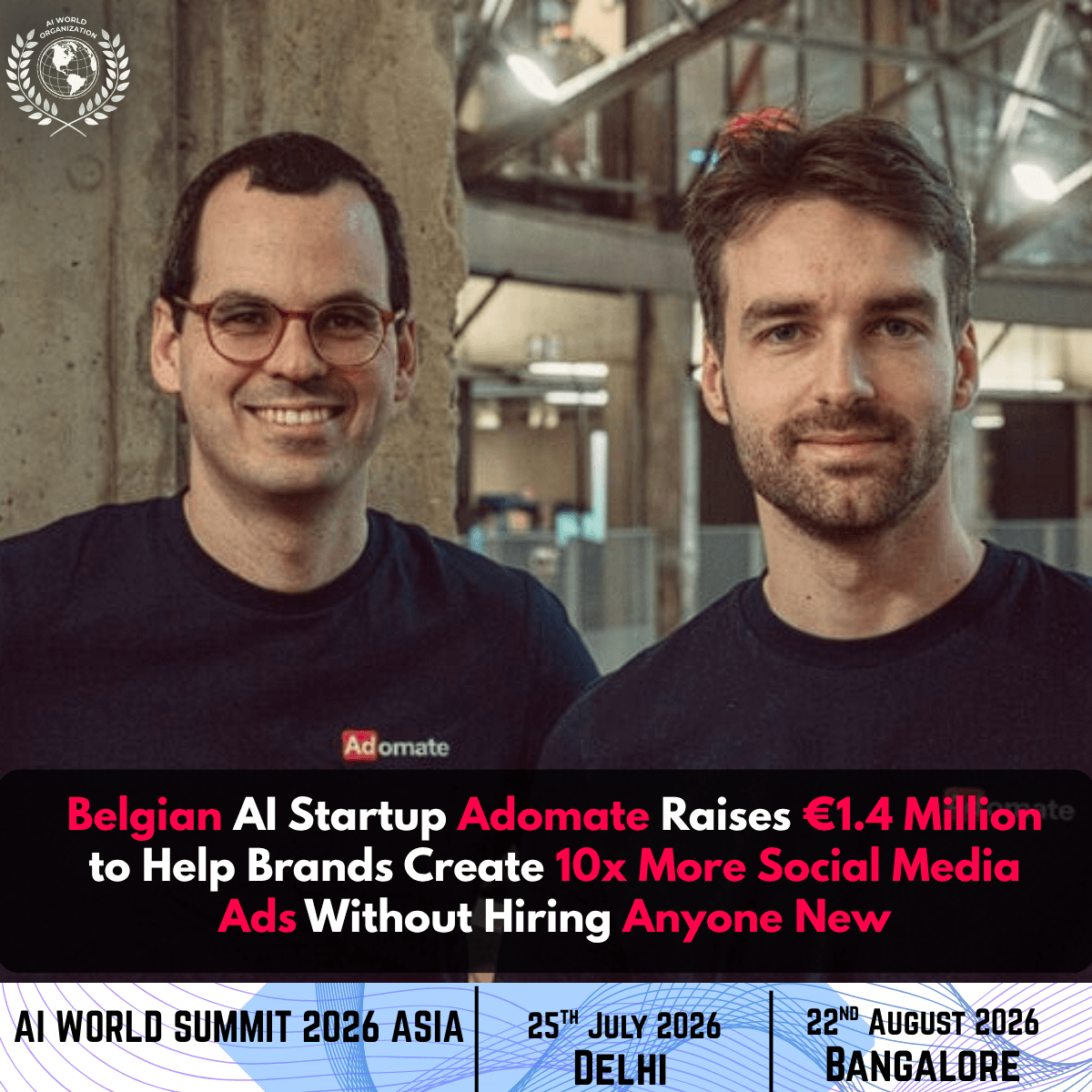
Adomate Raises €1.4M for AI-Powered Ad Creation
Ghent-based Adomate secures €1.4M in fresh funding to help marketing teams create AI-powered social media ads at scale, backed by top European investors.
TL;DR
Ghent-based AI startup Adomate has raised €1.4 million to help marketing teams produce social media ads faster and at scale. Founded in 2024 by former ML6 colleagues Simon Logghe and Lucas Desard, the platform blends performance data, competitor insights, and consumer behaviour to help brands generate ad creatives up to 10x faster — without needing to expand their team.
Adomate Raises €1.4 Million to Solve Social Media Advertising's Biggest Bottleneck — And It's Not What You'd Expect
There is a quiet crisis unfolding inside marketing departments around the world, and it has nothing to do with budgets, headcount, or strategy. It is a crisis of volume — specifically, the sheer amount of creative content that brands now need to keep producing just to stay relevant on social media platforms. The algorithms that power channels like Meta and TikTok have grown increasingly sophisticated, and as a result, they now reward advertisers who consistently publish a wide variety of fresh, well-targeted creatives. The brands that win are the ones that can test more angles, iterate faster, and keep audiences engaged before the inevitable wave of ad fatigue sets in. For most marketing teams, this is easier said than done.
It is exactly this gap — between what modern advertising platforms demand and what traditional marketing workflows can actually produce — that a Belgium-based startup called Adomate has set out to close. Founded in the city of Ghent in 2024, Adomate has spent its early years developing an AI-powered platform specifically designed to help marketing teams create social media advertising at scale. This week, the company announced that it has raised €1.4 million in a seed funding round, with participation from a strong mix of venture investors and seasoned industry operators. The fresh capital will be used to accelerate the company's international expansion, grow its team, and push the development of its platform further than it has ever gone before.
For those tracking the evolution of AI in marketing and advertising, this round is about more than just another startup securing early-stage money. It is a signal that the market is beginning to take seriously the idea that artificial intelligence should not merely assist in ad creation — it should fundamentally transform how the entire process works, from research and ideation all the way through to creative production and performance optimisation. Adomate is betting that it has built the right foundation to lead that transformation, and based on the early traction the company has already shown, there is a compelling case to be made that they might be right.
The Problem That's Been Keeping Marketing Teams Up at Night
To understand why Adomate exists, it helps to understand just how dramatically the social media advertising landscape has changed over the past few years. Not long ago, a marketing team could develop a handful of polished ad creatives, run them over several weeks, and expect consistent results. Platforms were less competitive, audiences were less saturated, and a strong creative had a longer shelf life. That world no longer exists.
Today, the algorithms that govern ad delivery on platforms like Meta and TikTok are built to surface variety. They are engineered in a way that increasingly penalises repetition and rewards fresh, relevant content. Brands that continuously refresh their creative libraries with new angles, new formats, and new messages tend to be rewarded with better reach, lower cost-per-click, and stronger overall campaign performance. Those that do not find themselves fighting diminishing returns on ads that the algorithm has essentially stopped promoting.
This shift has created an enormous operational pressure for marketing teams. It is not uncommon today for a mid-to-large brand to need dozens of distinct creative variations per campaign — different headlines, different visuals, different calls-to-action — all tailored to different audience segments and tested simultaneously. Producing this volume of content through traditional means, which typically involves briefing designers, copywriters, and creative strategists one concept at a time, is slow, expensive, and difficult to scale. The internal bottleneck is not a lack of ideas or talent — it is a structural mismatch between the pace that modern platforms demand and the pace that traditional creative production workflows can sustain.
On top of this, there is the very real phenomenon of ad fatigue. Users who are repeatedly exposed to the same creative naturally become desensitised to it. The click-through rates drop, engagement falls, and what was once a performing ad becomes dead weight in a campaign. To fight fatigue, brands need to continuously rotate and refresh their creative inventory, which only adds to the pressure already bearing down on marketing teams.
This is the problem Adomate was founded to solve. And it is a problem that, according to Simon Logghe, CEO and co-founder of the company, is only getting harder to ignore. "Advertising platforms increasingly reward brands that can deliver a high volume of creative, relevant, and diverse campaigns," Logghe has noted. "Marketing teams have access to more data than ever before, but often lack the time and resources to translate those insights into enough new creatives." That disconnect, in Logghe's view, is precisely where Adomate comes in — giving teams the means to create better-performing ads at scale without having to build out a much larger creative operation to do it.
From Agency Roots to a Full-Scale Software Platform
Adomate's origin story is one that will be familiar to anyone who has watched a smart technology company grow organically out of real-world experience. Simon Logghe and Lucas Desard, the two co-founders, met while working at ML6, a well-regarded Belgian machine learning consultancy. Their time at ML6 gave them both a deep technical grounding in applied AI and, equally important, a practical understanding of how artificial intelligence could be put to work in commercial contexts. When they set out to build Adomate in 2024, they were not starting from abstract theory — they were starting from firsthand knowledge of the problem.
The company's earliest iteration was not a software product at all. Adomate initially operated as an agency, using the AI-powered tools its founding team had built internally to develop advertising campaigns on behalf of clients. This approach, while not the company's long-term destination, proved to be invaluable. It allowed Logghe, Desard, and their team to test their technology in real-world conditions, work directly with marketing professionals under genuine production constraints, and refine their tools based on the specific feedback and pressures that come with client-facing creative work. In short, they built their product while simultaneously using it at scale — a rare advantage that gave them confidence that the technology actually worked before they tried to sell it to the wider market.
Over time, as the tools became more sophisticated and the results became more consistent, it became clear that the real opportunity was not in running an agency but in building a platform that marketing teams everywhere could use themselves. The pivot from services to software was a natural evolution, not an abrupt change in direction. What Adomate ultimately created is an ad creation data platform — a system that pulls together performance data from live campaigns, intelligence gathered through competitor analysis, and insights derived from observed consumer behaviour, and uses all of that information to help marketers generate new advertising creatives faster and with a much higher likelihood of success.
The platform enables teams to build custom workflows suited to their specific brand, category, and target audience. Rather than starting from a blank page — which remains one of the most time-consuming parts of any creative process — marketers using Adomate can start from a rich foundation of data-backed insight and move from concept to finished creative in a fraction of the time it would traditionally take. The company claims that teams using its platform are consistently producing five to ten times more creative output than they could manage through conventional methods, all without adding headcount. Research that would previously take days to gather and synthesise can now be turned into actionable creative concepts in a matter of minutes.
Adomate's credibility in this space has been formally recognised by the platforms it serves. The company holds the status of Meta Verified Tech Provider, a designation that reflects a certified level of expertise and integration with Meta's advertising ecosystem. It is also a LinkedIn Verified API Partner, meaning it has direct, sanctioned access to LinkedIn's advertising infrastructure. These are not honorary titles — they represent genuine technical partnerships with two of the most significant advertising platforms in the world and signal that Adomate is operating at a level of sophistication that goes well beyond most early-stage startups.
Who's Backing Adomate — and Why the Investor Mix Matters
The €1.4 million round that Adomate has just closed is notable not only for its size but for the composition of the investor group behind it. Alongside institutional backers, the round includes a group of individual operators whose own backgrounds add both credibility and strategic value to the company's next phase of growth.
On the institutional side, the round was supported by Angelwise, RDY Ventures, and Seeder Fund — three names that together represent a meaningful slice of Belgium's active early-stage investment community. Seeder Fund, in particular, has a well-established track record of backing ambitious Belgian technology companies in their earliest stages, and its involvement signals confidence in both the market opportunity that Adomate is pursuing and the team's ability to execute against it.
The individual investors in this round are equally noteworthy. Jo Deblaere, a former executive at Accenture, brings with him decades of experience in enterprise technology and digital transformation — the kind of perspective that will be invaluable as Adomate looks to move beyond SMBs and work with larger brand marketing operations. Jeroen De Wit, the founder behind Teamleader, a highly regarded Belgian SaaS company, brings direct experience in building and scaling a software business from a local market to international relevance. His involvement suggests a level of confidence in Adomate's platform model that goes beyond the financial.
Also participating in the round are Willem Dumon of Fleetmaster, Johnny Kegels of PR Force, and Stefan Tournoy, the founder of Vente Exclusive, the well-known European e-commerce company. The presence of Tournoy is particularly significant given the direct relevance of his background — Vente Exclusive operated in an intensely competitive digital retail environment where advertising performance and creative velocity were central to business success. His firsthand experience of the exact problem Adomate solves makes his investment feel less like a financial bet and more like an informed endorsement. ML6, the machine learning firm where both Logghe and Desard previously worked, is also a participant in the round, which speaks to the depth of the professional relationships at the core of this company's founding story.
This mix of institutional rigour and operational expertise gives Adomate something that money alone cannot buy — a network of advisors and supporters who have lived through the challenges that the company's customers face every day. That kind of strategic backing tends to pay dividends in ways that only become apparent over time.
The company has also received external validation in the form of the Rising Star Award from Start it @KBC, one of Belgium's most prominent startup support programs. This recognition further underscores the early momentum that Adomate has built and suggests that the wider Belgian startup ecosystem sees real promise in what the company is building.
What Adomate Delivers in Practice — And What the Early Numbers Show
It is one thing for a startup to describe what its product does. It is another to point to concrete outcomes and growing customer trust as evidence that it actually delivers. Adomate, despite being a very young company, is already able to do both. In the roughly two years since it was founded, the company has grown its customer base to more than 50 brands, a meaningful number for a pre-Series A company still in the process of shaping its go-to-market motion.
Among those customers is Loop Earplugs, a consumer brand that has built a strong presence on social media and whose growth has been closely tied to its ability to produce high-performing digital advertising at scale. The fact that Loop Earplugs — a company that has itself become something of a benchmark for smart, data-driven marketing — has adopted Adomate's platform is a meaningful validation of what the product can do in a demanding, real-world environment.
The specific capabilities that Adomate offers its customers can be broken down into four interconnected areas. First, there is the sheer volume uplift — the ability for marketing teams to produce significantly more creative variations than they could through manual workflows, with the company citing a five-to-ten times improvement as a typical benchmark. Second, there is the speed benefit — the compression of what used to be a multi-day research and ideation process into something that can now be completed in minutes, freeing up creative professionals to focus on higher-value thinking rather than time-consuming groundwork. Third, there is the performance improvement that comes from grounding creative decisions in data rather than intuition alone — by using competitor intelligence and consumer behaviour insights as inputs, teams can make more informed choices about which angles and concepts are most likely to resonate before spending budget to test them. And fourth, there is the strategic benefit of being able to encode and scale a brand's creative approach as a repeatable system rather than something that lives primarily in the heads of individual team members.
Together, these capabilities address something that has been genuinely underserved in the marketing technology landscape for years. There is no shortage of tools that help brands manage advertising campaigns, analyse performance data, or automate media buying. What has been far less developed is tooling that sits at the creative production layer — that helps teams generate more and better raw creative material to feed into those campaigns. Adomate is making a focused bet that this is where the next significant wave of marketing technology value will be created.
What Comes Next: International Ambitions and a Platform Built for the Future of Advertising
With €1.4 million now in the bank, Adomate's leadership has a clear set of priorities for the months ahead. International expansion sits at the top of the list. The company has so far built its customer base primarily within the European market, but the problem it solves is not geographically constrained — the pressure to produce more advertising creative at faster speeds is felt just as acutely by marketing teams in North America, Southeast Asia, and beyond. The funding will allow Adomate to begin the deliberate process of building a commercial presence in new markets, hiring team members who can open doors with brands and agencies outside of Belgium, and adapting its platform to serve the nuances of different regional advertising ecosystems.
On the product side, Adomate has already signalled a number of specific developments that are coming down the pipeline. The company is building a Reddit integration — a move that reflects growing recognition that Reddit has become a genuinely influential advertising platform, particularly for brands looking to reach highly engaged, topic-specific communities. Reddit's advertising offering has matured considerably in recent years, and brands that can produce native-feeling, contextually relevant creative for the platform stand to benefit meaningfully. Adomate's integration will add Reddit to the list of channels its platform can serve, expanding the addressable surface area for customers who are already managing multi-channel campaigns.
The company is also building tools designed to facilitate more structured collaboration between brands and content creators. The creator economy has fundamentally changed how advertising content gets made, and brands that want to work effectively with influencers and UGC creators need infrastructure that allows for smoother briefing, faster iteration, and cleaner integration between creator-produced content and paid advertising campaigns. Adomate's tools in this area will help bridge the gap between the organic, creator-driven side of social media and the more structured, data-driven world of paid advertising — a gap that many brands currently navigate with a patchwork of disconnected tools and manual processes.
Taken together, these developments paint a picture of a company that is thinking carefully not just about where the advertising market is today but where it is heading. The brands that will win in social media advertising over the next few years will be those that can operate with creative agility — producing more content, testing faster, learning continuously, and adapting constantly. Adomate is positioning itself as the infrastructure layer that makes that kind of agility possible, regardless of the size of the team behind it.
At The AI World, we see Adomate's story as a clear illustration of a broader trend we have been tracking closely across the global AI landscape — the increasing maturity of AI applications that solve specific, real operational problems rather than pursuing general-purpose intelligence for its own sake. The value of artificial intelligence in business does not come from the technology being impressive in the abstract. It comes from the technology being embedded in practical workflows and delivering measurable outcomes that matter to the people using it. Adomate appears to have built something that fits that description, and the early evidence — growing customers, strong investor conviction, formal platform partnerships, and recognised industry awards — suggests that the market is beginning to agree.
Belgium may not be the first country that comes to mind when people think about Europe's AI startup ecosystem, but companies like Adomate are part of a broader movement that is steadily changing that perception. Ghent, in particular, has quietly built a reputation as a city with serious technical talent, a pragmatic entrepreneurial culture, and a growing network of investors and accelerators who know how to back the right ideas at the right time. Whether Adomate ultimately becomes a global standard for AI-powered ad creation remains to be seen — but the foundation it has built in just two years is genuinely impressive, and the runway this round provides gives it every opportunity to find out.


