Synera Raises €35M to Power AI Engineering Agents
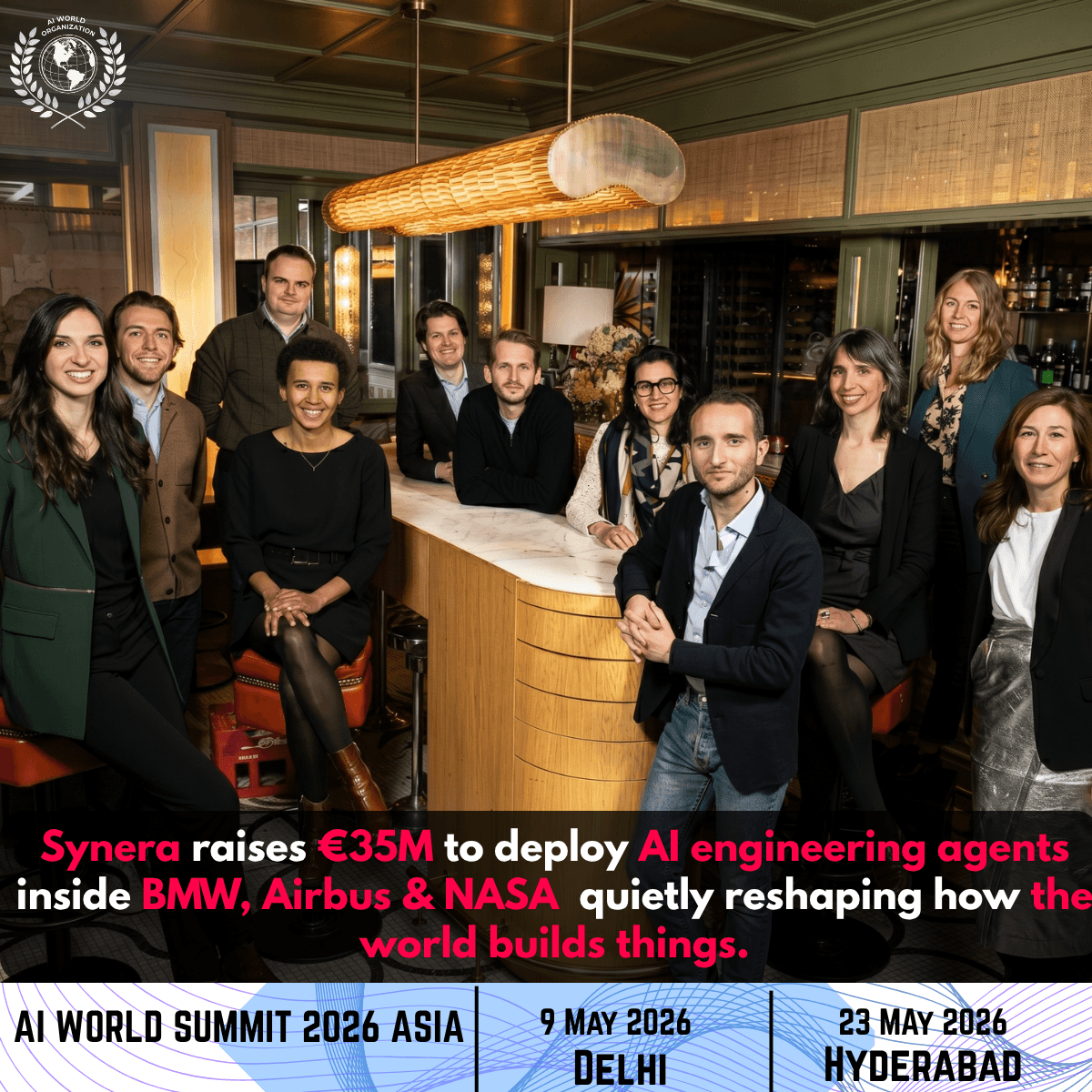
Synera secures €35M Series B led by Revaia to deploy AI engineering agents across BMW, Airbus, NASA, and 60+ enterprises globally.
TL;DR
Synera, a German deep-tech startup, has raised €35M in a Series B round led by Revaia. The company builds AI agents that automate complex engineering workflows for clients like BMW, Airbus, Volvo Trucks, and NASA — all running on-premise across 60+ enterprises in 15 countries. This marks one of the most significant AI funding moves in industrial automation so far in 2026.
Synera Closes €35M Series B to Deploy AI Engineering Agents Across BMW, Airbus, and NASA Workflows
The race to embed artificial intelligence into heavy industrial engineering has found one of its most compelling protagonists yet. Synera, a German deep-tech startup that builds AI agent platforms for complex engineering environments, has officially closed a €35 million ($40 million) Series B funding round — a milestone that is already drawing significant attention across the global AI funding news landscape. The round was led by European growth equity firm Revaia, and it brings together a powerful coalition of institutional investors who are clearly betting big on the next frontier of AI-driven industrial automation. For anyone tracking AI funding closely, this deal signals something far more significant than just another venture round — it points to a maturing appetite for AI solutions that go beyond chatbots and into the actual operational nerve centres of the world's most sophisticated engineering organisations.
What makes this AI funding news story particularly striking is not just the scale of the investment, but the calibre of the clients already using the platform. BMW, Airbus, Volvo Trucks, and NASA — four names that collectively define the cutting edge of engineering excellence across automotive, aerospace, and space exploration — are already integrated into Synera's ecosystem. That's not a pilot programme. That's real-world deployment at an enterprise level, spanning 60-plus organisations across 15 countries. And with fresh capital in hand, Synera is now preparing to scale far beyond its current footprint.
The Problem Synera Set Out to Solve
To understand why this round matters, you need to appreciate the specific gap Synera identified when it was founded back in 2018 in Bremen, Germany. The three co-founders — Dr. Moritz Maier, Sebastian Möller-Lafore, and Daniel Siegel — weren't looking to build another generic AI tool. They were working from a very precise observation: that industrial engineering workflows were, and largely still are, deeply fragmented. Engineers in the automotive or aerospace sectors routinely operate across software stacks from completely different vendors — Siemens, Altair, Autodesk, Hexagon, PTC — and the burden of connecting, running, and optimising those workflows falls almost entirely on human engineers, many of whom are spending more time wrestling with software than actually engineering.
This insight matters enormously in the broader context of AI funding news. There has been no shortage of investment in AI tools for enterprise settings, but the vast majority of that money has gone into what are essentially AI assistants — copilots that suggest things, summarise things, or draft things. What Synera built is categorically different. Rather than giving engineers a smarter keyboard, Synera gives them a team of autonomous agents that can actually run workflows from start to finish, make iterative decisions, and improve performance over time. It's the difference between handing someone a better pencil and replacing the entire drawing process with an intelligent system that draws, reviews, corrects, and approves — all on its own.
The urgency of solving this problem is underlined by a telling industry statistic. According to Deloitte research, approximately 86% of manufacturers have plans to adopt generative AI by 2026. Yet according to Gartner, only around 41% of AI prototypes ever make it into actual production. That gap — the chasm between AI ambition and AI delivery — is precisely the problem Synera's platform is engineered to close. And it's exactly the kind of structural inefficiency that justifies significant AI funding at the Series B stage.
How the Platform Works: Agents Over Copilots
At the heart of Synera's proposition is a fundamental architectural choice that sets it apart from nearly everything else in the market. The platform is built around teams of specialised AI agents, not a single generalist copilot. Engineers interact with the system through a visual, low-code editor that allows them to design and configure workflows without needing deep programming expertise. Once those workflows are defined, the AI agents take over — executing, iterating, and optimising independently across the full engineering lifecycle, from initial design through simulation, cost analysis, and final reporting.
What makes this particularly powerful in practice is that the agents operate across tools and platforms that engineers already use. There's no requirement to abandon existing software ecosystems or go through expensive migrations. Whether a team is running Siemens NX for CAD design, Altair for simulation, or Autodesk for visualisation, Synera's agents can interface with all of them within a single automated workflow. This vendor-neutral stance is, in fact, one of the platform's most strategically defensible characteristics, and it's one of the reasons why larger engineering organisations — who often have deeply entrenched software relationships across multiple vendors — have found it easier to adopt.
The platform's deployment model is also worth noting for those following AI funding news and enterprise AI trends. Synera runs entirely on-premise, meaning that proprietary engineering data, design files, simulation outputs, and intellectual property never leave the customer's own infrastructure. In industries like aerospace and defence, where IP protection is not just a preference but a contractual and regulatory obligation, this is not a nice-to-have — it's a prerequisite. NASA's decision to use Synera's agents to automate parts of its engineering design process, translating requirements into approved component designs through a chain of specialised agents handling optical design, mechanical layout, structural checks, and compliance reporting, is perhaps the most compelling proof point of this capability in action.
The Investors and What Their Backing Signals
The composition of the investor syndicate participating in this round offers its own set of insights into where smart money is moving in the AI funding space. Revaia, the lead investor, is a European growth equity firm with a strong track record in backing enterprise software and deep-tech companies across the continent. That a firm of Revaia's calibre chose Synera as its first German investment is, in itself, a strong endorsement. Jérémie Falzone, Partner at Revaia, was direct about the reasoning: the platform's end-to-end orchestration delivers measurable impact on speed, cost, and resource efficiency, and the investment reflects a conviction that the next generation of global AI leaders will emerge at the intersection of deep industrial expertise and advanced AI capabilities.
Capgemini, one of the world's largest IT services and consulting firms, joined the round through its ISAI Cap Venture vehicle — a strategic move that carries obvious implications for distribution and enterprise access across Capgemini's vast client portfolio. That a company of Capgemini's scale chose to take a financial stake in Synera rather than simply partner with it says something important about how seriously the industrial AI opportunity is being taken at the highest levels of the technology services industry.
All of Synera's Series A investors also chose to participate in this round, including UVC Partners, BMW iVentures, Cherry Ventures, Venture Stars, and Spark Capital. Continued participation from existing investors at a Series B is always a meaningful signal in the world of AI funding — it suggests that the company has not just met expectations since the previous round, but has outperformed them in ways that justify doubling down. BMW iVentures' continued participation is particularly notable given that BMW is also a customer of the platform, creating a rare and powerful alignment between financial investment and operational validation.
Competitive Landscape and Market Position
Understanding Synera's competitive positioning requires reframing what "competition" actually means in this space. The company does not primarily compete with other AI startups. Its real competitive set is made up of the large, established product lifecycle management (PLM) and simulation software giants — companies like Siemens, Dassault Systèmes, Ansys, and PTC — all of which have their own AI and automation roadmaps. These are formidable incumbents with decades of customer relationships, entrenched software architectures, and enormous R&D budgets.
But Synera's competitive thesis rests on a point of structural reality that the incumbents are inherently unable to address: real engineering environments use tools from multiple vendors, and no single vendor — no matter how dominant — can automate workflows that span a competitor's software. Only a truly neutral, vendor-agnostic platform can do that. It's a positioning that resonates clearly in the current AI funding news cycle, where the most interesting bets are increasingly being placed on platforms and orchestration layers rather than point solutions.
The numbers support the thesis. In 2025, Synera lost only 4% of potential customers to any indirect competitor — a remarkably low churn figure for a company operating in such a competitive and sales-cycle-heavy enterprise market. The far bigger challenge, as the team openly acknowledges, is customer inertia: the tendency of large engineering organisations to stick with familiar workflows even when better alternatives exist. That's a sales and change management problem as much as a technical one, and it's one that fresh AI funding will help address through expanded go-to-market investment.
Global Expansion: From Bremen to Boston and Beyond
With €35 million in fresh capital, Synera is wasting no time in mapping out its global growth agenda. The company currently operates with teams in Bremen, Germany and Boston, Massachusetts, giving it a solid dual-continent presence. The new funding will accelerate expansion into three key geographies: the United States, Asia-Pacific, and deeper across Europe. A new dedicated team is being established in France, which will strengthen Synera's European commercial operations and support its growing relationship with major French aerospace and industrial players.
The US market represents perhaps the single biggest near-term opportunity, given the scale and concentration of advanced manufacturing, aerospace, and defence engineering organisations in North America. NASA's presence as an existing customer already gives Synera significant credibility in the government and defence-adjacent engineering sector — a sector where AI funding for workflow automation is increasingly being treated as a strategic priority. The Asia-Pacific opportunity, meanwhile, is being shaped by the rapid growth of automotive and electronics manufacturing in countries like South Korea, Japan, and increasingly India, where AI funding news has been dominated by manufacturing and industrial automation stories over the past 18 months.
What is particularly telling about Synera's approach to international expansion is its discipline. Rather than trying to be everywhere at once, the company has chosen to concentrate its initial global push in regions where it already has proof points — either through existing customer relationships or through investor networks that can open enterprise doors. That measured approach to scaling is characteristic of deep-tech companies that understand their sales cycles are measured in quarters, not weeks.
Why This Moment Matters for Industrial AI
Stepping back from the specific details of this AI funding round, there is a broader narrative here that deserves attention. Industrial engineering has historically been one of the slowest sectors to embrace digital transformation, and for understandable reasons. The stakes are extraordinarily high — a failed simulation or a missed structural check in the aerospace or automotive sector doesn't result in a bad product review, it can result in catastrophic failure. The conservatism that has slowed AI adoption in this space is not irrational; it's a rational response to the asymmetry of risk.
What Synera's traction — and this funding round — suggests is that the engineering community is beginning to move past that conservatism, at least for the use cases where AI agents can be given clearly scoped responsibilities within human-supervised workflows. The on-premise deployment model, the vendor-neutral integration architecture, and the agent-based approach that keeps humans in the loop for final approvals all work together to make the platform feel less like a leap of faith and more like a natural evolution of existing workflows. That is, arguably, the only design philosophy that could have landed clients like Airbus and NASA — organisations that are not known for being early adopters of unproven technology.
As AI funding news continues to flood in from across sectors, it is increasingly clear that the deals that will define the next decade are not the ones chasing consumer attention — they are the ones quietly rewiring the operational infrastructure of industries that have been running on legacy processes for decades. Synera's €35 million Series B is exactly that kind of deal. And for those watching the intersection of AI, deep industrial expertise, and enterprise adoption, it is one of the most important AI funding stories of 2026 so far.
The broader AI funding landscape is shifting toward solutions that deliver measurable, auditable ROI in complex environments — and Synera's platform, already trusted by more than 60 enterprise customers across 15 countries, is exactly the kind of infrastructure play that defines this new era. With Revaia leading the charge and a heavyweight roster of co-investors backing the vision, Synera is not just raising money — it is making a credible case for becoming the operating system of the modern engineering workflow.