Subra Raises €40M to Scale Superconductor Cables
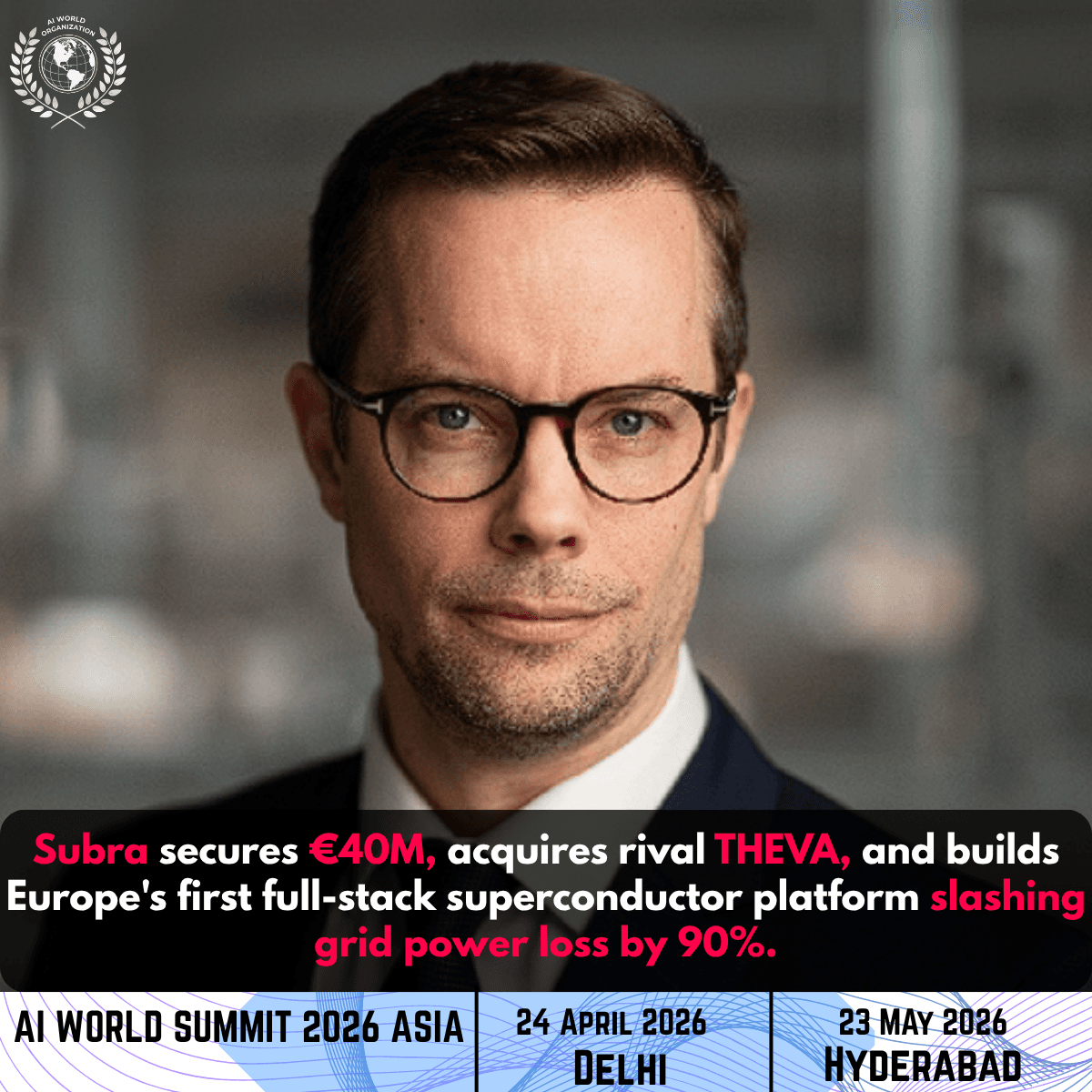
Danish deep-tech startup Subra secures €40M Series A led by Novo Holdings and acquires THEVA to build Europe's top superconductor platform.
TL;DR
Danish startup Subra has raised €40 million in a Series A round led by Novo Holdings and simultaneously acquired German superconductor materials firm THEVA. The combined company now controls the full production chain for high-temperature superconductor cables that cut power transmission losses by up to 90%. It's a significant step toward solving Europe's chronic energy grid inefficiency.
Subra Raises €40 Million in Series A to Build Europe's Next-Generation Superconductor Platform
Europe's energy transmission infrastructure has long been battling an invisible but costly problem — power loss. As the continent accelerates its shift toward renewable energy, the inefficiency of traditional copper-based transmission cables has become increasingly hard to overlook. Into this critical gap steps Subra, a Danish deep-tech company that has just closed a landmark €40 million Series A funding round to not only scale its revolutionary superconducting cable technology but also acquire one of Europe's oldest superconducting materials manufacturers. This development stands as one of the most significant milestones in European clean energy infrastructure this year, and the wider tech and AI funding news landscape is watching closely as deep-tech ventures continue to attract serious institutional capital alongside the AI funding wave reshaping global venture activity.
Europe's Power Grid Problem — And Why It Can No Longer Wait
To understand why Subra's funding round matters, it's important to grasp the scale of the problem it is trying to solve. Europe's electricity grid currently loses as much as 13% of all transmitted power as heat — a staggering inefficiency that is only worsening as new solar farms, wind turbines, and other renewable energy installations are being built further and further from the urban centres that consume electricity. The conventional copper cables that form the backbone of Europe's transmission network were never designed for the distances and loads that modern clean energy demands. According to data from the European Commission's own energy framework reports, the continent's pan-European high-voltage direct-current (HVDC) grid records energy losses estimated at 50 gigawatts across approximately 75,000 kilometres of transmission lines — equivalent to the output of 50 full-scale power plants being completely wasted.
This is the exact challenge that Subra has spent more than a decade trying to crack. Founded in 2014 as a spinoff from the Technical University of Denmark (DTU), Subra was born out of rigorous academic research and sits at the intersection of materials science, electrical engineering, and industrial manufacturing. Its founder and CEO, Anders C. Wulff, was previously an associate professor at DTU and personally invented the core patents that underpin the company's flagship product. What Subra has developed is not a minor improvement on existing cable technology — it is a fundamentally different approach to how electricity moves across distances, and the potential implications for Europe's energy transition are enormous.
The backdrop of this milestone is particularly relevant in the context of broader AI funding news and global deep-tech venture trends. As billions continue to pour into AI infrastructure and compute-heavy ventures, investors are simultaneously recognising that AI's own energy demands — data centres, GPU farms, and real-time inference systems — are accelerating the need for better, smarter energy transmission. The demand for clean, efficient, and loss-free power delivery isn't just a climate story; it's a technology story.
The SUBRACABLE: Technology That Redefines Power Transmission
At the heart of Subra's commercial offering is SUBRACABLE — a high-temperature superconductor (HTS) cable product that turns a once-exotic laboratory material into a scalable, industrially deployable solution. Superconductors, in principle, are materials that conduct electricity with virtually zero resistance when cooled below a certain critical temperature. The challenge has always been making this work at temperatures that are economically and practically viable outside of a lab setting. Subra's breakthrough lies in how it transforms high-temperature superconductor tape into bundled, round wires that can be manufactured in continuous lengths of more than 10 kilometres — a critical requirement for real-world grid deployment.
The numbers behind SUBRACABLE's performance are genuinely remarkable. Compared to conventional copper cables, HTS cables built using Subra's technology can reduce energy losses by as much as 90%, cut the amount of copper required by 99%, and bring down the levelised cost of transmission by up to 75%. These are not incremental gains — they represent a generational leap in what transmission infrastructure can deliver. Additionally, because HTS cables do not emit heat regardless of how much power they carry, they can be installed underground without the thermal management complications that limit conventional buried cables. This makes it possible to deploy energy infrastructure directly beneath cities and densely populated areas without the visual impact or land-use conflicts associated with traditional overhead power lines.
What makes SUBRACABLE particularly well-suited to Europe's current energy ambitions is its lack of length limitation. Traditional HTS cable products have often been limited to shorter segments, requiring costly jointing and intermediate installations for longer routes. Subra's manufacturing process removes this barrier entirely, opening the door to true long-distance superconducting power transmission that could connect offshore wind farms in the North Sea directly to demand centres in central Europe or link distributed solar arrays to national grids with minimal loss. This technical edge is what has attracted serious investor interest at a time when AI funding and deep-tech funding are converging on infrastructure plays that carry both climate and strategic significance.
The THEVA Acquisition: Completing the Vertical Integration Puzzle
The €40 million Series A is not just about scaling Subra's existing operations — it has been strategically deployed to fund a major acquisition that transforms the company's industrial position entirely. Alongside the funding announcement, Subra confirmed that it has acquired THEVA Dünnschichttechnik GmbH, a superconducting materials manufacturer based near Munich, Germany. THEVA was founded in 1996 and has spent nearly three decades developing proprietary thin-film coating technology that enables the production of high-performance superconducting tapes. These tapes are the foundational material used not only in power transmission cables but also in a wide range of demanding technical applications including MRI systems, high-field research magnets, and next-generation fusion energy reactors.
The logic behind this acquisition is compelling and follows a strategic model that has proven highly effective in deep-tech sectors: vertical integration. Prior to this deal, Subra focused on cable design and system architecture while relying on third-party suppliers — including THEVA — for the base superconducting materials. By bringing THEVA in-house, Subra now controls the entire production chain from raw material manufacturing through to finished cable products. The combined entity operates with facilities in both Denmark and Germany, making it a uniquely pan-European industrial platform at a moment when European governments are actively prioritising technological sovereignty across critical infrastructure sectors.
THEVA brings far more than a manufacturing facility to the table. Its proprietary thin-film deposition processes, developed over decades, represent deep intellectual property that would be extraordinarily difficult and time-consuming to replicate from scratch. By merging THEVA's materials expertise with Subra's cable engineering capabilities, the combined company now possesses an end-to-end technological stack that no other European company currently matches. The timing is deliberate — Europe has been acutely aware of its dependence on non-European suppliers for critical materials and technologies, and the creation of a domestically rooted superconductor champion directly addresses one of the continent's most pressing strategic vulnerabilities. Just as AI funding has catalysed the creation of European AI champions to reduce dependence on US and Chinese technology providers, this investment in Subra is part of a parallel movement to secure Europe's energy technology sovereignty.
Investor Confidence: Who Backed Subra and Why
The €40 million round was led by Novo Holdings, the investment arm of the Novo Nordisk Foundation, which manages approximately $100 billion in assets and is one of the most consequential institutional investors in Europe. The decision to back Subra was made through Novo Holdings' Planetary Health Investments team — a dedicated investment vertical that focuses on technologies and companies that can meaningfully contribute to the energy transition and sustainable infrastructure at scale. Novo Holdings does not often take lead positions in hardware and deep-tech manufacturing ventures, which makes this commitment a particularly strong signal about the investment team's conviction in Subra's technology and market timing.
Co-investing alongside Novo Holdings in this round were Maj Invest, a well-regarded Danish asset manager with a history of backing growth-stage European technology companies, and SPRIND — Germany's Federal Agency for Breakthrough Innovation, formally known as the Bundesagentur für Sprunginnovationen. SPRIND's participation is especially noteworthy because it represents direct governmental backing from Germany, the largest economy in the European Union. SPRIND was established specifically to fund the kinds of radical technological leaps that the private market alone tends to underfund due to long development timescales and high technical risk. Its inclusion in this round alongside private investors reflects a growing consensus that superconductor technology has crossed a threshold from promising research concept to commercially deployable industrial solution.
In the current climate of global AI funding news and technology investment activity, this round stands out for its focus on physical infrastructure rather than software or algorithmic platforms. While AI funding dominated venture capital headlines through 2024 and 2025, there is now a growing recognition among institutional investors that the physical layer of the digital and clean energy economy — cables, chips, power systems, and manufacturing infrastructure — is just as critical to back. Novo Holdings' move into superconductors sits alongside a broader portfolio strategy that recognises energy transmission as a foundational enabler for everything from fusion power to AI data centres that require stable, efficient electricity supplies.
What Comes Next: Scaling a European Superconductor Champion
With €40 million now in its account and THEVA fully integrated into its operations, Subra enters its next phase with an unusually strong set of capabilities for a company of its age. The immediate priorities for deploying the Series A capital are threefold: combining the two business entities into a coherent operational structure, scaling up manufacturing capacity to meet growing customer demand, and continuing product development across Subra's three core target markets — energy transmission, industrial applications, and research infrastructure. Each of these markets represents a substantial long-term revenue opportunity, and together they give Subra a diversified commercial foundation that reduces its reliance on any single application or customer segment.
The energy transmission market alone presents an enormous runway. European governments are in the midst of some of the most ambitious grid expansion and modernisation projects in the continent's history, driven by binding renewable energy targets and the practical requirements of integrating offshore wind, solar, and future nuclear fusion capacity into national grids. Superconducting cables are increasingly being discussed at the regulatory and planning level as a viable solution for the highest-demand transmission corridors, particularly in densely populated regions where overhead lines are not feasible. Subra's ability to produce cables in lengths exceeding 10 kilometres, combined with THEVA's materials production capability, positions it as a credible supplier for these projects in a way that would not have been possible before this funding round.
Beyond the grid, THEVA's existing customer base in research and industrial magnets gives the combined company immediate access to markets that are experiencing their own rapid growth cycles. High-field magnets are central to the development of fusion energy reactors, a sector that has attracted billions in AI funding and deep-tech investment from both private sources and national governments over the past three years. Companies like Commonwealth Fusion Systems and other fusion startups are actively sourcing high-performance superconducting tapes to build their magnet systems, and THEVA's established presence in this supply chain could translate into substantial commercial opportunities as the fusion sector moves from proof-of-concept to first-of-kind plant development.
Anders C. Wulff, speaking on the significance of this moment, captured the broader stakes clearly when he said that Europe's energy systems are under immense pressure and that bringing complementary technologies together within one unified company strengthens the ability to develop and deliver superconductor solutions to support the transformation of Europe's energy landscape. This is not the language of a founder celebrating a funding milestone in isolation — it is a statement of industrial purpose at a critical inflection point for both the European energy sector and the broader global deep-tech investment environment that is increasingly intersecting with AI funding trends and energy infrastructure priorities.
The AI World Organisation will continue to track Subra's progress as it builds out what could become one of Europe's most strategically important deep-tech companies. In a world where AI funding is reshaping what's possible in software and intelligence, Subra's work is a reminder that the physical world — its grids, its materials, its cables — needs an equally ambitious transformation.