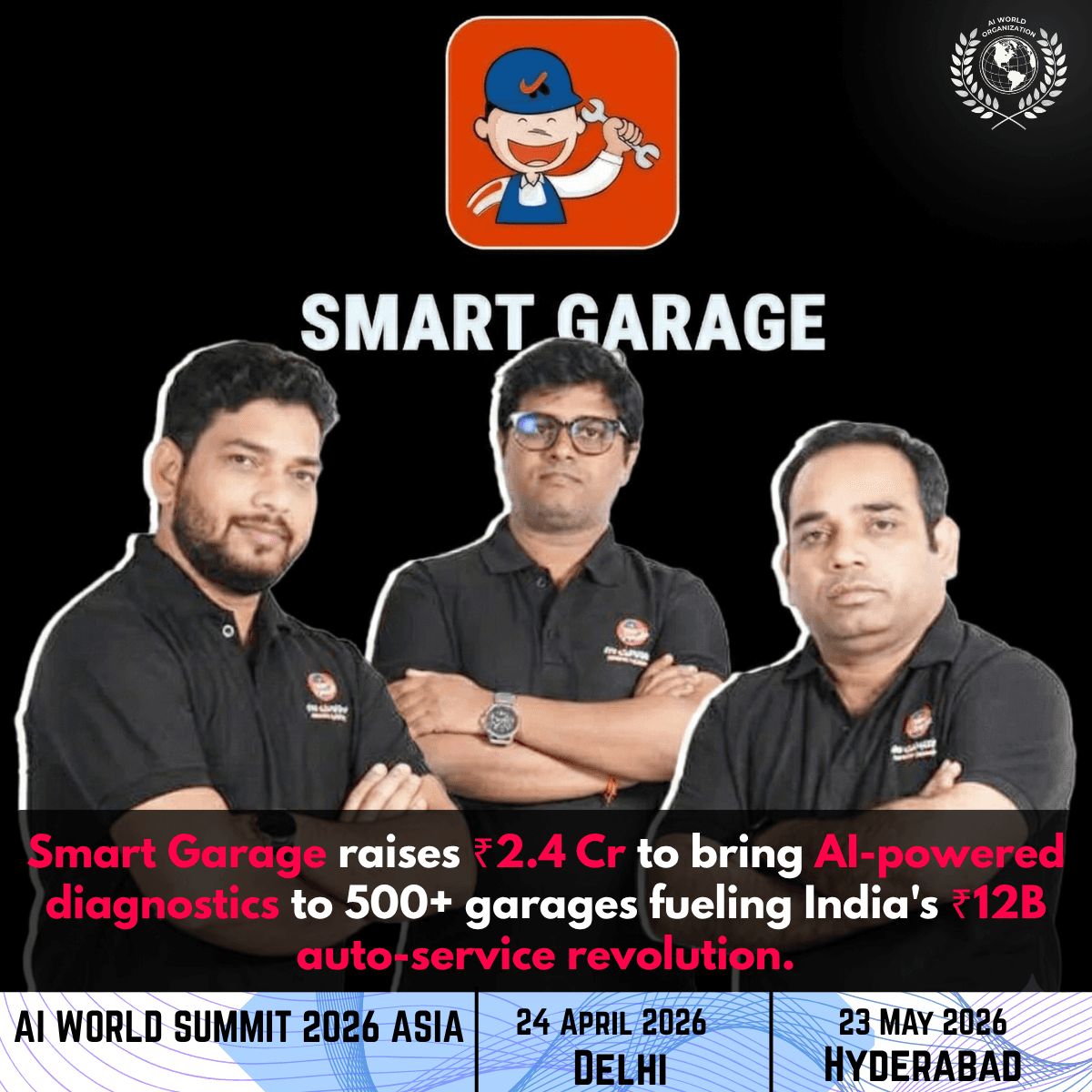
Smart Garage Raises ₹2.4 Cr in Pre-Series A Funding
Smart Garage raises ₹2.4 Cr in Pre-Series A AI funding to expand its 500+ garage network and hit ₹80 Cr revenue run rate by FY27.
TL;DR
Smart Garage, a Faridabad-based AI-powered auto-service marketplace, has raised ₹2.4 crore in a Pre-Series A round — the first tranche of a planned ₹15 crore fundraise. The platform connects garages, vehicle owners, and insurers using AI-led diagnostics and workflow tools, currently serving 500+ workshops across India, with a target of ₹80 crore revenue run rate by FY27.
Smart Garage Secures ₹2.4 Crore in Pre-Series A Round to Revolutionize India's AI-Powered Auto-Service Market
India's automotive aftermarket is undergoing a quiet but consequential transformation. While much of the country's startup attention tends to gravitate toward fintech, edtech, or generative AI platforms, a growing cluster of deep-tech and sector-specific startups is methodically rebuilding the infrastructure behind industries that have long operated without meaningful technological intervention. One such company is Smart Garage — an AI-driven auto-service marketplace that is now making waves not just on the roads, but in boardrooms and investor circles across the country. In the latest AI funding news, Smart Garage has successfully raised ₹2.4 crore in a Pre-Series A funding round, marking what the company describes as the opening chapter of a significantly larger fundraising journey. This development has placed Smart Garage firmly on the radar of everyone watching the intersection of AI funding and India's $12 billion auto-aftersales sector.
The raise, while modest in absolute numbers, is strategically significant. It is the first tranche of a broader ₹15 crore fundraise that the company has already set in motion. The remaining ₹12.6 crore is expected to be raised over the next 12 to 18 months, with a very specific target in mind — achieving a revenue run rate of ₹80 crore by the end of FY27. These are ambitious milestones, but they come backed by a clear operational foundation and a business model that has been quietly proving itself across Tier-1 and Tier-2 cities in India. The company has not disclosed the identities of the investors from this round, though the capital injection signals growing confidence in the platform's trajectory and the larger opportunity it is addressing.
The Origin Story: Building a Garage Network From Scratch
Smart Garage was founded by Pawan Singh Raghuvanshi, who serves as the company's CEO and brings with him over 14 years of experience in the automotive industry. Alongside him are Ratan Kumar Singh, the company's Chief Operating Officer, and Deepak Baranwal, who leads the company's technology stack as CTO. The founding team's combined expertise spans automotive supply chains, operations management, and technology development — a triad that is well-suited for the kind of platform they are building. The company is headquartered in Faridabad, Haryana, and has been operational since July 2019, giving it nearly seven years of on-ground experience navigating the complexities of India's fragmented auto-service landscape.
What started as a relatively straightforward idea — organizing and digitizing unstructured, neighborhood-level garages — has grown into something significantly more layered. Smart Garage today operates as a B2B2C platform, which means it does not merely cater to end consumers but creates a digital bridge between workshops, vehicle owners, insurance companies, and fleet operators. This multi-stakeholder model is central to why the company believes it is in a strong position to drive structural change in the way vehicles get serviced, diagnosed, repaired, and maintained across the country. The platform currently powers a network of over 500 partner garages spread across Tier-1 and Tier-2 cities, and the company has articulated clear plans to scale this to over 10,000 workshops by 2030.
Pawan Singh Raghuvanshi has spoken publicly about the mission that drives Smart Garage — to take what has historically been a largely informal, trust-dependent, and inconsistent experience for vehicle owners and turn it into something standardized, transparent, and technology-backed. The challenge is real. India's automotive aftermarket is massive, estimated at over $12 billion, but it is also deeply fragmented. A significant portion of vehicle servicing happens at standalone garages that lack digital tools, standardized workflows, or access to genuine spare parts supply chains. Smart Garage's pitch is that technology — specifically artificial intelligence — can be the connective tissue that ties all of this together.
AI at the Core: Diagnostics, Predictive Maintenance, and Workflow Automation
The AI funding news around Smart Garage is particularly interesting because of the depth to which the company has embedded AI into its actual product rather than simply using it as a marketing label. The platform uses a combination of AI and SaaS tools across multiple functions that collectively transform how a garage operates on a day-to-day basis. At the front end, the platform enables AI-led vehicle diagnostics — a capability that allows workshops to assess the condition of a vehicle with greater precision and speed than traditional manual inspection allows. This is especially valuable in a market where the technical expertise of individual mechanics can vary wildly from one workshop to another.
Beyond diagnostics, the platform incorporates AI-powered damage assessment tools, which are particularly relevant for insurance-linked repair cases. When a vehicle comes in after an accident or incident, the process of assessing the extent of damage, estimating repair costs, and liaising with an insurance company has traditionally been slow, paper-heavy, and prone to disputes. Smart Garage's damage assessment capabilities aim to compress this timeline and make the entire process more transparent for all parties involved. This is closely tied to one of the company's verticals — Claim Champion — which is specifically designed to streamline and digitize the insurance claim process for vehicles.
Predictive maintenance is another area where Smart Garage's AI capabilities create genuine value. Rather than waiting for a vehicle to break down before seeking repair, the platform can analyze usage patterns and vehicle data to recommend preemptive servicing intervals and flag potential issues before they become costly problems. For fleet operators — who manage large numbers of vehicles and for whom unplanned downtime directly translates into lost revenue — this capability is particularly compelling. The platform's workflow automation tools further help garages manage their internal processes more efficiently, from job card creation and spare parts ordering to customer communication and payment collection.
Alongside Smart Garage's core marketplace, the company has also built Pikpart — a dedicated platform for sourcing genuine spare parts. In a market where the proliferation of counterfeit or substandard parts is a persistent problem, Pikpart's focus on verified, quality spare parts addresses a critical pain point for both workshops and vehicle owners. Together, Smart Garage and Pikpart form an integrated ecosystem that covers the full lifecycle of a vehicle service event, from the first diagnostic check to the last spare part fitted. The company has also developed a dedicated mobile and web application suite to support this integration, enabling customers to book services, track repair progress, and approve or reject ongoing work digitally.
The use of AI in this space is not just a differentiator — it is increasingly becoming a prerequisite for scale. As India's AI funding ecosystem matures and more capital flows into applied AI for sector-specific problems, companies like Smart Garage that have built genuine, functional AI capabilities into their platforms are the ones that stand to benefit most from investor interest and enterprise adoption alike.
The Business Model: Hybrid Revenue Streams and Long-Term SaaS Ambitions
One of the more interesting aspects of Smart Garage's business is its revenue model, which reflects the kind of pragmatic flexibility that is often necessary when building in complex, fragmented markets. The company currently generates revenue through two primary channels — franchise operations and spare parts supply. The franchise model allows Smart Garage to onboard workshops and bring them under its brand umbrella, providing them with technology, training, and access to its supply chain in exchange for a structured commercial arrangement. This creates recurring, relationship-based revenue while also expanding the company's network footprint organically.
The spare parts supply vertical, powered in large part by Pikpart, generates revenue each time a workshop sources parts through the platform. Because the platform focuses on genuine parts and gives workshops access to a broader and more reliable inventory than they might otherwise have, it creates a sticky usage pattern — workshops that onboard to the platform tend to continue ordering through it because the experience is more efficient and the product quality is more consistent. This is the kind of compounding network effect that, at scale, can create significant top-line momentum.
Looking ahead, Smart Garage has articulated plans to introduce SaaS subscription-based revenue and commission-based income streams as the platform grows. The SaaS component would involve charging workshops a subscription fee for access to the platform's AI tools, diagnostics capabilities, and workflow management systems. As garages come to depend more heavily on these tools to run their daily operations, the subscription model creates predictable, recurring revenue that can scale proportionally with the network. The commission-based model, meanwhile, would allow Smart Garage to take a percentage of each transaction facilitated through the platform — whether that is a service booking, a spare parts order, or an insurance claim processed through Claim Champion.
This multi-layered revenue architecture is one of the things that makes the company's ₹80 crore revenue run rate target by FY27 appear credible rather than aspirational. With multiple income streams working in concert and a network that is still in relatively early stages of scaling, the unit economics can improve significantly as the platform achieves greater density in existing markets and expands into new ones.
Expansion Plans and the Road to 10,000 Workshops by 2030
The strategic deployment of the current round of AI funding will center on three main areas — technology enhancement, network expansion, and deeper integrations with key ecosystem partners. On the technology side, the company plans to accelerate the development of its AI capabilities, with particular emphasis on improving the accuracy and speed of its diagnostics and predictive maintenance tools. There is also likely to be investment in data infrastructure, as the platform's ability to deliver meaningful AI-driven insights depends directly on the quality and volume of data it can collect and analyze across its network.
Network expansion will be central to the next phase of growth. Smart Garage has already demonstrated that its model can work in both metro and non-metro markets, with its existing 500+ garage network spanning a meaningful geographic footprint. But the ambition to reach 10,000 workshops by 2030 requires a systematic and well-resourced onboarding and training operation. New workshops joining the network need to be equipped not just with access to the platform but with the skills to use it effectively. This means investing in training programs, field support infrastructure, and possibly a tiered onboarding model that helps garages transition from informal to fully digitized operations over time.
The company's focus on deepening integrations with OEMs, insurance firms, and fleet operators is arguably the most strategically significant element of its expansion plan. OEM integrations could allow Smart Garage to access warranty service data, provide authorized repair services for specific vehicle brands, or participate in extended warranty programs. Insurance integrations are already partly underway through Claim Champion, but there is significant room to deepen these partnerships by becoming a preferred or certified repair network for major insurers. Fleet operator integrations, meanwhile, open up the B2B segment more fully — large fleets represent high-volume, long-term relationships that can anchor significant revenue without the acquisition costs associated with individual consumer customers.
As the broader AI funding landscape continues to expand in India — with investors increasingly looking for startups that can demonstrate real-world AI deployment in industries beyond software and consumer internet — Smart Garage occupies an interesting position. It is not a pure AI company, but AI is central to how it delivers value. It is not a pure marketplace, but the marketplace is what gives its AI tools scale and relevance. This hybrid nature makes it a compelling case study in what the next generation of Indian tech startups can look like — deeply sector-specific, operationally complex, and technologically differentiated.
Why This Funding Round Matters for India's Auto-Tech Sector
Every significant AI funding news event in India's startup ecosystem carries implications that extend well beyond the company directly involved. Smart Garage's Pre-Series A raise is no different. At a time when many investors are cautious about backing early-stage startups without clear monetization paths, the decision to fund Smart Garage reflects a broader conviction that the organized auto-service market in India is ripe for disruption and that technology-first platforms are the most credible vehicle for driving that disruption.
India has one of the largest vehicle populations in the world, and it is growing rapidly. Two-wheelers and four-wheelers combined represent hundreds of millions of vehicles that require regular maintenance, periodic repair, and occasional insurance-linked servicing. Despite this enormous demand, the supply side of the auto-service market remains overwhelmingly fragmented and informal. Organized players — whether OEM-backed service centers or tech-enabled platforms like Smart Garage — account for a relatively small share of total servicing activity. This gap between demand and organized supply is precisely the kind of market condition that attracts both startup founders and investors with conviction.
Smart Garage's approach to this market is also notable for its inclusivity. Rather than seeking to replace existing garages with a centrally managed service center network — an approach that requires massive capital and faces significant operational challenges — it is building a platform that empowers existing workshops to upgrade their capabilities and participate in a more organized ecosystem. This is a fundamentally different and, in many ways, more scalable strategy, because it leverages existing infrastructure rather than trying to build from scratch.
The AI World Organisation closely tracks developments in applied AI funding, and Smart Garage's journey is emblematic of a broader pattern — one in which AI funding is increasingly flowing toward companies that are solving real, sector-specific problems using practical AI tools rather than pursuing frontier AI research. As AI funding news continues to highlight deals like this one, it becomes increasingly clear that the most impactful AI applications of this decade will not all come from large language model labs or consumer-facing chatbots. Many of them will come from companies like Smart Garage, quietly working at the intersection of AI, industry expertise, and operational execution to rebuild sectors that have been waiting decades for this kind of transformation.
The road ahead for Smart Garage is long, and the challenges are real — scaling a partner network across thousands of workshops, maintaining quality and consistency at scale, and competing with both informal incumbents and well-funded organized players will all test the company's resilience. But with a strong founding team, a multi-revenue business model, deepening AI capabilities, and growing investor support, Smart Garage is demonstrating that India's auto-tech sector may be on the verge of its own inflection point. And this latest round of AI funding is the fuel that could carry it there.