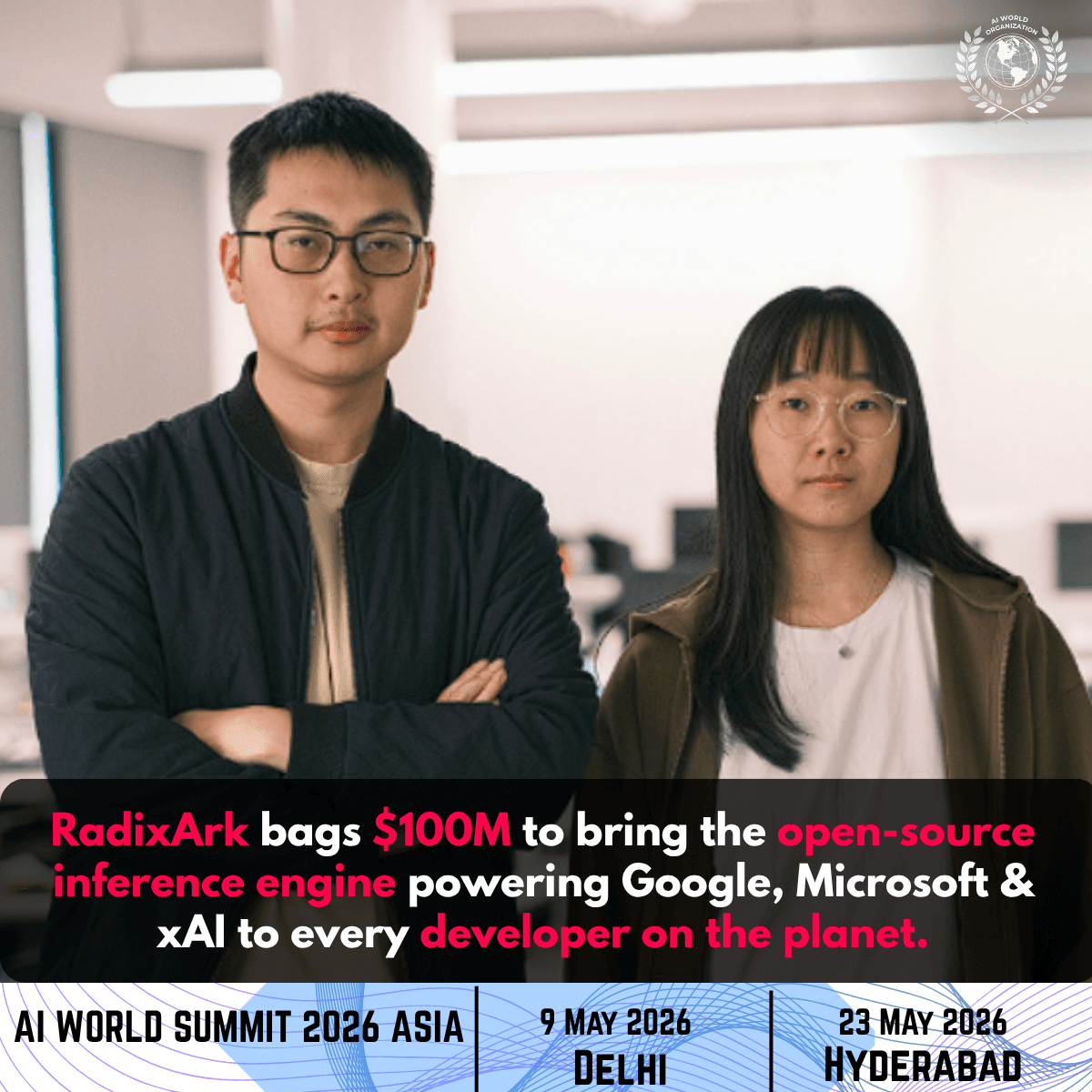
RadixArk Raises $100M to Power AI Inference
RadixArk secures $100M seed funding backed by Nvidia, Accel & Spark Capital to scale SGLang, the open-source AI inference engine trusted by Google, Microsoft & xAI.
TL;DR
RadixArk, founded by former xAI and Nvidia engineers, has raised $100 million in seed funding at a $400 million valuation. The company is commercialising SGLang — an open-source inference engine already running on hundreds of thousands of GPUs daily for the likes of Google, Microsoft, and xAI — while keeping the framework free for all developers.
There is a quiet but powerful engine running beneath the surface of today's most widely used AI systems — and until recently, very few people outside the technical inference community even knew it existed. That engine is SGLang, an open-source AI inference framework that has been silently processing trillions of tokens every single day for some of the biggest names in the technology world, including Google, Microsoft, xAI, and Nvidia. Now, the company that is bringing SGLang from a research project to a fully commercial product has just made a landmark entry onto the global stage. RadixArk, a Palo Alto-based AI infrastructure startup, has raised $100 million in seed funding at a valuation of $400 million, in one of the most significant AI funding news stories of 2026. This development is not only a milestone for the company but a strong signal that the AI infrastructure market is entering a transformative new phase, one where open-source systems challenge proprietary giants and make frontier-level AI accessible to every developer and organisation on the planet.
A Funding Round Built on AI Infrastructure Credibility
The $100 million seed round was led by two of Silicon Valley's most respected venture capital firms — Accel and Spark Capital — with a remarkable list of co-investors that reads like a who's who of the global AI and semiconductor ecosystem. NVentures, the venture arm of Nvidia, participated directly, as did AMD, MediaTek, Databricks, Salience Capital, A&E Investment, HOF Capital, Walden Catalyst, LDVP, and WTT Fubon Family. What makes this AI funding round genuinely extraordinary, however, is the calibre of individual angel investors who chose to back it. John Schulman, co-founder of OpenAI, joined the round. So did Soumith Chintala, the creator of PyTorch, which is arguably the most influential deep learning framework in the world. Thomas Wolf, co-founder of Hugging Face, the platform that has become the default hub for open-source machine learning models, also participated. The CEOs of both Intel and Broadcom rounded out an investor group that collectively represents the full spectrum of the global AI supply chain, from chips to models to developer tools.
For the AI world organisation and its community, this round is a defining data point. When hardware giants like Nvidia and AMD, software leaders like Databricks, and the individual architects of OpenAI, PyTorch, and Hugging Face all bet on the same infrastructure startup, it is not a coincidence. It is a statement about where the next layer of value in AI is being created — not in the models themselves, but in the systems that run them efficiently, cheaply, and at scale.
The Story Behind SGLang and the Founders Who Built It
To understand why RadixArk has attracted so much attention and capital so quickly, you need to go back to 2023 and a research group called LMSYS, a non-profit collaboration of researchers from Stanford, UC Berkeley, Carnegie Mellon University, and UC San Diego. It was within this group that Ying Sheng, one of RadixArk's co-founders, and her team created SGLang as an academic research project. The goal was straightforward in concept but enormously difficult in practice: build a faster, more memory-efficient way to run large language model inference.
Sheng later went on to build inference systems for Elon Musk's Grok models at xAI, giving her front-line experience operating at the very limits of large-scale AI deployment. Her co-founder, Banghua Zhu, brought a complementary background, having worked on systems at Nvidia itself, the company that manufactures the GPUs that power most of the world's AI workloads. Together, they founded RadixArk in 2025, with the explicit mission of taking SGLang from an academic curiosity to a production-grade, commercially supported infrastructure product.
What is striking about SGLang's journey to prominence is how it achieved it — entirely through technical merit, without a marketing team, without a sales organisation, without venture capital backing in its early years. Developers and engineers at the world's most demanding AI companies adopted it because it genuinely solved a problem that other tools did not. Today, SGLang runs on hundreds of thousands of GPUs worldwide, and the companies relying on it daily include some of the most computationally intensive organisations on earth. That kind of organic, grassroots adoption in the deeply technical AI infrastructure market is almost impossible to manufacture. It has to be earned.
How SGLang Solves the AI Inference Memory Problem
To appreciate why RadixArk and SGLang represent such a meaningful development in the AI funding news landscape, it helps to understand what the technology actually does and why it matters so deeply to the organisations that run AI at scale. The core challenge in large language model inference is a memory management problem. Every time a user sends a query to an AI model, the system typically needs to recompute the contextual understanding of that query's prompt from scratch, even when large portions of the prompt are identical or very similar to ones it has processed thousands of times before. At small scale, this is merely inefficient. At the scale of millions of queries per hour, it becomes enormously expensive and slow.
SGLang solves this by implementing a Radix tree data structure — which is, in fact, where both the "Radix" in RadixArk and the design philosophy of the project come from — to cache and store previously processed portions of prompts. When a new query arrives that shares context with a previous one, the system does not start from zero. Instead, it retrieves the already-computed portion from its cache and only processes the genuinely new parts. The result is a dramatic reduction in redundant computation, lower per-token processing costs, faster response times, and meaningful savings for any organisation running its own inference infrastructure.
This is not a marginal optimisation. For companies processing billions of tokens daily, the difference between recomputing context on every query and caching reusable portions can translate into millions of dollars in GPU costs annually. For smaller teams and startups that want to run frontier AI models but cannot afford to rent enormous amounts of cloud compute, it can be the difference between building a product and not building one at all. This is why SGLang's efficiency gains sit at the very core of RadixArk's mission and why AI funding news around this company has resonated so strongly across both investor and developer communities.
The Business Model: Open Source With a Managed Layer
One of the most interesting aspects of RadixArk's approach to building a business around an open-source technology is the clarity and honesty with which the founders describe it. SGLang itself will remain fully open and free. RadixArk has no intention of locking the framework behind a paywall, restricting access, or creating a proprietary fork that diverges from the community version. This is a principled commitment that distinguishes the company from some of its predecessors in the enterprise open-source world, and it is clearly one of the reasons that luminaries like John Schulman and Soumith Chintala — individuals with deep personal investment in keeping AI infrastructure open and accessible — chose to participate in the AI funding round.
The revenue model for RadixArk is instead built around managed hosting and infrastructure services, a proven approach that companies like Databricks and Elastic have successfully applied to other open-source technologies. In this model, engineers and organisations who want to run SGLang themselves can continue to do so for free. Those who want a managed, hosted, enterprise-grade version of the platform — with reliability guarantees, support, security features, and operational management handled by RadixArk — can pay for that layer of service.
Ivan Zhou, a partner at Accel, described the vision clearly when he noted that RadixArk is building the open foundation for the next era of AI, where companies do not simply consume models but train and manage them as a core part of their product development process. By making training and inference infrastructure more accessible and affordable, RadixArk enables engineers at companies of all sizes to experiment and innovate at the frontier, rather than leaving that capability exclusively to organisations with massive compute budgets. This is exactly the kind of democratisation that the AI World organisation has consistently championed, and it represents a meaningful step toward a future where the barriers to building powerful AI products are determined by ideas, not infrastructure costs.
What This Round Means for the Broader AI Infrastructure Market
The RadixArk seed round does not exist in isolation. It is part of a broader and accelerating shift in how the AI industry is being financed and where investors believe the most durable value will be created. For the past several years, the dominant narrative in AI funding news has been about foundation model companies — the builders of large language models like GPT, Claude, Gemini, and Grok. Those companies have absorbed tens of billions of dollars in venture capital and have rightly commanded enormous attention. But as the model layer becomes increasingly commoditised, with open-weight models from Meta, Mistral, DeepSeek, and others rapidly closing the performance gap with proprietary alternatives, investor attention is shifting toward the infrastructure that makes all of these models run better, faster, and more cheaply.
SGLang's primary competitor in the open-source inference engine space is vLLM, another framework that originated at UC Berkeley and has also recently been backed by significant venture capital through a separate startup. The fact that two open-source AI inference engines, both born from academic research at top universities, have now independently attracted major funding rounds is a clear indicator of where sophisticated investors see the next layer of value being created. The infrastructure market for AI is enormous, and it is still in its early innings. RadixArk's $400 million seed valuation reflects the conviction that the company building and supporting the most widely used open-source inference engine is positioned to capture a very significant portion of that market.
For the AI world and its readers, this kind of AI funding news is important not just as a financial story but as a signal about the direction of the industry. When Nvidia's own venture arm invests in an open-source inference engine that competes in certain ways with Nvidia's own software stack, it reflects the company's pragmatic recognition that the developers and organisations building on top of its hardware need the best possible software tools, regardless of who wrote them. It is a sophisticated acknowledgment that the hardware and software ecosystems are deeply interdependent.
The Road Ahead for RadixArk and Open-Source AI
With $100 million now in hand, RadixArk has outlined a clear and ambitious roadmap for how it plans to deploy that capital. The primary areas of investment are expanding SGLang's support for a broader range of model types and architectures beyond the large language models it currently serves, expanding its compatibility with a wider range of hardware platforms to move beyond its current strength on Nvidia GPUs, and growing the managed hosting platform to serve enterprise customers at greater scale and with more robust service offerings.
Ying Sheng herself articulated the company's mission with a directness that is worth reflecting on: "Our mission is simple yet ambitious — make frontier-level AI infrastructure open and accessible to everyone. We believe the next generation of AI won't be defined by who owns the biggest private infrastructure, but by who builds the most meaningful applications on top of shared, world-class systems. We aim to make these systems orders of magnitude cheaper and more accessible, so everyone can build on them."
That statement resonates deeply with the broader conversation happening across the AI world right now. As the gap between what the best-funded AI labs can build and what independent developers and smaller organisations can afford continues to narrow, the infrastructure layer becomes increasingly critical. RadixArk, with SGLang as its technical foundation and a $100 million seed round as its launchpad, is positioning itself to be one of the defining companies of that transition. This is AI funding news with implications that stretch far beyond a single company's balance sheet — it is a reflection of a global industry rethinking what open, accessible, and democratised AI infrastructure actually looks like in practice, and who gets to build it.


