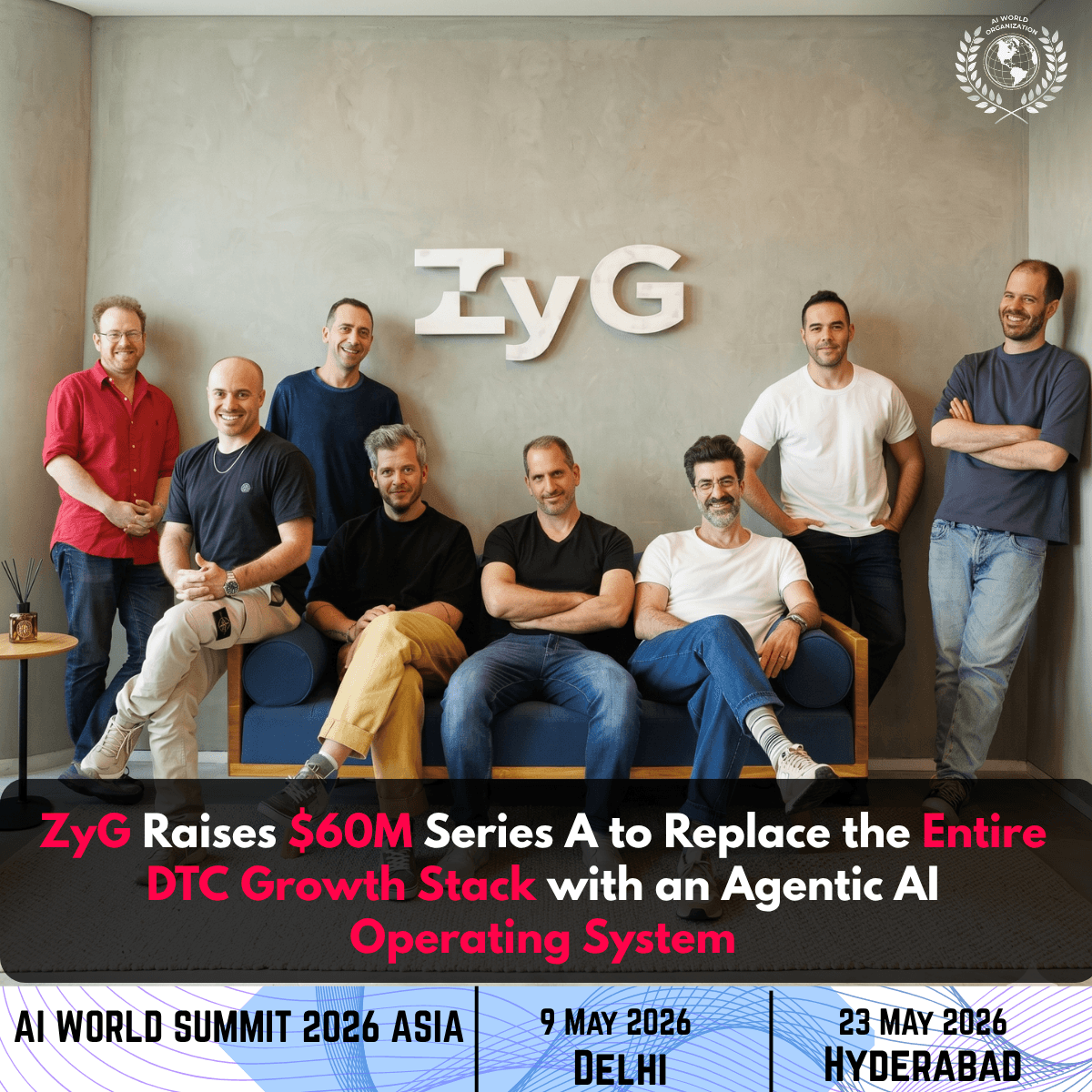
ZyG Raises $60M Series A to Scale Agentic eCommerce OS
ZyG secures $60M in Series A AI funding led by Accel to expand its agentic eCommerce operating system for DTC brands across the US and Europe.
TL;DR
ZyG, a Tel Aviv-based startup building an AI-powered operating system for direct-to-consumer brands, has raised $60 million in a Series A round led by Accel, bringing its total funding to $118 million in under a year. Founded by the co-founders of ironSource, the platform uses over 60 specialised AI agents to handle everything from product validation and creative development to logistics and financing — replacing the fragmented tool stack that causes most DTC brands to fail at scale. The fresh capital will fuel expansion into the US and European markets.
ZyG Raises $60 Million in Series A Round Led by Accel to Power Its Agentic eCommerce Operating System
The world of direct-to-consumer commerce has long been a brutal proving ground. Despite billions of dollars being poured into eCommerce infrastructure every year, the vast majority of consumer product brands still fail to scale, not because their products are bad, but because the ecosystem they operate within is deeply fragmented, overwhelmingly complex, and brutally unforgiving. That painful reality is precisely what drove the founding of ZyG — and it's also what is now attracting some of the biggest names in venture capital to back the company's ambitious vision.
In a major development in the AI funding news landscape, ZyG, the Tel Aviv-based startup building what it describes as a full-stack agentic operating system for direct-to-consumer (DTC) brands, has officially closed a $60 million Series A funding round. The round was led by Accel, one of the most respected venture capital firms in the technology world, and brought in Felix Capital as a notable new investor. With this latest AI funding milestone, ZyG's total capital raised now stands at an impressive $118 million — a remarkable achievement for a company that was founded just a year ago in 2025.
This is not just another funding round in the crowded eCommerce technology space. ZyG is attempting something significantly more ambitious: replacing the entire operational stack that DTC brands depend on — from product validation and creative development to logistics, financing, and customer retention — with a single, unified, AI-powered platform. It is a bold bet, and one that the venture community is clearly beginning to take very seriously.
From Seed to Series A: ZyG's Rapid Rise in the AI Funding Landscape
ZyG's journey to the top of the AI funding news charts has been nothing short of extraordinary. Just two months before this Series A announcement, in March 2026, the company had already closed a $58 million seed round — one of the largest seed rounds ever recorded in the Israeli tech ecosystem. That initial round was backed by three heavyweight investors: Bessemer Venture Partners, Viola Ventures, and Lightspeed Venture Partners, each of whom recognised the enormous market potential ZyG was targeting.
The fact that ZyG was able to follow up that record seed with a $60 million Series A from Accel in such a short timeframe speaks volumes about the confidence early investors have in the company's model and its founding team. Felix Capital, a London-based venture fund known for backing consumer and digital lifestyle brands, also joined this round as a new investor — bringing additional sector-specific expertise that aligns well with ZyG's DTC focus. Combined, the two rounds represent $118 million in total AI funding raised since the company's inception, establishing ZyG as one of the most well-capitalised early-stage AI startups in the eCommerce space today.
This kind of momentum is rare even in the best of market conditions. The fact that ZyG has achieved it in under a year of operation is a testament to both the urgency of the problem it is solving and the strength of the founding team behind it. For observers tracking the broader AI funding news cycle, ZyG's trajectory is a clear signal that investors are increasingly ready to back AI-native platforms that go beyond point solutions and tackle systemic, structural problems head-on.
The Founding Team: Industry Veterans Targeting a Structural Problem
Understanding why ZyG has attracted so much AI funding so quickly requires understanding who built it. ZyG was co-founded in Tel Aviv by Omer Kaplan and Tomer Bar-Zeev — two names that carry significant weight in the global technology industry. Bar-Zeev is best known as a co-founder of ironSource, the Israeli ad-tech and app monetisation giant that merged with Unity Technologies in a blockbuster $4.4 billion deal. That background in scaling digital consumer products at massive scale is directly relevant to what ZyG is trying to accomplish.
Alongside Kaplan and Bar-Zeev, the founding team also includes Assaf Ben Ami, Nadav Ashkenazy, Daniel Shina, Dr. Eyal Amitt, Omri Steinmetz, and Guy Tsur — a group that collectively brings together deep expertise in growth marketing, data science, artificial intelligence, logistics, and venture capital strategy. This is not a team of first-time founders experimenting with a new idea; these are seasoned operators who have lived the pain points they are now building solutions for.
The problem ZyG is solving is strikingly well-defined: more than 90% of direct-to-consumer products fail to scale. This failure, as ZyG's founders are quick to point out, rarely comes down to product quality. Most DTC founders have great products. What they lack is the operational expertise, the data infrastructure, and the capital strategy to take those products from initial traction to sustainable, scalable growth. Mastering all of those disciplines simultaneously — growth marketing, conversion optimisation, supply chain logistics, retention strategy, and predictive financing — is simply beyond the reach of most small and mid-sized DTC brands. ZyG was built to solve exactly that problem, and its rapid AI funding success suggests investors agree that this gap in the market is very real.
How ZyG's Agentic Platform Actually Works
At the heart of ZyG's proposition is a technology architecture that sets it apart from every other player in the eCommerce tools market. The platform begins its relationship with a potential partner brand through what it calls an "agentic marketability test" — a rigorous, data-driven assessment of a product's potential to scale. Each product assessed through this process receives a ZyG Score, a composite rating that evaluates the product's market opportunity, competitive positioning, and growth potential. Only products that meet a minimum threshold on this score are offered a formal partnership with ZyG.
Once a brand is onboarded, ZyG's platform takes over the full operational layer of that brand's growth journey. This includes brand identity and store development, creative asset generation, paid user acquisition, conversion rate optimisation, customer retention programmes, and end-to-end logistics management. What makes this truly differentiated is the underlying technology architecture: more than 60 individual AI agents, each specialised in a particular domain, work in concert on a unified data layer. Rather than operating as isolated point solutions, these agents share data, inform each other's decisions, and collectively optimise for a single goal: sustainable brand growth.
This architecture gives ZyG a significant structural advantage over the existing landscape of eCommerce tools. Shopify, for example, provides the infrastructure layer — the store, the checkout, the basic operational scaffolding — but it does not manage growth. Analytics platforms like Triple Whale or Northbeam provide valuable data insights, but only cover specific segments of the sales funnel. ZyG's stated ambition is to replace the entire stack: not just to support DTC brands, but to take ownership of the growth execution layer entirely. The platform handles validation, execution, financing, and scaling as an integrated system — something no competitor currently offers at this level of integration and automation.
This approach represents a genuinely new category in the eCommerce technology market, and one that has significant implications for how the industry will evolve over the next several years as AI agents become more capable and more commercially trusted.
What Accel's Investment Signals for the AI and eCommerce Ecosystem
Accel's decision to lead this Series A round is notable for reasons that extend beyond the size of the cheque. Accel is one of the world's most respected early-stage technology investors, with a portfolio that includes Facebook, Spotify, Slack, Dropbox, and dozens of other category-defining companies. When Accel leads a round, particularly at the Series A stage, it typically signals conviction not just in a company's current traction, but in its potential to define an entirely new market category.
Sonali De Rycker, partner at Accel, offered a pointed assessment of why the firm chose to back ZyG: "The industry has spent years perfecting how we sell online, yet scaling remains fragmented and fragile. By combining the ironSource founders' commerce pedigree with deep AI expertise, the ZyG team has built the definitive Agentic Operating System that finally gives entrepreneurs the automated growth engine they need to scale." That framing — "definitive Agentic Operating System" — is significant. It reflects Accel's view that ZyG is not building a feature or a tool, but an entirely new category of enterprise software.
For the broader AI funding news landscape, Accel's backing of ZyG is another strong signal that institutional capital is increasingly flowing toward AI-native platforms that demonstrate clear, measurable value in large commercial markets. eCommerce is one of the largest and most competitive markets on the planet, and the DTC segment within it represents hundreds of billions of dollars in annual transaction volume. If ZyG can capture even a modest share of that market by delivering on its promise of automated, end-to-end growth management, the return potential for its investors is enormous. The fact that ZyG already had approximately 65 employees at the time of its seed round — and is projecting tens of millions of dollars in revenue for 2026 — suggests the company is tracking well ahead of schedule on its commercial objectives.
ZyG's Expansion Plans: US, Europe, and Beyond
With $60 million in fresh Series A capital now in the bank, ZyG has outlined a clear set of priorities for the next phase of its growth. The company has confirmed that the new funding will be directed primarily toward two objectives: geographic expansion into the United States and European markets, and the continued development of its predictive financing models.
The US market is an obvious priority. It is the single largest DTC eCommerce market in the world, home to thousands of emerging consumer brands that face exactly the kind of scaling challenges ZyG is designed to solve. European markets, while more fragmented across national borders and regulatory regimes, also represent a substantial opportunity, particularly in the UK, Germany, France, and the Nordic countries, where DTC commerce has been growing rapidly. ZyG's expansion into these markets will likely involve building local operational teams, establishing logistics partnerships, and developing market-specific creative and acquisition capabilities.
The development of predictive financing models is equally important. One of the most significant barriers to DTC brand scaling is access to growth capital. Traditional financing options — bank loans, equity dilution, revenue-based financing — each come with significant limitations and trade-offs. ZyG's vision for its financing layer is to use its rich pool of performance data across its entire portfolio of partner brands to build predictive models that can accurately assess the risk and return profile of capital deployed into specific brand growth initiatives. If successful, this could give ZyG a meaningful advantage over competitors by allowing it to offer more flexible, performance-aligned financing structures that traditional capital providers cannot match.
At AI World Organisation, we have been closely following the rise of agentic AI platforms across different verticals, and ZyG's model is among the most coherent and commercially grounded applications of agentic AI we have seen in the consumer commerce space. The company's rapid progression from seed to Series A, the quality of its investor syndicate, and the structural clarity of its value proposition all point toward a company that has the potential to reshape how DTC brands are built and scaled in the coming years. As the AI funding ecosystem continues to mature and capital increasingly flows toward platforms with genuine operational differentiation, ZyG stands out as a company worth watching very closely.


