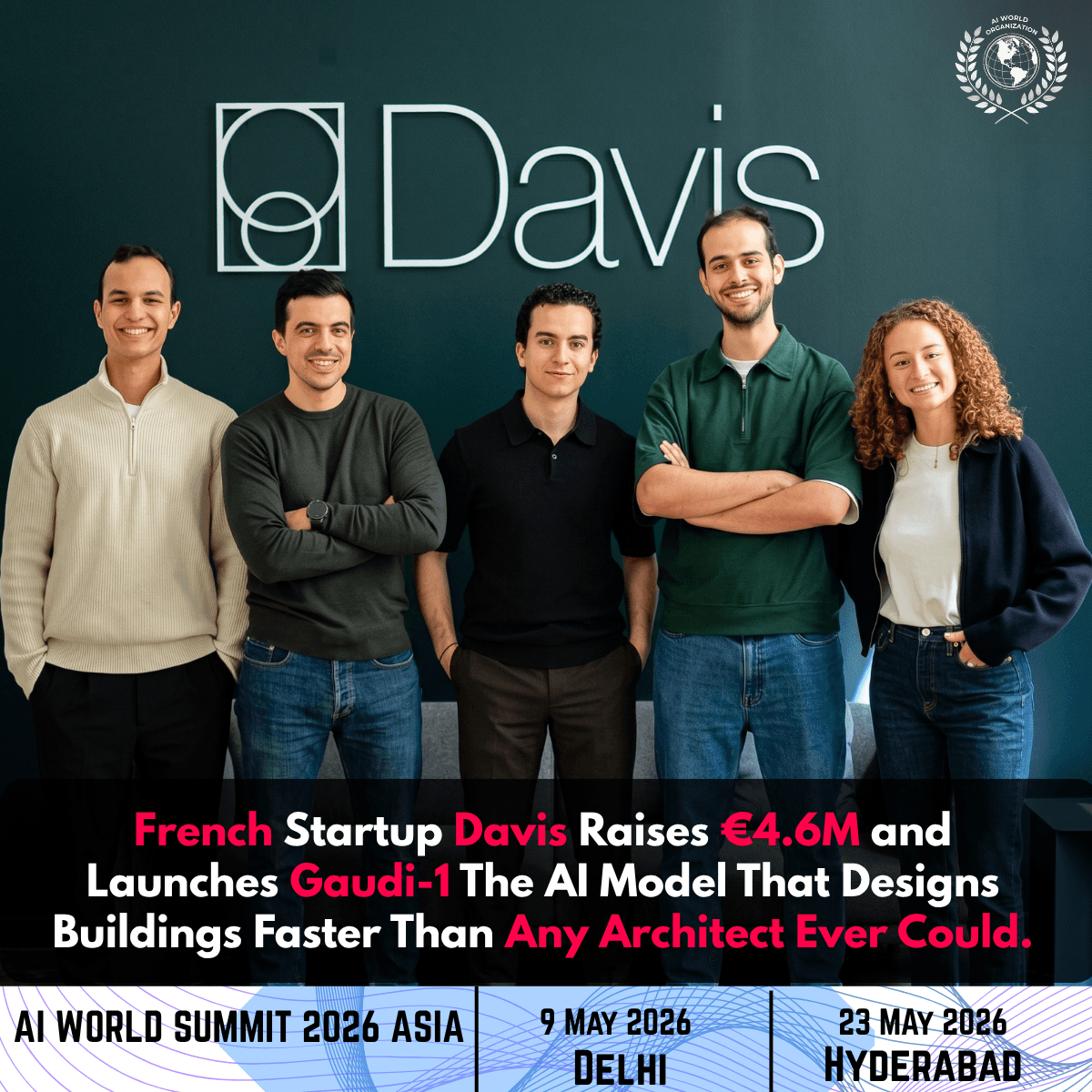
French AI Startup Davis Raises €4.6M, Launches Gaudi-1
French AI startup Davis secures €4.6M in seed funding and unveils Gaudi-1, an AI model automating architectural generation for real estate developers.
TL;DR
French startup Davis has raised €4.6 million in seed funding and launched Gaudi-1, an AI model that automates architectural design for real estate developers. With 15 pilots signed and over $500K in contracted revenue within just seven weeks of operations, Davis is compressing the traditionally slow pre-construction process — cutting timelines that once took months down to just days.
French AI Startup Davis Raises €4.6 Million and Launches Gaudi-1 for Automated Architectural Generation
France's PropTech sector is witnessing a transformative shift as Davis, a Paris-based AI startup, secures €4.6 million in fresh funding and simultaneously unveils its breakthrough product — Gaudi-1, an AI model purpose-built for automated architectural generation. This development marks a significant moment in AI funding news, not just for France but for the broader European real estate and construction technology landscape. The dual announcement signals that AI is no longer merely a tool for data analytics in real estate — it is now powering the very creation of buildings themselves, from the earliest design sketches to full-scale architectural outputs.
At The AI World Organisation, we closely track how AI funding is reshaping industry verticals across Europe and the world. The Davis story is one that deserves the full spotlight — a company that started with a bold vision to compress the entire pre-construction pipeline using artificial intelligence, and has now backed that vision with both capital and a market-ready product.
What Is Davis and Why Does It Matter?
Davis describes itself as the first AI-native operating partner for real estate developers. Rather than building a single-function tool, the company has taken a full-stack approach, targeting the entire pre-construction lifecycle — from initial design and planning to the documentation and approvals required before a single brick is laid.
In the real estate development world, pre-construction is where projects are most vulnerable. Delays in architectural planning, regulatory compliance, and stakeholder alignment can cost developers weeks, months, and sometimes years. Traditional processes involve dozens of separate vendors — architects, consultants, legal advisors, urban planners — all working in siloed environments. Davis wants to collapse all of that into a single AI-driven workflow. The result is a company that is not just building software, but reimagining how the real estate development process works from the ground up.
What makes Davis particularly compelling from an AI funding news standpoint is its traction. Within just seven weeks of operations, the company reportedly signed 15 pilots with real estate developers, secured over $500,000 in contracted revenue, and built a pipeline worth approximately $5 million — numbers that tell a story of rapid product-market fit in a notoriously slow-moving industry. This kind of early momentum is exactly what investors look for, and it clearly played a role in convincing backers to commit €4.6 million at this stage.
The €4.6 Million Funding Round: Who Backed Davis and Why
The €4.6 million seed round positions Davis as one of the more notable AI funding stories in the French startup ecosystem in 2026. France has been on a remarkable run in the AI space, with global attention increasingly turning toward Paris as a hub of serious deep-tech ambition — a narrative that has been turbocharged by the success of homegrown AI players and the broader momentum of European AI investment.
This round is not just about money. It represents institutional validation for a thesis that has been building quietly in PropTech circles — that generative AI can fundamentally change what architects and developers are capable of doing, and how fast they can do it. The AI funding that Davis has secured will reportedly be deployed across two key areas: accelerating the development and refinement of Gaudi-1, and expanding the company's commercial footprint by deepening relationships with real estate developers across France and broader Europe.
From a macro perspective, this AI funding news arrives at a time when European investors are doubling down on practical, sector-specific AI applications after years of excitement around general-purpose large language models. Vertical AI — AI built for a specific industry with domain-specific training data and workflow integrations — is having its moment, and Davis is a textbook example of this trend. PropTech has consistently been highlighted as one of the verticals where AI has the clearest ROI potential, given the massive inefficiencies built into traditional real estate development workflows.
The broader European PropTech landscape is now valued at over $40 billion and is increasingly driven by agentic AI systems capable of executing complex workflows autonomously — a wave that Davis is now firmly positioned to ride.
Gaudi-1: The AI Model Redefining Architectural Generation
The headline product in this announcement is Gaudi-1 — Davis's proprietary AI model for automated architectural generation. Named with an unmistakable nod to the legendary Spanish architect Antoni Gaudí, whose visionary and complex structures pushed the boundaries of what was architecturally imaginable, the model carries a bold promise: to automate the generation of architectural designs with a speed and scale that no human team could match alone.
At its core, Gaudi-1 is a generative AI model trained on architectural data, real estate development patterns, regulatory frameworks, and spatial planning logic. The goal is not to replace architects, but to dramatically accelerate the early-phase design process — the stage where projects often stall due to the time and cost involved in producing viable design options for developer review. Instead of waiting weeks for an architecture firm to produce a handful of concept designs, Gaudi-1 can generate multiple compliant, contextually aware architectural outputs in a fraction of the time.
This is a meaningful step forward from what already exists in the market. Tools like AI-powered design assistants and visualisation platforms have been growing in the architecture space for several years — with companies like ArchiLabs building AI co-pilots for architects that automate repetitive design and documentation tasks. However, Gaudi-1 appears to go further by operating at the level of full architectural generation, not just visualisation or documentation assistance. It is embedded within Davis's broader operating platform, which means the output of Gaudi-1 feeds directly into downstream workflows — planning submissions, feasibility analysis, and project coordination.
The launch of Gaudi-1 also reflects a deeper truth about where AI funding in the real estate sector is heading. The market is no longer interested in point solutions that solve one narrow problem. What developers want — and what investors are increasingly willing to fund — are platform-level products that own the entire workflow. Gaudi-1 is Davis's anchor product, but it is designed to function as part of a larger ecosystem that compresses the pre-construction timeline from months to days.
Broader Implications for AI in Real Estate and Construction
The implications of what Davis is doing extend well beyond France. Real estate development is a global industry characterised by enormous capital deployment, tight margins, and processes that have changed remarkably little over decades. The introduction of a capable AI model like Gaudi-1 into this workflow has the potential to save developers significant time and cost at the pre-construction stage — and those savings compound as projects scale up in size and complexity.
From an AI funding perspective, we are now entering a phase where proptech investors are less focused on digital infrastructure plays — online marketplaces, listing platforms, mortgage tools — and more focused on operational AI that can measurably improve how buildings get built. This is a higher-stakes game, requiring deeper technical capability and a more intimate understanding of how real estate development actually works. Davis appears to have both. Its founding team brings together expertise in AI development and real estate operations, which is exactly the combination needed to build a product that developers will trust with a multi-million-euro project timeline.
The French government and European institutions have also been increasingly supportive of AI development in construction and urban planning, recognising the sector's potential for reducing costs, improving energy efficiency, and accelerating housing delivery — all urgent priorities across Europe. The European Commission's GenAI4EU initiative, which is directing close to €700 million toward generative AI applications across strategic sectors, reflects a continental-level conviction that AI like Gaudi-1 is not a novelty but a necessity. Davis's timing is therefore well-calibrated — it is arriving at market just as public and private support for sector-specific generative AI is reaching an inflection point.
For the broader real estate development industry, the message from this AI funding news is clear: the pre-construction process is being digitised and automated at a pace that will make legacy workflows obsolete. Developers who adopt AI-native platforms early will gain a meaningful competitive advantage — both in terms of speed-to-market and cost efficiency. Those who wait risk being left behind as the technology matures and competitors begin using AI to cut weeks or months off development timelines.
Davis, France's AI Ecosystem, and What Comes Next
France has established itself as one of Europe's leading AI hubs, and the success of startups like Davis adds another data point to that narrative. Paris is home to a growing cluster of AI-native companies tackling verticals as diverse as healthcare, legal tech, climate, and now real estate — a diversification that reflects the maturing ambition of the French startup ecosystem.
The AI funding news around Davis also shines a light on the role of accelerators and early-stage investors in building the next generation of European AI companies. Programs that back founders from the earliest stages — before product, before revenue, before a founding team is fully assembled — play a critical role in enabling the kind of bold, full-stack thinking that Davis embodies. By committing to rebuild the entire pre-construction operating model rather than building a narrow tool, Davis has set itself a challenge that requires not just technical capability but genuine sector conviction.
With €4.6 million now in the bank and Gaudi-1 live in the market, the next phase for Davis will likely focus on expanding its developer network, refining its AI models with real-world project data, and proving that the platform can deliver measurable ROI at scale across different project types and geographies. If the early traction numbers hold — 15 pilots and $500K in contracted revenue within seven weeks — there is every reason to believe that Davis's next fundraise will be significantly larger.
The AI World Organisation will continue tracking Davis's progress as part of our ongoing coverage of AI funding news across Europe and beyond. The story of how artificial intelligence is transforming real estate development is still in its early chapters — and with companies like Davis and products like Gaudi-1 entering the scene, those chapters are about to get a great deal more interesting.