Otel AI Raises €2.8M to Automate Hotel Operations
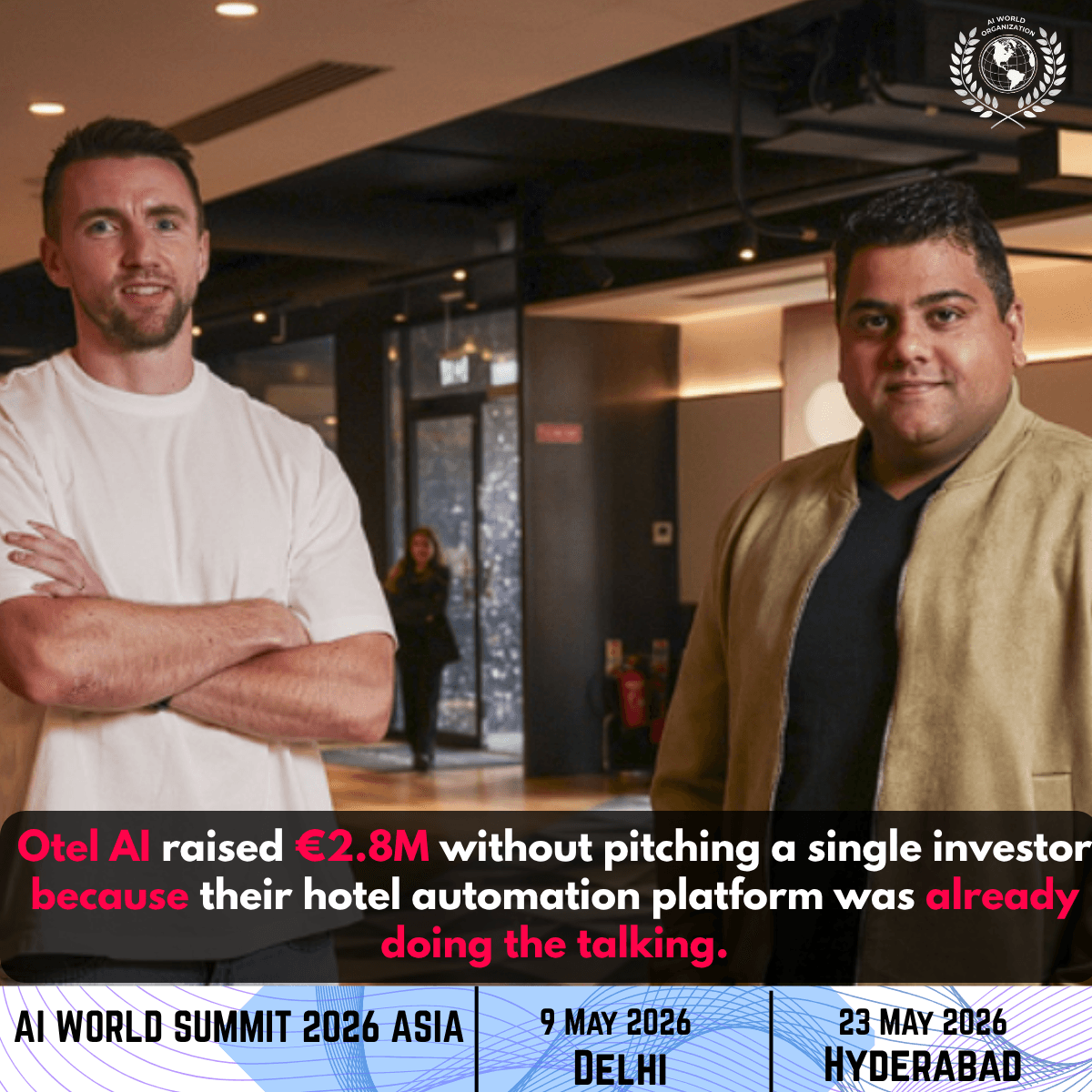
Otel AI secures €2.8M in AI funding led by Playfair to automate hotel operations across Ireland, UK, Europe, US, and UAE. Read the full story.
TL;DR
Otel AI, a Dublin-based startup founded in 2025, raised €2.8M led by Playfair — without even actively fundraising. Their AI platform connects a hotel's existing tools and automates daily back-office tasks, saving managers hours every morning. The Alex Hotel Dublin saw an 8.6% RevPAR jump in just three months. The funds will drive expansion into the US, Europe, and UAE.
Otel AI Secures €2.8 Million in Funding to Redefine Hotel Operations Through Artificial Intelligence
In a hospitality industry that has long struggled with fragmented technology stacks and operational inefficiencies, a quietly built Dublin-based startup is beginning to change the equation — not with another dashboard, but with genuine automation. Otel AI, founded in 2025 by Paul Ryan and Nikhil Patil, has officially announced €2.8 million in total funding, with the most recent round led by London-based early-stage investor Playfair. The raise is a strong signal in the broader AI funding landscape — and a particularly important one for a sector that has historically been slow to adopt intelligent automation at scale. At a time when AI funding news continues to dominate global technology headlines, Otel AI's journey from a self-funded prototype to a venture-backed product used by real hotels every single morning is one worth paying close attention to.
The hospitality industry is not short of software. Hotel managers juggle a dozen systems at any given time — property management systems (PMS), revenue management platforms, payroll tools, food and beverage trackers, and guest review aggregators. The problem has never been the absence of data. It has always been the time and effort required to make sense of it. A General Manager at any mid-to-large hotel will tell you that a significant chunk of their morning is consumed not by strategic thinking but by logging into multiple systems, pulling reports, cross-checking numbers, and building a mental picture of what's happening across their property. It is repetitive, time-consuming, and ripe for disruption. This is precisely the gap that Otel AI was built to close.
From Fragmented Systems to a Unified AI Intelligence Layer
The core product that Otel AI has developed is not a replacement for existing hotel technology. Rather, it functions as an intelligent integration layer — a platform that connects to a hotel's existing ecosystem of tools and brings all the outputs into one unified, actionable environment. Whether it's the PMS, the revenue management system, payroll, F&B reporting, or guest review platforms, Otel pulls the data together and handles the daily operational tasks that would otherwise require manual effort from hotel staff.
What sets Otel apart from earlier attempts at hotel tech aggregation — such as those offered by PMS providers like Mews or Apaleo — is that the platform does not simply consolidate information for viewing. It actively handles tasks. The AI processes the inputs and executes the routine work that previously required human intervention. That said, the company is careful not to position itself as a system that removes human oversight from the equation. Every action taken by the AI is traceable back to its source data, and final decision-making authority remains with the hotel's management team. This is an important design philosophy, particularly in an industry where trust in technology is still being built.
From a compliance and data security perspective, Otel AI has made strong foundational choices. The platform is ISO 27001-certified and fully GDPR-compliant. Given that hotels handle vast amounts of sensitive guest data — payment information, personal identification, stay preferences — these certifications are not just regulatory checkboxes. They represent a genuine commitment to keeping client data within the client's own environment. For hotel owners and operators cautious about third-party data exposure, this architecture provides a meaningful layer of assurance.
The Funding Journey: A Rare Off-Market Deal Built on Results
The €2.8 million figure is a cumulative total across two separate funding events, and the story of how these rounds came together reveals quite a lot about both the founders and the broader AI funding ecosystem. Paul Ryan and Nikhil Patil did not begin Otel AI with venture capital. They funded the company themselves in the early days — a deliberate choice that kept them focused on building a product that actually worked before inviting outside capital into the conversation.
The first external funding round raised €800,000 from three investors: Nebular, Baseline, and Angel Invest. This initial AI funding gave the founders the runway they needed to take their product out of development and into real hotel environments. By summer 2025, a working version of the platform had been launched, and within months, hotels were using it daily and seeing measurable results. It was at this point, just four months after product launch, that Playfair — a respected London-based early-stage investor known for backing pre-seed and seed-stage European technology companies — reached out to Otel directly. The resulting €2 million round was an entirely off-market deal. Nebular also increased its stake in this round, signalling renewed confidence in the company's trajectory.
What makes this particular AI funding news story compelling is the mechanism that triggered it. There was no pitch deck circulating through investor networks. There was no formal fundraising process with a target close date. Playfair did not come to the table because of a compelling narrative or a well-produced presentation. They came because hotel General Managers were already using Otel every morning and reporting genuine improvements to their operations. When an investor can pick up the phone, call a customer, and hear an unscripted account of how a product is changing their working day, the deal-making process moves quickly. That is exactly what happened here, and it represents a fundraising model that more founders should aspire to: let the results do the pitching.
Ryan himself was deliberate about the structure of the deal. He chose terms that were intentionally founder-friendly rather than prioritising a headline valuation figure. This pragmatic approach speaks to a clear-eyed understanding of what the company actually needed at this stage — not a number to put on a press release, but capital that could be deployed directly into the business to accelerate execution.
Real Results at Real Hotels: The Performance Data That Matters
For any AI startup operating in a sector as relationship-driven as hospitality, early customer results are the currency that matters most. Otel AI has been accumulating that currency at an impressive pace. The company is currently working with a portfolio of well-regarded hotel properties across Ireland and the United Kingdom, including the O'Callaghan Collection, Fitzpatrick Castle Hotel, Johnstown Estate, and Killarney Park. These are not test environments or pilot agreements — these are active, revenue-generating properties using Otel's platform as part of their day-to-day operations.
The most striking data point to emerge so far comes from The Alex Hotel in Dublin. During the first three months of using the Otel platform, the hotel recorded an 8.6% year-on-year increase in RevPAR — Revenue Per Available Room, the key performance metric in hospitality. Crucially, this improvement was achieved without adding a single member of staff. The platform had expanded to cover not just property management data but also F&B reporting, payroll processing, and guest review management, turning what was once a multi-system administrative burden into a largely automated daily routine.
For the hospitality industry, this kind of outcome is significant. Hotels operate on notoriously thin margins, and labour costs represent one of the most difficult expenses to control. When an AI platform can demonstrably improve revenue performance without increasing the headcount required to manage the property, it makes an economic case that is very difficult for operators to ignore. This is the kind of evidence-based AI funding news story that illustrates why institutional investors are increasingly directing capital toward AI applications with real-world, measurable commercial impact — not just theoretical potential.
The AI World Organisation has been tracking this trend closely across verticals, and the hospitality sector's gradual but accelerating adoption of intelligent automation represents one of the more underreported stories in enterprise AI. Otel AI's early numbers give that story a compelling data point.
What the €2.8M Will Build: Expansion, Headcount, and Global Ambitions
With €2.8 million now in the bank, Otel AI has a clear and well-articulated plan for how the capital will be deployed. The founders have been transparent about the priorities: growing the engineering and product teams, accelerating geographic expansion, and building a self-serve onboarding process that will allow hotels to get up and running on the platform without requiring intensive implementation support.
The geographic expansion roadmap is ambitious. From its current footprint in Ireland and the United Kingdom, Otel is targeting entry into broader European markets, the United States, and the UAE. Each of these markets presents a distinct profile. European expansion will require continued attention to GDPR compliance and the regulatory nuances of individual national markets. The US represents the world's largest single hotel market by room count, and cracking it will require both product localisation and relationship-building with major hotel groups and independent operators. The UAE, with its high-end hospitality sector and strong appetite for technology adoption, represents an opportunity to demonstrate the platform's capabilities at the premium end of the market.
Internally, the hiring focus will be squarely on engineering and product. This is the right instinct at this stage of the company's development. Otel is still in the phase where the product itself is the primary competitive advantage, and investing in the team that builds and improves it is the most defensible use of early-stage capital. Ryan has been candid about this logic in the way he frames the round: without this funding, the company would still be live with a handful of hotels rather than onboarding dozens. The capital has effectively converted a proof of concept into a scalable operation.
The development of a self-serve onboarding process is also strategically significant. Currently, bringing a new hotel onto the Otel platform presumably requires some degree of direct involvement from the founding team or a small customer success function. Self-serve onboarding would remove that bottleneck, allowing the company to grow its customer base without a corresponding increase in implementation resources. For a startup that has ambitions to operate across four distinct geographic markets, this kind of scalable infrastructure is not optional — it is foundational.
Why This Matters for the AI Industry and the Hospitality Sector at Large
Zooming out from the specifics of Otel's story, this AI funding news development sits within a much broader context of artificial intelligence reshaping traditional, non-tech industries. The hospitality sector has often been cited as one of the industries most resistant to digital transformation — not because technology hasn't been available, but because the operational culture of hotels has historically prioritised human service above all else. There is a legitimate concern among hotel operators that technology, if implemented poorly, can strip the warmth and personalisation out of the guest experience. Otel AI's design philosophy addresses this concern head-on.
By positioning the AI as an operational back-office tool rather than a guest-facing one, Otel threads a careful needle. It automates the parts of hotel management that are genuinely tedious and time-consuming for staff — report generation, data cross-referencing, task logging — without touching the parts that require human judgment and interpersonal skill. General Managers are freed from their morning administrative marathon to spend more time on the things that actually differentiate their property: staff management, guest relations, strategic planning, and product development. In this framing, the AI is not a threat to hotel employees. It is a tool that makes their working lives better and their hotels more competitive.
This is a narrative that the AI industry needs more of. Much of the public discourse around artificial intelligence and employment has focused on displacement — the jobs that AI will take. Otel AI offers a more nuanced and ultimately more accurate picture of what thoughtful AI implementation actually looks like in the real world. The AI handles the repetitive; the humans handle the meaningful. The result is a better business and, arguably, a better workplace.
From an AI funding perspective, the €2.8 million that Otel has secured is a relatively modest sum compared to the mega-rounds that dominate AI funding news in the large language model and foundation model space. But it is precisely the kind of focused, application-layer AI investment that tends to generate real commercial outcomes in compressed timeframes. Playfair's decision to lead this round, and to do so off-market based on customer evidence rather than speculative potential, is a signal that sophisticated early-stage investors are increasingly prioritising traction over vision when making AI funding decisions.
At the AI World Organisation, we believe that the companies most likely to define the next chapter of enterprise AI adoption are not always the ones raising the largest rounds. They are the ones, like Otel AI, that identify a specific operational pain point, build a product that genuinely solves it, prove the solution in the market, and then raise the capital needed to scale what works. Otel AI has executed this playbook with impressive discipline in its first six months of existence. The coming twelve to eighteen months — as it expands its team, enters new markets, and builds the infrastructure for self-serve growth — will determine whether it can sustain that discipline at scale. On current evidence, the signs are encouraging.