NudgeBee Raises $3M from Kalaari Capital for Agentic AI
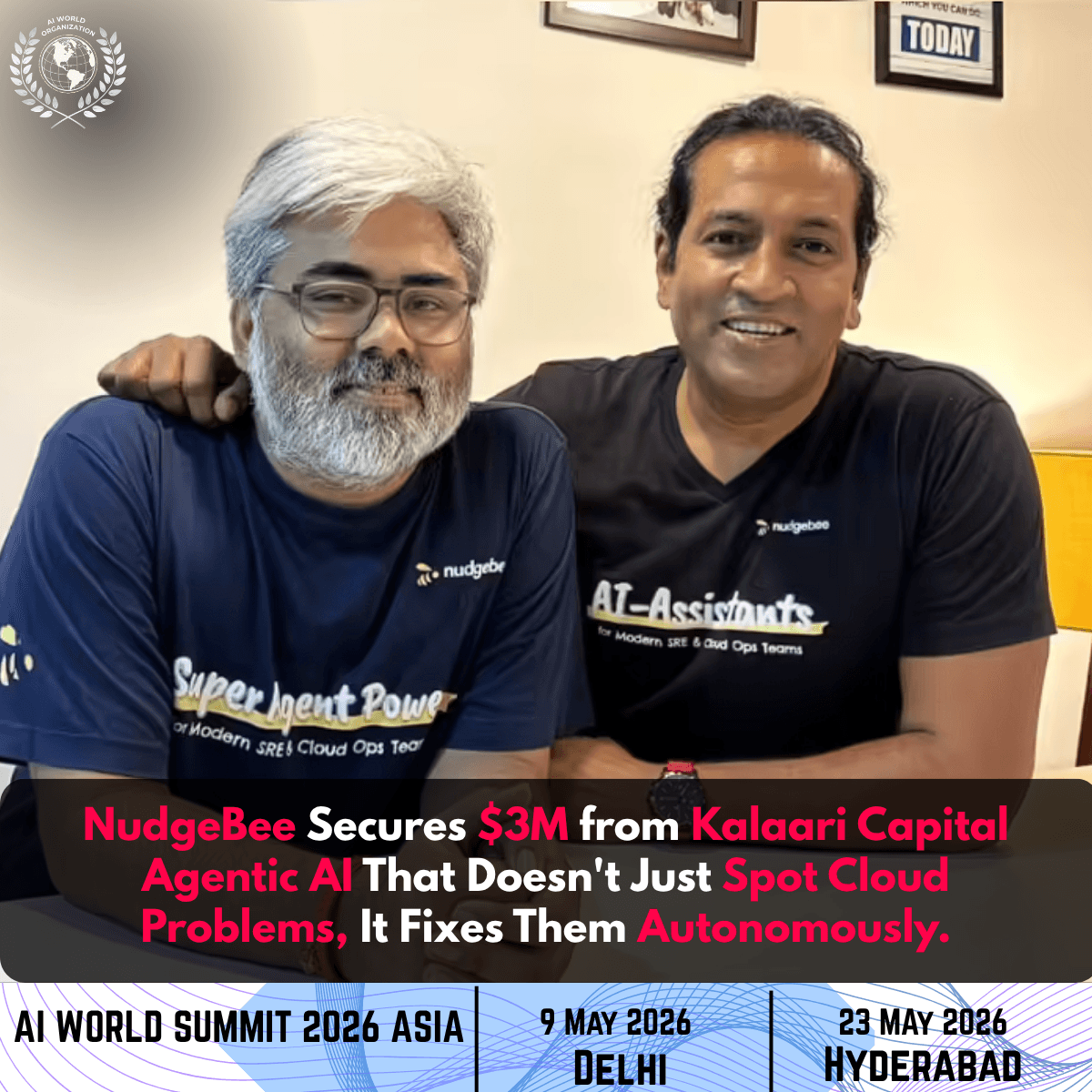
NudgeBee secures $3 million in AI funding from Kalaari Capital to automate cloud operations, cut incident resolution time by 80%, and reduce cloud costs.
TL;DR
NudgeBee, a Pune-based agentic AI startup, has raised $3 million in seed funding led by Kalaari Capital. The platform autonomously manages cloud operations — cutting incident resolution time by up to 80% and reducing cloud costs by nearly 34%. With early enterprise customers like Rackspace already on board, this AI funding signals strong investor confidence in autonomous infrastructure management tools coming out of India.
NudgeBee Raises $3 Million in Seed Funding Led by Kalaari Capital to Transform Enterprise Cloud Operations with Agentic AI
The Indian startup ecosystem has once again grabbed the spotlight in the world of enterprise technology, and this time, the attention is well-deserved. Pune-based agentic AI startup NudgeBee has successfully closed a $3 million funding round, with the investment led by one of India's most prominent venture capital firms, Kalaari Capital. This latest AI funding news is generating considerable buzz across the enterprise technology and cloud infrastructure space, not just because of the dollar figure, but because of what NudgeBee is quietly building — a platform that doesn't just flag problems in cloud environments but actually goes ahead and fixes them.
The deal marks one of the more interesting AI funding stories to emerge from India's growing deep-tech ecosystem in recent months. In a landscape where most enterprise software tools stop at detection or visualization, NudgeBee is positioning itself as an active resolution layer — one that understands your infrastructure, learns from it continuously, and acts on it in real time. It's a bold bet, and Kalaari Capital clearly believes the timing is right.
What NudgeBee Is Building and Why It Matters
Founded in 2024 by Rakesh Rajendran and Shiv Pratap Singh, NudgeBee was born out of a simple but deeply frustrating reality that every cloud and DevOps engineer knows all too well: modern enterprise cloud environments are messy, fragmented, and exhausting to manage. As companies have shifted to cloud-native and multi-cloud architectures, operational complexity has exploded. Teams are constantly juggling fragmented monitoring tools, drowning in alert fatigue, and spending hours each week on repetitive workflows that, in an ideal world, should never require human intervention in the first place.
NudgeBee's answer to this problem is an agentic AI platform built specifically for cloud operations, SRE (Site Reliability Engineering), and FinOps (Financial Operations) teams. The platform uses a semantic knowledge graph to connect telemetry data, infrastructure logs, historical incident patterns, and workflow context — and then deploys AI agents that can autonomously troubleshoot, remediate incidents, and optimize costs. In simpler terms, it builds an intelligent "brain" around your cloud environment that keeps learning and improving over time.
"When you install NudgeBee, it understands your applications, infrastructure, dependencies, and workflows. It builds a 'brain' underneath," explained Rakesh Rajendran, co-founder of the startup. This isn't just an AI layer slapped on top of existing tools — it's a context-rich intelligence engine that integrates deeply with the engineering stack and improves as it processes more signals from the environment.
The AI Funding Round: How the Capital Will Be Deployed
The $3 million in AI funding raised from Kalaari Capital is earmarked for three key areas of growth. First, NudgeBee plans to strengthen its core platform — improving the underlying intelligence, expanding its semantic knowledge graph, and making its AI agents more robust across diverse cloud architectures. Second, the startup will invest in building out its enterprise context layer, which is the component that allows the platform to understand the nuances of individual business environments rather than offering generic one-size-fits-all responses. Third, the fresh capital will be used to scale go-to-market efforts through a combination of strategic partnerships and direct enterprise sales outreach.
This approach to deploying capital reflects a maturity in thinking that goes beyond simply hiring engineers and expanding headcount. NudgeBee is focused on building defensible technology first, then scaling its commercial reach — a sequence that investors in the agentic AI space tend to find far more compelling than the reverse. The AI funding news around this raise signals that VCs are paying close attention to companies that solve real operational pain points with measurable outcomes, not just flashy demos.
The fact that Kalaari Capital, a firm known for backing high-conviction early-stage companies in India, chose to lead this round also adds a significant stamp of credibility to NudgeBee's vision. The firm has backed several category-defining companies over the years, and its decision to double down on agentic AI infrastructure speaks volumes about where enterprise software is heading.
Real-World Impact: The Numbers That Speak for Themselves
One of the most compelling parts of NudgeBee's story isn't the technology itself — it's the outcomes. In enterprise software, the ultimate test is always whether a product genuinely moves the needle on the metrics that operations teams care about most: incident resolution time, cloud spend, and overall productivity. NudgeBee's early results on all three fronts are striking.
On the incident resolution side, Rajendran shared that what previously took engineering teams anywhere between six to eight hours to resolve is now being handled in 20 to 25 minutes. That's a 70 to 80 percent reduction in mean time to resolve (MTTR) — a metric that every SRE and DevOps lead would consider transformational. When you consider that downtime and slow incident response can cost enterprises hundreds of thousands of dollars per hour, the business case becomes very clear, very quickly.
The cost optimization results are equally impressive. In one documented case, a customer reduced their cloud spend by approximately 30 to 34 percent within just two months of deploying NudgeBee. For large enterprises running significant cloud workloads, that kind of saving is not incremental — it's material. And on the automation front, companies like Rackspace, the global IT services giant and one of NudgeBee's early customers, are reportedly targeting over 1,200 automations per quarter through the platform, achieving substantial productivity gains without needing to increase headcount.
These numbers tell a story that resonates strongly in the current enterprise technology climate, where CFOs are scrutinizing cloud budgets and CIOs are being asked to do more with less. NudgeBee isn't selling a futuristic vision — it's delivering measurable ROI today, and that's a powerful differentiator in any AI funding conversation.
Investor Confidence and the Broader Agentic AI Wave
The voice from the investor side is equally telling. Sampath P, Partner at Kalaari Capital, laid out the firm's thesis clearly: "At Kalaari, we believe the next phase of infrastructure tooling will be defined by systems that don't just surface problems but resolve them. NudgeBee stands out in its ability to connect signals across the stack and translate them into reliable action, while integrating with existing engineering workflows."
This perspective captures something important about the moment we are in. The first wave of AI-driven enterprise tools was largely observational — dashboards, anomaly detection, alert systems. The next wave, which NudgeBee is firmly a part of, is about action. Agentic AI platforms that can take autonomous, context-aware steps to resolve operational issues represent a fundamental shift in how enterprises think about cloud management. And that shift is attracting serious AI funding from venture capital firms across the globe.
Rajendran himself acknowledged the economic pressures that are shaping this opportunity. "AI costs, especially compute and token costs, will become a major challenge. Enterprises will need dedicated systems with strong memory architecture to reduce repeated inference costs," he told ET. He further noted that relying solely on frontier AI models from the likes of OpenAI or Anthropic is not a sustainable approach at scale. Platforms that manage cost, memory, and execution together — essentially building efficiency into the AI layer itself — will have a lasting competitive edge.
This reflects a broader maturation in how enterprises approach AI adoption. The "just plug in a model" era is giving way to a more sophisticated understanding of what it takes to run AI reliably and economically at enterprise scale. NudgeBee is positioning itself right at the center of that transition.
India's Enterprise AI Moment and What Comes Next
NudgeBee's raise is part of a wider pattern of AI funding flowing into Indian enterprise startups that are solving real infrastructure and operational challenges for global customers. India has long been a powerhouse for IT services, and a new generation of founders — many of them deeply experienced in cloud, DevOps, and enterprise sales — are now building product companies that compete on the global stage from day one.
For The AI World, this development is a strong signal of what the next chapter of enterprise AI looks like. The shift from AI as an assistant to AI as an autonomous operator is happening faster than most predicted, and startups like NudgeBee are leading that charge. The combination of a strong technical foundation, early enterprise traction with global customers like Rackspace, and now a well-funded runway from a trusted investor makes NudgeBee one of the more exciting AI companies to watch in 2026.
The AI funding news around this deal also reinforces that investor appetite for agentic AI, particularly in the infrastructure and cloud operations space, remains very strong despite broader market uncertainties. As enterprises continue to grapple with the challenge of making their cloud environments smarter, faster, and cheaper to run, platforms like NudgeBee are moving from nice-to-have to mission-critical. And when a product becomes mission-critical, the growth trajectory tends to follow.