Newfund Closes €60M HEKA BrainTech AI Fund
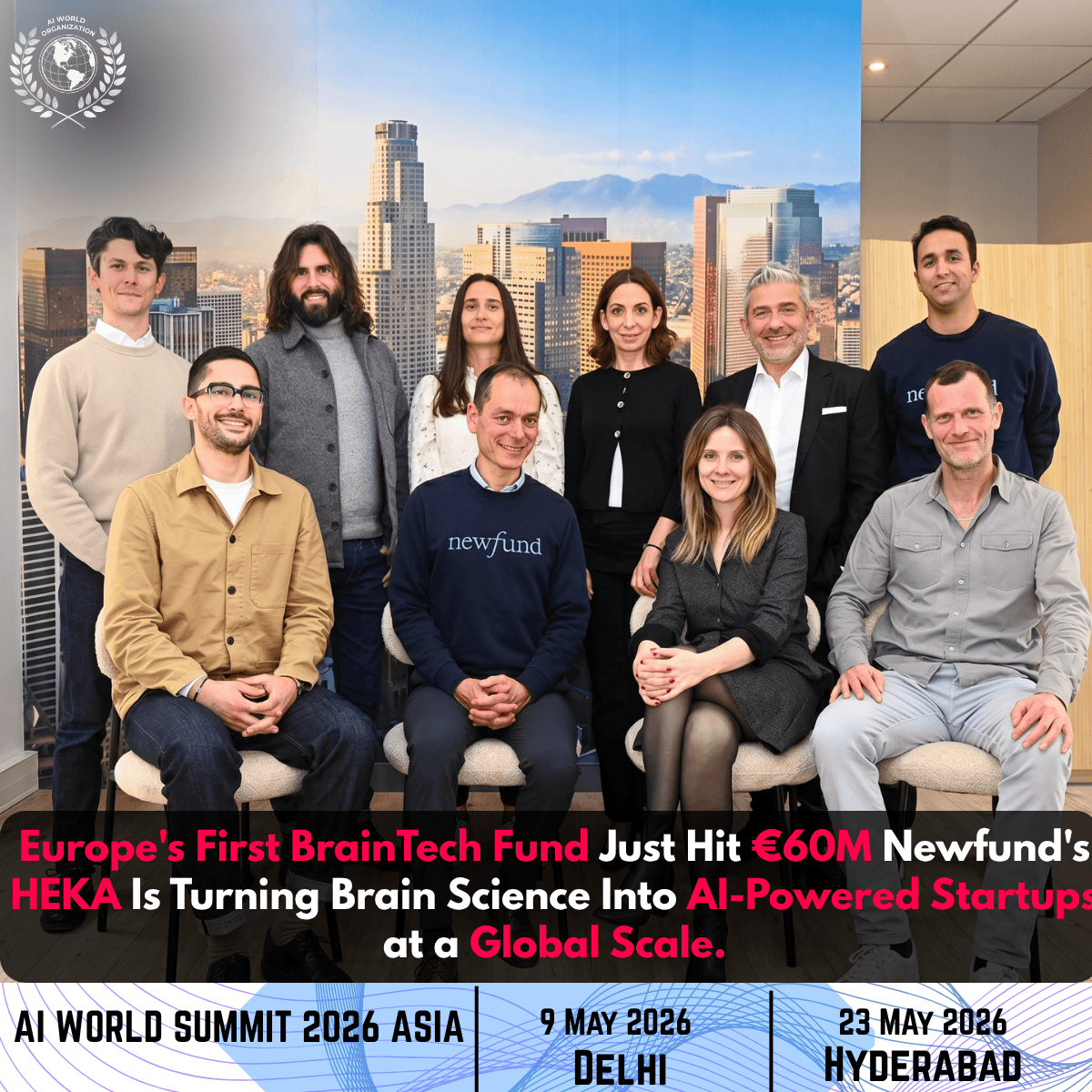
Newfund's HEKA fund closes at €60M — Europe's first BrainTech VC targets 25 AI startups bridging European neuroscience and US markets.
TL;DR
Newfund has officially closed its HEKA fund at €60M — Europe's first dedicated BrainTech venture fund. Launched in 2023 with just €20M, it tripled in size despite a tough fundraising climate. The fund has already backed 9 neuroscience and AI-driven health startups, with 8 actively operating in the US market and 3 accepted into Stanford's StartX programme.
Newfund's HEKA Closes €60M: Europe's First BrainTech Fund Is Rewriting the Rules of AI and Neuroscience Investment
Europe has long been home to world-class neuroscience research. Its universities, hospitals, and public research institutions have consistently ranked among the finest in the world, producing breakthroughs in brain science that rival anything coming out of the United States or Asia. And yet, for decades, Europe has struggled to transform that scientific excellence into commercial dominance. The talent has been there. The research has been there. But the capital, the venture infrastructure, and the transatlantic ambition — those have been harder to come by. That is precisely the gap that Newfund's HEKA fund was built to close, and in a significant milestone for European deep tech and AI funding news, the fund has now officially closed at €60 million.
This is not just another venture capital fund announcing a close. HEKA is the first and only dedicated BrainTech fund in all of Europe — a distinction that speaks volumes about how underserved this space has been, and how much opportunity remains untapped. Its full closure marks a major turning point not only for European neuroscience startups, but also for the broader global AI funding ecosystem. At a time when AI funding is flowing at historic rates into every conceivable corner of the technology sector, HEKA is making a pointed bet that the most transformative applications of artificial intelligence may well lie inside the human brain.
The Long Road to €60 Million: How HEKA Was Built from the Ground Up
The HEKA fund's journey to its final close was anything but simple. Newfund, the Paris and San Francisco-based venture firm with more than two decades of experience investing in both European and American startups, launched the fund back in June 2023 with an initial close of €20 million. At that point, the goal was clear — raise a dedicated pool of capital to back the most promising BrainTech companies emerging from European research labs, hospitals, and entrepreneurial ecosystems.
What followed was three years of intensive fundraising in one of the most challenging macro environments venture capital has seen in recent memory. Rising interest rates, tighter liquidity conditions, and broader uncertainty about technology valuations made it harder across the board for fund managers to raise fresh capital. Despite all of this, HEKA successfully reached its target, ultimately closing at €60 million — a threefold increase from where it began. That kind of fundraising achievement is notable even in strong markets; in the environment of 2023 through 2026, it is genuinely remarkable.
The investor base behind HEKA reflects both the depth of Newfund's network and the growing confidence among sophisticated private capital that BrainTech represents a category worth serious attention. The fund drew commitments from approximately 100 family offices and entrepreneurial investors who have long been part of Newfund's extended community. What makes this particularly compelling from an AI funding news perspective is that a meaningful portion of the capital came from founders who had already made money through previous Newfund investments. François Véron, Managing Partner at Newfund, noted that every founder who generated returns with the firm since 2020 chose to reinvest in HEKA. That kind of repeat commitment from successful entrepreneurs is one of the clearest signals of conviction in a fund's thesis — money returning to a manager not out of obligation, but out of genuine belief in the opportunity ahead.
Why BrainTech? Understanding the Thesis Behind Europe's Most Specialised AI Funding Play
To understand why HEKA matters in the broader landscape of AI funding news, you have to understand the specific problem it was designed to solve. Neuroscience and brain health represent one of the most pressing global challenges of our time. Neurological disorders — from Alzheimer's disease to treatment-resistant depression, from epilepsy to traumatic brain injury — affect hundreds of millions of people worldwide and place an enormous burden on healthcare systems that are already under strain. Despite this scale of need, the brain remains one of the least understood organs in the human body, and the tools available for diagnosis, treatment, and monitoring have historically lagged far behind the science.
This is where technology — and artificial intelligence in particular — is beginning to change the equation. The convergence of advanced imaging, machine learning, wearable biosensors, and digital therapeutics is opening up entirely new possibilities for how we understand and treat the brain. AI-powered diagnostic tools can detect subtle patterns in brain scans that human radiologists might miss. Digital therapies can deliver personalised cognitive interventions at scale. Real-time neural monitoring systems can help manage conditions like Parkinson's disease or severe depression with a precision that was unimaginable just a decade ago.
Europe, and France in particular, has exceptional infrastructure for this kind of work. Research institutions like INSERM, the Rothschild Foundation, Bordeaux University Hospital, and Inria have been doing pioneering work in neuroscience for years. The challenge has not been a lack of scientific talent or rigour. The challenge has been the commercial pipeline — the ability to take a breakthrough developed in a hospital research lab and turn it into a scalable company that can navigate regulatory approval, win reimbursement, and ultimately reach patients at meaningful scale.
HEKA's investment thesis is built around exactly this bottleneck. The fund invests in projects that combine deep scientific rigour with genuine commercial ambition, then provides the hands-on support and transatlantic connectivity needed to help those companies succeed. Anne-Sophie Saint-Martin, Partner at Newfund and the person responsible for HEKA's investment strategy, has been clear about the fund's philosophy: scientific excellence and commercial success are not in tension with each other — they reinforce each other. HEKA is trying to prove that Europe can build world-class BrainTech companies, not just world-class BrainTech research.
The Numbers Behind the Opportunity: AI Funding Is Flowing Into BrainTech at Record Pace
From a pure AI funding news perspective, the market dynamics driving HEKA's thesis are striking. Newfund's own research and market analysis shows that global BrainTech raised $4.2 billion in 2025 — a figure that underscores how seriously the broader investment community is beginning to take this space. Of that $4.2 billion, roughly $3.6 billion flowed into the United States. Europe, for all its scientific strength, captured only a fraction of the global capital being deployed into the category.
The numbers for early 2026 are even more striking. Newfund estimates that BrainTech companies globally raised $2.8 billion in just the first quarter of 2026 alone — a pace that, if sustained, would represent an extraordinary acceleration compared to historical norms. While these are the firm's own estimates and reflect their internal data and deal-tracking, the directional story they tell is clear: AI funding is flowing into brain science at an accelerating rate, and the companies that can credibly occupy this space — particularly those bridging European science and American market access — are positioned to capture disproportionate value.
This is the competitive window that HEKA is trying to exploit. The fund's leadership is explicit about their long-term goal: establish a European standard for BrainTech investment before the US cements its dominance in the category. Given that the US currently captures roughly 85% of global BrainTech capital, the urgency of that mission is not hard to understand. AI funding news from across the sector suggests that investors who establish early positions in transformative deep tech categories consistently outperform those who wait for the category to fully mature. HEKA is betting that BrainTech is still early enough for European investors to shape the ecosystem, not just participate in it.
Portfolio in Action: Nine Companies Already Building the Future of Brain Health
HEKA launched in 2023 and has already backed nine companies across the diagnostics, therapeutics, and infrastructure layers of the BrainTech stack. The portfolio is young by venture standards, but already showing meaningful signs of traction — particularly in the US market, which is the ultimate proving ground for companies in this space.
Eight out of the nine portfolio companies are already conducting business in the United States. That is a remarkable statistic for a European deep tech fund at this stage, and it reflects both the quality of the companies Newfund has selected and the value of the firm's American infrastructure in facilitating that market entry. Newfund operates a Palo Alto office and has built a network of 50 American portfolio companies over its two-decade history. This gives HEKA-backed companies a meaningful advantage when they begin the often difficult process of establishing themselves in the US healthcare system — a process that involves not only commercial sales but also regulatory navigation, reimbursement strategy, and the development of trusted relationships with hospital systems, physicians, and payers.
Among the portfolio, several companies are worth highlighting in the context of broader AI funding news. Raidium is working on AI-powered precision diagnostics in radiology — a field where machine learning is increasingly demonstrating its ability to detect disease earlier and more accurately than conventional methods. Diagnoly, Reev, and Inside Therapeutics round out the diagnostic and therapeutic layers, each addressing different aspects of brain health with a combination of deep science and sophisticated technology. The infrastructure layer of the portfolio — companies building the tools, platforms, and data systems that other BrainTech companies depend on — is also represented, reflecting Newfund's understanding that category-defining ecosystems require more than just point solutions.
Perhaps most impressively, three of the fund's nine portfolio companies have been accepted into Stanford's StartX accelerator program. StartX is one of the most selective and prestigious startup programs in the world, and acceptance is a meaningful signal of scientific and commercial credibility. For European companies to be recognised at that level this early in their journeys is precisely the kind of proof point that validates HEKA's approach and strengthens its case to future investors and portfolio companies alike.
The Road Ahead: Expanding the Portfolio and Defining a European BrainTech Standard
With the fund now fully closed at €60 million, Newfund is moving forward on multiple fronts. The first priority is completing the portfolio — HEKA has targeted backing approximately 25 companies in total, which means there are roughly 16 more investments to make. Given the pace at which AI funding and BrainTech deal flow are growing globally, identifying the right opportunities from the pipeline of European neuroscience startups will require both discipline and speed.
Beyond new investments, the team will also be focused on supporting existing portfolio companies as they mature. That means helping the current nine companies raise follow-on rounds — a process that becomes increasingly capital-intensive as companies move from early research validation into clinical trials, regulatory approval, and commercial scale-up. It also means continuing to deepen the connections between portfolio companies and the US market, leveraging Newfund's American network to open doors that would otherwise take European founders years to open on their own.
The broader ambition, however, is something larger than any individual portfolio company. Newfund is trying to build an ecosystem — a community of European BrainTech entrepreneurs, investors, researchers, and corporate partners who collectively create more value than they could in isolation. This ecosystem-building approach, which is central to how the best venture firms in the US Silicon Valley have operated for decades, is still relatively rare in Europe. If HEKA succeeds, it will have demonstrated that this model can work in deep tech, in neuroscience, and in the specific context of bridging European science and American markets.
For the global AI funding news community, this is a story worth watching closely. The intersection of artificial intelligence and brain science represents one of the most consequential frontiers in all of technology. The companies that figure out how to apply AI effectively to neurological diagnosis, treatment, and cognitive enhancement will not just build large businesses — they will reshape how humanity understands and cares for the brain. HEKA is betting that Europe, for all its historical struggles to commercialise its scientific strengths, is ready to play a leading role in that transformation. And with €60 million deployed, nine promising companies in the portfolio, a transatlantic network, and three Stanford StartX acceptances already to its name, it is off to a genuinely impressive start.