Nesto Raises €11M to Scale AI Workforce Platform
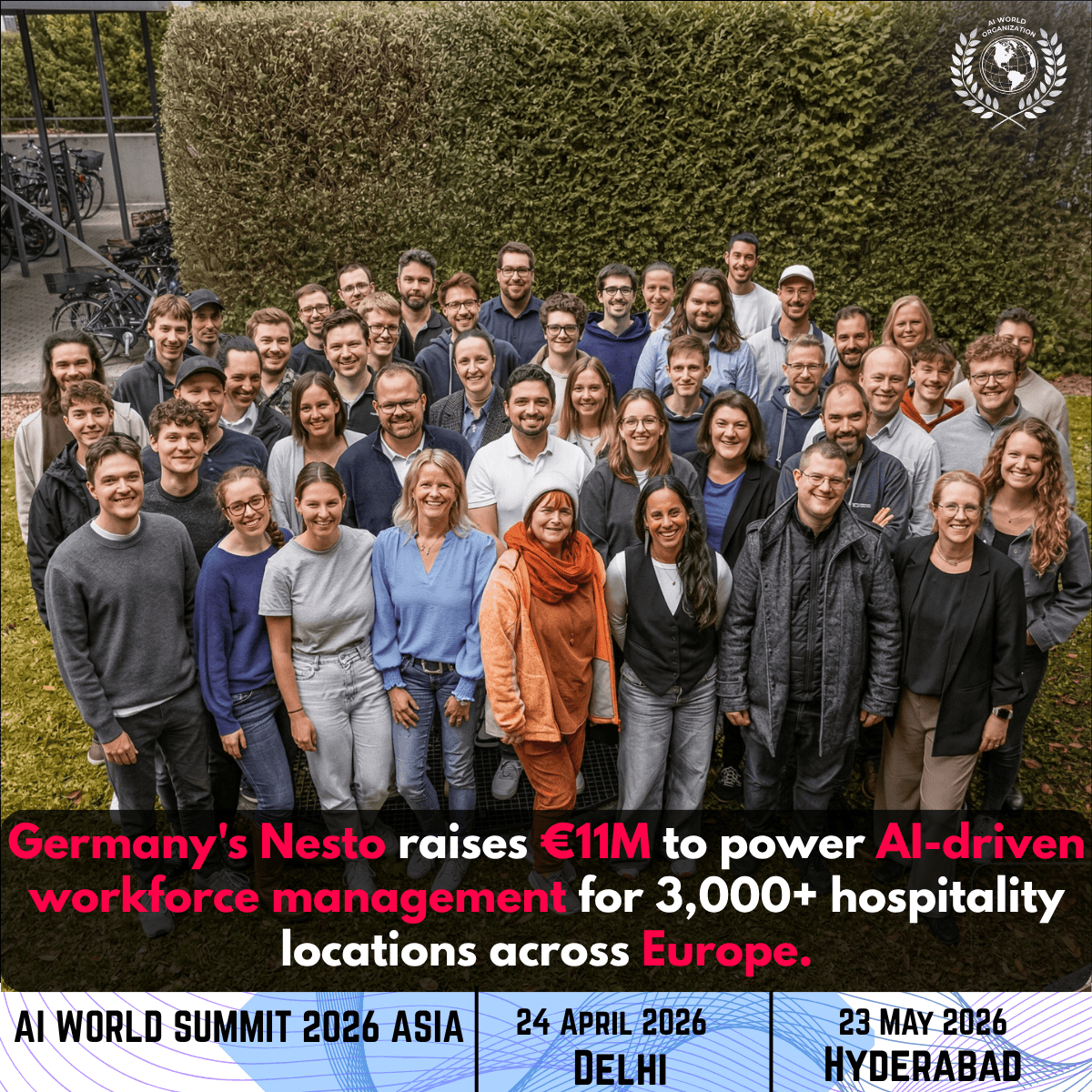
Germany's Nesto raises €11M in AI funding to scale its workforce management platform and NORA AI agent across European hospitality.
TL;DR
Germany's Nesto Software has raised €11M from Expedition Growth Capital to expand its AI-powered workforce management platform across European hospitality. Already live at 3,000+ restaurant locations — including McDonald's franchises — the platform handles 100,000+ daily shifts and delivers up to 22% better labour productivity. The fresh capital will fuel growth of its AI agent, NORA, which automates complex scheduling and HR workflows end-to-end.
Germany's tech ecosystem has once again made headlines with a significant AI funding milestone. Karlsruhe-based Nesto Software GmbH has officially secured €11 million in growth equity funding from Expedition Growth Capital, a transatlantic investment firm with offices in London and Boston. This is a landmark moment, not only for the company but also for the broader AI funding news cycle across Europe's hospitality and restaurant technology landscape. For an organisation like The AI World, which actively tracks breakthroughs in artificial intelligence and its real-world applications, this development is a strong signal that AI-powered workforce management is emerging as one of the most commercially viable and high-growth segments within enterprise technology.
What makes this particular AI funding story even more compelling is that Nesto had never previously taken any form of institutional investment. The company bootstrapped its way to profitability, building a robust platform used by more than 3,000 restaurant locations and managing over 100,000 daily employee shifts across Europe — all before a single euro of venture capital entered the equation. This kind of financial discipline, combined with a now-accelerating product roadmap, positions Nesto as one of the most promising AI-native workforce platforms on the continent.
A Platform Built for One of the World's Most Complex Industries
The hospitality industry is notoriously difficult to manage from a staffing perspective. Restaurants, hotel chains, and large food service operations face unpredictable demand patterns, seasonal fluctuations, high employee turnover, and razor-thin margins. Traditional workforce management tools — spreadsheets, basic scheduling apps, and manual HR systems — simply cannot keep pace with the operational complexity that modern hospitality businesses deal with on a daily basis. This is precisely the gap that Nesto was designed to fill.
Nesto's platform combines scheduling automation, demand forecasting, HR workflow management, and payroll preparation into a single, integrated solution. The system pulls in data from point-of-sale systems, supplier platforms, payroll providers, and external inputs such as local event calendars, historical sales records, and even real-time weather data to generate demand forecasts that the company reports achieve 92% accuracy. That is an exceptionally high benchmark in an industry where even a 5–10% staffing miscalculation can translate into thousands of euros in unnecessary labour costs or critical service gaps during peak hours.
The company was founded by engineers who graduated from the prestigious Karlsruhe Institute of Technology, one of Germany's leading technical universities and a well-established hub for applied engineering and software innovation. The founders' background in technical problem-solving is evident in the precision and depth with which Nesto has approached the challenge of workforce optimisation. Rather than simply automating scheduling, the platform creates a feedback loop between sales intelligence, shift planning, employee management, and financial reporting — an end-to-end operational layer that replaces a fragmented patchwork of legacy tools.
What the €11 Million AI Funding Round Means for Nesto's Growth
The growth equity investment from Expedition Growth Capital — a fund specifically focused on bootstrapped European software businesses generating more than €5 million in annual recurring revenue — is a strong validation of Nesto's business model and market traction. Expedition's investment thesis tends to favour companies that have already proven themselves in the market without relying on external capital, which makes Nesto an almost archetypal fit. The fact that the firm chose to back Nesto at this stage of its development speaks to the confidence investors now have in AI-powered HR and workforce technology.
According to the company's plans for this capital deployment, a significant portion of the funds will be directed toward accelerating product development, expanding the sales and marketing team, and investing more deeply in NORA — Nesto's proprietary AI assistant and emerging agent framework. For followers of AI funding news, NORA represents the most forward-looking element of this announcement. Rather than being a simple chatbot or a query-response tool, NORA is designed to act as an operational intelligence layer capable of executing multi-step workflows autonomously — a shift that marks a meaningful leap from AI-assisted management to AI-driven management.
The investment also signals Nesto's ambition to expand its geographic footprint across Europe. While the company has already established a strong presence in the German-speaking market and across European restaurant chains, the new capital gives it the resources to pursue market entry into additional regions, onboard larger enterprise clients, and build out the integrations and partnerships needed to support more complex, multi-country deployments. At The AI World, where we cover AI funding news and the evolving technology ecosystem globally, we see this as part of a broader trend in which European AI companies are finally scaling with the same ambition and velocity as their counterparts in the United States and Asia.
NORA: The AI Agent Redefining Restaurant Back-Office Operations
Of all the developments announced alongside this AI funding round, the evolution of NORA deserves the closest attention. NORA — Nesto's AI assistant — is currently capable of handling a wide range of operational queries related to staffing rules, compliance requirements, shift planning, and performance metrics. Restaurant managers can ask NORA questions in natural language and receive immediate, contextually relevant answers drawn from live operational data, historical records, and regulatory frameworks specific to their region.
But Nesto's roadmap takes NORA significantly further. The company has outlined plans to develop NORA from a conversational assistant into a full agent framework capable of executing complex, multi-step business workflows without requiring a human to manually navigate between systems. This means NORA will be able to autonomously handle absence management, approve or flag shift-swap requests, process payroll exceptions, and perform compliance checks — all in a unified, automated workflow. For restaurant operators managing dozens of locations, hundreds of employees, and multiple overlapping compliance obligations, this kind of agentic AI represents a transformational operational upgrade.
The broader significance of this development extends well beyond the hospitality sector. NORA's evolution reflects a shift that The AI World has been closely tracking: the transition from AI as a tool that answers questions to AI as an agent that takes actions. This shift is being enabled by advances in large language models, workflow automation infrastructure, and context-aware reasoning systems. The fact that a German B2B software company with deep domain expertise in hospitality is now building agentic AI capabilities into its core product is a strong indication of how broadly and rapidly this next wave of AI development is spreading across industries.
Nesto's decision to build NORA as an agent framework rather than a standalone product also reflects a sophisticated architectural choice. By embedding AI agency directly into the workflow layer — where scheduling data, HR records, payroll systems, and operational metrics already converge — NORA can act on real information in real time rather than operating in isolation. This integrated design philosophy is one of the key differentiators that sets Nesto apart from generic HR chatbots and task management tools.
McDonald's, 3,000 Locations, and a Proven Track Record
One of the most compelling aspects of this AI funding news is the scale at which Nesto has already proven its value. The company's platform currently serves more than 3,000 restaurant locations and handles over 100,000 employee shifts every single day. These are not pilot programmes or proof-of-concept deployments — they represent live, production-scale operations in one of the world's most demanding service industries.
The most high-profile and publicly documented deployment in Nesto's portfolio is with McDonald's European franchise operators. According to figures shared by the company, franchise operators using Nesto's platform have recorded a 9% reduction in staff costs and a 22% improvement in labour productivity. In a business where labour is typically the single largest controllable cost and margins are continuously under pressure, a 9% reduction in staffing expenditure can translate into millions of euros of savings annually across a large franchise network. A 22% productivity lift, meanwhile, means that the same number of staff are delivering significantly more output — a compounding advantage that becomes more valuable the larger the operation.
These figures also underscore a broader truth about AI's value proposition in enterprise settings: the most impactful AI deployments are not necessarily those building the flashiest consumer-facing products, but those creating measurable, repeatable efficiency gains in industries that have traditionally been resistant to digital transformation. The hospitality sector is one such industry, and Nesto's results demonstrate that AI, when deeply integrated with domain-specific data and operational workflows, can deliver outcomes that are both statistically significant and commercially decisive.
The 10% improvement in labour productivity cited by Nesto across its entire customer base — not just McDonald's — further validates the platform's generalisability. Whether it is a boutique hotel chain managing housekeeping schedules or a multi-city restaurant group coordinating kitchen staffing and front-of-house rotations, Nesto's AI-driven forecasting and scheduling tools are consistently delivering tangible operational improvements. At The AI World, this is the kind of concrete, enterprise-grade AI impact we believe deserves to be highlighted and understood by businesses exploring AI adoption.
The Bigger Picture: AI Funding in European Workforce Tech
Nesto's €11 million raise does not exist in isolation. It is part of a much larger and accelerating wave of AI funding flowing into European enterprise software, and specifically into AI-powered workforce management tools. European startups raised an impressive $8 billion across over 100 rounds above $15 million in just the first two months of 2026 alone, reflecting a strong investor appetite for well-built, revenue-generating European technology businesses. Nesto, with its first institutional raise coming at a stage of meaningful scale and profitability, is in some ways the ideal representative of this new generation of European enterprise AI companies.
The workforce technology sector, in particular, is receiving growing investor attention as businesses across hospitality, retail, logistics, and manufacturing wake up to the reality that managing people — their time, their skills, their schedules, and their compliance obligations — is one of the most complex and costly operational challenges they face. AI-powered platforms that can automate, predict, and optimise these workflows are not a luxury but an operational necessity, especially in tight labour markets where businesses cannot afford to waste capacity or lose staff due to poor scheduling practices.
Global HR software startups alone raised over $3 billion in the first half of 2026, a figure that continues to grow as demand for AI-native workforce solutions increases across every major industry. For The AI World's community of readers and researchers who follow AI funding news closely, this trajectory points to a multi-year investment supercycle in applied AI for enterprise operations — one where companies like Nesto, with deep domain expertise and proven commercial traction, are poised to play a leading role.
Expedition Growth Capital's decision to back Nesto with €11 million in growth equity also reflects a maturing investment thesis in the European AI landscape. Rather than chasing pre-revenue AI moonshots, seasoned investors are now increasingly directing capital toward AI companies that have already demonstrated product-market fit, built defensible data moats, and scaled their platforms with real customers in real industries. This is a healthy and necessary evolution in how AI funding is allocated, and it bodes well for the long-term sustainability and credibility of the European AI ecosystem.


