Factory AI Raises $150M Series C, Hits $1.5B Valuation
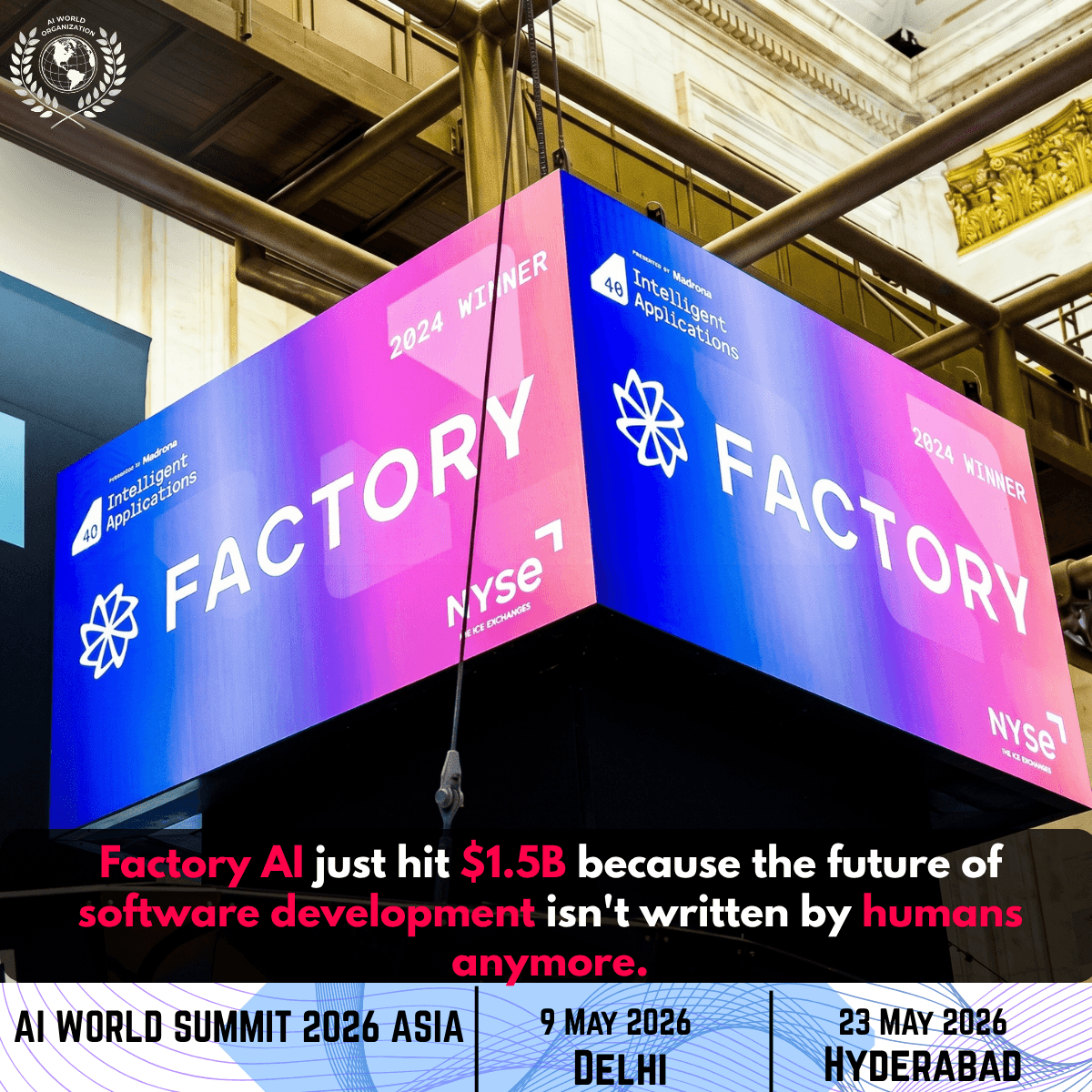
Factory AI secures $150M Series C led by Khosla Ventures and Sequoia Capital, reaching a $1.5B valuation with AI agents reshaping enterprise software development.
TL;DR
Factory, a startup that builds AI agents to handle software development tasks like testing, documentation, and deployment, has raised $150M at a $1.5B valuation. Backed by Khosla Ventures and Sequoia Capital, the company's revenue has doubled every month for six straight months, with clients like Nvidia, Adobe, and MongoDB already on board.
Factory AI Becomes a Unicorn: Raises $150M Series C to Redefine How Developers Build Software with AI Agents
In one of the most significant AI funding announcements of April 2026, Factory — an AI-powered software development platform — has officially entered the unicorn club after closing a $150 million Series C funding round at a valuation of $1.5 billion. The round was led by Khosla Ventures, with participation from an impressive roster of institutional backers including Sequoia Capital, Insight Partners, Blackstone, Evantic Capital, Abstract Ventures, 20VC, NEA, and Mantis VC. This milestone marks a defining moment not only for the company but also for the broader wave of enterprise AI tooling that is rapidly transforming the global software development landscape.
The AI funding news world has been buzzing with excitement as Factory's latest round confirms what many in the industry have long speculated — that the future of software engineering lies not in writing code manually, but in orchestrating intelligent agents that can do it faster, smarter, and with far fewer errors. Factory's journey from a two-person founding team in 2023 to a billion-dollar-plus company in under three years is a testament to how quickly enterprise appetite for AI-driven development infrastructure has grown.
What Factory Actually Builds — And Why It Matters
Factory was founded in 2023 by Matan Grinberg and Eno Reyes with a bold thesis: that writing code is just a small fraction of what software engineering actually involves. The duo recognised early on that the most significant bottlenecks in development pipelines aren't in generating code — they're in testing it, reviewing it, documenting it, and deploying it reliably. That insight gave birth to Factory's flagship product: AI agents internally called "Droids."
Unlike many AI coding tools that function primarily as smart autocomplete engines, Factory's Droids operate as fully autonomous software engineering agents. They don't just suggest the next line of code — they take on end-to-end responsibilities across the software development lifecycle. From running test suites and catching edge cases to writing comprehensive documentation and managing CI/CD pipelines, Droids are designed to work the way a capable junior engineer would, but at a scale and speed no human team can match. This is the fundamental differentiator that has drawn hundreds of thousands of developers to the platform and attracted the attention of some of the world's most respected venture capital firms.
The significance of this AI funding round goes beyond the dollar figure. It signals that the investment community has moved past the early hype cycle of generative AI and is now placing serious, long-term bets on companies that are building real infrastructure for enterprise software development. Factory isn't selling a chatbot. It's selling a new way of building software at scale — and the market is clearly responding.
Enterprise Adoption: From Nvidia to MongoDB
One of the most compelling proof points behind Factory's $1.5 billion valuation is the sheer breadth and calibre of its existing enterprise customer base. The company reports that hundreds of thousands of developers across globally recognised organisations are using Droids daily. The list reads like a who's who of enterprise technology: Nvidia, Adobe, EY, Palo Alto Networks, Adyen, MongoDB, Bayer, and Zapier are among the companies that have integrated Factory's AI agents into their core development workflows.
This level of adoption by blue-chip enterprises at such an early stage of the company's existence is remarkable and speaks volumes about the product's reliability and performance. For large organisations with sprawling engineering teams, complex tech stacks, and strict compliance requirements, adopting new tooling carries significant risk. The fact that companies like Nvidia and Adobe — both of which have world-class engineering organisations — have embraced Factory's Droids suggests that the platform has cleared a very high bar for enterprise-grade quality and security.
What makes this even more noteworthy in the context of the broader AI funding news landscape is that Factory hasn't had to rely on heavy discounting or aggressive sales tactics to win these customers. The platform's value proposition has been strong enough to earn adoption on its own merits. For enterprise clients, Factory makes a compelling case: AI agents are only as effective as the infrastructure they operate within. Clean documentation, robust test coverage, well-maintained CI/CD pipelines, and tight integration with internal developer tools aren't optional extras — they're the foundation without which even the most advanced AI agents will underperform.
Factory describes this philosophy as "paving the roads." The company positions itself not as the vehicle that gets you to the destination, but as the team that builds the highway that makes the journey possible at all. This infrastructure-first mindset has resonated deeply with enterprise engineering teams who have seen too many AI tools fail in production because they lacked the proper foundation to operate reliably at scale.
The Model-Agnostic Advantage in a Crowded Market
The AI coding tool space is no longer a niche — it's a fiercely competitive market that now includes players ranging from GitHub Copilot to Cursor to a growing number of agentic platforms backed by top-tier investors. In this environment, differentiation is everything, and Factory has made a strategic choice that sets it apart from most of the competition: a model-agnostic approach to foundation AI models.
Co-founder Matan Grinberg has been explicit about this in his communication with investors and clients alike. Factory's platform is designed to work seamlessly across multiple foundation models, including Anthropic's Claude and DeepSeek, among others. Rather than locking enterprise clients into a single AI model provider, Factory allows organisations to switch between models depending on their specific use case, cost considerations, or compliance requirements. This flexibility is not just a nice-to-have feature — in the enterprise context, it's a critical capability.
As AI funding news from across the sector continues to highlight the rapid advancement and increasing commoditisation of foundation models, the ability to remain model-agnostic insulates Factory and its clients from the volatility of the underlying AI model market. If a newer, cheaper, or more capable model emerges tomorrow, Factory's clients don't need to rebuild their workflows — they simply plug in the new model and keep moving. This is a significant enterprise advantage and one that Grinberg views as central to the company's long-term competitive moat.
While competitors like Cursor have also begun supporting multiple models, Factory's broader pitch is that enterprise development requires more than just flexible code generation. It requires complete orchestration across the entire technology stack — version control, testing infrastructure, documentation systems, deployment pipelines, and beyond. Factory argues that offering a wide selection of models within a narrow code-generation context still leaves enterprises without the deeper infrastructure orchestration they need to truly scale AI-assisted development across their organisations.
Revenue Growth and the Road Ahead
Perhaps the most striking detail in this AI funding announcement is Factory's revenue trajectory. The company has reported that its revenue has doubled every single month for the past six consecutive months. For a startup at the Series C stage, this kind of growth rate is extraordinary and goes a long way toward explaining why investors were willing to assign a $1.5 billion valuation to a company that was founded just three years ago.
Monthly revenue doubling is a rate of growth that very few companies in any sector ever achieve, let alone sustain for half a year. It points to a product that isn't just attracting users — it's retaining them, expanding within accounts, and generating the kind of recurring revenue that justifies premium valuations. It also suggests that Factory's go-to-market motion is working exceptionally well, with word-of-mouth and enterprise referrals likely playing a significant role in driving new business alongside direct sales efforts.
The $150 million raised in this round will be deployed across three primary areas. First, the company plans to double down on research and development, pushing the boundaries of what its Droids can do and expanding the range of software development tasks they can handle autonomously. Second, it will invest heavily in product development to improve the user experience, deepen integrations with existing enterprise tooling, and make it even easier for large engineering teams to adopt and scale Factory across their organisations. Third, and perhaps most ambitiously, Factory intends to use a significant portion of the new capital to accelerate its international expansion, taking its enterprise AI platform beyond its current strongholds and into new global markets where demand for AI-assisted software development is growing rapidly.
For the broader AI World community, this development is a clear signal that the enterprise AI tooling sector is entering a new phase of maturity and investment intensity. The days when AI funding news was dominated by foundation model companies are giving way to an era where application-layer platforms — particularly those with real enterprise traction and measurable business outcomes — are commanding the biggest rounds and the highest valuations.
Factory's Place in the Larger AI Ecosystem
Zooming out, Factory's Series C is part of a larger wave of AI funding that is reshaping how enterprises think about software engineering as a discipline. The traditional model — where teams of human developers write, test, review, and deploy code largely by hand — is being fundamentally disrupted by the rise of autonomous AI agents. What Factory is building represents the next logical step in that disruption: not AI as a helper that makes individual developers more productive, but AI as a fully capable teammate that can own entire workflows end-to-end.
This shift has profound implications for software teams, engineering managers, and technology leaders across every industry. It raises important questions about how organisations should structure their engineering teams, what skills developers should be investing in, and how companies should think about the build-versus-buy decision when it comes to AI development infrastructure. Factory's Droids don't replace human engineers — they change what human engineers are responsible for, shifting the focus from writing and debugging code to designing systems, setting technical direction, and overseeing AI agent performance.
The AI World Organisation has been closely tracking this evolution in enterprise AI tooling, and the Factory story is one of the clearest illustrations of where the market is heading. As AI funding news continues to pour in from across the sector, the pattern is unmistakable: investors are moving away from speculative bets on AI potential and toward companies that have demonstrated real-world enterprise adoption, measurable revenue growth, and a defensible infrastructure position. Factory checks all of those boxes, and its unicorn status is a well-earned reflection of the value it has already delivered to the engineering community.
The company's model-agnostic philosophy, its infrastructure-first approach to AI-assisted development, and its remarkable financial trajectory all point to a business that is well-positioned to be a defining player in enterprise software development for years to come. With $150 million in fresh capital, a billion-dollar-plus valuation, and a customer base that spans some of the most respected names in global technology, Factory is building the roads that the next generation of software will travel on — and the journey is just getting started.