Danish Startup Flare Raises €3.6M for AI Knowledge Validation
Copenhagen's Flare secures €3.6M pre-Seed to build AI-era knowledge validation infrastructure. Latest AI funding news from Europe's trust tech space.
TL;DR
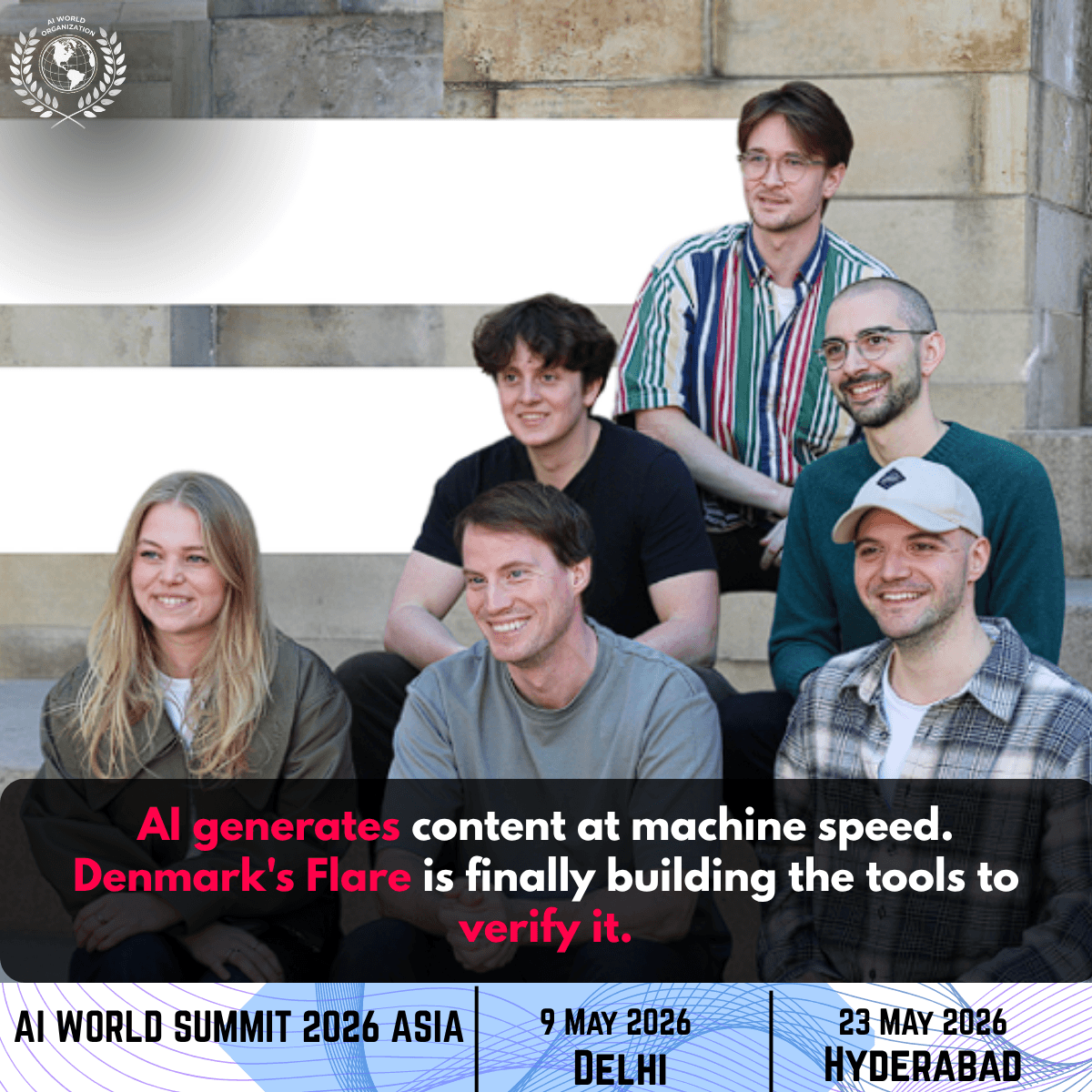
Danish startup Flare has raised €3.6 million in pre-Seed funding to build a platform that helps people verify whether information is actually backed by evidence — a growing need as AI-generated content floods the internet faster than humans can fact-check it. Led by 20VC with backing from angels across Stack Overflow, GitHub, and Reddit, the Copenhagen-based team of six is now building the trust layer the information age desperately needs.
Danish Startup Flare Raises €3.6 Million to Tackle the AI Knowledge Verification Crisis
In a world where artificial intelligence can generate thousands of convincing-sounding claims in the time it takes a human to verify a single one, a quiet but urgent crisis has been building at the heart of how we consume and trust information. A Copenhagen-based startup called Flare has stepped into this gap — and investors have noticed. The company recently closed a €3.6 million pre-Seed funding round aimed at building what it describes as "trust infrastructure" for the AI age. This latest AI funding news signals that the race to fix how humans validate knowledge in the digital era is very much underway, and that European tech investors are placing early bets on solutions that could reshape how the world handles information integrity.
The Problem Nobody Wanted to Talk About — Until Now
For years, the conversation around AI centred on what it could do: write essays, compose music, generate code, hold conversations. Far less attention was paid to what happens when those capabilities start outrunning the human systems designed to keep information honest. Flare's founding thesis is simple but sobering — we built the infrastructure for content production long before we built the infrastructure for content verification. And the gap between the two has never been wider.
Nicolai Frost Kolborg Jacobsen, co-founder and CEO of Flare, put it plainly: "We've spent years building systems that had to be both large and trustworthy. What's broken right now isn't that people are naïve. It's that the infrastructure for discernment hasn't scaled with the infrastructure for content. That's what we're building."
This observation cuts to the core of a challenge that spans industries — from journalism and healthcare to legal systems and financial services. When AI-generated text looks indistinguishable from expert-verified content, the responsibility of determining what is credible falls back on individuals who rarely have the time, tools, or context to make that call accurately. The result is an information environment where falsehoods can circulate at machine speed while corrections still travel at human pace.
Flare believes the answer isn't to slow down AI. Instead, it is building a layer underneath the content — a structured, transparent system that allows users to see exactly which claims are supported by evidence and which are not, aggregating verification through collective intelligence rather than depending solely on centralised editorial authority. It's a shift in paradigm: from hoping content creators behave honestly, to building a system that makes the honesty (or lack thereof) visible to everyone.
Inside the €3.6 Million Round: Who Backed Flare and Why
The pre-Seed round was led by 20VC, one of the more active early-stage venture funds with a strong appetite for frontier technology bets. Participating alongside 20VC were ByFounders — a Scandinavian-focused fund known for backing purpose-driven tech — and 20Growth. The angel investor list reads like a who's who of the tech ecosystem's most respected platforms: Stack Overflow, GitHub, Reddit, Meta, Kahoot, HubSpot, and Encord all sent individual backers to the table.
The breadth of that angel network isn't coincidental. Each of those platforms deals intimately with the challenge of knowledge quality at scale. Stack Overflow has spent over a decade curating verified developer knowledge. Reddit moderates millions of claims daily. GitHub is ground zero for code integrity. The fact that operators from all of these companies chose to invest personally in Flare says something meaningful about how seriously the people closest to the problem take the solution Flare is proposing.
From an AI funding perspective, this round positions Flare within a wider category of startups tackling digital trust. Nicolai has confirmed that the pre-Seed capital will be deployed primarily across three areas: compute infrastructure, team salaries, and talent acquisition. The company currently operates with a team of six and plans to grow to eight by the end of the year — a lean, deliberate approach that prioritises depth of expertise over rapid headcount expansion. "The goal is to make it easier for everyone to trust what they read," Nicolai noted, framing the mission not as a niche tech product but as a foundational public good.
Flare in the Context of Europe's Booming AI Trust Sector
Flare's raise doesn't exist in isolation. Across Europe, AI funding news has increasingly reflected a broader investor conviction that the next wave of valuable AI companies won't just be the ones building AI capabilities — they'll be the ones building the systems that make AI outputs trustworthy and safe. The numbers bear this out.
In Paris, Tremau raised €3 million to scale an AI-powered trust and safety platform. In London, Keyless secured €1.9 million specifically to address the growing threat of deepfakes through biometric authentication technology. Italy's IdentifAI attracted €5 million for a platform dedicated to deepfake detection at enterprise scale. Milan-based Trustfull closed a €6 million round to expand its fraud prevention technology across European markets. And Romania's TMT ID — one of the largest raises in this cohort — secured €34 million as it scaled its comprehensive digital trust and fraud prevention infrastructure.
When you add Flare's €3.6 million to these figures, the combined total across this loosely defined "AI trust" category approaches €53.5 million. That is not a niche investment trend. That is a structural market response to a structural problem. Investors are recognising that in an AI-saturated information environment, trust itself has become a commodity — and that the companies capable of delivering it reliably will occupy an extraordinarily valuable position in the technology stack.
What differentiates Flare within this landscape is its focus. Most of the companies in the adjacent space are working on identity — verifying who someone is, whether content was AI-generated, or whether a face in a video matches a passport photo. Flare is working on something slightly different and arguably more foundational: verifying whether what someone is saying is actually supported by evidence. It's not about the source — it's about the substance. That distinction matters enormously in an era where even verified human authors can spread misinformation at scale.
The Team Behind the Vision
Founded in 2026, Flare is a young company operating in a space that rewards experience as much as innovation. The founding team brings expertise drawn from some of the most demanding technical environments in the world — Google, Unity, IBM, Amazon, and Corti. That blend of big-tech engineering rigour and healthcare-grade standards for accuracy (Corti is a Copenhagen-based AI company serving clinical settings) suggests a team that understands what it means to build systems where mistakes carry real consequences.
That background matters because the challenge Flare is taking on is not primarily a product design challenge — it is a systems architecture challenge. Building infrastructure that can evaluate the validity of claims in real time, aggregate evidence from multiple sources, and present that information in a way that's both transparent and accessible to non-expert users is deeply complex. It requires robust compute, sophisticated data pipelines, and a contribution model that incentivises accuracy over noise. The team's track record suggests it has the technical foundations to execute.
The Copenhagen base also places Flare in one of Europe's most active startup ecosystems. Denmark has quietly built a reputation for producing technology companies that combine commercial ambition with a strong civic sensibility — a cultural fit for a company whose mission is to make public information more trustworthy. The Scandinavian region's broader investment landscape, supported by funds like ByFounders, has become increasingly attractive for companies at the intersection of AI and societal infrastructure, and Flare fits squarely into that mould.
What This Means for the Future of Information Integrity
The bigger picture here is one that every organisation, media outlet, and platform will eventually have to reckon with. As AI tools become more powerful and more accessible, the asymmetry between content generation and content verification will continue to widen — unless deliberate infrastructure is built to close it. Flare's bet is that this infrastructure doesn't have to take the form of censorship, algorithmic suppression, or centralised editorial control. It can instead take the form of transparency: showing people, openly and at scale, which claims have been examined, what the evidence says, and where genuine uncertainty exists.
This approach reflects a broader philosophical shift in how some of the most thoughtful people in tech are thinking about information governance. Rather than asking "how do we stop bad information from spreading," they are asking "how do we make the quality of information visible?" It's a more democratic and arguably more durable solution — one that respects human agency while giving people better tools to exercise it.
From an AI funding news standpoint, what makes Flare's round particularly worth watching is the timing. This is a pre-Seed investment, which means investors are backing a thesis and a team as much as they are backing a finished product. The fact that it attracted lead investment from 20VC and a roster of angel investors from major tech platforms at this stage suggests a high degree of conviction that the problem Flare is addressing is not only real but commercially significant. If the company executes well, it could become the kind of foundational infrastructure layer that nobody notices individually but everyone depends on — the same way people depend on encryption or authentication without necessarily understanding how it works.
For those tracking AI funding trends across the European startup ecosystem, Flare is a company worth keeping a close eye on. It sits at the intersection of two of the most important technological conversations of our time: the capabilities of AI and the resilience of truth. And with €3.6 million in the bank and a team that has built for scale before, it is now in a position to start answering the question that its founders have been asking all along — can we build systems for discernment that are as powerful as the systems we've already built for creation?