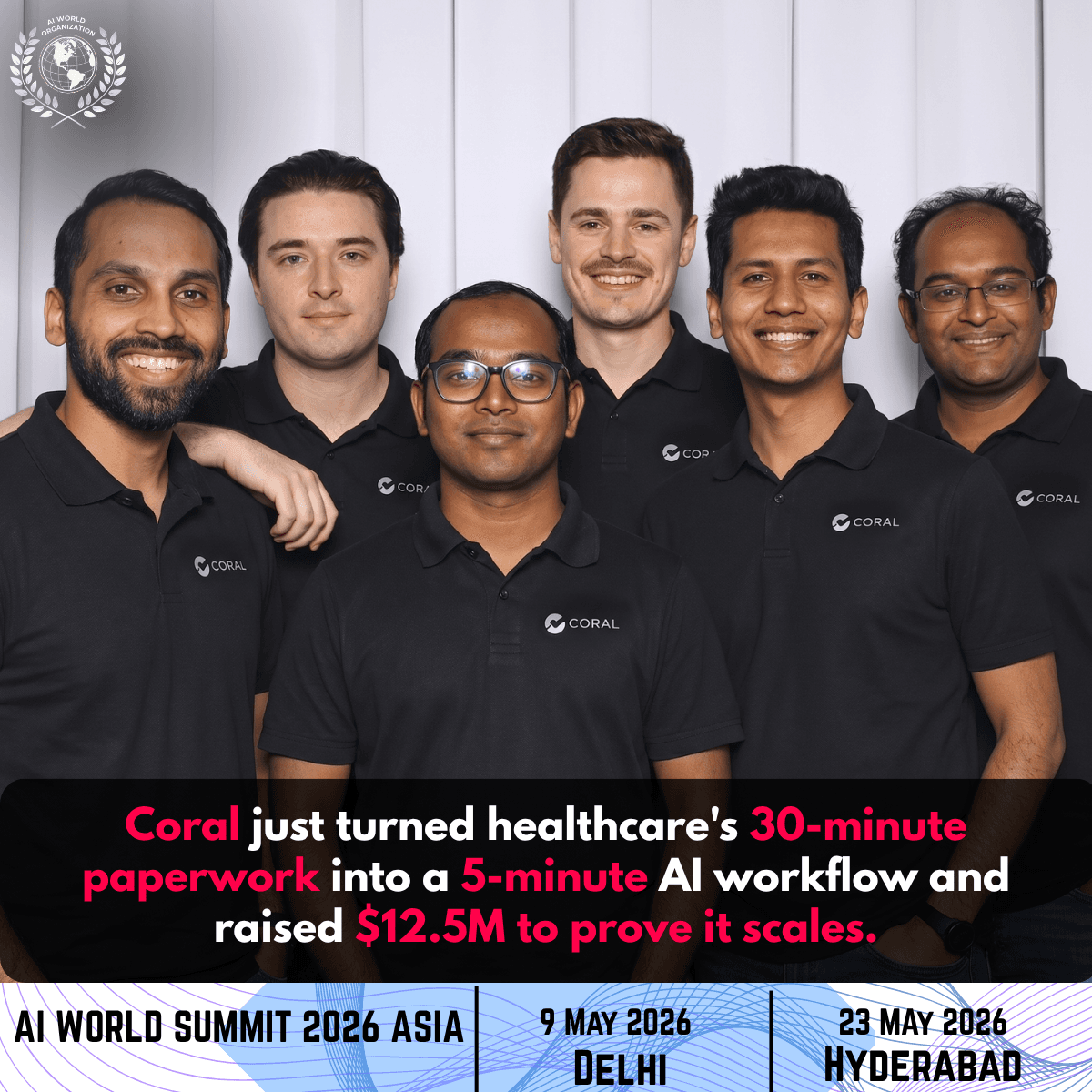
Coral Raises $12.5M to Automate Healthcare AI
Coral secures $12.5M in AI funding from Z47 and Lightspeed to automate US healthcare's back-office workflows with 99.7% accuracy.
TL;DR
New York-based healthcare automation startup Coral has raised $12.5 million in seed funding from Z47 and Lightspeed. Founded by two IIIT Hyderabad alumni, Coral uses AI to handle prior authorizations, insurance verifications, and patient intake — cutting a 30-minute manual process down to under five minutes. With revenues growing 8x and 500K monthly workflows processed, this AI funding news marks a strong vote of confidence in vertical healthcare automation.
Coral Raises $12.5 Million to Automate Healthcare's Back Office: A Major Leap in AI Funding for Health-Tech
Healthcare in the United States has long been held hostage by a paperwork nightmare — mountains of handwritten fax forms, tangled insurance verifications, and prior authorization requests that can take weeks to process. While the clinical side of medicine has seen remarkable technological progress over the years, the administrative infrastructure powering it has barely moved an inch. That is exactly the gap that New York-based startup Coral is betting on — and investors are clearly taking notice. In a significant development in AI funding news, Coral has raised $12.5 million in a seed round led by Lightspeed and Z47, formerly known as Matrix Partners India, to aggressively scale its AI-powered healthcare automation platform.
This is not just another funding announcement in a crowded field. It is a pointed signal that the market is ready to back solutions that tackle the stubborn, deeply embedded inefficiencies sitting at the core of the US healthcare system's administrative crisis.
The $450 Billion Problem Nobody Talks About
Most people walking into a hospital or a specialty clinic think about the quality of their doctors or the speed of their diagnosis. What they rarely see is the staggering administrative machinery that must work in the background before a single prescription gets filled or a piece of medical equipment gets shipped to their door. According to industry estimates, US healthcare spends close to $450 billion every single year on administrative overhead, a figure that dwarfs the budgets of many national economies.
Eligibility verifications, prior authorization exchanges, fax-based communications, and insurance card processing together consume a disproportionate share of that sum. A complex patient intake process that once required nearly 30 minutes of manual coordination from staff can stall entire care pipelines. Physicians alone average around 40 prior authorization requests every week, many of which sit in queues for days before getting resolved.
This is the world Coral's founders decided to walk into. Ajay Shrihari and Aniket Mohanty, who met while studying at IIIT Hyderabad and later worked together as founding engineers at the enterprise automation company LimeChat, saw first-hand how AI could be used to dismantle repetitive, rule-bound workflows in high-stakes environments. They founded Coral in 2024 with a clear conviction: that healthcare's administrative chaos was not just tolerable inefficiency — it was a systemic failure actively harming patient outcomes.
What Coral Actually Does — And Why It Works
Many technology companies attempting to enter the healthcare space immediately face a fundamental barrier: providers are deeply reluctant to overhaul their existing systems. Electronic Health Record platforms are notoriously entrenched, payer portals are fragmented across hundreds of insurers, and fax machines — yes, fax machines — remain the primary communication channel for large segments of the industry. Trying to rip out that legacy infrastructure has caused numerous well-funded health-tech ventures to fail spectacularly.
Coral's approach is deliberately different, and that pragmatism is arguably its biggest competitive edge. Rather than asking providers to change how they work, Coral's platform integrates directly into existing EHR systems, fax lines, and payer portals, working within the infrastructure that clinics, specialty pharmacies, and DME suppliers already rely on every day. The AI handles end-to-end administrative workflows including patient intake, prior authorizations, insurance verification, and document processing — all without requiring a single software migration or IT overhaul from the provider's side.
The accuracy numbers are striking. Coral's models have reached 99.7% accuracy on the specific document types that define healthcare's back office: handwritten fax forms, scanned insurance cards, prior authorization templates, and payer portal screens. For context, general-purpose Robotic Process Automation tools typically operate at around 52% accuracy on these same document types — a gap wide enough to render them practically unreliable in clinical settings where errors carry real consequences.
One of the most practical outcomes of Coral's platform is the dramatic reduction in patient intake times. A process that previously demanded 30 minutes of staff coordination can now be completed in under five minutes. For infusion centers or specialty pharmacies where patient volume is high and scheduling margins are tight, that difference translates directly into improved capacity, reduced staff burnout, and faster access to care for patients who genuinely cannot afford to wait.
AI Funding Momentum: Z47 and Lightspeed Double Down on Health-Tech Automation
The latest AI funding round places Coral firmly on the radar of the global venture community, backed by two firms with distinct but complementary strengths in the enterprise AI space. Z47, formerly known as Matrix Partners India, has built a portfolio heavily weighted toward AI-driven enterprise software, with notable investments in companies like Rocketlane and Krutrim. Lightspeed, a global multi-stage venture firm, had already participated in Coral's early-stage journey, having led a $2 million seed investment when the company was still in its formative months.
The decision to lead this significantly larger follow-on round reflects a level of conviction in Coral's growth trajectory that goes beyond typical early-stage bets. What makes this particular AI funding story compelling is the speed at which Coral has delivered commercial results. The company has grown revenues 8x and reached a milestone of 500,000 monthly workflows processed, all within less than a year of launching its platform.
Perhaps even more telling is the customer behavior around payment terms. A meaningful share of Coral's customers are reportedly paying full contract value upfront — a rare and powerful signal in B2B software that indicates genuine demand and strong confidence in the platform's ROI. When customers are willing to commit their entire contract value before a product has been fully deployed across their operations, it suggests they have already seen enough proof in pilots or early rollouts to remove any hesitation.
This AI funding news also reflects a broader market shift. Investors are increasingly moving away from broad, horizontal AI bets and concentrating capital on vertical AI companies that have domain-specific moats — teams with deep operational knowledge of a single industry, proprietary training data, and integrations that are genuinely hard to replicate. Coral's founders bring backgrounds in robotics and medical image processing, which gives them an unusual technical advantage in understanding exactly how healthcare documents are structured, what errors look like, and how edge cases should be handled in clinical contexts.
From DME to Infusion Centers — How Coral Is Expanding Its Footprint
When Coral first launched, it focused specifically on the durable medical equipment sector — a subsegment of healthcare characterized by high administrative complexity, heavy reliance on prior authorizations, and significant coordination between providers and insurance payers. It was a deliberate choice to start narrow and go deep, building expertise in a single vertical before attempting to expand.
That strategy appears to have paid off. The company has since extended its reach into infusion centers and specialty pharmacies, two areas of healthcare where administrative bottlenecks have outsized consequences. In an infusion center, for instance, a delayed prior authorization doesn't just mean paperwork sitting on a desk — it can mean a cancer patient's treatment being postponed by days while staff manually chase insurers for approvals. Coral's automation directly addresses this bottleneck, turning what was once a weeks-long process into one that resolves in minutes.
The platform's most recent product additions have deepened its automation capabilities even further. Coral recently shipped AI-powered voice and text workflows that automate follow-up communications with payers, patients, and referral sources — replacing phone calls that previously required a staff member to set aside time and manually navigate hold queues and payer phone trees. This layer of automation is significant because it extends the platform's value beyond document processing into the full communication lifecycle of an administrative case.
Looking ahead, Coral is building two major product features that could substantially expand its addressable market. The first is an AI workflow builder that will allow providers to design and deploy their own custom administrative processes without any IT involvement, adapting Coral to the specific operational rhythms of individual practices. The second is a co-pilot layer — essentially an intelligence dashboard — that surfaces actionable insights from the operational data already flowing through the platform, including which payers have the highest claim denial rates, where cases are stalling in the authorization process, which referral sources convert reliably, and what changes would improve outcomes on insurance resubmissions.
What This Means for the Future of Healthcare AI
Coral's fundraise arrives at a moment when AI-powered automation across healthcare administration is rapidly transitioning from experimental curiosity to operational necessity. Staffing shortages, rising administrative costs, and the increasing complexity of insurance payer requirements are all pushing healthcare organizations to seriously evaluate automation tools that were previously considered optional.
What distinguishes Coral from earlier waves of health-tech automation is its refusal to propose a clean-slate approach. The company's core product philosophy — integrate with what exists, automate the friction, and make the gains immediately measurable — is well-calibrated for the slow-moving, risk-averse nature of healthcare procurement cycles. Providers don't need to trust Coral enough to rebuild their systems; they only need to trust it enough to connect it to the systems they're already running.
With the proceeds from this latest AI funding round, the company plans to scale its engineering team and bring on domain experts with deep backgrounds in healthcare operations. The combination of technical talent and operational knowledge is critical in a space where the details — the specific fields on a prior authorization form, the way a particular payer's portal handles rejections, the nuances of DME billing codes — can mean the difference between a workflow that works seamlessly and one that generates costly errors.
For The AI World, this development is a reminder that some of the most durable AI funding stories in 2026 are not the headline-grabbing foundation model rounds — they are the quieter, disciplined bets on vertical AI companies solving real operational problems with measurable outcomes. Coral is automating paperwork that has frustrated clinicians and patients for decades, and it is doing so with the kind of technical accuracy and commercial traction that makes the investment case straightforward.