Bounti Raises €4M to Bring AI to Frontline Workers
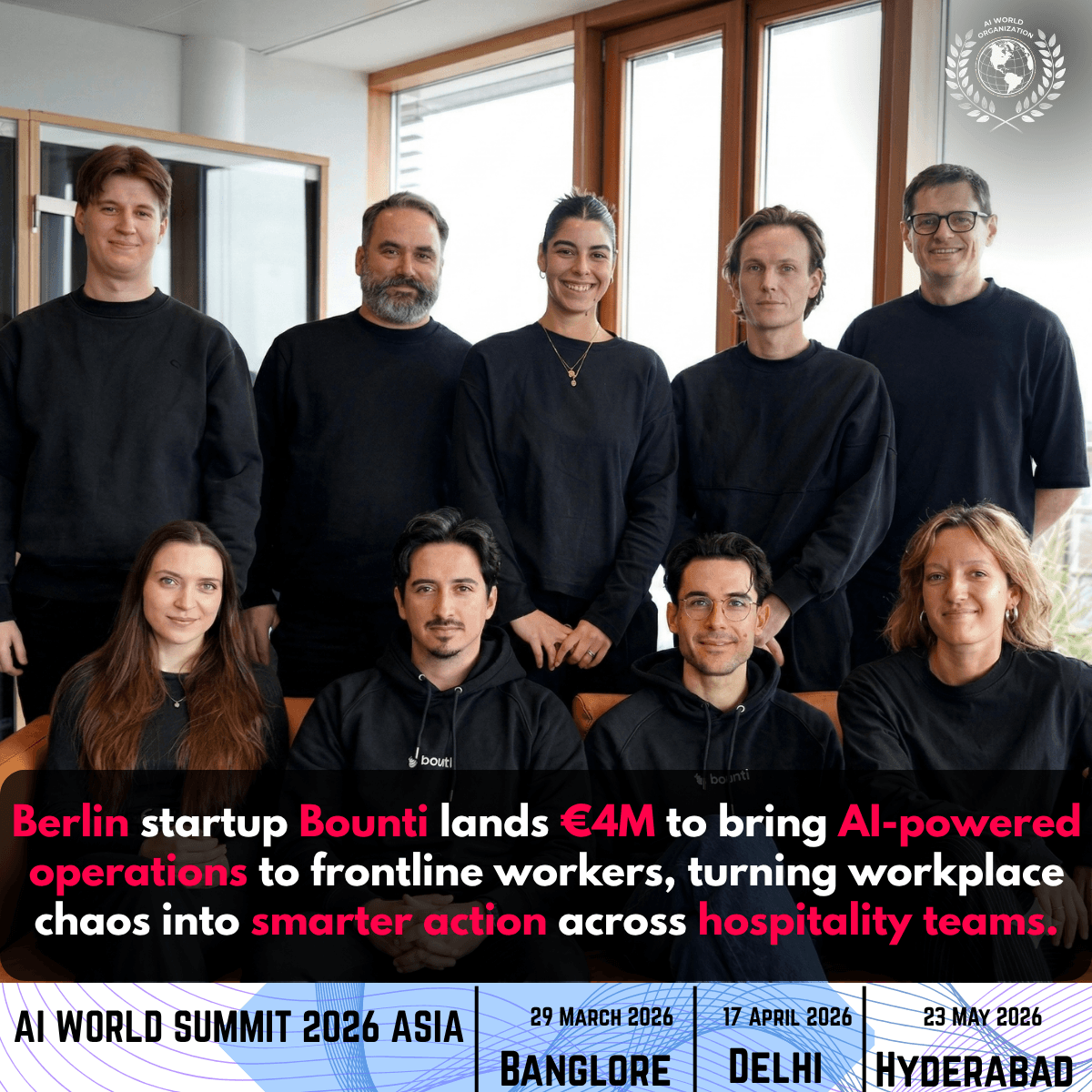
Berlin startup Bounti secures €4M in seed funding to deploy AI for frontline workers in hospitality, logistics & multi-site businesses across Europe.
TL;DR
Berlin-based startup Bounti has raised €4M in seed funding to bring AI-powered operational tools to frontline workers in hospitality and logistics people tech has long ignored. Led by Ventech, the round will help Bounti replace messy, disconnected workplace tools with one smart platform that doesn't just flag problems, but actually acts on them.
Bounti Raises €4M to Deploy AI for Frontline Workers Powering the Physical Economy
For years, the conversation around artificial intelligence in the workplace has revolved almost entirely around one type of worker — the knowledge worker. Software developers using AI code assistants, marketers leveraging generative tools, analysts running machine-learning models on their laptops. The productivity revolution powered by AI has been real, significant, and well-documented. But there is an enormous, often invisible workforce that has been left almost completely untouched by these advances: the frontline workers. The baristas pulling double shots at 6 AM, the warehouse pickers navigating aisles for ten-hour stretches, the shift managers at fast-casual restaurant chains trying to maintain quality standards across dozens of locations — these are the people who physically keep the economy running, and yet when it comes to the tools available to them, very little has changed since the early 2000s. Clipboards, WhatsApp group chats, printed PDFs, and verbal handovers still define how operational knowledge gets transferred in the physical economy. A Berlin-based startup called Bounti is determined to change that, and its latest AI funding round signals that serious investors are beginning to pay attention.
Bounti has officially closed a €4 million seed funding round, making it one of the more noteworthy pieces of AI funding news to emerge from the European startup scene this March. The round was led by Ventech, a well-established pan-European venture capital firm with a strong track record of backing early-stage technology companies across the continent. Joining Ventech in the round are IBB Ventures, Robin Capital, and Common Magic. What makes this particular deal even more compelling is the calibre of the business angels who have also come on board. Paul Forster, the co-founder of Indeed — one of the world's largest job search platforms — has invested, alongside Koen Bok and Jorn van Dijk, the co-founders of Framer, the popular no-code web design tool. The presence of these operators-turned-investors sends a clear signal: people who have built and scaled companies before believe that what Bounti is building is both timely and necessary.
The Problem That Enterprise Software Has Always Avoided
To understand why Bounti exists, you need to appreciate just how structurally broken the flow of operational information is in multi-site physical businesses. Take a restaurant chain with eighty locations spread across Germany, Austria, and Switzerland. Headquarters might spend months developing detailed brand standards — hygiene check protocols, opening and closing routines, upselling scripts, merchandising guidelines, and allergen compliance procedures. These documents are carefully written, formatted, and distributed. And then they are promptly ignored. Not because frontline staff are careless or uninterested, but because the information is delivered in formats that are entirely incompatible with the realities of a fast-paced shift. A 47-page PDF sitting in a shared Google Drive folder is not a useful operational tool for someone who has three minutes between table turns. A training video hosted on a learning management system is not going to be watched by a part-time barista who shares a device with four colleagues and has just been handed a shift at the last minute.
This gap between what leadership designs and what actually happens on the ground is not a niche problem. It is a universal one for any organisation that operates physical locations at scale, and it gets exponentially worse as chains grow. At five locations, a founder can visit every site and keep standards tight through sheer personal presence. At fifty locations, that becomes impossible. At two hundred, it becomes a logistical nightmare. The companies that manage it best tend to rely on a patchwork of tools — workforce scheduling software, separate training platforms, checklist applications, communication apps, and business intelligence dashboards — none of which talk to each other, and all of which require yet another login that a frontline worker has to remember. The result is friction, non-compliance, and a persistent gap between strategy and execution.
It is precisely this gap that has kept larger enterprise software vendors away from the space. Frontline workers in the hospitality sector, for example, experience annual turnover rates that can reach seventy percent. Teams are often multilingual, predominantly part-time, and regularly sharing devices. The onboarding cycle is short, the attention window even shorter, and the tolerance for complex software essentially zero. Any tool that slows down a shift — even by a few minutes — gets abandoned immediately. Building for this demographic requires a fundamentally different design philosophy from building for a corporate office environment, and most legacy vendors have simply never bothered.
What Bounti Actually Builds And Why It's Different
Bounti's platform approaches the problem from a direction that is both logical and surprisingly underexplored. Rather than asking frontline workers to use yet another separate application, Bounti integrates directly into existing operational workflows and makes the right information available at the right moment during a shift. The platform takes the standard operating procedures, compliance documents, and training materials that headquarters produces and transforms them into dynamic, mobile-friendly micro-workflows that staff can access and complete in real time.
But the genuinely interesting part of Bounti's product is not the workflow digitalisation — it is what sits on top of it. Ziar Khosrawi, the co-founder and CEO of Bounti, describes a scenario that illustrates the platform's ambition well. If a chain like Burgermeister, which operates thirty-plus locations, starts seeing a revenue decline at a specific site, Bounti's AI does not simply flag the decline on a dashboard and wait for someone to investigate. Instead, it automatically analyses the available data to identify probable causes — incomplete checklists, a spike in customer complaints, an undertrained team member recently onboarded — and then takes targeted action. That might mean automatically triggering a short piece of micro-training for the relevant staff member, sending an alert to the area manager with specific context, or surfacing a checklist for the location manager to complete at the start of the next shift. The system closes the loop between data and action without requiring a manager to check a dashboard, run a report, and then manually decide what to do.
This proactive, event-driven approach to operational AI is meaningfully different from what most workforce management tools offer today. It is also well-aligned with where enterprise AI is heading more broadly — away from passive analytics and towards systems that actually initiate actions. The broader AI funding news landscape reflects this shift, with investors increasingly backing startups that build AI agents capable of operating with some degree of autonomy rather than simply presenting information and waiting for a human to respond.
Khosrawi himself brings an unusual and valuable perspective to this problem. Before entering the startup world, he spent five years working frontline jobs in both construction and hospitality. He has direct, lived experience of what it feels like to receive a stack of new procedures via WhatsApp at the start of a shift, or to be held accountable for standards that were never explained in a format you could actually use. That founder-market fit is something investors often look for, and it clearly resonated with the backers who participated in this round.
Early Traction and the Customers Already on Board
Despite being a team of only seven people, Bounti has already built a credible early customer base that gives its thesis real-world validation. Among the brands currently using the platform are Burgermeister, L'Osteria, BackWerk, LAP Coffee, Coffee Fellows, and Peter Pane — a roster that spans fast-casual dining, coffee chains, and bakery concepts, all operating at meaningful scale across the DACH region (Germany, Austria, and Switzerland). These are not pilot customers in a proof-of-concept stage; they are active, multi-location operators with real operational complexity, real compliance requirements, and real pressure on labour costs.
The DACH market is a particularly relevant proving ground for this kind of solution. Labour costs in Western Europe have risen sharply since 2021, driven by both inflation and legislative changes around minimum wages. At the same time, the hospitality and logistics sectors continue to face significant staff shortages, making the efficient training and deployment of the workers they do have increasingly critical. Operators who previously might have absorbed operational inefficiencies through volume or margin are now feeling genuine pressure to do more with less — and that shifts the willingness to invest in technology significantly.
Beyond Europe, Bounti is reportedly seeing inbound interest from the United States, Latin America, and Eastern Europe, suggesting that the operational problem it is solving resonates across geographies. This is not entirely surprising. The disconnect between headquarters strategy and frontline execution is a universal feature of multi-site physical businesses, not a European-specific challenge.
The Competitive Landscape and Where Bounti Fits
It would be inaccurate to describe the workforce management software space as empty — it is, in fact, rather crowded at first glance. Companies like Deputy, Workforce.com, Axonify, and Bindy all operate in adjacent territories, addressing pieces of the frontline worker challenge through scheduling, training, communication, and audit tools respectively. The challenge, as Bounti sees it, is that these tools are disconnected silos. An operator using all four of those products is still managing four separate logins, four separate data streams, and four separate user experiences — none of which communicate with each other to produce a unified picture of what is actually happening across locations.
Bounti's competitive positioning is as a consolidation and intelligence layer — a single platform that replaces the patchwork with a unified system, and then adds the proactive AI capability that none of the incumbents currently offer. The value proposition for operators is straightforward: stop paying for multiple disconnected tools, reduce the administrative overhead of managing several platforms, and gain AI-driven operational insights that actually translate into action. If the platform delivers on this promise at scale, the return on investment case becomes compelling.
The more significant competitive risk, arguably, comes not from the point-solution vendors but from the enterprise giants. Companies like Workday and SAP are actively investing in AI capabilities across their workforce management product lines, and they have the enterprise relationships, compliance infrastructure, and existing customer trust that a seven-person startup does not. Bounti's window of opportunity is real, but it is also time-limited, which makes the speed of execution over the next twelve to eighteen months particularly important.
This is where the current AI funding news around Bounti becomes strategically meaningful. The €4 million is earmarked for three core areas: product development, with a particular focus on advancing the proactive workflow capabilities and deepening the automation layer; sales and go-to-market expansion within Europe; and technical integrations with point-of-sale systems and HR platforms that will make the product significantly stickier within existing operator tech stacks. The faster Bounti can embed itself into the operational infrastructure of its customers, the harder it becomes for a larger competitor to displace it.
The Broader AI Opportunity in the Physical Economy
Stepping back from the specifics of Bounti's product and business model, this round is also a useful indicator of a broader shift in where AI investment is flowing. The first wave of enterprise AI adoption was heavily concentrated in knowledge work — legal, finance, software development, marketing. The tools were easier to build because the inputs and outputs were largely text-based, and the buyers were office-based professionals who were already comfortable adopting software.
The second wave, which is now beginning to build momentum, targets the physical economy. This includes not just frontline worker productivity tools like Bounti, but also AI applications in manufacturing quality control, construction site safety, agricultural operations, and retail floor management. These are harder problems to solve because the environments are messier, the users are less digitally native, and the integrations required are more complex. But the scale of the opportunity is immense. Frontline workers represent the majority of the global workforce, and the businesses that employ them are under greater cost and efficiency pressure than ever before.
The AI funding news landscape over the coming years will increasingly reflect this shift, as capital follows both the magnitude of the problem and the maturity of the technology needed to address it. Bounti is an early mover in this space, with a product that is live, customers who are paying, and a founding team with genuine domain expertise. That combination — at the seed stage, in a market that is just beginning to attract serious attention — is precisely the kind of opportunity that well-informed investors tend to move on quickly.
At The AI World Organisation, we watch this category closely because it represents one of the most grounded applications of artificial intelligence — not AI as a theoretical capability, but AI as a direct tool for improving the working lives of millions of people who have been overlooked by the technology industry for far too long. As the global AI summit circuit continues to spotlight these use cases, and as conversations at events like the AI World Summit bring together operators, investors, and policymakers, it becomes increasingly clear that the physical economy is not just a footnote to the AI story. It is one of its most important chapters.