Autoscience Raises $14M to Automate AI Research
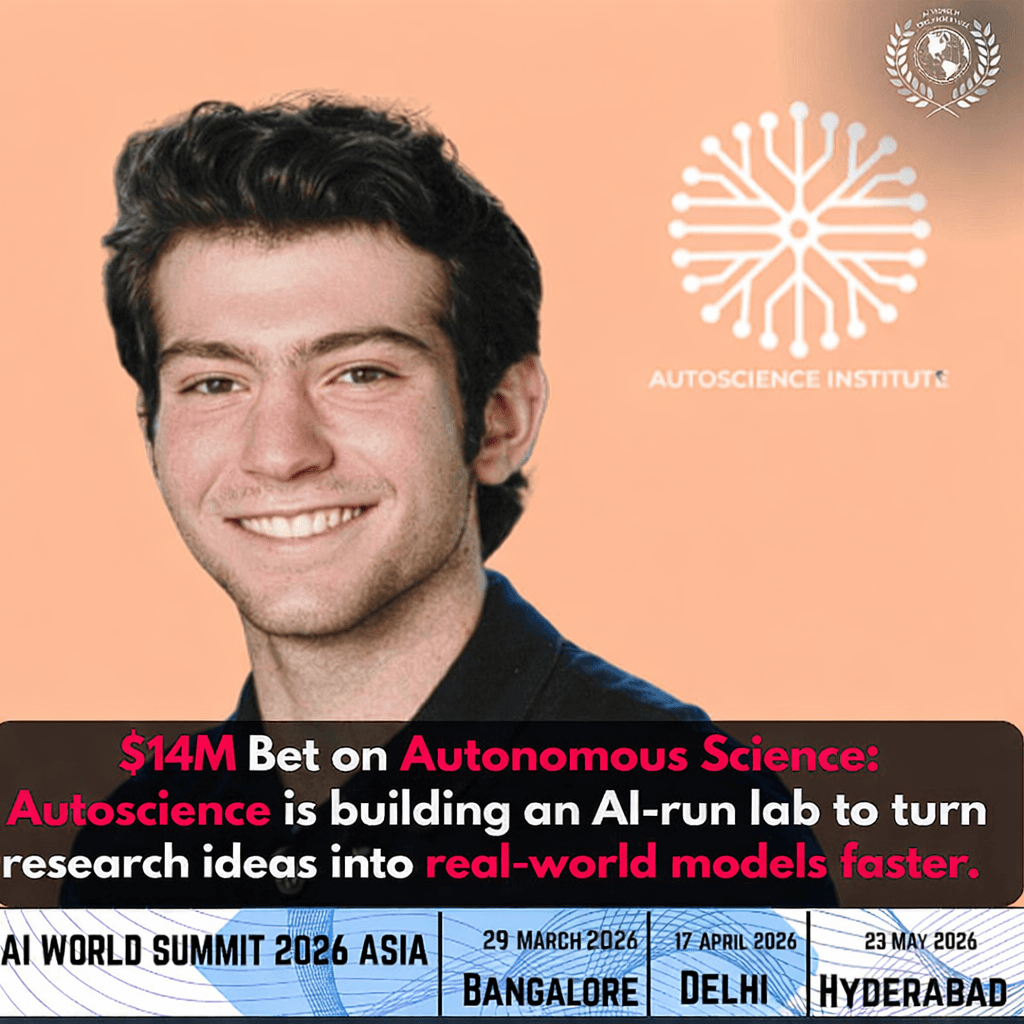
Autoscience secures $14M in seed funding led by General Catalyst to build a fully automated AI research lab, replacing human researchers with AI systems.
TL;DR
Autoscience, a California-based startup, has raised $14 million in seed funding led by General Catalyst to build a fully autonomous AI research lab. Instead of human researchers, the platform uses AI scientists and AI engineers to read literature, generate hypotheses, and build production-ready ML models compressing years of research into months. Early wins include a peer-reviewed ICLR 2025 paper and a Kaggle silver medal beating 3,300+ human teams.
Autoscience Bags $14M Seed Round Led by General Catalyst to Build World's First Fully Automated AI Research Lab
The artificial intelligence landscape is no stranger to bold bets, but every now and then, a startup comes along that does not merely improve existing workflows — it challenges the very foundation of how scientific discovery works. Autoscience, a California-based deep tech startup headquartered in San Mateo, is one such company. In a significant piece of AI funding news making waves across the global tech community, Autoscience has successfully closed a $14 million seed funding round, with the goal of building what could become the world's first fully autonomous AI research laboratory. This is not just another funding milestone — it represents a fundamental reimagining of who, or rather what, conducts AI research in the modern era.
The round was led by prominent venture capital firm General Catalyst, a name synonymous with backing transformative, category-defining companies. Joining the round as co-investors were Toyota Ventures, the strategic venture arm of the global automotive giant, the Perplexity Fund, MaC Ventures, and S32. The diversity of investors backing this round — spanning automotive, consumer AI, and deep tech — signals the broad applicability and cross-industry relevance of what Autoscience is building. The freshly secured capital will be deployed primarily to expand Autoscience's core platform, scale its engineering talent, and onboard a select group of large enterprise clients, including Fortune 500 companies that are looking to supercharge their machine learning research and development capabilities.
The Problem That Autoscience Is Solving
To truly appreciate what Autoscience is doing, one must first understand the scale of the problem it is addressing. The volume of machine learning research being published globally has reached staggering proportions. Thousands of new papers, models, architectures, and algorithmic breakthroughs are released every single week across repositories like arXiv, NeurIPS, ICML, and ICLR. For any human research team — no matter how talented or well-resourced — keeping pace with this torrent of information, let alone synthesising it into actionable insights, has become practically impossible.
The bottleneck in modern AI development is no longer access to data. It is no longer computing power, which has become increasingly democratised through cloud infrastructure. The real constraint is human cognitive capacity. Skilled researchers can only read so many papers, generate so many hypotheses, and run so many experiments in a given week. The gap between what could be tested and what actually gets tested continues to widen every year.
This is the precise gap that Autoscience has set out to close. Rather than hiring more researchers and scaling human capital, the company is engineering AI systems that function as researchers themselves — capable of reading literature, generating original hypotheses, designing and executing experiments, and converting successful algorithmic ideas into deployable machine learning models. The vision is ambitious, the execution even more so.
Inside the Autoscience Virtual Lab: AI Scientists and AI Engineers
The architecture that Autoscience has built is as fascinating as it is unconventional. At the heart of its platform lies what the company describes as a virtual research laboratory — powered not by human scientists and engineers, but by "AI scientists" and "AI engineers" that work in tandem to automate the complete research cycle.
The AI scientist component is responsible for the generative and exploratory side of the workflow. It reads and processes existing machine learning literature, identifies gaps and opportunities, and produces novel hypothetical directions for algorithmic research. It is, in essence, performing the ideation and literature review functions that a human researcher would typically carry out — but at a pace and scale no human team could realistically match.
The AI engineer component, on the other hand, focuses on refinement and operationalisation. Once a hypothesis or new algorithm idea has been generated and tested, the AI engineer works to turn the most promising ones into real-world, production-ready machine learning models. It handles the more systematic, iterative aspects of model development — fine-tuning, evaluation, optimisation, and deployment readiness.
Together, these two layers create a closed-loop, end-to-end research pipeline. A new idea can move from generation to testing to deployment without requiring a human to intervene at each stage. The implications of this are profound. Research cycles that once took months can potentially be compressed into days. Eliot Cowan, the CEO and co-founder of Autoscience, has articulated this vision with clarity and conviction.
"We've reached a point where human intuition is no longer enough to navigate the complexity of algorithmic discovery," said Cowan. "We've built a research organisation where the researchers are AI systems. We aim to compress a decade of machine learning research into months, unlocking new AI capabilities for scientists and forming a competitive edge for our customers."
This is the kind of statement that would have seemed hyperbolic just a few years ago. Today, given the trajectory of AI capabilities and the mounting pressure on enterprise R&D teams to deliver results faster, it reads as a genuine and well-grounded strategic objective.
Peer-Reviewed Research and Kaggle: Early Proof Points
One of the most compelling aspects of Autoscience's story is not just its vision, but the tangible evidence it has already produced to validate that vision. In a world where startup claims often outpace delivery, Autoscience has done something notable — it has produced results that can be independently verified.
The company's autonomous AI research system became one of the first of its kind to produce a peer-reviewed research paper accepted at an ICLR 2025 workshop. ICLR, the International Conference on Learning Representations, is one of the most prestigious venues in the machine learning world. Getting a paper accepted there is a meaningful achievement even for seasoned human researchers. The fact that an autonomous AI system generated and submitted a paper that passed peer review at such a venue is a genuinely landmark moment in the history of AI-assisted research.
But the evidence of Autoscience's capabilities does not stop there. The company's system also competed in a Kaggle competition — the globally recognised platform where data scientists and machine learning practitioners compete to solve complex modelling challenges — and secured a silver medal. This was achieved while competing against more than 3,300 human teams. Finishing among the top performers in a field of thousands of experienced human practitioners is not a trivial outcome. It speaks to the practical, real-world competence of the platform, not just its theoretical potential.
These two data points together — a peer-reviewed academic contribution and a competitive performance in a practitioner-oriented contest — represent a rare and meaningful combination of scientific credibility and applied capability. They also mark a shift in the narrative around AI. For much of the past decade, AI has been positioned as a tool that assists researchers. Autoscience's early results suggest we are moving into a phase where AI can compete with researchers — and in some domains, outperform them.
Enterprise Focus: Financial Services, Manufacturing, and Fraud Detection
While the academic and competitive achievements of Autoscience's platform are impressive, the company's commercial strategy is squarely focused on delivering measurable value in high-stakes enterprise environments. This is where the business model becomes particularly compelling, and where the AI funding rationale becomes clear.
Autoscience has identified three primary verticals for its initial enterprise deployments: financial services, manufacturing, and fraud detection. The choice of these sectors is deliberate and strategic. These are industries where the quality of machine learning models has a direct and often dramatic impact on business outcomes. A marginally better fraud detection model can save a bank hundreds of millions of dollars annually. A more accurate predictive maintenance model in manufacturing can reduce costly equipment downtime and improve operational efficiency. A superior risk model in financial services can mean the difference between profitable and unprofitable portfolios.
In each of these domains, the pace of model iteration has traditionally been constrained by the availability of skilled data scientists and machine learning engineers — resources that are expensive, scarce, and in high demand across virtually every industry. By automating the research and model development cycle, Autoscience offers something that enterprise teams have been hungry for: the ability to run faster, more comprehensive experiments without proportionally scaling their human workforce.
The decision to start with Fortune 500 companies rather than smaller clients also reflects a mature commercial strategy. Large enterprises have the scale and complexity of problems that are best suited to Autoscience's platform, and they also have the appetite and budget to invest in cutting-edge AI research infrastructure. By establishing credibility with flagship clients early, the company sets itself up to expand into broader market segments over time.
Yuri Sagalov, Managing Director at General Catalyst, weighed in on the firm's conviction behind this AI funding decision: "We believe Autoscience is tackling an increasingly important challenge in machine learning: the pace and scalability of experimentation. As research output continues to grow, teams are looking for ways to more efficiently test, validate, and translate new ideas into production systems. We're excited about their progress in advancing autonomous R&D to scale that workflow."
What This Means for the Broader AI Research Ecosystem
The significance of Autoscience's $14 million raise extends well beyond the company itself. It is a signal — one that the broader AI and venture capital ecosystem will be paying close attention to — that the automation of knowledge work is now pushing into territory that was previously considered uniquely human. Research, by its very nature, has always been associated with creativity, curiosity, and the kind of intuitive leaps that seem quintessentially human. The idea that these qualities could be replicated, or at least approximated, by AI systems challenges some of our most deeply held assumptions about the boundaries of machine intelligence.
This AI funding news also arrives at a moment when the global conversation around AI's role in scientific discovery is intensifying. Across the life sciences, climate research, materials science, and now machine learning itself, AI systems are increasingly being deployed not just to process data but to generate new knowledge. The question is no longer whether AI can contribute to research — it clearly can. The question is how quickly, how reliably, and at what scale.
Autoscience is betting that the answer to all three of those questions is: faster, more reliably, and at a far greater scale than most people currently expect. With $14 million in fresh capital, a team of experienced engineers, and early validation from both the academic community and the competitive data science world, the company is well-positioned to find out.
For enterprises grappling with the relentless pace of AI development and the challenge of keeping their models competitive, a platform that can autonomously run research cycles and surface new algorithmic advantages is not just useful — it could become essential. The future of AI research may not look like a room full of brilliant human minds. It may look like a virtual laboratory where AI scientists and AI engineers work ceaselessly, around the clock, generating the next generation of machine learning breakthroughs.
The AI world is watching closely, and so is the investment community. Autoscience's seed round may well be one of the most consequential early-stage AI funding news stories of 2026 — not because of its size, but because of what it represents: the moment AI research began to research itself.