Zalos Raises $3.6M to Build AI CFO Agents
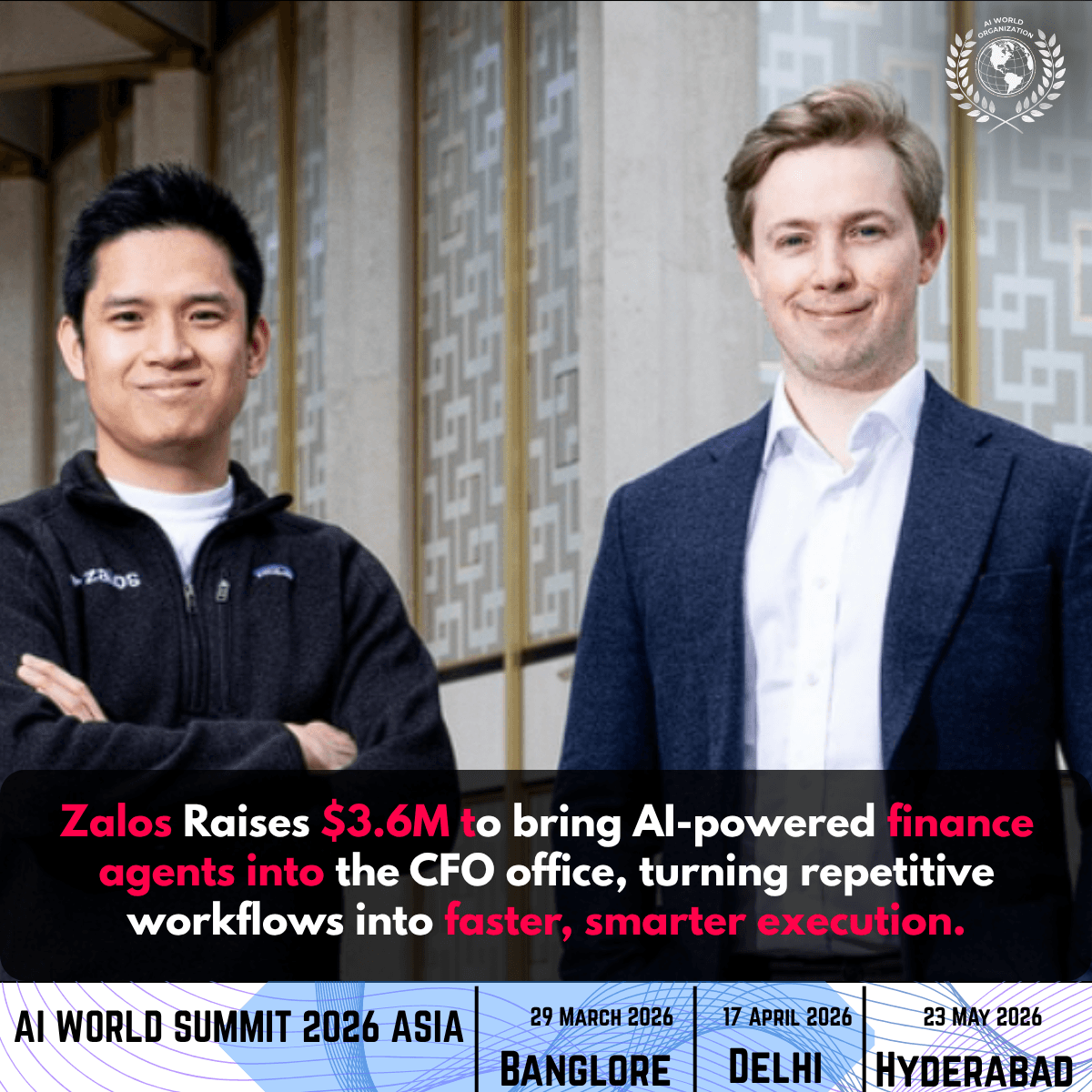
Zalos secures $3.6M seed funding to deploy AI-powered Computer Agents for CFO workflows. Explore the latest AI funding news shaping enterprise finance in 2026.
TL;DR
Zalos, a San Francisco-based startup, has raised $3.6M in seed funding led by 14 Peaks to build Computer Agents that automate repetitive finance workflows for CFOs think billing runs, ERP data entry, and month-end reconciliations. The agents learn by watching a screen recording and then execute the same tasks autonomously, with full audit logs. Backers include CFOs from FedEx, Tide, and Ada, plus founders of Indeed and 11x.
Zalos Raises $3.6M to Deploy AI-Powered Computer Agents for Finance Teams and CFOs
The world of enterprise finance is undergoing a quiet but powerful revolution. While headlines around artificial intelligence have largely been dominated by chatbots, image generators, and general-purpose assistants, a far more consequential transformation is taking shape beneath the surface — one that directly touches the nerve centre of every organisation: the finance function. In the latest AI funding news to emerge from San Francisco, Zalos, a 2025-born startup focused exclusively on building Computer Agents for finance operations, has raised $3.6 million in seed funding. This development is a strong signal that the era of AI agents that can actually operate enterprise software — not just advise on it — has officially arrived, and the CFO's office is ground zero.
At The AI World Organisation, we closely track how AI funding news shapes the future of industries globally. This particular round stands out not just for the capital raised, but for the strategic depth behind it — from the calibre of backers to the clarity of the problem Zalos is solving. It represents a pivotal moment in the broader conversation around what AI can practically deliver for the enterprise, and why targeted, domain-specific AI agents are increasingly winning the confidence of both investors and operators.
The Seed Round That's Turning Heads in AI Funding Circles
The $3.6 million seed round was led by 14 Peaks, a venture firm with a reputation for backing fintech and future-of-work startups at the frontier. Joining them were Cohen Circle and 20VC, two names well-regarded in the startup investment ecosystem. But it is the angel investor list that arguably makes this round exceptional in the AI funding landscape. The investors are not merely financial backers — they are a who's who of finance and technology leadership, bringing both credibility and deep domain knowledge to the table.
Among the angels are CFOs from globally recognised companies, including the CFO of FedEx, the CFO of Tide, and the CFO of Ada. Enterprise veterans such as a Global Vice President from Oracle and SAP have also joined the cap table. The founder cohort within the angel group is equally impressive, featuring the founder of Indeed, founders of zerohash, Tilt Payments, Beanworks Accounts Payable, and 11x, among others. Representation also comes from the head of Browser Infrastructure at Perplexity AI and multiple venture-backed founders across legal, accounting, and fintech verticals. This confluence of operational CFOs and serial founders investing together sends a very deliberate message: the problem Zalos is solving is real, deeply felt, and commercially significant.
For those following AI funding news in the enterprise automation space, it is worth noting that this round was not built on hype. It was built on a precise thesis — that the most meaningful productivity gains in finance will not come from replacing existing enterprise systems, but from building software that can operate them autonomously, the way a skilled human professional would.
What Are Computer Agents, and Why Do Finance Teams Need Them?
To understand why this AI funding round matters, one must first understand the distinction between AI tools that assist humans and AI agents that act on their behalf. Most enterprise software today, even AI-enhanced tools, still requires human input at every step. A finance professional might use a tool to generate a report, but they still need to log into the ERP, navigate the interface, cross-reference spreadsheets, reconcile discrepancies, and compile the output. This process is time-consuming, error-prone, and largely unchanged despite years of so-called digital transformation.
Computer Agents represent the next evolutionary step. These are software programmes that can log into systems, navigate digital interfaces, enter data, validate outputs, and complete multi-step workflows — all without requiring human hand-holding at each stage. They function much like a digital employee who has been trained to replicate a specific process, can do it consistently at scale, and never forgets a step.
For finance teams, the implications are enormous. Billing cycles, account reconciliations, intercompany transactions, month-end reporting, and ERP data entry are all high-volume, rule-bound tasks that currently demand significant manual effort. These are not creative or strategic tasks — they are operational necessities that consume hours of skilled finance professionals' time every week. Computer Agents can absorb this workload entirely. The result is not just faster execution but also a dramatic reduction in human error, faster close cycles, and the ability to redirect finance talent toward higher-value analysis and strategic decision-making.
Zalos has built its entire platform around this premise. Rather than asking finance teams to overhaul their existing software stack or undergo months-long implementation projects, the platform works with what is already in place. Finance teams across the globe use a fragmented ecosystem of ERPs like NetSuite, Sage, and SAP S/4HANA, alongside Excel, email, and a range of internal tools. Zalos operates across all of these environments without requiring any deep integration work, which is precisely what makes it so immediately deployable and commercially attractive.
How Zalos Actually Works: From Screen Recording to Autonomous Agent
The product design philosophy behind Zalos is refreshingly practical, and it deserves detailed examination because it addresses one of the most persistent frustrations in enterprise software: the gap between what a system promises and what it actually delivers in real-world conditions.
The process begins with something surprisingly simple — a screen recording. A finance professional records themselves performing a workflow, whether that is a billing run in NetSuite, a reconciliation in Excel, or a reporting task in SAP. The Zalos platform analyses this recording and converts it into a fully functional Computer Agent that can replicate the same process autonomously, on demand, and at scale. There is no complex coding required, no lengthy onboarding process, and no need to rebuild the workflow from scratch in a new system.
Once deployed, these agents operate just as a human would. They log in using existing credentials, navigate through system interfaces, click through dashboards, enter and validate data, and check outputs against predefined controls. Every single action is captured in a detailed, auditable log — which is non-negotiable in finance, where traceability and compliance are foundational requirements. The platform is also built with enterprise-grade security standards in mind, supporting single sign-on, role-based access controls, SOC 2 Type II compliance, and options for on-premise deployment for organisations with strict data governance policies.
This approach solves what the Zalos team describes as the "human API" problem. In most large organisations, finance professionals function as the connective tissue between systems that do not talk to each other. They manually extract data from one platform, transform it, and push it into another — acting, in effect, as a human integration layer. This is inefficient, scalable, and deeply frustrating for talented finance professionals who entered the field to analyse and advise, not to copy-paste data between systems. Zalos eliminates this entirely by replacing the human-as-connector with a software agent that can do the same job faster, more accurately, and without fatigue.
The insight behind this approach came directly from real conversations with CFOs. The co-founder and CEO of Zalos spent considerable time at a CFO-focused software company speaking with hundreds of finance leaders. The most consistent theme that emerged was a deep frustration with ERP implementations — projects that typically take twelve months or more, carry significant career risk if they go poorly, and deliver uncertain upside even when they succeed. The lesson was clear: any AI solution for finance must sit on top of the existing stack, not demand its replacement. That conviction became the architectural foundation of Zalos.
A Platform Designed Around the CFO and the Enterprise Finance Stack
At The AI World Organisation, one of the themes we have consistently tracked in AI funding news is the shift from horizontal AI platforms to vertical, domain-specific applications. Zalos is a textbook example of this trend, and its product strategy reflects a sophisticated understanding of how enterprise buying decisions are made and what finance leaders actually care about.
The primary users of Zalos are CFOs and finance leaders at mid-market and enterprise companies. These are individuals managing complex, multi-system environments where accuracy, auditability, and risk management are paramount. They are not early adopters by nature — they are pragmatists who need solutions that work reliably within existing infrastructure and can withstand the scrutiny of auditors, boards, and regulators. Zalos was designed with all of these constraints in mind.
The platform already supports the major mid-market ERPs, including NetSuite, Sage, and SAP S/4HANA, which together represent a substantial portion of the mid-market enterprise software landscape. The roadmap includes expansion into enterprise ERPs and on-premise systems, which would open the platform to larger organisations with even more complex environments and, correspondingly, even greater need for automation.
Beyond traditional enterprises, Zalos is gaining notable traction with technology companies and private equity firms. The appeal for PE firms is particularly compelling. Portfolio companies in a private equity portfolio are often acquired at different maturity levels, running different ERP systems, with different finance team configurations. Driving operational efficiency across these varied environments without forcing costly system harmonisation is a significant value creation lever. Zalos offers exactly that capability — a layer of autonomous agents that can operate across disparate systems, reducing manual effort and improving reporting speed without requiring the portfolio company to undergo a full-scale ERP overhaul.
The co-founder and CTO of Zalos brings a particularly relevant technical background to this challenge. Having spent five years at Apple Pay before becoming deeply involved in the Computer Agent research space — including time at a leading lab focused on agent-based systems — he brings both payment infrastructure experience and cutting-edge AI expertise to the platform. His conviction, rooted in hands-on research, is that Computer Agents represent the truest form of general artificial intelligence in practice, because they avoid the brittleness and limitations of API-dependent systems. In finance specifically, where APIs are often unavailable, poorly documented, or unreliable, this architecture gives Zalos a structural advantage over competitors who rely on conventional integration approaches.
The Competitive Landscape and What This Means for the Future of AI in Finance
The emergence of Zalos into the AI funding spotlight comes at a moment when the Computer Agent space is becoming increasingly competitive. The category includes generalist agents from the largest AI companies in the world. OpenClaw, which was built as a competitive product in this space, has since been acquired by OpenAI, underscoring just how strategically valuable this category has become. Anthropic's enterprise offering, Claude CoWork, is another force in the broader enterprise agent landscape. Against these generalist players, Zalos is making a deliberate and defensible bet on specialisation.
The argument for vertical focus is strong. Finance is not a domain where close-enough is acceptable. Every calculation must be correct. Every entry must be traceable. Every automated action must be explainable to an auditor. Generalist agents, trained on broad datasets and optimised for general task completion, are not inherently designed with these constraints in mind. A finance-native platform, one built from the ground up to understand ERP environments, accounting workflows, and compliance requirements, offers a fundamentally different value proposition. This is the moat Zalos is building, and the AI funding it has secured is the fuel for that construction.
Looking further ahead, the vision articulated by the Zalos leadership is not simply to automate individual tasks but to build a connected intelligence layer across the entire finance function. The concept of a "context graph" — a dynamic, evolving map of the finance team's workflows, systems, data flows, and relationships — underpins this vision. Once this layer is established, multiple agents can work together seamlessly, each handling different parts of a workflow while sharing context and coordinating outputs. The result would be a finance operation where human professionals focus entirely on judgment-intensive work — analysing results, making strategic recommendations, managing relationships — while agents handle the operational execution end-to-end.
This is not a distant aspiration. Zalos already has paying customers across the major mid-market ERPs. The seed funding will accelerate product development, deepen integrations with enterprise-grade systems, and expand the team. The progress made with the $3.6 million will be closely watched by investors, enterprise buyers, and the broader AI ecosystem. If Zalos can deliver on its roadmap, it will not just be another AI funding success story — it will be a case study in how deeply specialised, operationally grounded AI platforms can redefine what is possible in enterprise finance.
At The AI World Organisation, we believe that stories like this — where genuine technological innovation meets a clearly articulated commercial problem, backed by investors who understand the domain deeply — represent the most meaningful direction of AI development today. This is not AI for its own sake. This is AI funding being deployed in service of a real, measurable, and transformative outcome: freeing finance teams from the operational grind and enabling them to operate at their highest potential.