Ethos Raises $22.75M to Redefine AI Talent
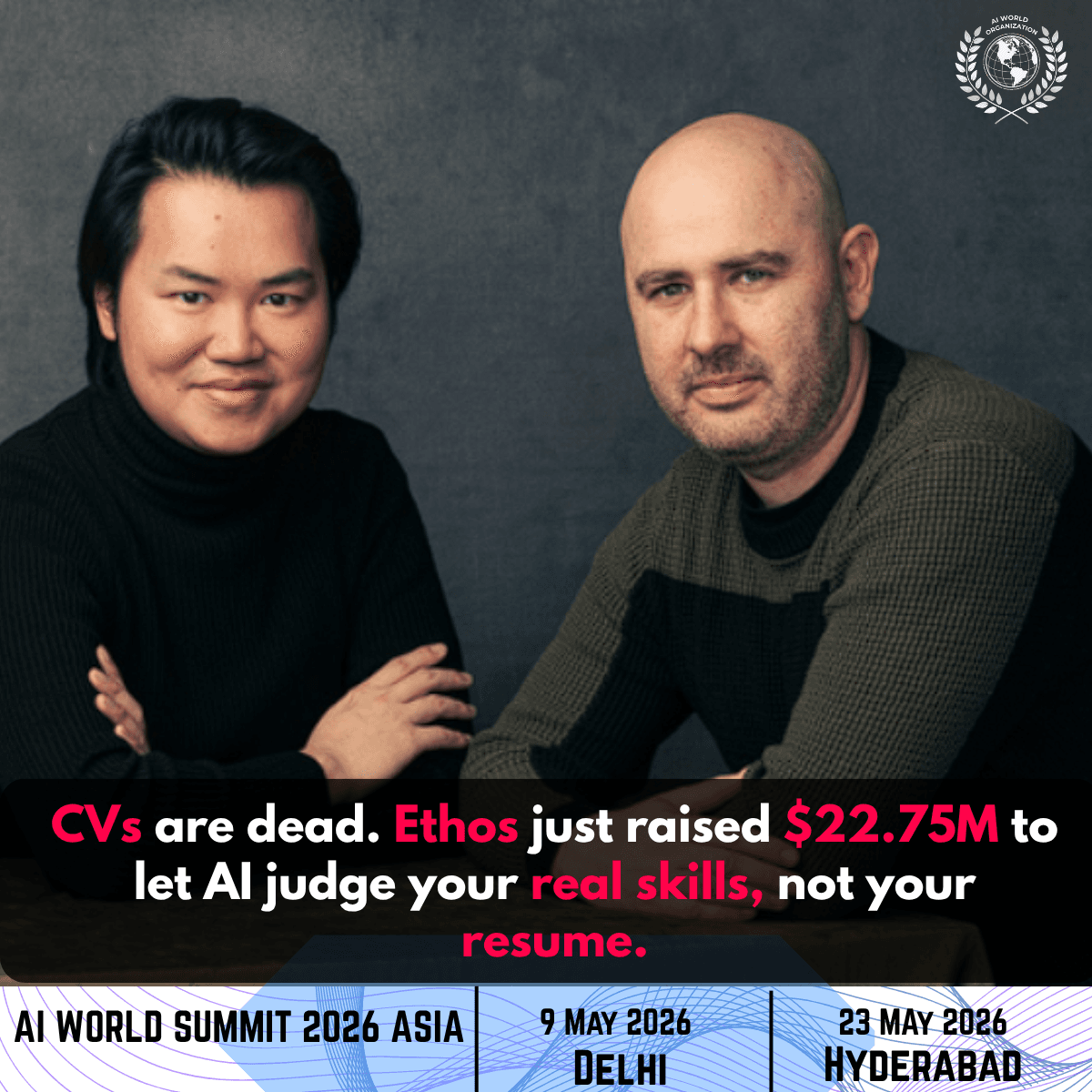
Ethos secures $22.75M Series A led by a16z and General Catalyst to replace CVs with an AI talent agent, connecting experts to high-value global opportunities.
TL;DR
London-based startup Ethos has raised $22.75 million in Series A funding, backed by Andreessen Horowitz and General Catalyst. Instead of relying on traditional CVs, Ethos uses an AI agent to evaluate real professional work — from code to research papers — and connects experts to paid opportunities. Over 5,000 professionals join weekly, earning an average of £4,500 extra per month through the platform.
Ethos Raises $22.75 Million in Series A Funding to Build the Future of AI-Driven Talent Matching
The global hiring landscape is going through one of the most disruptive phases in its history. Traditional resumes, long considered the gold standard for evaluating professional capability, are steadily losing their relevance in a world where artificial intelligence can generate polished job applications in seconds. Against this backdrop, a London-based startup called Ethos has just made a significant move — raising $22.75 million in Series A funding to reimagine how companies find talent and how professionals get discovered. This is one of the most compelling pieces of AI funding news to emerge from the European startup ecosystem this month, and it signals just how seriously the investment world is taking the intersection of AI and the future of work.
The round was led by none other than Andreessen Horowitz (a16z), one of Silicon Valley's most influential venture capital firms, and was joined by General Catalyst, another heavyweight in the global VC space. The sheer quality of backers alone tells a story — when firms of this caliber put their weight behind a startup at Series A stage, it's rarely a coincidence. It reflects deep conviction in both the problem being solved and the team's ability to execute at scale. For the broader AI funding ecosystem, this deal further confirms that talent intelligence is quickly becoming one of the most competitive and well-funded categories in enterprise technology.
The Problem That Ethos Set Out to Solve
To understand why Ethos is generating so much excitement, you have to first understand the scale of the problem it's tackling. For decades, the resume or CV has served as the primary document through which candidates present themselves to potential employers. It lists education, work experience, certifications, and skills — all self-reported, rarely verified, and increasingly easy to fabricate or embellish with the help of generative AI tools.
Today, AI tools make it incredibly fast and cheap to write compelling job applications. A person can generate a professional-sounding resume in minutes, even if their actual skills fall far short of what the document claims. On the employer side, this has led to an overwhelming surge in nearly identical applications. Investment funds, AI labs, consulting firms, and other knowledge-intensive businesses are drowning in profiles that all look the same on paper but offer very little signal about true expertise. The traditional filtering mechanisms — keyword screening, ATS software, recruiter calls — are struggling to keep pace with the volume and the noise.
This is the exact gap that Ethos is designed to fill. Rather than relying on what candidates say about themselves, Ethos uses AI to actually evaluate what candidates have done. The platform conducts AI-powered interviews, reviews academic papers, analyses code, and examines other professional outputs to build a comprehensive, evidence-based profile of each individual's capabilities. It goes beyond surface-level credentials to understand the actual depth and shape of a person's expertise — and then connects them with relevant paid opportunities, whether that's expert calls, market research, AI data labelling tasks, consulting projects, or full-time employment.
James Lo, co-founder and CEO of Ethos, put it plainly: "A CV is a poor proxy for what someone is truly capable of. Ethos helps people to see the full shape of their expertise and where it fits in an AI-transformed economy — acting as their agent, opening doors they didn't know existed, and giving companies a far more precise way to find the people they actually need. AI is reshaping the labour market faster than our tools for valuing human expertise can keep up. Ethos is built to change that."
The Founding Team and Their Vision
Ethos was co-founded in 2023 by James Lo and Daniel J. Mankowitz, both of whom bring exceptional pedigrees to the table. Lo previously worked at Google DeepMind, the world-renowned AI research laboratory, while Mankowitz also has roots at DeepMind, along with experience at McKinsey and SoftBank. Their combined exposure to cutting-edge AI research, strategic consulting, and global venture finance gives them a rare vantage point to understand both the technical complexity of what they're building and the market dynamics they're navigating.
The founding story of Ethos is not just a business narrative — it's a deeply personal one rooted in a lived frustration with how talent gets evaluated in the modern economy. Both founders have spent significant time in environments where the gap between what a resume says and what a person can actually do is painfully obvious. The solution they're building is, in many ways, the product they wish had existed when they were navigating their own careers.
What makes Ethos particularly interesting from an AI standpoint is that it doesn't just use AI as a feature — it positions AI as the core infrastructure of its talent intelligence engine. The AI agent doesn't simply match keywords; it synthesizes rich, contextual information from multiple professional artifacts to construct a nuanced picture of a candidate's true value. In a world increasingly shaped by large language models, the ability to understand expertise deeply — not just categorize it — is a genuine differentiator.
Rapid Growth and Real Earnings for Professionals
One of the clearest indicators that Ethos is building something that works is the pace at which professionals are joining the platform. According to the company, more than 5,000 professionals sign up every single week — a remarkable growth rate for a platform that was only founded in 2023. These aren't just tech workers, either. The user base spans a wide range of fields including accounting, banking, consulting, law, healthcare, technology, and even skilled trades such as electricians and plumbers. This breadth speaks to the universality of the problem Ethos is solving — expertise exists across every industry, and the challenge of surfacing and monetizing it is not unique to any one sector.
The financial impact on users is also compelling. On average, professionals on Ethos earn an extra £4,500 per month through opportunities surfaced by the platform. Among the top 10% of earners, that figure climbs above £7,000 per month. These are not trivial numbers — for many professionals, this represents a meaningful second income stream or, in some cases, earnings that rival or exceed their primary employment. The platform isn't just a job board or a networking tool; it's functioning more like a professional revenue engine for the people using it.
This focus on active opportunity delivery is what fundamentally separates Ethos from most of its competitors. Platforms like GLG and AlphaSights have built strong businesses in the expert network space, but they primarily operate through a model where clients search for experts. Toptal and newer entrants like Contra and Braintrust serve the freelance professional market but rely heavily on self-reported credentials. Ethos flips this dynamic by proactively surfacing the right opportunity to the right expert at the right time — a shift from passive talent marketplaces to an AI-powered talent agent model. This is where the latest AI funding news surrounding Ethos becomes especially meaningful: the capital will directly accelerate the intelligence behind this matching engine.
How This AI Funding Will Fuel Ethos's Next Chapter
With $22.75 million now in the bank, Ethos has articulated a clear plan for how it intends to deploy this AI funding round. The priorities are threefold: expanding the AI agent's capabilities, growing the global network of professionals on the platform, and building deeper partnerships with AI labs and enterprise clients.
On the product side, the goal is to make the AI agent smarter, faster, and more personalized. The current version already does something impressive — it evaluates professional work outputs and builds evidence-backed expertise profiles. But the next iteration will need to handle an even broader range of professional domains, support more nuanced forms of expertise evaluation, and surface even more precise opportunity matches for a rapidly growing user base. This requires significant investment in AI research, model training, and product engineering — exactly the kind of work that a well-structured Series A can enable.
From a market expansion perspective, Ethos has the potential to scale significantly beyond its current London base. The challenges of the CV economy are global, not regional. Every country, every industry, and every type of organization struggles with the same fundamental problem: finding the right person for the right role is hard when the tools for evaluating people haven't kept up with the complexity of modern work. With backing from Andreessen Horowitz and General Catalyst, Ethos has both the capital and the strategic relationships to pursue international growth aggressively.
Jeannette zu Fürstenberg, President and Managing Director of General Catalyst, captured the broader vision with notable clarity: "Knowledge is our most precious resource, yet for too long the expertise inside people's heads has been invisible to the economy. Ethos changes the game by capturing the true value of what people know and connecting it to the opportunities that need it most."
What This Means for the Future of Work and AI
Zooming out, the story of Ethos is really a story about where AI funding is flowing and why. Investors are increasingly gravitating toward companies that use AI not just to automate existing workflows, but to fundamentally reconceive how humans and institutions create and exchange value. The talent economy is one of the largest and most inefficient markets in the world — trillions of dollars of human expertise sit underutilized because the infrastructure for surfacing and deploying it simply doesn't exist at scale.
What Ethos is building — an AI agent that understands human expertise deeply and connects it to the economic opportunities that need it — is a genuinely new category of platform. It sits at the intersection of HR technology, AI infrastructure, and the future of professional services. And as AI continues to reshape the labour market, the ability to accurately measure and deploy human expertise will only become more valuable, not less.
At AI World Organisation, we see the Ethos funding round as a strong signal of where the broader AI ecosystem is heading. The most impactful AI applications of the next decade won't just be the ones that replace human tasks — they'll be the ones that make human expertise more visible, more accessible, and more valuable than ever before. This latest AI funding news from Ethos and its backers at a16z and General Catalyst is a perfect illustration of that thesis in action.
As the lines between human capability and artificial intelligence continue to blur, the companies that figure out how to bring the two together effectively — and equitably — will be the ones that define the next era of work. Ethos, with fresh capital and a clear mission, looks like a strong contender to be one of them.