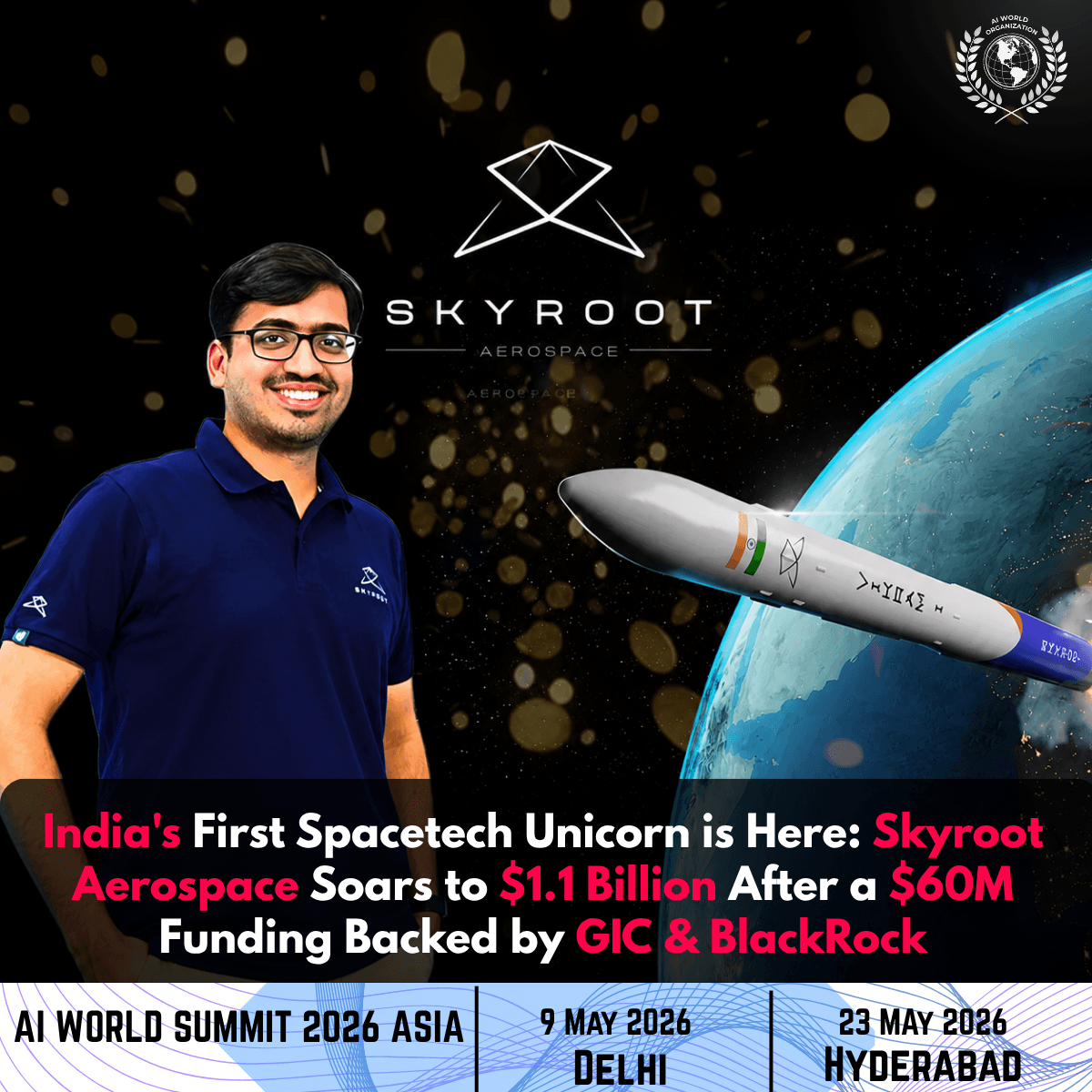
Skyroot Is Now India's First Spacetech Unicorn
Skyroot Aerospace raises $60 million from GIC, BlackRock & Sherpalo Ventures, hitting a $1.1 billion valuation to become India's first spacetech unicorn in 2026.
TL;DR
Hyderabad-based Skyroot Aerospace has become India's first spacetech unicorn after closing a $60 million funding round led by Sherpalo Ventures, GIC, and BlackRock — pushing its valuation past $1.1 billion. The company, founded by two ex-ISRO scientists, is now gearing up for the orbital launch of its Vikram-1 rocket while simultaneously developing the more powerful Vikram-2.
Skyroot Aerospace Crosses the $1.1 Billion Mark: India's Spacetech Sector Gets Its First Unicorn
India's private space industry has achieved a milestone that many in the startup ecosystem had been waiting for. Hyderabad-based Skyroot Aerospace has officially entered the unicorn club after successfully closing a $60 million funding round, pushing its valuation past the $1.1 billion mark. This makes Skyroot the first spacetech company in India to achieve this status — a moment that signals not just the company's own growth, but the broader maturation of India's commercial space ambitions. For those tracking AI funding news and deep-tech investment trends, Skyroot's journey offers a compelling case study in how patient capital, strong founding teams, and the right policy environment can combine to create transformational outcomes.
The funding round was co-led by Sherpalo Ventures and GIC, Singapore's sovereign wealth fund — a pairing that brings together Silicon Valley heritage and Southeast Asian institutional strength. The round also saw participation from investment giant BlackRock, Arkam Ventures, Playbook Partners, Shanghvi Family Office, and existing backers including the founders of Greenko Group, one of India's largest renewable energy companies. With this round, Skyroot's total capital raised has now climbed to approximately $160 million — a number that reflects the growing confidence global investors are placing in Indian deep-tech and space ventures.
From ISRO Labs to Launchpads: The Skyroot Story
Skyroot Aerospace was founded in 2018 by Pawan Kumar Chandana and Naga Bharath Daka, both former scientists from the Indian Space Research Organisation (ISRO). The duo left the safety of government jobs with a bold vision — to build India's first private launch vehicle and give satellite operators around the world affordable, on-demand access to space. That ambition wasn't just a pitch deck dream. In November 2022, Skyroot became the first private Indian company to successfully launch a rocket into space with its Vikram-S mission, a suborbital flight that validated critical technologies including solid propulsion systems, carbon composite structures, avionics, and telemetry.
The Vikram-S launch, called Mission Prarambh (meaning "beginning" in Sanskrit), was more than a technical demonstration — it was a statement of intent. It proved that private players in India could compete on the global stage. And now, with fresh capital in hand, Skyroot is preparing to take the next leap forward. The company is actively working toward the orbital debut of Vikram-1, its first full-fledged small-lift launch vehicle, and is simultaneously accelerating work on Vikram-2, a heavier launch vehicle that will feature a cryogenic propulsion stage — a significant leap in capability that very few private companies globally have managed.
The Vikram series of rockets is designed specifically for the growing small satellite market, offering what the company describes as fast, flexible, and cost-effective launches. As the global demand for satellite deployment — particularly for LEO (Low Earth Orbit) constellations — continues to surge, Skyroot's position as an Indian-origin launch provider with competitive pricing and domestic regulatory backing gives it a distinctive edge in the international market.
What the $60 Million Means: Scale, Speed, and the Road Ahead
The proceeds from this latest funding round are earmarked for three core priorities: scaling up manufacturing capacity, increasing the frequency of Vikram-1 launches, and fast-tracking the development of Vikram-2. These are not vague strategic aspirations — they are operational mandates that will define how quickly Skyroot can convert its valuation into actual revenue.
As part of the deal, Ram Shriram, the founder of Sherpalo Ventures and one of Google's earliest investors, will join Skyroot's board of directors. This is a significant addition — Shriram's involvement is not just symbolic. His experience backing early-stage companies that went on to reshape industries brings strategic value that extends well beyond the capital itself. His appointment signals that Skyroot is entering a more structured phase of corporate governance, preparing itself for the kind of operational discipline that precedes a potential public listing or major international partnership.
For those following AI funding news and deep-tech investment cycles, this round also underscores a broader global trend: sovereign wealth funds and institutional investors are increasingly backing frontier technology companies in emerging markets. GIC's participation alongside BlackRock is particularly telling. These are not venture-style bets — they are calculated, long-term plays on the future of commercial space. India, with its proven scientific infrastructure, a growing pool of technical talent, and a government that has actively liberalized space sector FDI rules (allowing up to 100% FDI via the automatic route for certain sub-segments), is increasingly seen as one of the most attractive destinations for spacetech capital.
It is also worth noting that Skyroot remained in the pre-revenue stage as of the end of FY25 (March 2025), and its losses widened to approximately Rs 99.70 crore during the year, primarily due to continued heavy investment in R&D. This is entirely expected for a deep-tech company in the build phase — the kind of company that needs to spend years perfecting technology before it can monetize it. The fact that investors are willing to value this company at $1.1 billion despite it not yet generating revenue reflects the quality of the founding team, the strength of the technology roadmap, and the sheer scale of the market opportunity ahead.
India's Unicorn Club in 2026: A New Chapter for Deep Tech
Skyroot's unicorn milestone carries additional significance when placed within the context of India's broader startup landscape in 2026. The company becomes the fourth Indian startup to enter the unicorn club this year, joining a list that includes KreditBee, which crossed the billion-dollar mark last month after its $280 million Series E round; Neysa, a generative AI startup that turned unicorn in February following a Blackstone-led funding round worth $1.2 billion; and Juspay, which hit the $1 billion valuation mark in January after a $50 million investment from WestBridge Capital.
What makes Skyroot's addition to this group particularly meaningful is that it represents a category that hasn't appeared in India's unicorn list before — spacetech. While India has produced unicorns across fintech, edtech, healthtech, and SaaS, the space industry has historically been the exclusive domain of government agencies like ISRO. That paradigm is now shifting decisively. The Indian government's decision to open the space sector to private players, combined with targeted support measures like the INR 1,000 crore fund for spacetech startups and a 0% GST regime for early-stage space companies, has created an environment where commercial space ventures can grow from lab to launchpad to unicorn within a decade.
Other well-funded spacetech startups in India — including Agnikul Cosmos, Pixxel, and Digantara — are watching Skyroot's trajectory closely. Agnikul has been developing its own Agnibaan launch vehicle using a unique semi-cryogenic engine architecture. Pixxel is building a hyperspectral satellite constellation for earth intelligence. Digantara is focused on space situational awareness, tracking debris and satellites in orbit. Together, these companies represent a new generation of Indian deep-tech builders who are taking on problems that were previously considered the exclusive province of nation-states. Skyroot reaching unicorn status will likely accelerate fundraising conversations across the entire sector.
The AI funding landscape is also deeply intertwined with this story. Advanced AI tools — for trajectory optimization, satellite scheduling, propulsion modeling, and mission planning — are increasingly embedded in the workflows of modern space companies. Skyroot, like many frontier tech companies, is not just a rocket manufacturer. It is a data-driven, AI-assisted engineering organization working at the cutting edge of multiple disciplines simultaneously. As AI funding news continues to dominate the global tech headlines, the convergence of artificial intelligence and space technology is producing some of the most exciting companies of this decade.
India's Space Ambitions: The Bigger Picture
Prime Minister Narendra Modi has been vocal about his expectations from the Indian spacetech ecosystem. At a high-profile address last year, he challenged Indian space startups to create five unicorns in the next five years. With Skyroot checking off the first box, that target suddenly looks less aspirational and more achievable.
The government's broader policy posture has been supportive. The establishment of IN-SPACe (Indian National Space Promotion and Authorisation Centre) as a regulatory body has given private players a clearer, more predictable pathway to operate. The liberalization of FDI rules in the space sector was another critical signal to global investors that India is serious about building a commercial space ecosystem that can compete with the United States, Europe, and China over the coming decades.
For context, the global small satellite launch market is expected to grow substantially through the rest of the decade, driven by the proliferation of broadband internet constellations, remote sensing satellites, IoT connectivity networks, and climate monitoring systems. India, with its cost-competitive engineering talent and established space infrastructure through ISRO, is uniquely positioned to capture a meaningful share of this market. Skyroot is leading that charge — and its unicorn status, backed by the kind of investors who backed Google and managed the sovereign wealth of Singapore, suggests that global capital agrees.
From an AI World Organisation perspective, developments like Skyroot's unicorn milestone matter deeply. The intersection of AI, deep tech, and frontier industries like space is precisely where the next decade of innovation is being written. As AI funding news flows into companies that are building the infrastructure of tomorrow — from launch vehicles to satellite networks to AI-powered mission systems — tracking these milestones is not just about financial headlines. It is about understanding the trajectory of human ambition and technological capability.


