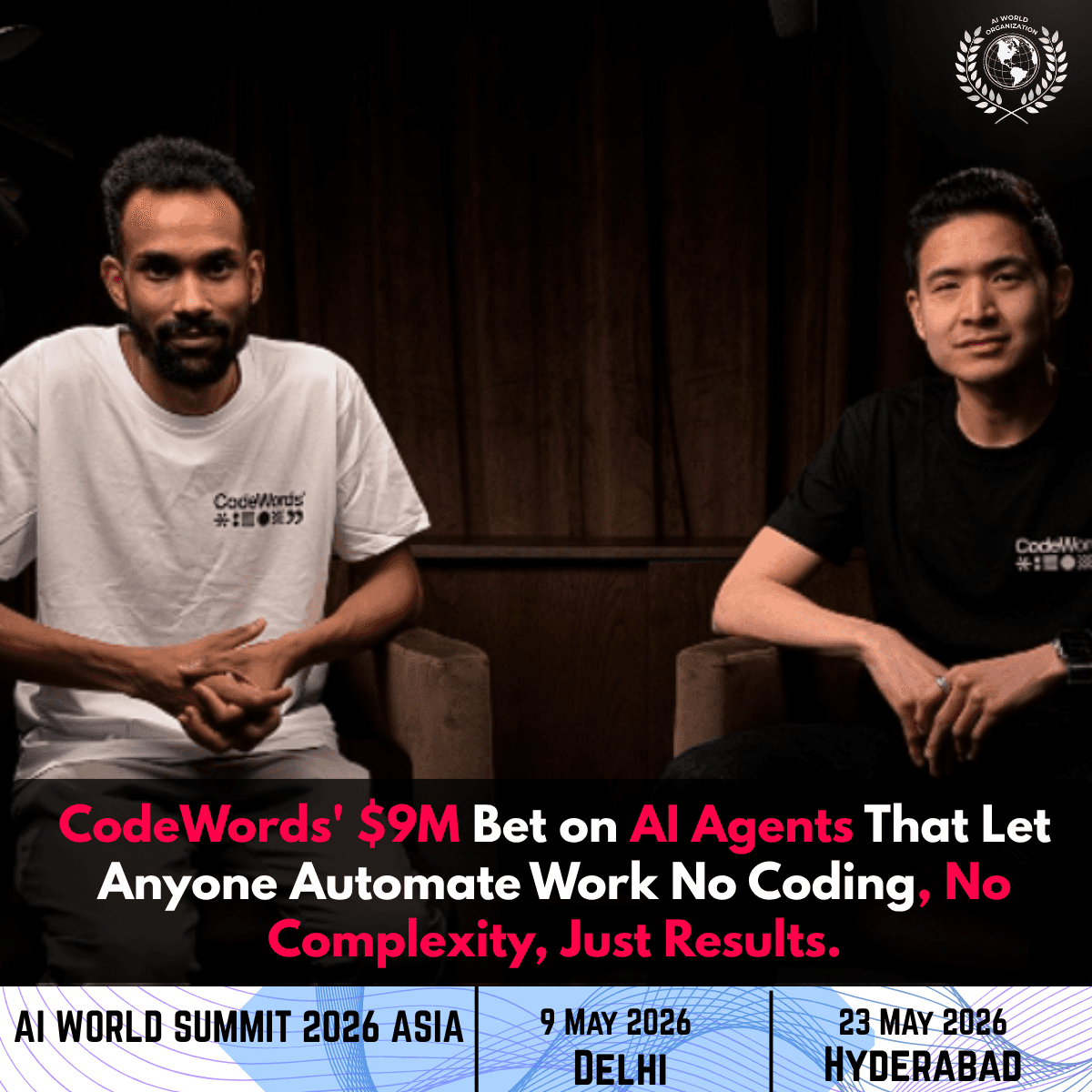
CodeWords Raises $9M to Power AI Agent Automation
London-based CodeWords secures $9M in seed funding to deploy Cody, its no-code AI agent automating business workflows for non-technical teams worldwide.
TL;DR
London startup CodeWords has raised $9M in seed funding to expand Cody, its AI agent that automates business workflows for non-technical teams using plain language — no coding needed. Backed by Visionaries and angels from Miro, ElevenLabs, HubSpot, and even executives from Zapier, Cody already processes over 500,000 workflows monthly. Fresh features like memory retention and WhatsApp integration make it a tool worth watching in the AI funding space.
The AI automation space just got a major shot of confidence. London-based startup CodeWords — formerly operating under the name Agemo — has successfully closed a $9 million seed funding round, and the names backing this round say a lot about where the industry is heading. This latest AI funding development marks a significant milestone not just for the company, but for the broader narrative around making artificial intelligence accessible to people who don't write a single line of code. At a time when most enterprise tools still demand technical fluency to unlock their full value, CodeWords is betting on a radically simpler approach — and investors are clearly buying in.
The round was led by Visionaries, a venture firm with a strong track record in backing deep tech and AI-native businesses. Joining them at the table were firstminute capital, Sequel, and Illusian, a cohort of investors that brings both capital and strategic credibility to the table. But what makes this AI funding news particularly compelling is the roster of angel investors who chose to participate personally. These aren't just passive check-writers — they are some of the most recognizable names in global tech.
A Star-Studded Investor Lineup That Signals Industry Confidence
Angel investors in this round include Andrey Khusid, the CEO of collaborative whiteboard giant Miro; Mati Staniszewski, who leads ElevenLabs, one of the fastest-growing AI voice companies in the world; Hanno Renner, CEO of Personio, Europe's leading HR software platform; Robert Gentz, co-founder and CEO of Zalando, one of Europe's largest e-commerce companies; and Ilkka Paananen, the founder of mobile gaming powerhouse Supercell. Alexandre Berriche, the founder of Fleet, also joined in, as did Kieran Flanagan, CMO at HubSpot — a name synonymous with modern inbound marketing strategy. Rounding out this impressive list is François Chollet, the co-founder of the ARC Prize and one of the most widely respected voices in AI research globally.
Beyond these headline names, the round also saw participation from senior executives at OpenAI, Mistral, n8n, and Zapier. That last pair is particularly noteworthy — n8n and Zapier are direct competitors in the workflow automation space, and having executives from those companies personally invest in CodeWords speaks volumes. It suggests that even people inside the existing automation ecosystem recognize that CodeWords is doing something distinctly different, and potentially transformative.
This level of angel participation in an early-stage seed round is unusual and underscores just how much belief the global AI community has placed in this team and their vision. When some of the sharpest minds in technology decide to put their own money into a startup, it becomes one of the most credible signals that something genuinely valuable is being built.
The Team Behind CodeWords: From Big Tech to Building for the Future
CodeWords was founded in 2023 by Osman Ramadan and Aymeric Zhuo, two individuals whose professional backgrounds read like a who's who of elite technology companies. Ramadan brings experience from Palantir, the data analytics and AI company known for working with some of the world's most complex enterprise problems, while Zhuo has spent time at both Microsoft and Meta — two organizations at the absolute forefront of global AI development. The duo also has ties to PolyAI, a conversational AI company that has made significant strides in enterprise voice automation.
What makes this founding story compelling from an AI funding news perspective is the speed at which Ramadan and Zhuo moved from concept to product. According to Robert Jäckle, a partner at Visionaries who led the investment, the team went from research phase to a fully functioning product in a matter of months. That pace of execution — rare in any startup environment, and even rarer in AI infrastructure development — was a key factor in Visionaries' decision to lead the round.
Zhuo has been vocal about the philosophy that drives CodeWords. In his own words, "The best operators don't wait to be asked. We built Cody on the same principle — an agent that learns about your business, sees what needs doing, and delivers outcomes." That framing is telling. The goal isn't just to build another automation tool — it's to create an intelligent system that functions more like a proactive team member than a passive software product.
What Cody Does — And Why It's Different from Existing Automation Tools
At the heart of CodeWords is Cody, an AI agent designed to handle repetitive business workflows without requiring users to build, configure, or maintain any technical infrastructure. To understand why this matters, it helps to look at the current landscape of no-code and low-code automation tools.
Platforms like Zapier and Make have done a remarkable job of democratizing automation over the past decade. Millions of businesses use them to connect apps, move data, and trigger actions across their software stacks. But as anyone who has spent time with these platforms knows, there's still a meaningful technical burden involved. You need to understand trigger-and-action logic, map data fields between systems, handle errors, and continuously maintain workflows as software updates and API changes break existing automations. For business users without a technical background, this remains genuinely hard.
CodeWords removes that layer entirely. With Cody, users describe what they need in plain language, and the agent handles everything else — from deployment and setup to ongoing maintenance and adaptation. There are no flowcharts to design, no conditional logic to configure, and no integrations to troubleshoot. As Robert Jäckle put it, "Most automation tools promise simplicity, but still require technical thinking underneath. CodeWords is one of the first products we've seen where that truly disappears — you describe the task, and Cody runs it."
The real-world applications of this are already visible. CodeWords reports that Cody is currently handling over 500,000 workflows every single month. The use cases span a wide range of business functions — from monitoring deal pipelines and automating social media publishing, to running lead generation tasks and tracking competitor activity. Teams at agencies, go-to-market functions, and non-technical business units are already benefiting from what the platform can do, without needing to involve developers or data engineers.
This is where the company's value proposition becomes particularly resonant with the current AI funding landscape. Investors across the world are looking for AI companies that can demonstrate real, recurring, measurable usage — not just impressive demo videos. Half a million workflows processed monthly at the seed stage is a meaningful proof point, and it's the kind of traction that justifies confidence from both investors and enterprise customers.
New Features, Expanding Vision, and What Comes Next for CodeWords
Alongside the funding announcement, CodeWords revealed that it is rolling out three significant new features that will further deepen Cody's capabilities and make it more useful across a wider range of business contexts.
The first is contextual memory. This allows Cody to retain knowledge about a specific business, its processes, preferences, and history, so that it becomes more effective over time rather than starting from scratch with every interaction. This is a meaningful upgrade because it moves Cody closer to functioning as a genuine institutional knowledge holder — something that has historically required human effort to maintain.
The second new feature is WhatsApp integration. By bringing Cody into WhatsApp, CodeWords is meeting users on a platform they already live on for business communication, particularly relevant in markets across Europe, Asia, and Latin America where WhatsApp is a primary professional tool. This dramatically expands the reach of the platform and lowers the barrier to entry even further.
The third update involves the introduction of different Cody modes — effectively new ways in which the agent can plan, reason, and execute tasks. These modes allow users to tune how Cody approaches a given problem depending on whether they need speed, depth, caution, or creativity. It's a thoughtful addition that signals CodeWords is thinking carefully about how enterprise teams with different risk profiles and operational rhythms will use the product in practice.
As for how the $9 million will be deployed, the company has been clear: the capital will go toward expanding both the go-to-market team and the engineering function. That's a sensible allocation at this stage. More engineers means faster product development and the ability to take on more complex enterprise use cases. More go-to-market resources means the ability to convert the strong organic interest the platform is already generating into durable, long-term customer relationships.
CodeWords in the Context of the Broader AI Agent Investment Wave
To fully appreciate what this AI funding news means, it's worth stepping back and looking at the broader market context. AI agents — software systems capable of planning, reasoning, and taking autonomous action to achieve goals — have become one of the hottest categories in technology investing over the past 18 months. Billions of dollars have flowed into companies building agentic systems for everything from legal research and financial analysis to customer support and software development.
But much of that investment has gone into tools that still require significant technical sophistication to deploy and manage. The gap between what AI agents can theoretically do and what non-technical business users can practically access remains wide. CodeWords is explicitly targeting that gap, and the AI funding community's response — led by a firm like Visionaries and backed by a remarkable group of angel investors — suggests that the market opportunity is very real.
The AI World Organisation has consistently tracked this shift toward agentic AI as one of the most consequential trends in enterprise technology. The ability for a business user — someone who runs sales operations, manages marketing campaigns, or oversees customer success — to interact with an AI agent in natural language and get meaningful business outcomes without any technical dependency is not just a convenience. It is a fundamental shift in how work gets done, and which teams within an organisation can scale their output without proportionally scaling their headcount.
CodeWords, through Cody, is building the infrastructure for that shift. And with $9 million in the bank, a world-class investor base, and half a million monthly workflows already running on the platform, they have a genuine foundation to build from. The coming months will be telling — particularly as the company expands its engineering team to broaden Cody's capabilities and its go-to-market function to bring the product to a wider global audience.
For anyone watching the AI agent space, CodeWords is a name worth paying close attention to. This is exactly the kind of team, building exactly the kind of product, that could meaningfully shift how businesses of all sizes think about automation, productivity, and the role of AI in their daily operations.


