Xovian Aerospace Raises $2M in AI Satellite Funding
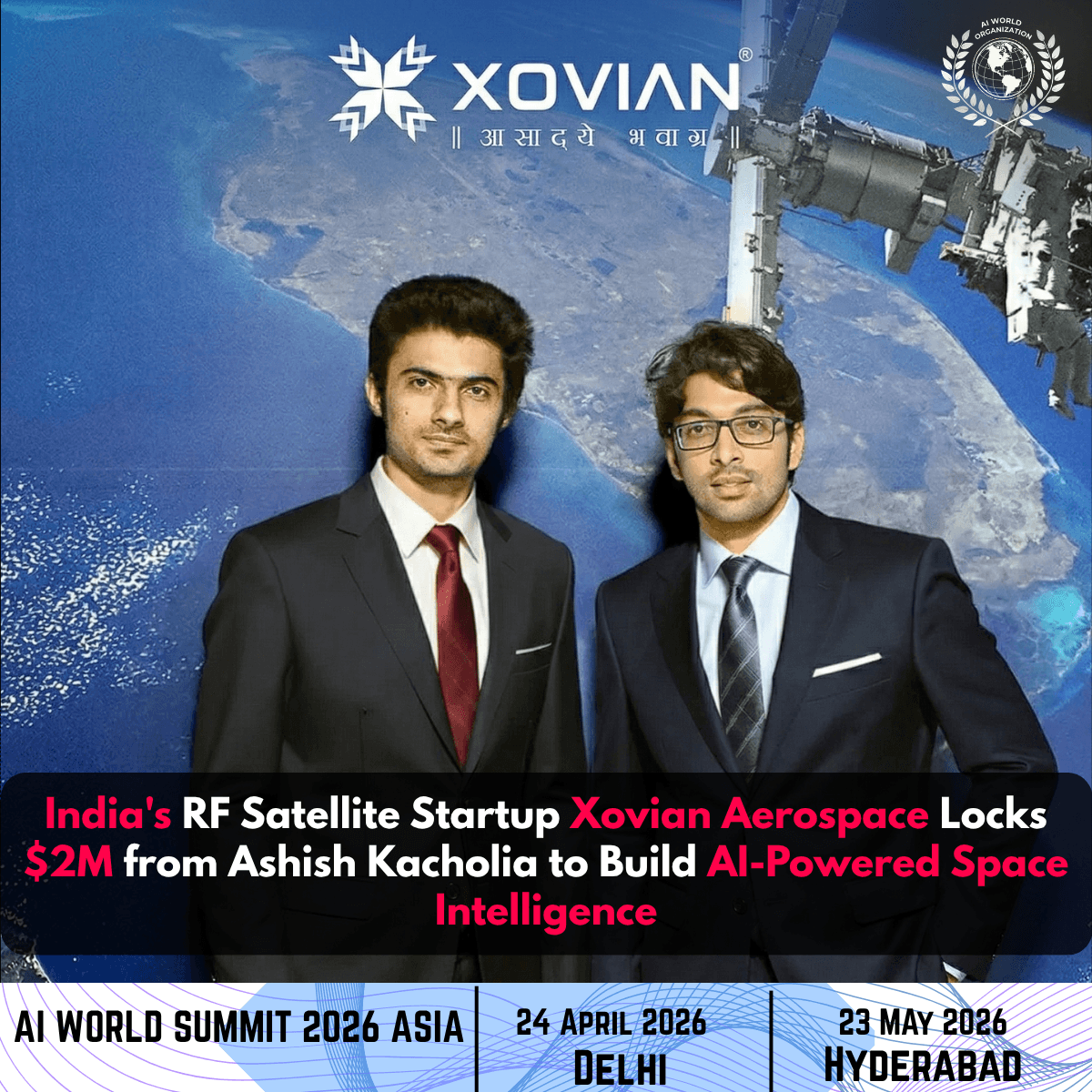
Xovian Aerospace secures $2M in strategic AI funding led by Ashish Kacholia to scale RF satellite intelligence across defense, maritime, and climate sectors.
TL;DR
Bengaluru-based Xovian Aerospace has raised $2 million in a strategic round led by ace investor Ashish Kacholia, with Inflection Point Ventures also participating. The startup builds AI-native RF satellites that track ships, aircraft, and climate signals — even through clouds and at night. Funds will go toward satellite development, team expansion, and enterprise pilots across India, Southeast Asia, and the Middle East.
Xovian Aerospace Secures $2 Million in Strategic Funding Led by Ashish Kacholia to Advance AI-Powered RF Satellite Intelligence
In a significant development for India's rapidly growing space technology sector, Bengaluru-based satellite intelligence startup Xovian Aerospace has successfully closed a $2 million strategic investment round, led by renowned ace investor Ashish Kacholia. The round also saw renewed participation from existing backer Inflection Point Ventures (IPV), reaffirming institutional confidence in the company's long-term vision. This fresh capital injection comes at a time when AI funding in the deep-tech and space-tech domains is seeing an unprecedented surge globally, with Indian startups increasingly claiming their share of the spotlight. As AI funding news continues to dominate headlines across the technology investment landscape, Xovian Aerospace's latest milestone stands out as a bold and strategically significant step forward for India's private space industry.
The Bengaluru-based company, which specializes in building AI-native radio frequency (RF) satellite infrastructure, plans to deploy the newly raised funds across three core priorities: advancing satellite development, rapidly scaling its engineering and AI teams, and deepening commercial partnerships with governments, enterprises, and humanitarian organizations. With this round now closed, Xovian Aerospace's total disclosed funding stands at approximately $4.5 million — a figure that reflects the growing appetite among serious investors for deep-technology companies solving real-world intelligence challenges through space-based platforms.
From Pre-Seed to Strategic: Xovian's Funding Journey So Far
Xovian Aerospace's investment story began gaining momentum in August last year, when the startup successfully raised $2.5 million in a pre-seed funding round. That round was led by venture capital firm Piper Serica and early-stage accelerator TurboStart, with co-participation from Inflection Point Ventures (IPV) and Eaglewings Ventures. The pre-seed capital was critical in helping the company validate its core technology thesis — that radio frequency signals, rather than optical imagery, represent the future of real-time satellite intelligence.
That original AI funding round set the foundational tone: a team of deep-tech engineers and space scientists building something the market had not yet seen at scale in India. The involvement of Piper Serica, a firm known for backing high-quality research-driven businesses, gave Xovian's mission early credibility. TurboStart's participation further accelerated the startup's go-to-market preparation, equipping the founding team with the mentorship and network needed to scale from prototype to commercial deployment.
Now, with the latest $2 million strategic round led by Ashish Kacholia — a name synonymous with identifying multi-bagger investment opportunities in India's stock and startup ecosystem — the company is entering a new phase. Kacholia's involvement is not merely financial; it is a strong endorsement of Xovian's technology differentiation and the company's positioning at the intersection of artificial intelligence, satellite communications, and national security intelligence. For the broader AI funding news landscape, this deal signals that sophisticated individual investors are increasingly willing to bet on frontier technology startups building sovereign-grade intelligence infrastructure in India.
The Technology That Sets Xovian Apart: AI-Driven RF Satellite Intelligence
At the heart of Xovian Aerospace's value proposition is a deceptively simple but deeply powerful idea: the world is awash in radio frequency signals, and most of them are going completely unanalyzed. Ships broadcast AIS signals. Aircraft emit transponder data. Weather systems generate measurable electromagnetic patterns. Military and industrial assets communicate through radio waves constantly. Yet the dominant approach to satellite intelligence has historically relied on optical imaging — cameras in space capturing visual photographs of the Earth's surface.
Optical imaging, while powerful, has significant and well-documented limitations. Cloud cover renders it useless across large geographies for extended periods. Nighttime operations eliminate visibility entirely. Camouflage, underground infrastructure, and dark vessels — ships that deliberately switch off their transponders to avoid detection — can evade optical satellites with relative ease. This is the fundamental gap that Xovian Aerospace was founded to close.
The company's AI-native platform is built around a radio-based nanosatellite infrastructure that captures and analyzes the electromagnetic spectrum around the clock, irrespective of weather, lighting, or deliberate signal suppression. By deploying a constellation of small satellites equipped with multi-frequency RF receivers, Xovian can simultaneously collect Geospatial Intelligence (GEOINT) and Signals Intelligence (SIGINT) data from a single platform. This dual-mode approach dramatically increases the volume and richness of intelligence data available in real time, while keeping costs significantly lower than traditional large-format satellite systems.
What truly sets this apart is the AI layer that sits on top of the raw signal data. Xovian's proprietary AI algorithms process the incoming RF data streams to identify patterns, detect anomalies, predict risk events, and generate decision-ready intelligence dashboards for end users. Crucially, the platform is vertically integrated — from the satellites that capture the signals, to the AI engines that interpret them, to the API-based subscription platform through which enterprise customers access the intelligence. This end-to-end control gives Xovian a significant competitive moat, since it ensures full control over data quality, processing latency, and innovation cycles.
Co-founder Ankit Bhateja has previously articulated the company's ambition in clear terms: "We are capturing the entire radio spectrum to deliver real-time, actionable intelligence across sectors. Our vertically integrated platform means satellites that listen, AI that understands, and a dashboard that supports critical decision-making." This captures the essence of why AI funding news around Xovian continues to generate excitement — it is not just another satellite imaging company, but a fundamentally different approach to understanding the physical world through the electromagnetic spectrum.
Founding Story, Team, and the ISRO Advantage
Xovian Aerospace was co-founded in 2019 by Ankit Bhateja and Raghav Sharma, two entrepreneurs who had previously built a space education technology startup and worked on a satellite mission together. Their shared background gave them first-hand understanding of both the technical complexity and the commercial opportunities inherent in building space-based intelligence platforms. Crucially, the team is backed by former scientists from the Indian Space Research Organization (ISRO), whose deep expertise in satellite technology development lends significant engineering credibility to the company's ambitions.
The ISRO connection is more than symbolic. India's space program has produced generations of world-class satellite engineers, and having former ISRO scientists involved in a private space startup brings institutional knowledge that cannot easily be replicated. Their involvement accelerates the company's ability to navigate the technical challenges of building, launching, and operating nanosatellites — from payload design and frequency licensing, to orbital mechanics and ground station operations.
The startup has already achieved meaningful commercial traction, with pilot customers in the maritime and aviation sectors. These two verticals represent an ideal initial market for Xovian's technology: maritime operators face the persistent problem of dark vessel tracking (where ships disable transponders to conceal cargo or location), while aviation stakeholders benefit from enhanced real-time aircraft monitoring beyond the coverage limits of conventional radar. Both sectors are characterized by high stakes decision-making where actionable intelligence has a direct and measurable economic value — precisely the environment where Xovian's platform can command strong pricing and long-term enterprise contracts.
Looking ahead, the company has outlined an ambitious technology roadmap. It plans to validate its payload on ISRO's PSLV rocket by the end of this year and expects to begin pilot trials with five to six enterprise customers across India, Southeast Asia, and the Middle East by Q2 2026. A full constellation of ten satellites is targeted by 2027 — a scale that would give the platform near-continuous global coverage and dramatically expand the breadth and depth of intelligence it can deliver. As AI funding continues to flow into deep-tech space ventures, Xovian is well-positioned to raise additional capital to execute this constellation buildout.
The Market Opportunity: Climate, Defense, Aviation, and Maritime Intelligence
The addressable market for what Xovian Aerospace is building is enormous and growing rapidly. The company's technology platform is designed to deliver intelligence across five broad verticals: climate, defense, aviation, maritime, and infrastructure. Each of these represents a multi-billion-dollar industry segment where real-time, weather-independent, signal-based intelligence can provide decisive strategic or economic advantages.
In the maritime domain alone, illegal, unreported, and unregulated (IUU) fishing causes estimated global losses of $50 billion annually. The ability to track dark vessels through RF signal monitoring — even when they disable their standard AIS transponders — is a capability that coast guards, port authorities, environmental agencies, and naval intelligence units are willing to pay significant premiums for. Similarly, the climate risk management sector, valued at approximately $97 billion in insurance exposure, represents a major opportunity where satellite-based environmental monitoring can dramatically improve risk modeling accuracy.
In the defense and geopolitical intelligence space, the value proposition becomes even more acute. As global geopolitical tensions rise across multiple theaters — from the Indo-Pacific to Eastern Europe to the Middle East — governments and defense agencies are increasingly seeking to build resilient, redundant intelligence infrastructure that can operate independently of allied systems. India's own defense modernization program has created strong domestic demand for sovereign intelligence capabilities, and Xovian's AI-native platform is positioned to serve as a critical component of that infrastructure.
The company's combined GEOINT and SIGINT platform is directly relevant to border monitoring, maritime domain awareness, counter-smuggling operations, disaster response coordination, and infrastructure monitoring. For humanitarian organizations operating in conflict zones or climate-affected regions, the ability to receive real-time situational awareness without relying on weather-dependent optical imagery can quite literally save lives. This humanitarian dimension adds a compelling social impact layer to Xovian's commercial story — one that resonates strongly with the kinds of institutional and impact-focused investors who are driving the current wave of AI funding into the deep-tech sector.
From a competitive standpoint, other players operating in adjacent spaces include OrbitAid, InspeCity, and Sisir Radar. However, Xovian's differentiated positioning — built around the RF spectrum rather than optical imaging, and deeply integrated with AI at every layer of the stack — gives it a distinct technical moat that is difficult to replicate. At the AI World Organisation, we have been closely tracking the evolution of AI funding news across the Indian deep-tech landscape, and Xovian Aerospace represents exactly the kind of compound innovation — where artificial intelligence, space technology, and national security converge — that defines the next frontier of high-impact startup development.
What Ashish Kacholia's Bet Means for India's Space-Tech Ecosystem
The name Ashish Kacholia carries significant weight in the Indian investment community. Known popularly as the "Big Bull" of small and mid-cap investing, Kacholia has a long and distinguished track record of identifying transformational businesses at early stages and backing them with patient, conviction-driven capital. His decision to lead Xovian Aerospace's latest funding round is, therefore, far more than a transactional event — it is a public endorsement of the company's technology, team, and market potential from one of India's most respected and successful investors.
For the broader Indian space-tech ecosystem, Kacholia's involvement sends an important signal to the investment community: that AI-native, deep-technology space startups are now maturing to the point where they can attract serious, large-scale strategic capital. This represents a meaningful evolution from the early days of India's private space sector, when most startups in the domain struggled to raise beyond small seed rounds from specialized deep-tech venture funds. Today, as AI funding news around Indian space startups becomes increasingly mainstream, more generalist investors with large networks and strong commercial instincts — like Kacholia — are entering the space with confidence.
The strategic nature of this round is also noteworthy. Unlike a traditional venture capital raise, a strategic investment round typically involves investors who bring more than capital to the table — including access to networks, potential customers, distribution partnerships, and industry introductions. Kacholia's extensive connections across India's corporate and financial landscape could prove instrumental in accelerating Xovian's enterprise sales efforts, particularly as the company begins its pilot rollouts across India, Southeast Asia, and the Middle East in the coming months.
With continued AI funding flowing into the Indian deep-tech ecosystem and the government's increasingly supportive posture toward private space ventures under the liberalized FDI and space policy frameworks, Xovian Aerospace appears to be operating in an environment that is uniquely favorable for ambitious companies building foundational intelligence infrastructure. The fresh capital, the high-profile investor backing, the clear technology differentiation, and the ambitious satellite constellation roadmap collectively paint a picture of a startup that is approaching its inflection point — and potentially one of the most compelling space-tech stories to emerge from India in this decade.


