Xoople Raises $130M Series B to Map Earth for AI
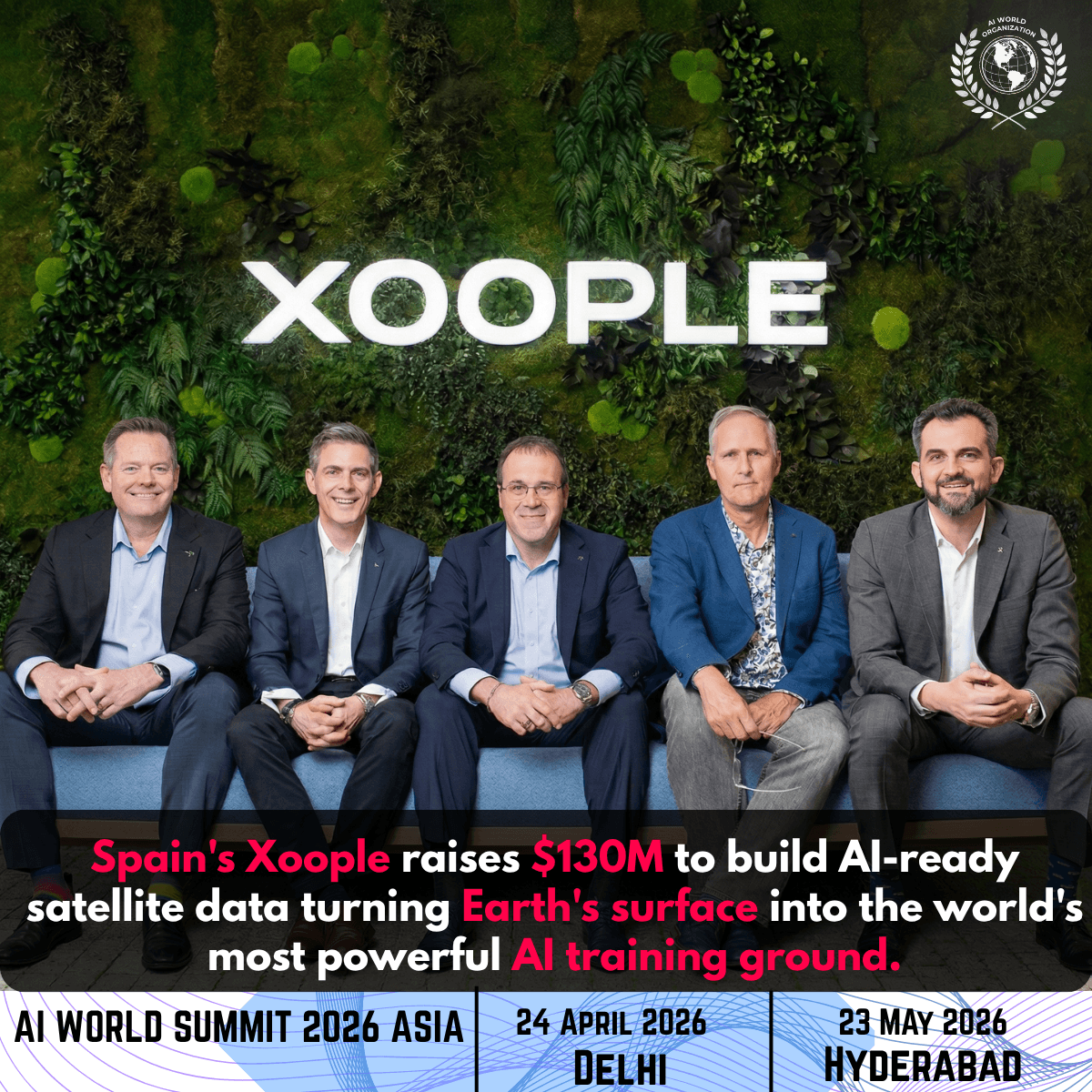
Spain's Xoople secures $130M Series B led by Nazca Capital to build AI-grade satellite data and partner with L3Harris for next-gen Earth observation sensors.
TL;DR
Spain's Xoople has raised $130 million in a Series B round led by Nazca Capital, bringing its total funding to $225 million. The Barcelona-based startup is building AI-ready satellite data by partnering with L3Harris for next-gen sensors. Already embedded in Microsoft Azure and Esri, Xoople aims to become the definitive real-world data source powering enterprise AI systems globally.
Xoople Raises $130 Million Series B to Build AI-Ready Satellite Data for Enterprise
Spain's Xoople, a Barcelona-based space data startup, has officially closed a $130 million Series B funding round with the stated ambition of becoming the definitive source of real-world ground truth data for artificial intelligence systems. The AI funding round was led by Nazca Capital and marks one of the most significant investments in European space-tech in recent years. For those tracking AI funding news, this deal signals a maturing appetite among institutional investors to back startups that sit at the crossroads of satellite technology and enterprise AI infrastructure.
The round was joined by a mix of private and government-backed investors including MCH Private Equity, CDTI — a technology development fund partially backed by the Spanish government — Buenavista Equity Partners, and Endeavor Catalyst. The company has now raised a cumulative total of $225 million since its founding in 2019, and while CEO and co-founder Fabrizio Pirondini declined to reveal the company's current valuation, he made one thing clear: "We are in unicorn territory." That statement alone places Xoople firmly among Europe's most valuable deep tech ventures, and positions it as a company that global AI-focused organizations and enterprises will want to watch closely in 2026 and beyond.
From Government Data to Enterprise AI Infrastructure
Xoople's journey began not with its own satellites, but with publicly available data. Since its founding seven years ago, the company has built an impressive technical stack on top of datasets gathered by government-operated spacecraft, most notably the European Space Agency's Sentinel-2 constellation. Rather than waiting for its own proprietary hardware, Xoople chose a distribution-first approach — embedding its analytics and data layers directly into enterprise-grade platforms like Microsoft Azure and Esri, two of the most widely used geographic information system (GIS) environments in the world.
This strategy, which observers have described as unconventional but savvy, allowed Xoople to cultivate deep integration with enterprise buyers long before it had its own orbital infrastructure in place. Aravind Ravichandran, CEO of Earth observation consultancy TerraWatch Space, captured the significance of this move well: "They laid the distribution pipes before having their own data supply — embedding into Microsoft and Esri, the two platforms where enterprise, government and most GIS buyers already live, but neither has proprietary Earth observation data." He added that the real benchmark Xoople will be measured against is Google's head start in geospatial AI models, a comparison that underscores just how high the bar is in this space.
This pre-positioning in the enterprise ecosystem has been central to Xoople's value proposition. Rather than selling raw satellite imagery to defense agencies and then hoping for private sector adoption — a pattern common among many Earth observation companies — Xoople has flipped the playbook. It is building commercial relationships first and deploying satellites second. For the AI world, where real-time, high-fidelity geospatial data is becoming an increasingly critical ingredient for training robust deep learning models, this kind of "distribution-first" thinking could prove to be a master stroke.
The L3Harris Partnership and the Sensor Technology Driving the Vision
Alongside the Series B AI funding announcement, Xoople revealed a landmark partnership with L3Harris Technologies, one of the United States' foremost space and defense contractors. Under this deal, L3Harris will be responsible for designing and building the sensors that will fly aboard Xoople's planned satellite constellation. L3Harris is known for operating at the frontier of commercial imaging systems, having built some of the most technically sophisticated remote sensing payloads currently operating in orbit. The fact that Xoople has secured this partnership is telling — it suggests the startup is not cutting corners when it comes to hardware quality.
Pirondini described the ambition behind the sensor program in striking terms. The spacecraft being developed will be capable of collecting "a stream of data that is going to be two orders of magnitude better than existing monitoring systems." Two orders of magnitude means a hundredfold improvement — a claim that, if realized, would fundamentally raise the ceiling of what Earth observation data can offer to AI systems. Such data density and precision would make Xoople's eventual proprietary dataset far superior in quality to anything currently being collected by legacy satellites, including those operated by some of its most established competitors.
Despite the bold projections, the company has remained tight-lipped about many specifics. Pirondini has not disclosed how many satellites the company plans to launch, nor has he shared precise timelines for when the constellation will become operational. What is confirmed is that the sensors will collect optical data — the most widely demanded format in commercial Earth observation — and that L3Harris's involvement ensures the hardware will be built to a defense-grade standard. The secrecy around details may be strategic, designed to keep competitors from anticipating Xoople's moves in what is already a fast-moving and competitive market.
Competing in a Crowded Market with a Clear Differentiation Strategy
The Earth observation and geospatial AI market is no longer a niche field. It has grown into a multi-billion dollar industry with a range of well-funded players jostling for position. Xoople will be going up against formidable rivals, including Planet Labs, BlackSky, Vantor, and Airbus's satellite division in Europe, all of which already have operational satellite constellations generating live data feeds. These companies have years of orbital experience, established customer relationships, and in many cases, their own AI analytics layers.
The critical question is: how does Xoople differentiate itself? Pirondini's answer is rooted in data quality and enterprise depth. The company is not simply trying to be another imagery provider. It is positioning itself as the definitive platform through which enterprise clients — from global agribusinesses to multinational logistics companies to national infrastructure agencies — can receive not just images, but actionable, AI-processed insights embedded directly within the software tools they already use. The enterprise embedding model, as mentioned earlier, is core to this differentiation.
In the context of the broader AI funding news landscape, it is worth noting that most capital flowing into Earth observation startups has historically been absorbed by hardware-heavy constellation builders or defense-oriented intelligence firms. Xoople's enterprise-first, AI-native approach represents a meaningful shift in how investors and founders are thinking about where the value actually lives in the geospatial value chain. Rather than racing to put the most satellites in orbit, Xoople is racing to build the deepest integrations with the buyers who will ultimately pay for the data.
At The AI World Organization, where we closely track the convergence of artificial intelligence and emerging sectors, this funding event reflects a pattern we have observed repeatedly in 2026 — AI funding is flowing not just to model developers and LLM labs, but increasingly to infrastructure companies that supply the raw material AI systems need to function at scale. Geospatial data is fast becoming one of those critical raw materials.
Use Cases Across Industries and the Path to Earth's System of Record
Xoople's enterprise focus is not theoretical. Pirondini has outlined a range of concrete use cases that illustrate why businesses and governments are willing to pay for high-quality satellite data delivered through familiar software environments. Government agencies, for instance, can use Xoople's data streams to track transportation networks in real time, monitor urban expansion, or assess the extent of damage caused by natural disasters within hours of an event. The ability to quantify damage quickly after a flood or earthquake has obvious implications for emergency response, insurance claims, and long-term urban recovery planning.
In agriculture, the opportunities are equally compelling. Large agribusinesses can use satellite-derived data to monitor crop health at scale, detecting early signs of disease, drought stress, or pest infestation across hundreds of thousands of acres simultaneously. This kind of precision agriculture intelligence is already in demand, but the quality and frequency of currently available satellite imagery often limits how actionable the insights can be. Xoople's promise of dramatically superior data resolution could change the economics of agri-intelligence entirely.
For large corporations managing complex physical supply chains — construction firms monitoring infrastructure projects across multiple continents, mining companies tracking extraction sites, or energy companies overseeing pipeline networks — the value proposition is similarly strong. Real-time monitoring of physical assets from orbit, delivered through platforms like Microsoft Azure, could fundamentally alter how enterprises manage operational risk and compliance. When something changes on the ground, Xoople's system would theoretically detect and flag it faster and more accurately than any currently available solution.
The long-term ambition, however, extends well beyond these individual use cases. Pirondini has described his ultimate vision as building "Earth's System of Record" — a comprehensive, continuously updated digital model of the physical world. This would not just be a map. It would be a living, AI-driven model that integrates data from Xoople's satellites with information from other sources to generate a dynamic, real-time representation of the planet's surface. Pirondini has also suggested that this project could eventually involve the development of a true AI world model, built in collaboration with strategic partners. That ambition — if realized — would position Xoople not just as a data company, but as a foundational piece of the global AI infrastructure stack.
What This Means for the AI and Space Tech Ecosystem in 2026
Xoople's Series B is more than just another AI funding news headline. It represents a broader inflection point in how the tech industry thinks about data and artificial intelligence. For years, the narrative around AI has been dominated by software — foundation models, generative systems, large language models. But as AI matures and moves deeper into industrial and enterprise settings, the quality and accuracy of real-world data becomes just as important as the models themselves. Garbage in, garbage out — and Xoople is betting that the enterprise sector is finally ready to pay a premium for the opposite.
The Spanish startup's rise also carries significance for the European tech ecosystem, which has historically struggled to produce hardware-intensive deep tech companies at the scale seen in the United States. Xoople's success in raising $225 million in total, partnering with L3Harris, and embedding into the world's leading GIS platforms is a testament to the fact that world-class space and AI companies can indeed emerge from Spain and from Europe at large. With backing from both private equity and a government-linked development fund, the company also benefits from a kind of institutional legitimacy that will help it navigate the regulatory and procurement complexities of selling to government clients.
As we at The AI World Organization see it, the companies that will define the next phase of AI development are not necessarily those building the most impressive generative models. They are the ones — like Xoople — that are quietly and methodically constructing the data pipelines, hardware layers, and enterprise integrations that AI systems will depend on for decades to come. In a world where every model is only as good as the data it learns from, the ability to map the Earth with unprecedented accuracy and deliver those insights at enterprise scale is not just a business opportunity. It is a strategic imperative. The AI funding flowing into companies like Xoople in 2026 is proof that the investment world is beginning to understand this reality in earnest.