WeRize Raises $7M: Sony Backs AI Fintech for Small-Town India
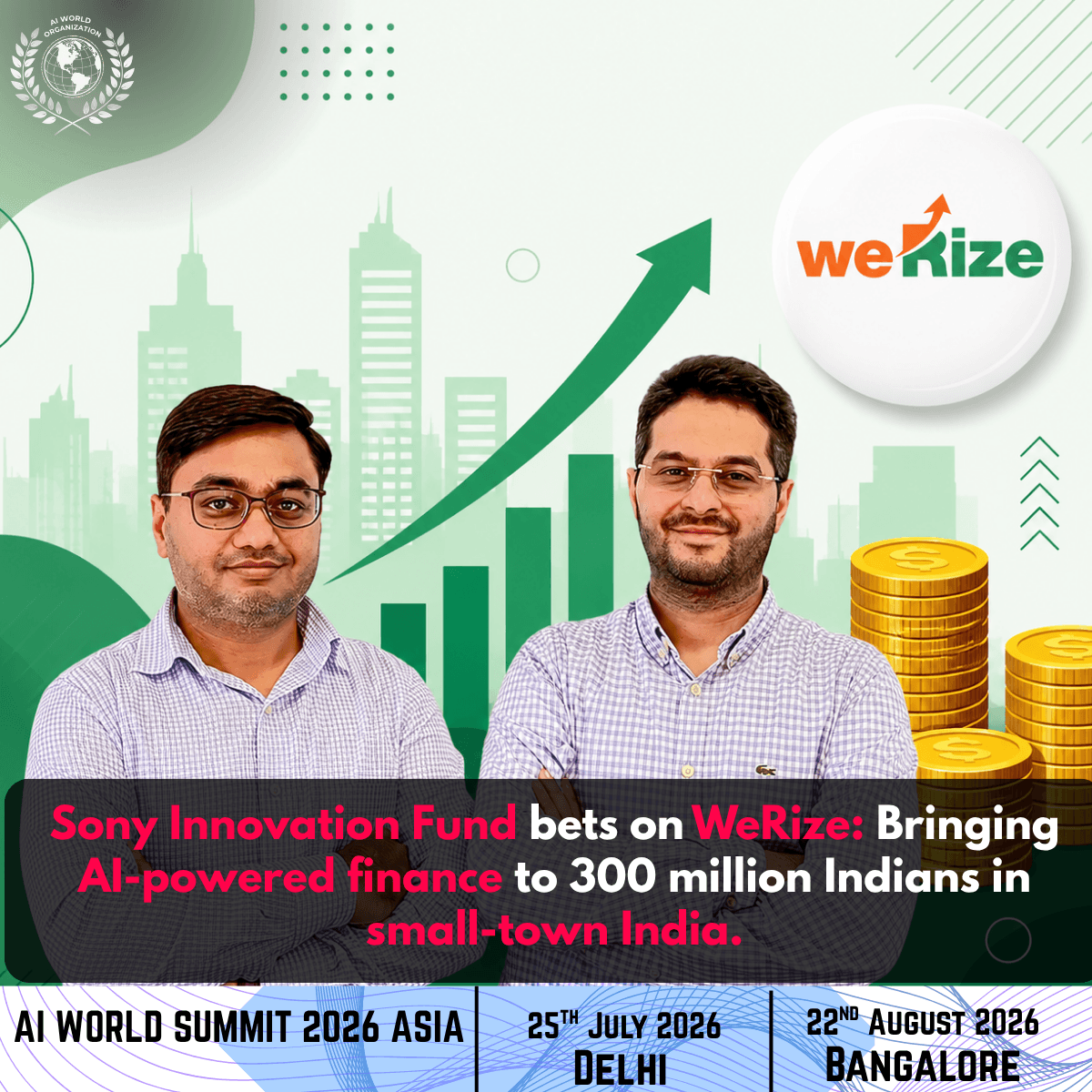
Sony Innovation Fund leads a $7M pre-Series C round in WeRize, the AI-powered fintech platform serving 300 million underserved Indians across 5,000+ towns.
TL;DR
WeRize, an AI-powered fintech platform that brings credit, insurance, and investment products to over 300 million people across India's smaller towns, has pulled in $7 million in fresh funding, led by Sony Innovation Fund. The money will fuel its expanding AI infrastructure and help it roll out new offerings like mutual funds, co-branded credit cards, and housing loans — all without a single physical branch.
Sony Innovation Fund Backs WeRize with $7 Million to Accelerate AI-Powered Fintech Growth Across India
India's AI-driven fintech sector is witnessing a significant vote of confidence as WeRize, a social distribution fintech platform powered by artificial intelligence, secures $7 million in a pre-Series C funding round led by Sony Innovation Fund, with participation from veteran investor 3one4 Capital. This milestone not only pushes WeRize's total equity capital raised since its founding beyond the $28 million mark but also signals growing global investor appetite for AI-first financial inclusion models targeting India's underserved heartland.
At The AI World, we have been closely tracking how artificial intelligence is reshaping the financial services landscape — not just in metro cities, but deep within the corridors of Tier II, Tier III, and Tier IV towns where traditional banking infrastructure has long been absent or inadequate. WeRize's latest funding round is a compelling case study in how purpose-built AI, deployed thoughtfully, can become a genuine equalizer for hundreds of millions of people who have historically been left out of India's formal financial ecosystem.
WeRize's Funding Round: What the $7 Million Means for India's Fintech Landscape
The pre-Series C round, led by Sony Innovation Fund — the corporate venture arm of the global electronics and entertainment giant Sony Group Corporation — brings fresh capital into a startup that has carefully positioned itself at the intersection of technology, community trust, and financial access. The participation of 3one4 Capital, one of India's most respected early-stage venture funds and a returning investor in WeRize, further reinforces confidence in the company's long-term trajectory.
This funding comes after a gap of nearly four years since WeRize's last equity raise. Back in June 2022, the company had raised $15.5 million at a valuation of $115 million, in a round that included British International Investment alongside Sony Innovation Fund and existing backers. The fact that Sony Innovation Fund has returned for this pre-Series C round is particularly telling — it demonstrates that the investor sees WeRize not merely as a portfolio bet, but as a platform that is maturing into something genuinely differentiated and scalable. In venture capital circles, a lead investor returning for a follow-on round is one of the most credible signals of a company's underlying health and potential.
With the fresh infusion of $7 million, WeRize has laid out a clear and ambitious deployment roadmap. A significant portion of the capital will be directed toward deepening the company's investment in its proprietary artificial intelligence stack and broader technology infrastructure. Additionally, WeRize plans to expand its product catalogue by venturing into new financial verticals, specifically mutual funds and online bonds, secured co-branded credit cards, and housing loans. These are categories that have enormous demand among India's aspiring middle class in smaller cities — a demographic that is increasingly digitally connected but still woefully underserved by conventional financial institutions.
Building the Three-Sided AI Marketplace: WeRize's Core Innovation
To truly appreciate what WeRize has built, one must understand the structural problem it set out to solve. India's financial inclusion challenge is not simply about a lack of products — banks, insurers, and mutual fund houses have products in abundance. The real problem is distribution. Reaching a first-generation earner in a small town in Uttar Pradesh, Bihar, or Rajasthan with a relevant, affordable, and trustworthy financial product has traditionally required either an extensive physical branch network (expensive and slow to build) or a degree of digital literacy that many in these communities do not yet possess.
WeRize, co-founded in 2019 by Vishal Chopra and Himanshu Gupta, took a fundamentally different approach. Rather than replicating the branch model or betting entirely on direct-to-consumer digital channels, the company built what it describes as a three-sided full-stack marketplace. On one side sit over 300 million underserved consumers spread across more than 5,000 cities and towns. On another side are more than 19,000 trained local financial micro-entrepreneurs — individuals embedded in their own communities who act as trusted distribution agents. On the third side are institutional partners: banks, non-banking financial companies (NBFCs), mutual funds, and insurers. The glue holding all three sides together, and enabling them to interact efficiently and at scale, is WeRize's proprietary AI layer.
This architecture is genuinely novel. The micro-entrepreneur model is not new to India — it borrows from the playbook of companies like insurance aggregators and microfinance institutions. What sets WeRize apart is the intelligence layer it has built on top of this network. The platform currently operates with zero physical branches, covers more than 5,000 cities and towns, and delivers its services in six Indian languages. That last point — multilingual delivery — is far more strategically significant than it might appear at first glance. Language has always been one of the most stubborn barriers to financial inclusion in India, and the ability to communicate with customers in their native tongue, whether that is Bhojpuri, Marathi, Tamil, or Bengali, fundamentally changes the trust dynamic between a financial services provider and its end users.
The AI Stack: 20 Billion Data Points and the Intelligence Behind the Platform
For those of us at The AI World who closely follow developments in applied artificial intelligence, the most fascinating dimension of WeRize's story is the scale and sophistication of the AI infrastructure it has assembled over the past six years. The company's proprietary AI stack has been trained on over 20 billion data points, sourced from more than four million households across more than 5,000 cities. This is not a generic large language model or an off-the-shelf machine learning framework borrowed from a cloud provider. It is a domain-specific, contextually rich AI system built specifically for the financial behaviors, needs, and constraints of consumers in India's smaller urban centers.
On the distribution side of the marketplace, WeRize's AI drives three critical functions: lead generation, assisted selling, and lifecycle engagement. Lead generation in this context means identifying, within a community, which individuals are most likely to be receptive to a particular financial product at a given point in time — a capability that dramatically improves the efficiency and effectiveness of the micro-entrepreneur network. Assisted selling means equipping those micro-entrepreneurs with real-time, AI-generated recommendations and conversational support tools that help them have better, more informed conversations with potential customers. Lifecycle engagement means using AI to ensure that customers who have already bought a product receive timely, relevant communication that builds long-term financial relationships rather than one-time transactions.
On the manufacturing side, the same AI stack powers underwriting, risk selection, and product structuring. Underwriting consumers in Tier III and Tier IV towns is notoriously difficult using conventional credit assessment frameworks, most of which were designed around formal income documentation, credit bureau histories, and asset ownership patterns that are common in urban India but sparse or absent in smaller towns. WeRize's AI, trained on behavioral, social, and transactional data points unique to its consumer base, enables a form of alternative credit assessment that is both more accurate and more inclusive than traditional methods. Product structuring — the ability to design financial products that are genuinely suited to the income patterns, risk appetites, and life events of a specific consumer segment — is another area where AI gives WeRize a structural competitive advantage that would be very difficult for a new entrant to replicate.
What makes this AI infrastructure particularly valuable from a strategic standpoint is its proprietary nature. Every data point WeRize collects, every model it trains, and every prediction it makes deepens a competitive moat that grows stronger with time and scale. As more micro-entrepreneurs join the network and more consumers engage with the platform, the AI gets smarter, the predictions get sharper, and the product-market fit improves — creating a virtuous cycle that is characteristic of the best AI-native businesses anywhere in the world.
Financial Performance: Strong Revenue Growth and a Path to Profitability
One of the most compelling aspects of WeRize's story, and one that almost certainly played a significant role in convincing Sony Innovation Fund to lead this funding round, is the company's financial performance. In an era when many Indian startups are still grappling with the challenge of balancing growth with sustainability, WeRize presents a refreshingly disciplined picture.
The company is currently running at an annualised gross revenue rate of $65 million and a net revenue run rate of $32 million. Its EBITDA run rate stands at $15 million, and its annualised pre-tax profit run rate has crossed $7 million. These are not vanity metrics — they reflect a business that has found genuine unit economics that work at scale. Over the next twelve months, WeRize projects a two to three times increase in profitability, a target that, while ambitious, appears credible given the trajectory it has already established.
Looking at the formal financial records, WeRize's revenue from operations grew by 64% in the fiscal year ended March 2025, reaching Rs 236 crore — up from Rs 144 crore in FY24. This came on the back of more than two-fold revenue growth in FY24 itself, suggesting that the company's growth has not been a one-year anomaly but a sustained multi-year trend. Equally important is the trajectory of profitability: net profits doubled in FY25, a signal that the company is not simply growing its top line but becoming more operationally efficient as it scales. For a fintech startup operating in one of the most complex distribution environments imaginable, this combination of rapid top-line growth and improving profitability is a rare and valuable achievement.
The financial profile WeRize has built is a direct product of its AI-first approach. By leveraging artificial intelligence to automate lead generation, underwriting, and risk assessment — functions that in a traditional financial services company would require large teams of analysts and field officers — WeRize has kept its cost structure lean even as it has expanded its reach and product breadth. This is the economic logic of AI at its most powerful: not replacing human judgment wholesale, but augmenting it in ways that dramatically improve efficiency and scale.
What This Investment Signals for AI in Indian Fintech and Beyond
Zooming out from the specifics of WeRize's business, the Sony Innovation Fund-led round is worth examining as a broader signal about where global capital is flowing within the AI ecosystem. Sony Innovation Fund is not a generalist investor — it is a strategic fund that invests at the intersection of technology, entertainment, and social impact. Its decision to lead a round in a company like WeRize, which operates in a market as far removed from Sony's traditional consumer electronics business as small-town Indian fintech, is a clear statement about the universal applicability of AI-driven distribution models.
There is a larger narrative here that The AI World has been following closely: the gradual but accelerating shift in how global technology investors think about emerging markets. For much of the past two decades, India's startup ecosystem attracted capital primarily through its large and growing consumer internet market — e-commerce, food delivery, ride-hailing, and similar urban-first models. The next wave of value creation, however, is widely expected to come from companies that use AI to reach the next 300 to 400 million Indians who are not well served by existing digital platforms. WeRize sits squarely in the middle of this opportunity.
The expansion roadmap that WeRize has announced using the new funding — mutual funds, online bonds, co-branded credit cards, and housing loans — is also significant from an AI perspective. Each of these product categories involves a different risk profile, a different customer journey, and a different set of regulatory requirements. Successfully expanding into all four will require WeRize to build new AI models, train them on new data, and integrate them seamlessly into an already complex three-sided marketplace. This is a genuine test of the depth and flexibility of WeRize's AI infrastructure, and it will be fascinating to watch how the company navigates it over the next twelve to eighteen months.
For startups, investors, and policymakers watching the evolution of AI in financial services, WeRize offers several important lessons. First, that proprietary data — collected over years, at scale, in a specific and underserved context — is among the most valuable AI assets a company can possess. Second, that community-based distribution, when supercharged with AI, can overcome infrastructure barriers that have historically seemed insurmountable. And third, that profitability and social impact are not in tension — a well-designed AI system can deliver both simultaneously, which is precisely what makes WeRize's model so instructive for the broader technology and investment community.
As India continues its remarkable journey toward becoming one of the world's largest and most sophisticated digital economies, stories like WeRize's serve as an important reminder that the most transformative applications of artificial intelligence are often not the ones making headlines in Silicon Valley, but the ones quietly solving deep structural problems in places that the rest of the world rarely looks. At The AI World, we will be watching WeRize's next chapter with great interest.