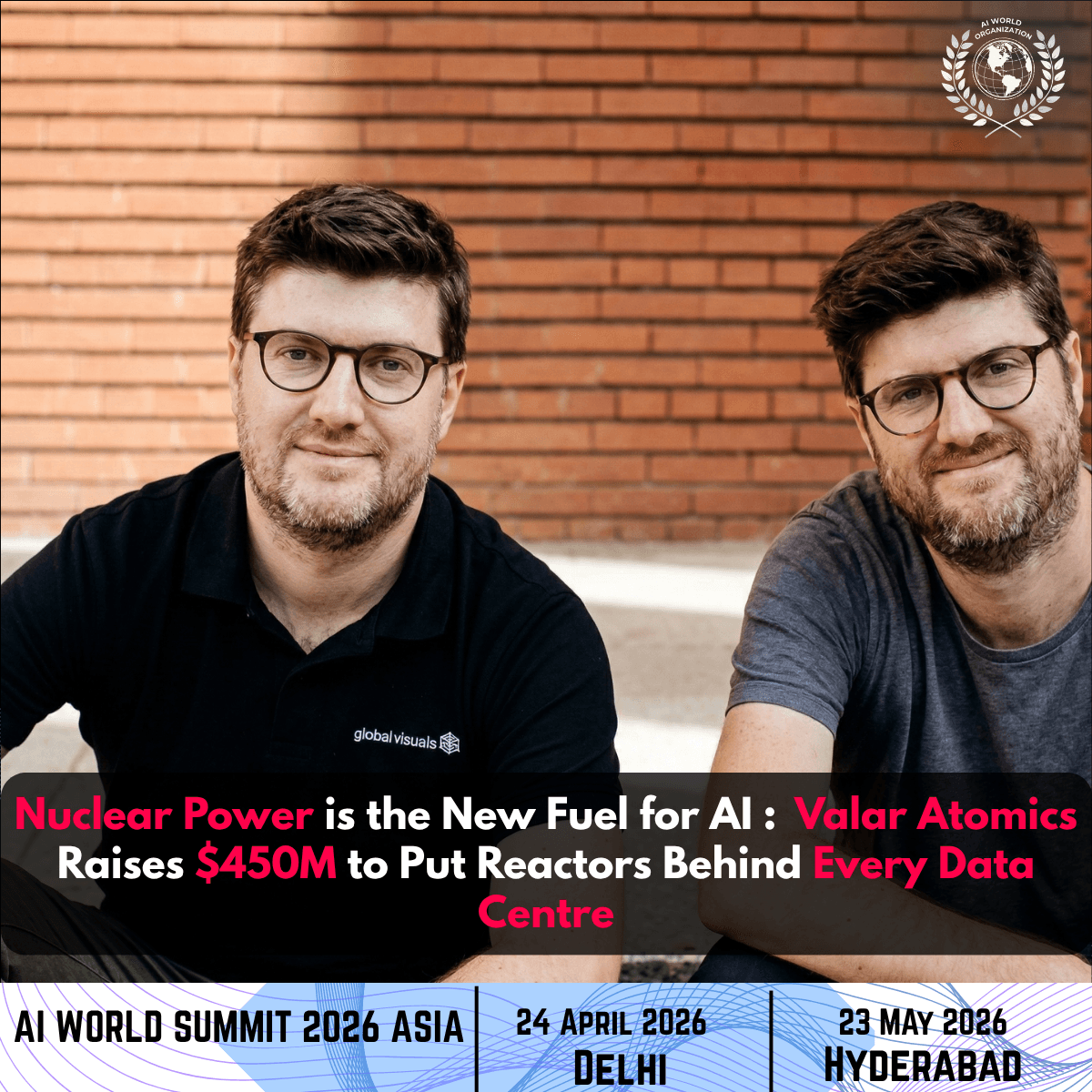
Valar Atomics Raises $450M to Power AI Data Centres
Valar Atomics secures $450M at a $2B valuation to build small nuclear reactors powering AI data centres, backed by Palmer Luckey and Shyam Sankar.
TL;DR
Valar Atomics, a nuclear startup founded by 27-year-old Isaiah Taylor, has raised $450M at a $2B valuation to build small, factory-made nuclear reactors for AI data centres. Backed by Palmer Luckey and Palantir's Shyam Sankar, the company is targeting commercial reactor operations by mid-2026 making a strong case that AI's future runs on nuclear power.
Valar Atomics Raises $450M at $2 Billion Valuation to Power AI Data Centres with Small Nuclear Reactors
In one of the most closely watched AI funding news stories of early 2026, Valar Atomics — a California-based nuclear energy startup — has successfully closed a landmark $450 million funding round, pushing its valuation to an impressive $2 billion. The round, which includes $340 million in equity and $110 million in debt, comes just five months after the company raised $130 million in a Series A round in November 2025. This latest capital injection signals a growing and urgent recognition among the world's leading investors that artificial intelligence infrastructure is not merely a software challenge — it is fundamentally an energy challenge, and nuclear power may hold the answer. The news has sent ripples through the global AI funding landscape, underscoring how the appetite for reliable, carbon-free, and dense energy supply is becoming one of the most critical investment verticals of our time.
Backed by high-profile names including Anduril Industries founder Palmer Luckey and Palantir Technologies' Chief Technology Officer Shyam Sankar, the startup has rapidly elevated itself from a promising concept to one of the most richly valued nuclear energy companies in the United States. Lockheed Martin board member John Donovan also participated in the earlier round, further cementing the startup's ties to the national security and defence ecosystem. The combined funding now brings Valar Atomics' total raise to approximately $580 million — a staggering figure for a company that was founded as recently as July 2023, yet one that makes complete sense when viewed against the backdrop of AI's explosive and unrelenting demand for power.
The Visionary Behind the Reactor: Isaiah Taylor and the Birth of Valar Atomics
At the centre of Valar Atomics' ambitious journey is Isaiah Taylor, a 27-year-old self-taught entrepreneur and father of four who founded the company in El Segundo, California, with a belief that the global energy grid is fundamentally broken for the age of artificial intelligence. Taylor, an autodidact who taught himself nuclear physics and engineering outside of conventional academic pathways, identified a critical gap in the market: while technology companies were racing to build ever-larger AI data centres, the power infrastructure required to sustain these operations was being left dangerously behind. Traditional energy grids, burdened by aging infrastructure and regulatory complexity, could not keep pace with the compute demands that modern AI workloads require. Taylor's thesis was straightforward but bold — the world needed a new class of compact, factory-built nuclear reactors that could be deployed rapidly, at scale, and without the multi-decade lead times associated with conventional nuclear builds.
Supporting Taylor as Chief Nuclear Officer is Mark Mitchell, described as a leading expert in TRISO-fuelled reactor design. Together, the team has developed an integrated business model that removes the traditional barriers to reactor deployment at scale. Unlike legacy nuclear companies that rely on bespoke, site-specific engineering, Valar's approach centres on mass production, standardised components, and rapid modular assembly — essentially treating nuclear reactors with the same philosophy that transformed the consumer electronics and automotive industries. The company designs and manufactures its own reactors, giving it tight control over costs, quality, and deployment timelines. This vertical integration is one of the key differentiators that has attracted investors in the latest AI funding round and sets Valar apart from the rest of the emerging nuclear field.
TRISO Fuel, Helium Cooling, and the Gigasite Vision: A Technical Deep Dive
Valar Atomics' flagship reactor design is the Ward 250, a 100-kilowatt thermal (kWt) High-Temperature Gas-Cooled Reactor (HTGR) that uses helium as its primary coolant and TRISO fuel encased in graphite as its core fuel form. This technology is not a speculative leap — TRISO fuel has been under development for decades and is considered among the safest and most resilient nuclear fuel forms ever created. Each TRISO particle is a tiny sphere of uranium fuel wrapped in multiple layers of ceramic and carbon coatings, designed to contain radioactive byproducts even under extreme conditions. The combination of TRISO fuel with helium coolant allows Valar's reactors to operate at temperatures exceeding 950 degrees Celsius — roughly triple the operating temperature of conventional light-water reactors — and opens the door to applications far beyond simple electricity generation, including high-efficiency thermochemical hydrogen production.
The true power of Valar's model, however, lies not in any individual reactor unit but in what the company calls "gigasites." These are sprawling industrial campuses designed to host hundreds or even thousands of Ward 250 units operating in concert. The concept transforms the traditional nuclear plant paradigm entirely: instead of a single massive reactor serving a region, Valar envisions distributed clusters of small, modular units that can be scaled up or down in line with actual demand. This architecture is perfectly suited to the load profiles of modern AI data centres, which require dense, continuous, and controllable power delivery. The reactor shielding itself is an engineering marvel — designed using a custom concrete mix and self-tensioning gravity-stacked blocks that reinforce each other without welding or mechanical joining, a design approach that CEO Isaiah Taylor has noted does not exist anywhere else in the world.
Reaching Criticality First: Valar's Edge in the Nuclear Pilot Programme
In a competitive field that includes well-funded rivals such as TerraPower, Kairos Power, X-Energy, and Oklo, Valar Atomics has established a meaningful and highly symbolic head start. In November 2025, the company announced that its NOVA Core prototype had achieved zero-power criticality at Los Alamos National Laboratory's National Criticality Experiments Research Centre. Zero-power criticality refers to the moment when a reactor achieves a self-sustaining chain reaction — specifically in uranium-235 — without reaching full operating temperatures. While it is not equivalent to a working commercial power plant, it is a critical validation milestone in the reactor development process, and Valar became the first company to reach it under the United States Department of Energy's Nuclear Reactor Pilot Programme. This distinction is not merely symbolic; it represents a verifiable technical achievement that gives regulators, customers, and investors measurable confidence in the platform.
Building on that milestone, Valar has been actively preparing its Ward 250 reactor for full power operations at the Utah San Rafael Energy Research Centre (USREL). In a logistical feat that captured widespread attention in February 2026, the reactor was transported from California to Utah aboard three C-17 Globemaster military cargo aircraft in a joint operation coordinated between the U.S. Departments of Defence and Energy. The airlifted deployment was not just a transport exercise — it served as a live proof-of-concept for the company's core commercial thesis: that its small reactors are physically mobile, rapidly deployable, and capable of being integrated with national security infrastructure. Valar is now targeting operational status before the 4th of July 2026, the DOE-mandated deadline for three pilot programme reactors to achieve criticality. Meeting that deadline would further solidify Valar's position as the most technically advanced startup in the advanced reactor space.
AI Funding News: Why Investors Are Betting Big on Nuclear Power for the AI Era
The broader context of this AI funding news story is impossible to separate from the tectonic shift occurring in the global energy landscape. Artificial intelligence, which once seemed primarily a software-driven phenomenon, has evolved into one of the most energy-intensive industries in human history. OpenAI's CEO Sam Altman has publicly stated that meeting the demands of next-generation AI may require as much as 250 gigawatts of new power capacity — equivalent to the entire electricity consumption of Brazil. Even more conservative industry projections suggest that by 2030, AI data centres alone will need to double the roughly 40 gigawatts they currently consume. This is not a gradual trend; it is an energy crisis in slow motion, and traditional power grids — already straining under industrial, residential, and electric vehicle demand — are simply not equipped to absorb this new load.
This is precisely why the latest AI funding round for Valar Atomics resonates so deeply with investors who follow AI infrastructure. Palmer Luckey, whose Anduril Industries is already one of the most influential players at the intersection of national defence and advanced technology, understands better than most that the future of AI leadership is inseparable from energy sovereignty. Shyam Sankar of Palantir, whose company processes massive volumes of sensitive government and enterprise data, equally recognises that sustainable, high-density power is a prerequisite for operating secure and performant AI systems at scale. Their combined backing of Valar is a strategic signal to the market: in the race to dominate artificial intelligence infrastructure, the company that controls the power supply holds the most durable competitive advantage. The $2 billion valuation that Valar now carries would have seemed improbable just five years ago; today, it barely scratches the surface of what may eventually be required.
Valar vs. the Field: How It Compares to Other Advanced Nuclear Startups
Valar Atomics does not operate in isolation. The advanced nuclear energy sector has attracted a wave of well-capitalised startups in recent years, each approaching the problem from a different technical and commercial angle. TerraPower, backed by Bill Gates, is developing sodium-cooled fast reactors and is further along in the regulatory process in some respects. Kairos Power uses fluoride salt as a coolant and has secured partnerships with Google for future power purchase agreements. X-Energy is developing pebble bed reactors with significant Department of Energy backing. Oklo, which went public through a SPAC merger in 2024, is pursuing fast-neutron microreactors with a focus on remote and off-grid applications. Each of these companies represents a serious technical bet on advanced nuclear power, and each has its own investor base, regulatory strategy, and deployment timeline.
What sets Valar apart, according to its supporters and its own positioning, is the focus on gigasite-scale AI data centre deployment combined with the company's proprietary emphasis on industrial heat applications and synthetic fuel production. Valar's HTGR technology, operating at temperatures far exceeding conventional reactors, unlocks the possibility of producing hydrogen and synthetic hydrocarbons at competitive costs relative to fossil fuels — a capability that has major implications for the decarbonisation of heavy industry as well as energy-intensive AI compute. The integrated manufacturing model, which drives down per-unit reactor costs through centralised factory production rather than on-site construction, gives Valar a cost structure that could ultimately prove more commercially scalable than any of its competitors. The $450 million AI funding round provides the company with the runway needed to move from pilot operations in Utah to commercial gigasite builds, bringing the vision one major step closer to operational reality.
What This Means for the Future of AI Infrastructure and Clean Energy Policy
The significance of Valar Atomics' $450 million raise extends well beyond a single company's balance sheet. It is a referendum on the future of how artificial intelligence will be powered, and by extension, how humanity chooses to manage the tension between rapid technological progress and the urgent need for decarbonisation. The AI funding news around nuclear energy startups — from Valar to Oklo to TerraPower — collectively points to a growing consensus among the most forward-thinking technology investors: that renewable energy alone cannot deliver the firm, dispatchable baseload power that AI infrastructure demands. Solar and wind are variable and intermittent by nature; nuclear power, and particularly advanced small modular reactor designs, offers the density, reliability, and carbon-free profile that no other energy source can match at the scale required.
From a policy standpoint, Valar's involvement in the DOE's Nuclear Reactor Pilot Programme reflects a broader and encouraging shift in regulatory posture in Washington. The Biden administration's support for advanced nuclear, continued and expanded under subsequent policy frameworks, has created a more permissive environment for companies willing to move fast and innovate outside the constraints of traditional nuclear licensing pathways. Valar's use of a relatively compact and proven HTGR design, combined with its aggressive deployment timeline targeting July 2026 criticality, suggests it is deliberately positioning itself to be first to market in a regulatory environment that is finally aligned with its goals. With an estimated $580 million in total funding, a world-class technical team, a validated reactor core, and backing from some of the most influential figures at the intersection of technology and national security, Valar Atomics stands at a genuinely historic inflection point — one that could determine how the AI-powered future is literally powered.


