Transition Ventures Closes €128M Fund II for AI & Deep Tech
Transition Ventures raises €128M in Fund II to back early-stage startups merging AI with the physical world across energy, robotics, and computing hardware.
TL;DR
Transition Ventures, a London-based early-stage VC firm co-founded by Unity's David Helgason, has closed its €128M Fund II, pushing total AUM past €257M. The firm backs startups where AI meets the physical world — from photonics computing hardware to autonomous wildfire drones — across Europe and the US.
Transition Ventures Closes €128 Million Fund II to Back the Next Generation of AI and Deep Tech Startups
There is a quiet but unmistakable shift happening at the frontier of venture capital, and it is not simply about software anymore. The most consequential bets being placed today are on companies that sit at the crossing point of artificial intelligence and the physical world — the kind of businesses that do not just write code but reshape how energy flows, how materials are processed, how fires are fought, and how the infrastructure beneath modern civilisation actually functions. Transition Ventures, the London-based early-stage investment firm, has just made a decisive statement about where it believes the future lies. The firm has officially closed its second fund, Fund II, at €128 million — approximately $150 million — bringing its total assets under management to more than €257 million, or roughly $300 million. It is a milestone that signals not only the firm's own growth but also a broader reckoning within the European and global venture ecosystem about what truly transformative technology looks like in this decade.
For those who follow the intersection of AI, deep technology, and climate solutions, this announcement carries real weight. Transition Ventures is not a generalist firm chasing the latest trend. It was built on a very specific and carefully considered belief: that the most important companies of the coming decades will emerge at the point where artificial intelligence meets physical systems — replacing outdated, polluting, and inefficient legacy infrastructure with solutions that are smarter, cleaner, and fundamentally more capable. Fund II is the firm's most ambitious expression of that thesis yet.
From Game Engines to Deep Tech: The Vision Behind Transition Ventures
To understand why Transition Ventures occupies such an interesting position in the current investment landscape, it helps to understand where it came from. The firm was co-founded by David Helgason, who many in the technology world will recognise as the founder and former chief executive of Unity Technologies — one of the most widely used game engine platforms on the planet, which went public in 2020 at a valuation exceeding $13 billion. After stepping away from Unity, Helgason did not take the conventional exit route of retirement or passive investing. Instead, he channelled his experience building large-scale technology infrastructure into a new venture — one focused on the deep, often unglamorous, but enormously consequential work of transforming how the physical world operates.
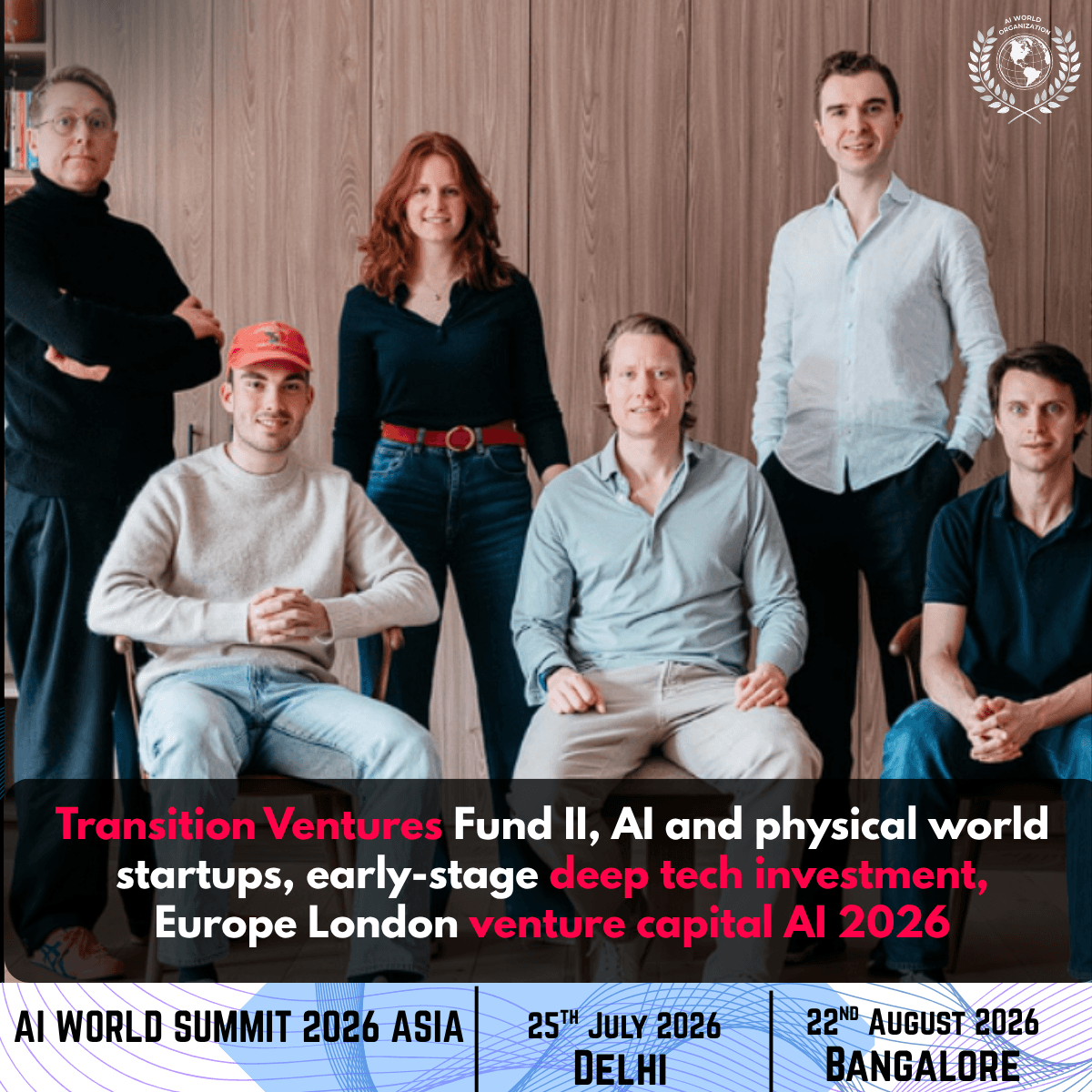
The investment team that Helgason assembled around this vision is notably strong. Alongside him is Ari Helgason, who brings a background as a former entrepreneur and investor at Index Ventures, one of Europe's most respected venture firms. Kristian Branaes joins from a background spanning CPP and Atomico, bringing institutional-grade discipline to early-stage dealmaking. Clara Ricard, formerly of Balderton Capital and recognised by Forbes as one of Europe's 30 Under 30 in 2024, adds sharp analytical and founder-facing capabilities. David Pacák, who has worked with Earlybird and Picus Capital, rounds out a team that collectively carries both operational and financial credibility across geographies.
The firm invests across both Europe and the United States, which gives it a genuinely transatlantic perspective at a time when the collaboration and competition between these two markets is increasingly shaping the trajectory of emerging technology. Their portfolio companies are built on the conviction that enormous swathes of the old industrial system — energy infrastructure, computing hardware, mobility platforms, fire suppression — are not just inefficient but ripe for wholesale reinvention by founders who combine scientific ambition with commercial rigour.
What €128 Million Means for AI and Physical World Innovation
The closing of Fund II at €128 million is significant for several reasons that go beyond the headline number. First, it reflects genuine LP confidence in a thesis that, while compelling, is not without its risks. Investing in deep tech and physical AI companies requires patience, technical due diligence, and a tolerance for longer development cycles than pure software businesses. The fact that Transition has attracted this level of capital — taking its total AUM past the quarter-billion-euro mark — suggests that institutional and sophisticated private investors are increasingly willing to back that kind of patient, high-conviction approach.
Second, the scale of Fund II reflects the maturation of the firm itself. The team has collectively founded and built companies worth more than €12 billion across software, hardware, and deep technology. That is not theoretical knowledge of what it takes to build great companies — it is lived experience at the highest levels of the technology industry. When Transition Ventures backs a founder working on a breakthrough in photonics-based computing or autonomous wildfire suppression, they are doing so with an understanding of what truly hard technological challenges look like and what it takes to navigate them.
Third, and perhaps most importantly for the wider ecosystem, the fund represents a continuing commitment to backing companies at their earliest stages — the point where the risk is highest but the potential upside, and the potential for real-world impact, is also greatest. Transition does not wait for companies to de-risk themselves through multiple funding rounds. They come in at the beginning, when the vision is still forming and the founders need partners who can help them think through product, market, and execution challenges from the ground up.
The broader context matters here too. Climate technology investment, which reached a peak of around $128 billion globally in 2022, is forecast to come in around $89 billion in 2026 according to BloombergNEF, with an increasing proportion of that capital flowing toward companies that support AI infrastructure rather than purely emissions reduction. Transition's Fund II reflects this evolution thoughtfully — the firm has never been rigidly siloed into one category, and its portfolio increasingly spans the full range of physical world transformation, from energy and materials to computing hardware and autonomous systems.
Portfolio Highlights: The Companies Already Redefining Their Industries
One of the most compelling aspects of Transition Ventures' story is not just the fund size — it is the quality and ambition of the companies they have already backed. The firms in their portfolio are not incremental improvements on existing solutions. They are genuine attempts to build something new, and the early results are striking.
Olix is perhaps the most high-profile name in the current portfolio. The company is developing photonics-based computing hardware — a technology that uses light rather than electrical signals to process information, delivering a meaningful step-change in both performance and energy efficiency compared to conventional semiconductor architectures. In a world where AI workloads are placing unprecedented demands on computing infrastructure, and where the energy consumption of data centres is becoming a serious bottleneck, Olix's approach addresses a genuinely critical problem. The company is now valued at €858 million — close to $1 billion — having raised over €188 million since Transition invested in its first round alongside LocalGlobe. That trajectory is the kind of outcome that validates an entire investment thesis.
Seneca takes the notion of physical AI in a very different but equally urgent direction. The company has developed a full-stack physical AI solution for wildfire suppression — a problem that has become devastatingly acute as climate change drives more frequent and more severe fire events across multiple continents. Seneca's autonomous drone systems can reach active fires within ten minutes, substantially faster than what is reportedly achievable with conventional fire-suppression methods, while also being considerably more cost-effective. Transition invested in Seneca's first venture round, and the company has since grown to raise €51 million. In a world where the cost of wildfire damage runs into billions of dollars annually, the potential scale of what Seneca is building is difficult to overstate.
Upway represents the portfolio's consumer-facing dimension. The company operates a platform for refurbished and pre-owned electric bikes, addressing both the affordability barrier and the sustainability dimension of urban mobility. Since Transition invested in spring 2022, Upway has grown its revenue by more than thirty times — a rare and impressive commercial trajectory in any market — and has now raised over €103 million in total. It is a reminder that physical world transformation does not always require exotic materials science or quantum computing; sometimes it means building the right marketplace infrastructure around an existing technology to unlock its mass-market potential.
Beyond these flagship names, Transition has also backed Invisix, a semiconductor metrology startup targeting bottlenecks in the AI hardware supply chain — another example of the firm's appetite for companies working on the unglamorous but essential infrastructure that makes AI systems actually function at scale.
Why the Intersection of AI and the Physical World Is the Most Important Investment Theme of This Decade
At The AI World, we have been closely tracking the evolution of artificial intelligence from a predominantly software-based discipline into something with far greater reach and consequence. The most exciting development of this era is not large language models or generative image tools, though those are genuinely significant. It is the deployment of AI-driven intelligence into physical systems — robots, autonomous vehicles, smart energy grids, advanced manufacturing, climate management, and computing hardware itself — that will define the next chapter of technological history.
The investment thesis at Transition Ventures captures this moment precisely. David Helgason articulated it well when he noted that ambitious founders do not just want to build a great business — they want to build something that will matter for generations. That framing is important because it sets a high bar. Companies that simply apply machine learning to an existing workflow are not what Transition is looking for. They are looking for founders who understand that the old industrial system is genuinely broken in deep ways — that it is inefficient, often polluting, frequently fragile — and who have the technical and entrepreneurial capability to replace it with something fundamentally better.
The data centre buildout that is currently underway globally has, as Helgason himself noted, become one of the defining investment themes of 2026. The computational demands of modern AI systems are vast, and the energy implications of meeting those demands with current semiconductor architectures are significant. Companies like Olix that are developing new approaches to computing hardware — approaches that deliver more performance per watt, that use different physical principles altogether — are not just interesting technology stories. They are responses to a real and urgent constraint on the progress of AI itself.
Similarly, the application of physical AI to climate-critical challenges like wildfire suppression, as Seneca is doing, represents one of the most meaningful early deployments of autonomous AI systems in the real world. These are not laboratory demonstrations or proof-of-concept projects. They are operational systems deployed in high-stakes environments where the cost of failure is measured not in user dissatisfaction but in lost lives and burned landscapes. That kind of deployment — and the commercial models it enables — is exactly what bridges the gap between AI as a technical capability and AI as a genuine force for societal improvement.
Europe's venture ecosystem has, for a long time, been perceived as trailing the United States in its ability to back the most ambitious technological bets. The emergence and growth of firms like Transition Ventures challenges that narrative directly. With a team that combines operational experience at companies like Unity, Index Ventures, Atomico, and Balderton, access to deal flow across both Europe and the US, and a track record of backing companies that have gone on to raise hundreds of millions and achieve unicorn valuations, Transition is demonstrating that world-class deep tech investing can be done from London and with a European sensibility.
The close of Fund II at €128 million is, in the grand scheme of global venture capital, a relatively modest number. But the ambition it represents — and the companies it will help build — is anything but modest. Transition Ventures is backing founders who believe that AI and physical world technologies, applied with rigour and imagination, can replace legacy systems that have been constraining human progress for decades. As the AI revolution moves from the digital realm into the physical one, the firms and founders making those bets are likely to look back on this moment as the point at which everything changed.
At The AI World, we will continue to track the developments from Transition Ventures and the portfolio companies they are building as this story unfolds. The convergence of artificial intelligence, deep technology, and physical world systems is not a future trend — it is happening now, and it is happening faster than most people realise.