THEKER Raises $85M in Europe's Biggest Robotics A
Barcelona startup THEKER closes Europe's largest robotics Series A at $85M, backed by CRV, Samsung & LVMH. See what's powering this AI robotics breakthrough.
TL;DR
Barcelona-based THEKER just closed Europe's largest-ever robotics Series A at $85M, led by CRV and joined by Samsung and LVMH — both backing a Spanish startup for the very first time. The company builds adaptive AI robots already running inside live Inditex production lines, bringing total funding to $106M as it eyes rapid global expansion.
THEKER Raises $85M in Europe's Biggest-Ever Robotics Series A, Pulling CRV, Samsung, and LVMH Into Spain for the First Time
Barcelona has quietly been building something. Not the kind of story that announces itself loudly on conference stages or through splashy press releases, but the kind that begins on actual factory floors, inside real production lines, with robots doing real work. That is the story of THEKER — and this week, it got a lot harder to ignore.
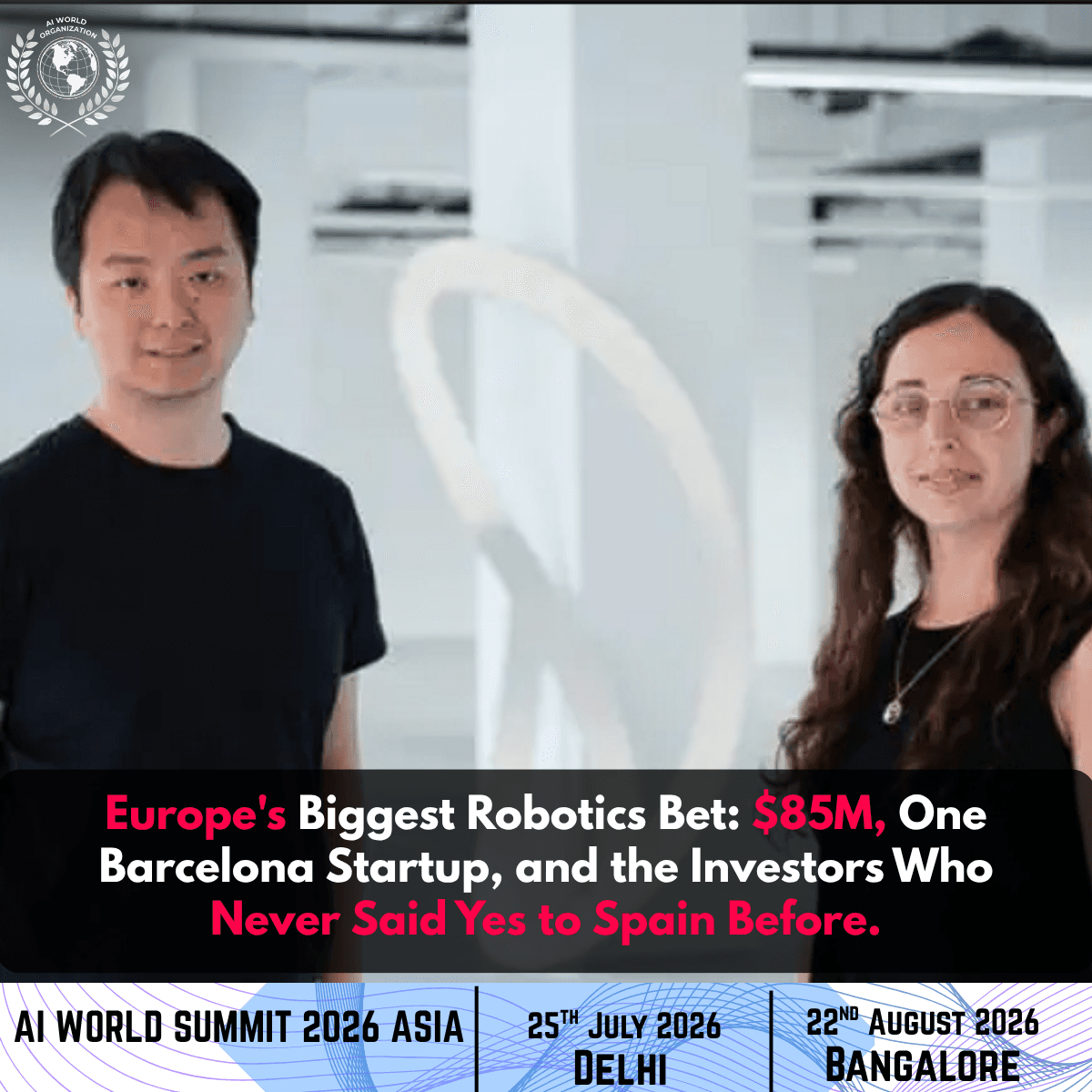
The Spanish industrial robotics company has closed an $85 million Series A funding round, a figure that makes it the largest raise of its kind in European robotics history. The round was led by CRV, the veteran Silicon Valley venture firm with a portfolio that spans some of the most consequential technology businesses of the past two decades. Joining alongside CRV are two names that had never before placed a bet on a Spanish startup: Samsung and LVMH. Three global heavyweights, three firsts for Spain, and one company built by a pair of engineers who say they never actually went looking for this kind of money.
"Part of a founder's job is that when people of this calibre knock on the door, you take the meeting. That's how most of these conversations started," said Carla Gómez Cano, who co-founded THEKER in 2022 alongside engineer Jiaqiang Ye Zhu. What began as a round of conversations has now translated into a landmark capital raise that pushes THEKER's total funding to approximately $106 million — a number that would have seemed implausible for a Spanish deeptech startup just a few years ago.
The broader investor group is equally striking. Bright Pixel Capital, Cathay Innovation, 20VC, Henkel Ventures, Korelya, Itnig, and Mission all participated in the round alongside a handful of angel investors. Returning backers Inditex, Kfund, and Kibo Ventures also recommitted, a signal that those already closest to the company's progress remain confident in where it is headed. This $85M round follows a €18 million seed raise completed in July 2025, which at the time was itself the largest early-stage funding round in Spanish startup history. THEKER has now broken its own country's record twice in under a year.
A Record-Breaking Round That Rewrote the European Robotics Playbook
To understand why this round matters beyond the headline number, it helps to put it in the context of what European robotics investment has typically looked like. The continent has produced exceptional academic research and some strong niche players in industrial automation, but it has historically struggled to attract the kind of bold, early-stage capital that Silicon Valley robotics startups take for granted. Series A rounds in European robotics have rarely crossed the $50 million mark, and the gap between research-stage companies and production-ready platforms has proven stubbornly difficult to bridge with European venture money alone.
THEKER's raise does not just beat that benchmark — it nearly doubles it. And it does so while bringing in American, Korean, and French institutional capital in a single coordinated round. CRV is a firm with more than five decades of history and a track record that includes early-stage backing of companies like DoorDash, Mercury, and Vercel. The fact that it chose Barcelona for what is understood to be one of its first investments in Spain says something about how the firm sees the opportunity — and about how much has changed in the European deeptech landscape over the past few years.
For Samsung, the investment represents a strategic alignment between its own manufacturing and consumer electronics interests and what adaptive AI robotics can offer in production environments. The company has long been a player in industrial automation at the component and display manufacturing level, and a bet on THEKER suggests it sees something in the platform that goes beyond a passive financial return. LVMH's participation is perhaps the most surprising at first glance. The luxury goods conglomerate — home to brands including Louis Vuitton, Dior, and Moët Hennessy — is not the obvious name one expects to find in a robotics Series A. But luxury manufacturing is intensely labour-dependent, notoriously resistant to automation, and under growing pressure to modernise production without compromising the craftsmanship standards that justify premium pricing. If THEKER's robots can operate intelligently in complex, variable environments, the application in high-end manufacturing becomes obvious rather than surprising.
Spain's venture capital ecosystem, which recorded €3.1 billion in total funding in 2025, is clearly producing something worth paying attention to internationally. THEKER is now its most visible proof point.
From the Factory Floor Up: What THEKER Actually Builds
There is a version of the robotics story that exists almost entirely in demonstration videos — machines performing impressively choreographed tasks under carefully controlled conditions, followed by investor decks full of market projections and a note somewhere at the bottom about "ongoing commercial pilots." THEKER is consciously not that company, and it is worth explaining why that distinction matters so much in this sector.
What Gómez Cano and Ye Zhu built from day one was an AI-native robotics platform designed to function inside real industrial environments — environments that are messy, unpredictable, and fundamentally unforgiving to technology that requires constant human supervision to keep running. THEKER's robots are trained to handle irregular product types, varied packaging formats, shifting layout configurations, and the kind of day-to-day operational variability that fixed-task industrial machines simply cannot accommodate without expensive reprogramming.
The distinction sounds technical, but the commercial implications are enormous. Traditional industrial robots — the kind produced by legacy players like ABB, FANUC, and KUKA — are extraordinarily precise and reliable within their defined parameters. They are also extraordinarily rigid. Every time a product changes, a packaging format shifts, or a production line is reconfigured, someone has to intervene. That intervention has a cost in time, in engineering hours, and in production downtime. For retailers and manufacturers operating at scale with frequent product rotations — fast fashion being perhaps the most extreme example — that rigidity is not just an inconvenience. It is a structural limitation.
THEKER's approach is to build robots that adapt without requiring intervention. A machine already operating inside a live Inditex facility — the Spanish multinational behind Zara, Massimo Dutti, and Pull&Bear, among others — can shift from processing one garment category to another without an engineer touching the configuration. That is not a capability that exists on a testing floor. It is a capability that exists in a real, operating production environment at one of the most operationally demanding retailers on the planet. For a company that has been operating for roughly three years, having live deployment at that level of scale is genuinely rare.
"From day one, we took a very pragmatic approach to technology: we never wanted to build a research lab, we wanted to solve real problems," Gómez Cano has said of the company's founding philosophy. That pragmatism is embedded in how THEKER recruits, how it allocates engineering resources, and how it decides which problems to prioritise. The company currently employs somewhere between 20 and 50 people — a lean team relative to the complexity of what it is building — and plans to scale to approximately 100 employees by the end of 2026 or early 2027 as it expands deployments and deepens its technical stack.
The Investor Lineup That Made History
What is unusual about this round is not just the size — it is the convergence of investor profiles that do not typically end up in the same cap table. Venture capital, consumer electronics manufacturing, and luxury goods represent three very different industries with very different relationships to production, automation, and technology adoption. That CRV, Samsung, and LVMH all arrived at the same conclusion about THEKER — through entirely different analytical lenses — is the kind of validation that money alone cannot manufacture.
Reid Christian, a General Partner at CRV, described what he saw in the company in terms that speak to how rare this profile is globally. What the team has built is exceptionally uncommon — a technically rigorous platform that has simultaneously achieved real commercial deployment momentum. His firm's conviction is that THEKER has the potential to define a generation of robotics companies, which is a significant statement from a firm that has seen a very large number of them come and go over five decades. CRV's entry into Spain through this round also underscores something broader: that the quality of technical founding teams emerging from Barcelona and the wider Spanish ecosystem has genuinely improved to the point where Silicon Valley funds are flying across the Atlantic to back them rather than waiting for them to relocate.
Returning investors Inditex and the Spanish venture funds Kfund and Kibo Ventures recommitting is also noteworthy. For Inditex in particular — which is not just a financial backer but also an active customer with THEKER robots operating inside its facilities — the continued investment is less a vote of financial confidence and more a statement that the technology is delivering operational value at a level that justifies deeper commitment. It is the kind of signal that speaks more loudly than any press release.
The participation of Henkel Ventures is similarly telling. Henkel is a global manufacturer with operations across adhesive technologies, beauty care, and consumer goods — all domains that involve complex, high-volume production environments where adaptive automation would have substantial practical value. Backing THEKER at this stage positions Henkel to explore those applications as the company's platform matures and its deployment footprint grows.
Navigating a Crowded Field Without Playing the Same Game
The broader robotics investment landscape in 2025 and into 2026 has been dominated by a single narrative: humanoid robots. The sector attracted approximately $27.6 billion in global investment in 2025 — nearly double the preceding year — and the bulk of that capital has flowed toward machines designed to look and move like people. Figure AI closed a Series C that valued the company at $39 billion. Apptronik extended its Series A to reach $935 million at a $5.5 billion valuation. NEURA Robotics closed a $1.4 billion Series C that made it Europe's most heavily funded humanoid company. The narrative has been hard to escape, and the ambition behind it — machines that can perform any task a human can perform, in any environment a human can navigate — is genuinely compelling.
THEKER is not competing for that narrative. The company has made a deliberate choice to build for environments where the business case for automation is already established, the return on investment can be demonstrated in months rather than years, and the question is not whether automation will happen but how intelligently and flexibly it can be deployed. That is a more grounded position, and it comes with its own set of challenges. The incumbents in fixed-task industrial robotics — ABB, FANUC, KUKA — have decades of enterprise relationships, extensive global service networks, and pricing leverage built on decades of market dominance. Displacing or supplementing them requires a compelling case not just for capability but for total cost of ownership, integration complexity, and operational reliability.
The argument THEKER is making is that AI-native adaptability changes that equation. If a platform can handle product variety and environmental change without costly reprogramming cycles, the total cost of deployment over a product line's lifecycle looks meaningfully different from what traditional automation can offer. The Inditex relationship — with its constant product rotation, compressed seasonal timelines, and massive operational scale — is the clearest validation available that this argument holds in practice, not just in theory.
What Comes Next for THEKER and the Industrial AI Robotics Market
The $85 million THEKER has just closed will be deployed across three broad priorities. The first is accelerating commercial deployments with tier-one industrial operators — manufacturing and logistics companies large enough to validate the platform's scalability and generate the kind of reference relationships that open doors elsewhere in the market. The second is continuing to deepen the underlying AI and robotics technology stack, which remains the foundation of the company's competitive position. The third is building the team, with a target of reaching around 100 employees before 2027 across software, electronics, mechanical engineering, and operations functions.
The market context into which THEKER is expanding is exceptionally favourable. The global industrial robotics sector was valued at approximately $54 billion in 2026 and is expected to grow to around $94 billion by 2031, driven by sustained labour shortages in manufacturing and logistics, rising operational costs, and the continued maturation of AI vision and control technologies. The conditions that make adaptive automation commercially attractive are not cyclical — they are structural, and they are deepening. Companies that can demonstrate reliable, scalable deployment today are building the reference base that will matter enormously as adoption accelerates across the next several years.
Barcelona, meanwhile, is quietly becoming a credible European anchor for deeptech ambition. Spain's venture ecosystem has grown substantially in depth and international visibility, and THEKER is now its flagship story — a company that began with a pragmatic technical thesis, proved it in live industrial environments, and attracted a globally diverse investor syndicate that had never collectively shown up for a Spanish startup before. Whether this translates into a broader cluster effect — more international capital flowing into the Spanish ecosystem, more technical founders choosing to stay rather than relocate — remains to be seen. But the signal is there.
What THEKER represents, stripped of the superlatives, is a company that chose to build something that works over something that impresses, and that bet has now paid off spectacularly. The robots are running. The production lines are moving. And $106 million in total funding means the experiment is only getting started.