Theia Insights Raises $8M to Map Global Economy with AI
Cambridge's Theia Insights secures $8M Series A led by MiddleGame Ventures to revolutionise financial market classification with AI.
TL;DR
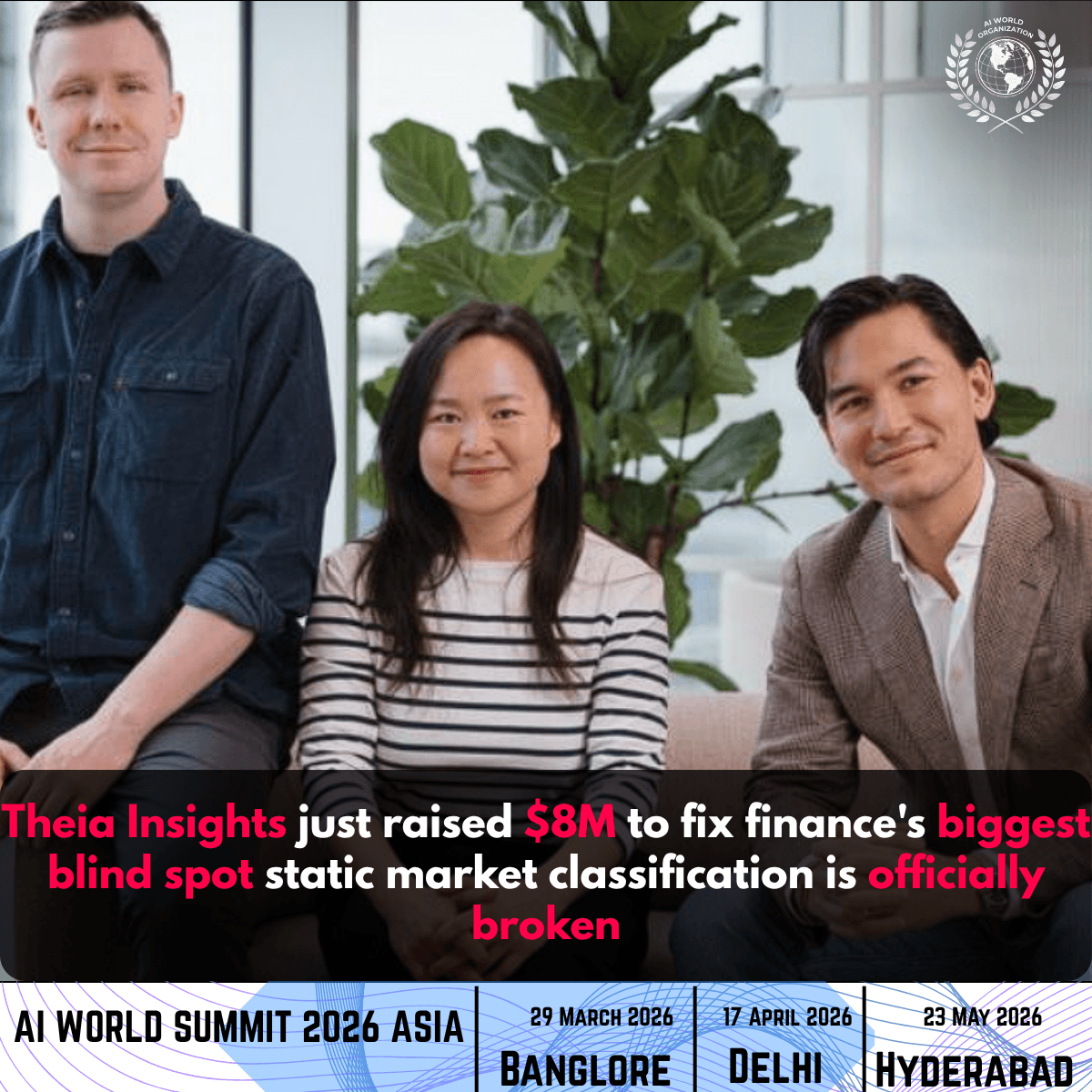
Theia Insights, a Cambridge-based AI startup founded by ex-Amazon researcher Dr. Ye Tian, has raised $8M in Series A funding led by MiddleGame Ventures. The company is replacing outdated financial market classification systems with a dynamic, AI-powered economic map helping investors see beyond misleading sector labels and make smarter, data-backed decisions.
Theia Insights Raises $8M in Series A to Rewrite the Rules of Financial Market Intelligence with AI
A Cambridge-based artificial intelligence startup is on a mission to change the way the world understands its own economy — and it has just raised $8 million to make that vision a reality. Theia Insights, a deeptech company building a dynamic, self-learning map of the global economy for financial markets, has successfully closed an $8 million Series A funding round, pushing its total capital raised to $14.5 million. The round was led by MiddleGame Ventures, an early-stage FinTech-focused fund, with participation from Further Ventures and returning investor Unusual Ventures. This latest development in AI funding news marks a pivotal chapter not only for Theia Insights but for the broader movement to modernise financial market infrastructure using the power of artificial intelligence.
Founded in 2022 by Dr. Ye Tian, a former PhD research scientist at Amazon Alexa, Theia Insights was built from the ground up to tackle one of the most persistent and underappreciated structural problems in global finance — the continued reliance on outdated, static industry classification systems. As the global investment community increasingly turns to AI-driven decision-making tools, the inadequacy of legacy data frameworks has become harder to ignore. The company's emergence at this moment in financial history is no accident; it is the result of years of academic research, real-world product development, and a deep understanding of where modern portfolio analysis falls short. At The AI World Organisation, we recognise that breakthroughs in AI funding like this one represent exactly the kind of transformative progress that is reshaping industries at their foundations.
The fresh capital injection will be deployed across three core areas: expanding into new asset classes beginning with private markets, deepening research and engineering capabilities, and scaling Theia's global commercial presence. With institutional investors already showing strong interest in its platform, Theia is positioned to become a foundational data layer for the next generation of AI-powered investment tools. The company's growth story is part of a much wider surge in AI funding across the fintech and capital markets space, where legacy infrastructure is increasingly seen as a liability rather than an asset.
The Broken Promise of Static Market Classification
To understand why Theia Insights matters, it is important to first understand the scale of the problem it is solving. Global financial markets have long relied on a small number of standardised industry classification systems to categorise companies and their economic activities. These systems — which include frameworks like the Global Industry Classification Standard (GICS) and the Standard Industrial Classification (SIC) codes — were designed decades ago and have seen very little meaningful evolution since. They assign each company a single primary classification, which was perhaps sufficient in an era when most businesses operated in clearly defined, single-sector markets. But the modern economy looks nothing like that.
Consider Amazon, the world's most cited example of corporate complexity. Under standard classification frameworks, Amazon sits in the Consumer Discretionary sector, a label that captures its e-commerce origins but says absolutely nothing about its cloud computing division, its advertising business, its logistics network, its streaming media platform, or its smart home hardware ecosystem. Each of these business lines operates in fundamentally different markets, competes with entirely different companies, and responds to entirely different economic forces. When a portfolio manager allocates capital based on the assumption that Amazon is a retailer, they are making decisions on a misrepresentation of reality. The same principle applies to hundreds of the world's most influential companies, from Google and Microsoft to Tesla and Apple, all of which defy tidy, single-category labels.
This misclassification problem creates cascading failures throughout the investment process. Portfolio construction becomes skewed because sector exposures are inaccurate. Risk management suffers because the true drivers of a company's performance are hidden behind a misleading label. Thematic investing — increasingly popular among institutional and retail investors alike — becomes unreliable when the data infrastructure cannot accurately identify which companies are truly exposed to a given theme. Patrick Pinschmidt, Co-Managing Partner of lead investor MiddleGame Ventures, captured this frustration directly when he noted that financial markets still rely on static classification systems that have changed very little over the past several decades. His endorsement of Theia's approach as providing game-changing tools for investors and AI systems to reason from carries significant weight in the context of the wider AI funding news landscape, where investor enthusiasm for foundational data infrastructure is growing rapidly.
The world of finance has long needed a classification system that evolves as the economy evolves — one that does not freeze companies into boxes they quickly outgrow, but instead reflects the living, breathing complexity of how businesses actually operate. Theia Insights was built specifically to deliver that system, and its Series A funding round signals that institutional investors are now ready to back that vision at scale.
How Theia's AI Platform Rebuilds the Map of the Global Economy
At the heart of Theia Insights is a proprietary technology platform that processes vast volumes of unstructured and structured financial data to construct what the company describes as a dynamic, self-learning ontology of the global economy. The platform ingests a wide range of inputs including regulatory filings, earnings call transcripts, press releases, and financial data from publicly listed companies. It then applies advanced natural language processing (NLP) techniques alongside quantitative modelling to extract detailed information about each company's actual business activities across all of its revenue lines. The result is an economic map that not only captures what each company does today, but also tracks how that changes over time — providing a living, accurate picture of corporate activity rather than a static snapshot.
This approach allows Theia to model companies as multidimensional entities rather than forcing them into a single classification bucket. The platform tracks "who does what by how much" across the full breadth of each company's operations, updating that picture dynamically as businesses evolve. This continuous, evidence-based reassessment of corporate identity is what fundamentally separates Theia from legacy classification systems that are updated only periodically and struggle to keep pace with the speed of corporate transformation.
The platform powers four distinct products that serve different investment workflows. The first is the Theia Dynamic Industry Classification system, known internally as TIIC, which provides a multidimensional, continuously updated classification of companies across the global economy. The second product is the Concept2Universe tool, or C2U, which enables investment professionals to translate high-level investment themes — such as "energy transition" or "digital payments" — into evidence-backed universes of relevant companies. Rather than relying on gut instinct or incomplete databases, portfolio managers can use C2U to systematically identify all the companies with meaningful exposure to a particular theme, regardless of their traditional sector label. The third product is the Thematic Factor Model (TFM), which identifies the structural trend drivers behind stock price movements over time, giving investment teams a far more granular understanding of what is actually influencing portfolio performance. The fourth product is the Theme Watch Indices (TWI), which track the performance of global industry themes in real time, offering a new lens for monitoring shifts in the economy at a macro level.
Together, these four tools form a comprehensive intelligence layer that can be integrated into existing investment workflows, data systems, and AI-driven analytical platforms. The company has already established a notable commercial foothold, including an early channel partnership with Nasdaq, which speaks to the credibility and practical applicability of its technology. This AI funding round will allow Theia to further develop these products, extend their coverage to private markets, and bring this foundational infrastructure to a wider global audience of institutional investors, asset managers, ETF issuers, index providers, and private equity firms.
The Exceptional Team Driving Theia's Vision Forward
Behind Theia Insights is a founding team with a combination of deep academic expertise and real-world experience across some of the most demanding institutions in technology and finance. The company's CEO, Dr. Ye Tian, is a former PhD research scientist at Amazon Alexa with a strong background in natural language processing and computational linguistics. It was Dr. Tian's time at Amazon that gave her a front-row seat to the transformative potential of NLP at scale — and also, perhaps, an appreciation of just how poorly the financial industry was using the same technologies to understand its own data. Her academic grounding at the intersection of AI and economics gave her the intellectual toolkit to articulate the problem clearly and build a technically robust solution.
Dr. Tian is joined by Dr. James Thorne, who serves as Chief Technology Officer, and Dr. Lemin Wu, the company's Chief Economist. The broader team draws on talent from some of the most respected institutions in both technology and finance, including Nasdaq, Morgan Stanley, Meta, UC Berkeley's economics department, and the University of Cambridge's computer science department. This rare fusion of quantitative finance expertise with cutting-edge AI research capability is central to what makes Theia's approach both scientifically rigorous and commercially viable. Also on the leadership team is Garrett Conway, Chief Product Officer, and Isami Ito, who leads commercial operations, bringing the total founding group to a multi-disciplinary unit spanning research, engineering, economics, and go-to-market strategy.
Dr. Ye Tian has spoken with clarity and conviction about the philosophy driving the company's work. "Financial markets are ultimately systems of resource allocation," she has said. "To allocate well, we must first see the economy clearly — not in fragments, but as an interconnected whole. Theia exists to map the unmapped, to make visible the structure of the global economy." That statement captures not just a product roadmap but a founding conviction — that better data, organised with greater intelligence and precision, can meaningfully improve how capital flows through the global economy. As AI funding news continues to highlight the growing investment appetite for foundational AI infrastructure, the team behind Theia represents exactly the kind of deep-technical, mission-driven leadership that investors are increasingly seeking.
What This $8M Round Will Power Next
The Series A proceeds will be directed toward three strategic priorities, each of which addresses a clear growth opportunity. The first and most immediate priority is expansion into private markets. To date, Theia's platform has primarily covered publicly listed companies, drawing on the regulatory filings, earnings transcripts, and financial data that listed companies are required to make public. Private markets present both a significantly greater data challenge and a significantly greater commercial opportunity. Institutional investors managing private equity, venture capital, and private credit portfolios have historically had even less reliable tools for understanding the true economic nature of the companies they hold, making the demand for a dynamic, AI-driven classification layer potentially even more acute than in public markets.
The second priority is the deepening of Theia's research and engineering capabilities. The company's core technology is built on proprietary NLP models and quantitative frameworks that require continuous refinement to remain accurate and comprehensive as the global economy evolves. With additional capital, Theia will be able to accelerate its model development, expand its data ingestion infrastructure, and invest in the kind of long-term research programmes that can keep the company at the frontier of economic modelling and financial AI. This is an area where the depth of the founding team's academic background becomes a genuine competitive advantage.
The third priority is scaling Theia's global commercial presence. The company has already demonstrated strong early traction with institutional investors, as noted by MiddleGame Ventures' Patrick Pinschmidt, who highlighted the strong early engagement from institutional investors who prize genuine alpha and have little tolerance for what he described as innovation theatre. That endorsement reflects a market reality: institutional investors are increasingly distinguishing between AI tools that offer genuine, evidence-based improvements in investment outcomes and those that are essentially repackaging of existing capabilities under a new label. Theia sits firmly in the former category, and its commercial expansion will benefit from an investment community that is actively looking for exactly what the platform delivers.
The fact that Unusual Ventures, which also backed Theia's previous $6.5 million seed round in 2024, has returned to participate in this Series A is itself a meaningful signal. Returning investors are among the most credible validators of a startup's progress, and their continued support suggests that Theia has executed meaningfully against the milestones it set with its earlier capital. For those following AI funding news across the fintech and capital markets sectors, this pattern of continued investor backing from sophisticated institutional funds makes Theia one of the more compelling young companies to watch.
Why This AI Funding Milestone Matters for the Future of Finance
The $8 million raised by Theia Insights is, in isolation, a relatively modest figure compared to the mega-rounds that dominate AI funding headlines. But the significance of this investment extends well beyond its dollar amount. What Theia is building is not another AI wrapper around existing financial data — it is a fundamental rethinking of the informational infrastructure that underlies how markets understand and price economic activity. That kind of foundational infrastructure, once built and validated, has the potential to become a standard utility across the global investment industry in much the same way that existing classification systems became embedded over the past several decades.
The timing of this AI funding round is also notable. The financial services industry is at an inflection point in its adoption of artificial intelligence. Hedge funds, asset managers, and institutional investors are increasingly building AI-driven models for portfolio construction, risk management, and alpha generation. But the effectiveness of those models is only as good as the data they are trained on. If the foundational classification and categorisation of companies and economic themes remains anchored in frameworks built for a different era, the sophistication of the AI models layered on top becomes largely irrelevant. Theia's approach addresses this problem at the root, providing a dynamic, high-resolution economic map that AI investment systems can actually reason from in a meaningful way.
From the perspective of The AI World Organisation, which tracks and celebrates transformative developments in artificial intelligence across industries globally, this investment represents one of the more intellectually grounded examples of AI applied to financial markets. The company is not using artificial intelligence as a marketing label — it is deploying advanced NLP, machine learning, and quantitative modelling to solve a genuine, decades-old structural problem that has real consequences for how capital is allocated around the world. As the AI economy continues to mature, the distinction between companies that are genuinely AI-native in their approach and those that are merely AI-adjacent will become increasingly apparent — and Theia Insights sits clearly on the right side of that line.
The broader narrative of AI funding in the fintech and capital markets space reflects a global recognition that financial infrastructure is overdue for a technological upgrade. From trade settlement and fraud detection to credit underwriting and regulatory compliance, AI is being deployed to address inefficiencies that have persisted for decades. Theia's focus on the classification and economic mapping layer adds an important dimension to this picture, one that has received less attention than more visible applications but may ultimately prove to be among the most consequential. The company's $14.5 million in total funding to date, combined with its institutional partnerships, its Nasdaq channel relationship, and the quality of its founding team, positions it to be a lasting presence in this transformation.
Dr. Ye Tian's ambition — to make visible the structure of the global economy — is as simple to state as it is difficult to achieve. But with $8 million in fresh capital, a world-class team, and a clear commercial path through public and private markets, Theia Insights is closer to realising that ambition than any company that has come before it. In a global AI funding landscape filled with bold promises, Theia stands out for the rigour and depth of its technical foundations, the clarity of the problem it is solving, and the growing evidence that institutional investors and market participants are ready to embrace a fundamentally better way of understanding the world they invest in.