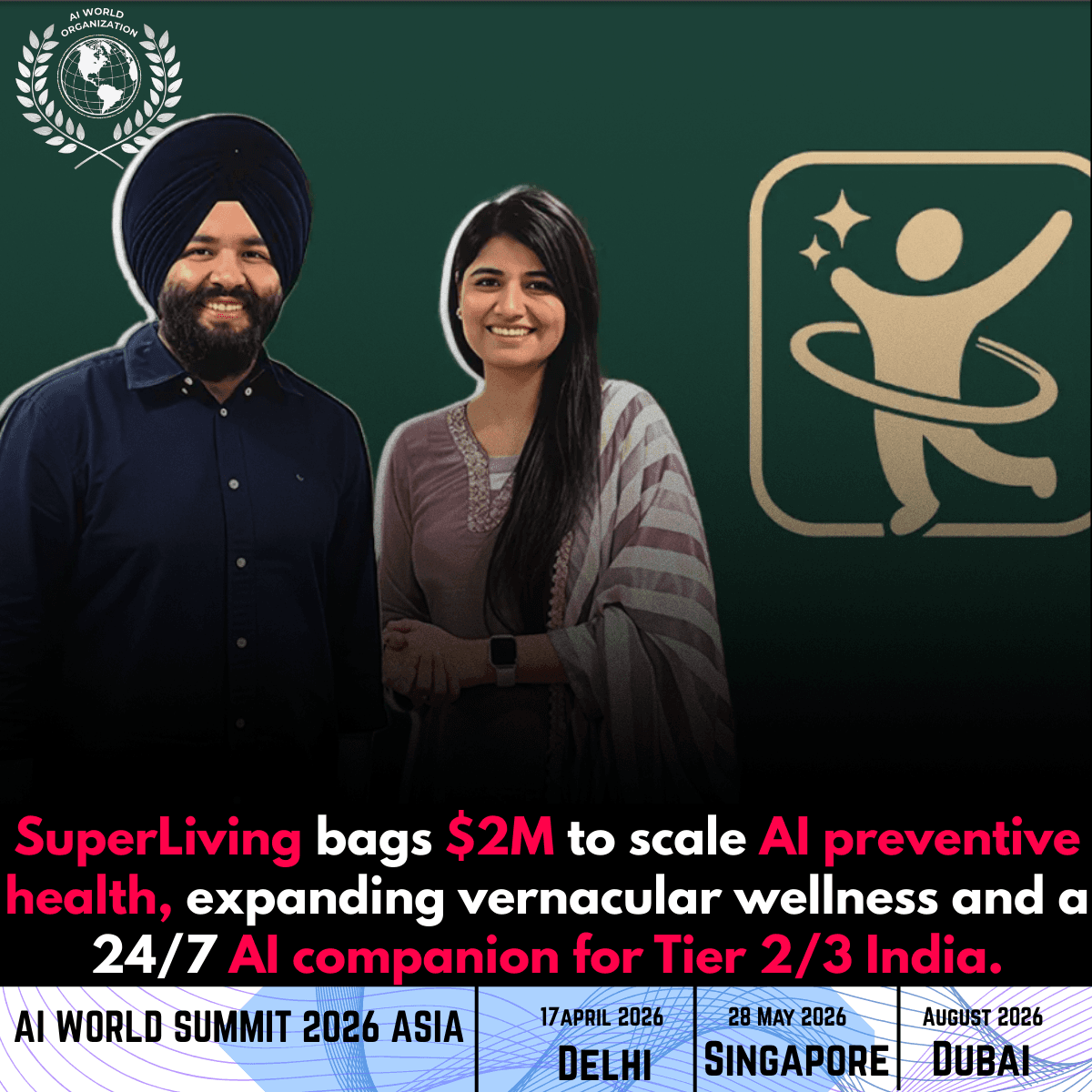
SuperLiving Raises $2M for Preventive AI Health
SuperLiving has raised $2M led by Kae Capital to expand its AI preventive lifestyle platform, boost vernacular content, and reach Tier 2/3 India.
TL;DR
Bengaluru-based SuperLiving raised $2M in a round led by Kae Capital (with All In Capital and angels) to scale its AI-powered preventive lifestyle platform. The app tracks 115+ lifestyle signals and is seeing strong demand beyond metros. Funds will improve features, expand vernacular content, strengthen its 24/7 AI companion, and grow across Tier 2/3 India.
SuperLiving’s $2 Mn raise highlights a shift toward preventive, AI-led wellness in India
Bengaluru-based healthtech startup SuperLiving has raised $2 million in a funding round led by Kae Capital, with participation from All In Capital and other angel investors. The funding comes at a time when preventive lifestyle support is increasingly being treated as a scalable product category—especially when it is built around local language access, cultural relevance, and an “always-on” coaching layer that fits into daily life rather than demanding dramatic, short-term change.
The company’s stated plan for the new capital is straightforward and execution-focused: improve product features, expand vernacular and culturally tailored content, strengthen its AI companion tool, and scale distribution across Tier 2 and Tier 3 cities in India. That combination—product depth, language reach, an AI companion, and non-metro distribution—signals that SuperLiving is optimizing for “Bharat-first” adoption rather than building only for metro early adopters.
At the ai world organisation, stories like this matter because they show how applied AI is moving from pilots and prototypes into practical consumer services that target mass-market outcomes—better daily habits, better consistency, and better adherence—without waiting for hospital visits to trigger action. This is also the kind of real-world implementation that often becomes a central thread at the ai world summit, where founders, investors, operators, and product leaders debate what “responsible,” “useful,” and “scalable” AI actually looks like in everyday life.
What SuperLiving is building: an AI-led preventive lifestyle platform
SuperLiving was founded in 2025 by Manavdeep Singh Grover and Gurjot Kaur, and it operates an AI-powered preventive lifestyle platform focused on everyday guidance rather than episodic medical interventions. The platform is designed to help users across core lifestyle pillars—nutrition, movement, sleep, stress management, and daily habit formation—because these are the areas where consistency often matters more than intensity.
The product experience is built around bite-sized courses, regionally tailored content, and a 24/7 AI companion intended to support users as they try to build routines that can actually be sustained. Instead of assuming that one set of “ideal” behaviours fits everyone, the platform positions cultural and regional context as a feature—suggesting that language, food norms, schedules, and constraints are not edge cases, but the default reality for much of India.
A key technical claim is that the platform analyzes user behaviour across more than 115 lifestyle parameters and then adjusts recommendations based on observed activity patterns. If executed well, that approach can move beyond static wellness content and into adaptive guidance—where suggestions evolve with what the system sees a user doing (or struggling to do), rather than what a one-time questionnaire predicted.
Other reports also describe SuperLiving as a mass-adoption offering that combines AI-personalised lifestyle courses, habit-building nudges, vernacular content, and a 24×7 AI companion that adapts to users’ routines, constraints, and cultural context. The same coverage notes the product positioning as avoiding supplement upsells and extreme regimens, and instead emphasizing simpler, sustainable behaviour change.
Why Tier 2 and Tier 3 adoption is central to the SuperLiving thesis
SuperLiving has emphasized building products tailored to Tier 2 and Tier 3 cities since its founding, which is a deliberate departure from the typical “launch in metros first” playbook. In India, language comfort, local culture, household structure, and time constraints can shape whether a wellness product feels usable or irrelevant—so a Tier 2/Tier 3 lens often forces a different approach to onboarding, content, and coaching design.
The company has also shared early monetisation data indicating that within about 2.5 months of starting monetisation, more than 70% of its paying users came from Tier 2 towns and smaller markets. That detail is notable because it suggests willingness to pay outside the largest metros, provided the pricing, content, and user experience match the needs of those markets.
Additional coverage states that SuperLiving’s courses are priced in a low-cost range (reported as Rs 99 to Rs 250), reinforcing the “priced for mass adoption” narrative rather than premium wellness positioning. That pricing strategy, if paired with strong retention and effective habit formation outcomes, can become a defensible moat—because mass adoption products often win through trust, repeat usage, and strong unit economics at scale rather than high margins per user from the start.
Beyond language and pricing, culturally tailored guidance can be a product advantage in preventive health, particularly when recommendations need to fit existing diets, local routines, and household realities. In practical terms, “what to eat,” “how to move,” “when to sleep,” and “how to manage stress” are behaviours shaped by region, family structure, climate, commute patterns, and work style—so personalization that respects context is often more realistic than a generic global wellness template.
Where the $2M will go: product depth, vernacular content, AI companion, and distribution
SuperLiving’s stated use of funds focuses on four building blocks: improving product features, expanding vernacular and culturally tailored content, strengthening the AI companion, and scaling distribution across Tier 2 and Tier 3 cities. Each of these areas directly connects to the company’s core bet: preventive health outcomes are improved not by “one perfect plan,” but by repeated, small, context-aware decisions that a user can stick with.
On the product side, “enhancing features” typically implies making the daily experience easier and more sticky—better tracking, clearer nudges, more relevant prompts, and fewer drop-off points after the first burst of motivation. For preventive health platforms, small UX improvements can matter disproportionately because a user’s journey is not a single conversion event; it is a long series of micro-decisions where convenience and clarity determine whether a habit becomes real.
On content, the focus on vernacular and cultural tailoring is not a cosmetic layer; it is a distribution strategy and a retention strategy at the same time. If a user can learn and act in the language they think in—and sees guidance that matches local realities—the platform can reduce friction, increase trust, and drive higher completion rates for courses and routines.
On AI, strengthening the “companion” layer is central because the AI companion is positioned as a 24/7 support system rather than a periodic content library. The “always available” nature of a companion matters when the goal is habit formation, because the moments that shape habits—late nights, stressful mornings, irregular workdays, travel, festivals, family commitments—rarely align with scheduled coaching sessions.
The platform’s adaptation logic is also described as being based on analysis across more than 115 lifestyle parameters, adjusting recommendations based on observed activity patterns. For users, the value proposition is that the system does not keep repeating generic advice; it aims to react to what the user is actually doing, which is more likely to create a sense of relevance and momentum over time.
Finally, scaling distribution across Tier 2 and Tier 3 India indicates that the company is thinking beyond online acquisition alone and may look at channel partnerships, community-led growth, and local trust mechanisms—because preventive health adoption often depends on credibility, not just downloads. In India’s non-metro markets, distribution can be as much about “who recommends you” and “does the experience feel made for me” as it is about performance marketing efficiency.
What this funding signals for AI healthtech—and why it belongs on the AI World stage
This funding round reflects a broader trend: investors are increasingly backing AI applications that are narrowly focused on a clear, repeatable use case—here, preventive lifestyle guidance—rather than vague “AI for healthcare” narratives. The fact that SuperLiving’s early paying user mix reportedly skews heavily toward Tier 2 and beyond also reinforces that India’s next wave of consumer AI may be led by products designed for linguistic diversity, cultural nuance, and affordability.
Some reports also note that SuperLiving previously raised around Rs 2 crore from All In Capital in September 2025 after winning an “Elevator Pitch” event, suggesting that the company has progressed from early validation into a larger scale-up round within a relatively short time window. That type of momentum often comes when a product shows clear signals of demand, a differentiated positioning, and a path to scalable distribution—especially when it’s not restricted to the top few metros.
For the broader ecosystem, the key question is not only “can AI personalize content,” but “can AI drive consistent behaviour change in real life”—because preventive health success is measured over weeks and months, not just in onboarding satisfaction. The companion model, the adaptive recommendation layer, and the culturally aligned content strategy together represent a product thesis that can be evaluated on retention, habit consistency, and long-term user outcomes rather than short-term engagement spikes.
At the ai world organisation, this is exactly the category of innovation that aligns with community conversations around applied AI, consumer trust, and scalable impact. As ai world organisation events continue to bring together founders, enterprise leaders, investors, and policy-aware practitioners, preventive health platforms like SuperLiving offer concrete case studies: vernacular-first product design, AI companions that operate at “daily life frequency,” and distribution plans that prioritize Tier 2 and Tier 3 adoption.
This is also why the ai world summit agenda increasingly benefits from healthtech tracks and real-world deployment stories—because healthcare AI is no longer only about hospitals and imaging, but also about behaviour, routines, and preventive care at scale. For readers tracking this space, ai world summit 2025 / 2026 conversations can serve as a practical map of how startups, investors, and operators are approaching trust, personalization, and accessibility in consumer AI products.
For anyone building in healthcare AI, the most immediate takeaway from SuperLiving’s announcement is that “personalization” in India often means more than algorithmic targeting—it means language depth, cultural fit, price sensitivity, and support that can keep pace with day-to-day constraints. And for anyone simply trying to understand where the market is going, the signal is clear: AI-based preventive lifestyle services are becoming investable when they show traction beyond metros and a strategy built for India’s diversity by default.
As the ai world organisation continues to spotlight applied AI through the ai world summit and other ai conferences by ai world, funding stories like this help ground the narrative in what is actually working: practical AI companions, measurable behaviour adaptation, vernacular-first content, and non-metro distribution. For stakeholders who want to follow these shifts closely, AI World Summit 2026 Asia (Singapore) is positioned as one of the key convening points where builders and decision-makers can discuss deployment realities, partnerships, and the next wave of consumer AI adoption.


