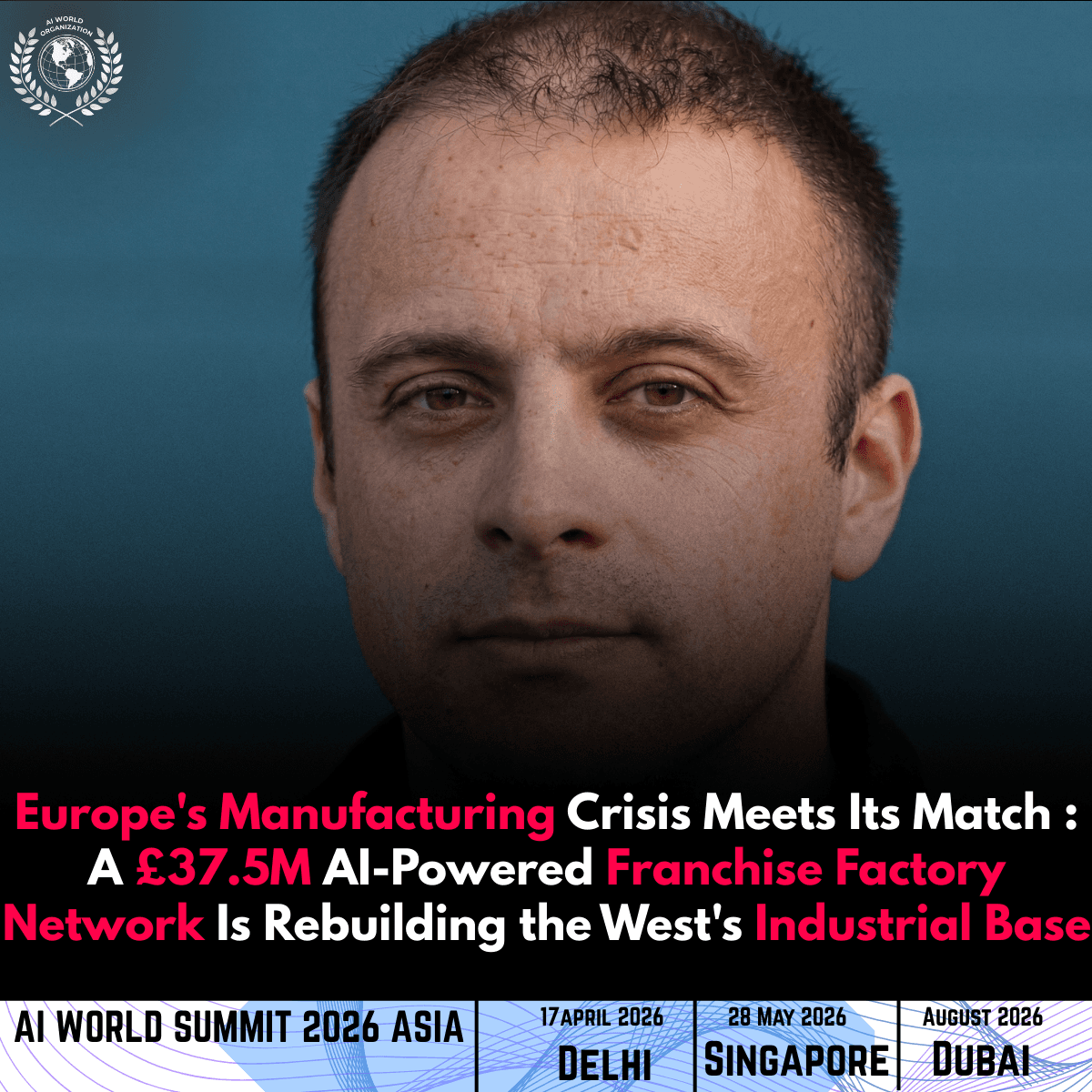
Isembard Raises £37.5M for AI-Powered Factories
Isembard secures £37.5M Series A to expand AI-powered franchise factories across Europe, backed by Union Square Ventures and top angels.
TL;DR
Isembard, a London-based startup, has raised £37.5M in Series A funding to tackle Europe's growing manufacturing capacity crisis. Using its AI operating system, MasonOS, the company runs franchise-owned factories end-to-end from quoting to delivery. It plans to open 25 new factories across the UK, Germany, France, and Ukraine by end of 2026.
Isembard Raises £37.5M Series A to Power Europe's AI-Driven Manufacturing Revolution
Europe's industrial landscape is standing at a crossroads. Decades of gradual deindustrialisation, an ageing workforce of small factory owners, and a sudden, sharp spike in demand from sectors like aerospace, defence, energy, and robotics have created a manufacturing capacity crisis that few had fully anticipated. Into this gap steps Isembard, a London-based manufacturing startup with a bold vision — rebuild the West's industrial base one franchise-operated, AI-powered factory at a time. The company has just closed a landmark £37.5 million (approximately $50 million) Series A funding round, cementing its position as one of the most promising players in what is rapidly becoming a global AI funding news story. This raise comes in less than a year after Isembard secured its seed funding, a pace of growth that speaks volumes about investor confidence in the company's model and the urgency of the problem it is solving.
The round was led by Union Square Ventures, a New York-based venture capital firm with a distinguished track record of backing transformative technology companies. Joining them in this round were Tamarack Global and IQ Capital, alongside existing investors Notion Capital and CIV, all of whom doubled down on their belief in Isembard's trajectory. The deal also attracted a noteworthy set of angel investors, including Alex Bouaziz, co-founder of global payroll and compliance platform Deel; Andrei Danescu, founder of warehouse robotics company Dexory; and Matt Briers, former Chief Financial Officer of international money transfer giant Wise. The presence of these seasoned operators from the technology and finance world signals that the smart money is watching AI funding in manufacturing very closely right now.
A Manufacturing Crisis That Demands a New Kind of Solution
To understand why Isembard's raise has captured so much attention in the AI funding news space, it is important to first understand the problem the company is working to solve. The global component manufacturing market is estimated to be worth around $1.8 trillion annually — a staggering figure that reflects just how central precision manufacturing is to the modern economy. Yet despite this enormous scale, the sector is dominated not by large industrial giants but by small, owner-operated businesses. Approximately 95% of all component production worldwide comes from these smaller enterprises, many of which have been quietly running for decades under the stewardship of their founders.
The challenge is that an entire generation of these factory owners is now approaching retirement age, and there is no clear succession pipeline to fill the void they will leave behind. At the same time, megatrends including reshoring — the process of bringing manufacturing back from lower-cost overseas locations — and a dramatic increase in defence spending across NATO member states are driving demand for precision components higher than it has been in years. The result is a dangerous mismatch: demand is rising steeply, but the supply side is shrinking. This is not a niche problem confined to a single industry. Aerospace manufacturers, defence contractors, energy companies, and robotics firms are all competing for a shrinking pool of manufacturing capacity, and the consequences of inaction could reverberate across entire supply chains.
Isembard was founded with a clear-eyed understanding of this crisis. Rather than trying to replace human operators or take over existing factories, the company has designed a franchise model that leverages the skills and experience of people who already understand manufacturing, military logistics, and operational management. By providing these individuals with cutting-edge technology, a recognised brand, proven engineering standards, and direct access to a pipeline of customer demand, Isembard dramatically lowers the barriers to factory ownership and operation.
MasonOS: The AI Brain Running Isembard's Factory Network
At the heart of everything Isembard does is MasonOS, the company's proprietary artificial intelligence operating system designed specifically to run high-performance manufacturing facilities. This is where the story truly intersects with the broader wave of AI funding sweeping across the technology sector, because MasonOS represents something genuinely novel — an end-to-end agentic AI platform built not for a generic enterprise software use case, but for the gritty, complex, real-world demands of physical manufacturing.
MasonOS integrates every major function of a modern factory into a single intelligent operating layer. This includes the quoting process, where potential jobs are evaluated and priced with speed and accuracy; production scheduling, which ensures that machines and operators are allocated efficiently across competing orders; supply chain management, which tracks and optimises the procurement of raw materials and components; the manufacturing process itself; quality control systems that monitor output against precise engineering tolerances; and final delivery logistics. In a traditional factory environment, each of these functions might be managed by a different team using a different set of tools, with inevitable inefficiencies at every handover point. MasonOS collapses all of that into a unified, continuously self-optimising system.
The agentic nature of MasonOS is particularly significant in the context of today's AI funding landscape. Unlike earlier generations of industrial software, which required human operators to interpret data and make decisions, an agentic AI system can take autonomous action to improve performance. It does not simply flag a scheduling conflict — it resolves it. It does not simply report a quality issue — it identifies the root cause and adjusts parameters to prevent recurrence. This kind of intelligent, self-improving operational capability is exactly what investors in the AI funding space have been hoping to see emerge from the sector, and Isembard appears to have built it specifically for one of the world's most demanding operational environments.
Rebecca Kaden, Managing Partner at Union Square Ventures, captured this well when she said that Isembard is redefining the process of owning and running a factory. By embedding deep operational expertise into an agentic operating system, MasonOS lowers the barrier to running high-performance manufacturing businesses and enables a networked, capital-efficient path to scale. She further noted that at a moment when demand for advanced manufacturing is accelerating and interest in small and medium business ownership is rising, Isembard brings both forces together in a powerful and timely way.
Expanding the Franchise Network Across Europe and Beyond
The new £37.5 million in AI funding will serve several strategic purposes for Isembard, the most headline-grabbing of which is the company's plan to open 25 new factories by the end of 2026. This is an ambitious target that would represent a significant expansion of the company's current footprint and would require not just capital but careful management of the franchise onboarding process, engineering quality assurance, and customer pipeline development.
Geographically, Isembard plans to use the funding to enter new markets in Germany, France, and Ukraine. Germany is the obvious choice — it remains Europe's largest industrial economy and has deep expertise in precision engineering, automotive manufacturing, and aerospace components. France presents similar opportunities, particularly given increased investment in defence capabilities following shifting geopolitical dynamics on the continent. Ukraine is perhaps the most striking choice, and also the most strategically meaningful. As the country begins to think seriously about postwar reconstruction, the need to rebuild and modernise its industrial infrastructure will be enormous, and a franchise model that can rapidly deploy AI-powered manufacturing capacity could play a meaningful role in that effort.
Beyond new factories, the Series A funding will also support the continued development and expansion of MasonOS itself, as well as significant investment in growing engineering teams across both Europe and the United States. This reflects a broader reality about AI funding in the manufacturing space: the most sustainable competitive advantage does not come from the factories alone, but from the technology platform that makes them run smarter, faster, and more efficiently than anything a traditional operator could achieve.
Alexander Fitzgerald, Founder and CEO of Isembard, articulated the company's mission with notable clarity. He described manufacturing as the origin of security, prosperity, and national purpose, and expressed that the Series A funding will allow the company to open more factories, invest further in MasonOS, support exceptional franchisees, and recruit the best engineers across Europe and the United States. His stated mission — to forge industrial acceleration — carries a sense of urgency that is entirely appropriate given the scale of the challenge the company is addressing.
The Franchise Model: Democratising Factory Ownership Through AI
One of the most intellectually interesting dimensions of Isembard's approach, and one that sets it apart from most of the AI funding news flowing out of the technology sector, is the way the company thinks about who should be running its factories. In most industries, the rollout of AI-powered automation is discussed primarily in terms of what it displaces — jobs that machines can now do more cheaply or efficiently than humans. Isembard flips this narrative on its head by asking a different question: who are the right people to run factories, and how do we give them everything they need to succeed?
The company's answer draws from a surprisingly diverse talent pool. Isembard actively identifies and recruits exceptional operators from the manufacturing sector itself, but also from the military — where disciplined logistics management, precision execution, and the ability to lead under pressure are deeply ingrained — and from the wider franchising industry, which has its own body of knowledge about scaling operational businesses efficiently. These individuals bring domain expertise and operational credibility that no AI system can replicate on its own. MasonOS then acts as a force multiplier, handling the complexity of running a modern factory so that human operators can focus on leadership, customer relationships, and continuous improvement.
This model is significant from an AI funding and investment perspective because it addresses one of the persistent criticisms of AI-driven automation: that it concentrates economic value in the hands of technology owners at the expense of everyone else. Isembard's franchise structure means that the financial upside of owning and operating a high-performance factory is distributed to individual operators rather than retained centrally. Combined with the company's mission to preserve and grow manufacturing employment in communities where factory closures would otherwise leave lasting economic damage, this creates a genuinely differentiated value proposition that resonates far beyond the technology investment community.
What This Means for the Future of AI in Industrial Manufacturing
The global AI funding environment in 2026 is characterised by a flight to quality — investors are increasingly focused on companies that are solving real, hard problems with defensible technology rather than chasing trends. Against that backdrop, Isembard's Series A stands out as a particularly mature and credible example of AI funding news. The company is not deploying AI as a marketing narrative; it is using it as the operational core of a network of physical factories that produce tangible components for demanding industries.
The implications of this are broader than Isembard itself. If the company can demonstrate at scale that AI-powered franchise factories can produce aerospace and defence-grade components at competitive cost and quality, it creates a template that could be replicated across dozens of other manufacturing sub-sectors. It also sends a powerful signal to policymakers across Europe and North America who are wrestling with questions about industrial sovereignty — the ability to produce critical components domestically rather than depending on distant supply chains that have proven fragile in recent years.
At The AI World Organisation, we see Isembard's journey as emblematic of a broader transformation underway in the global economy. AI is no longer confined to software applications and digital services. It is finding its way into the factory floor, the supply chain, and the operational fabric of industries that have changed little in decades. The £37.5 million Series A secured by Isembard is not just a notable data point in the AI funding news cycle — it is a signal that the industrialisation of AI is accelerating, and that the companies building the physical infrastructure of the next industrial revolution are attracting serious, sophisticated capital. As the company moves toward its goal of 25 factories by end of 2026 and expands across the European continent, it will be one of the most compelling case studies to watch in the intersection of artificial intelligence, advanced manufacturing, and the future of work.


