Supabase Raises $500M at $10.5B - AI Agents Lead
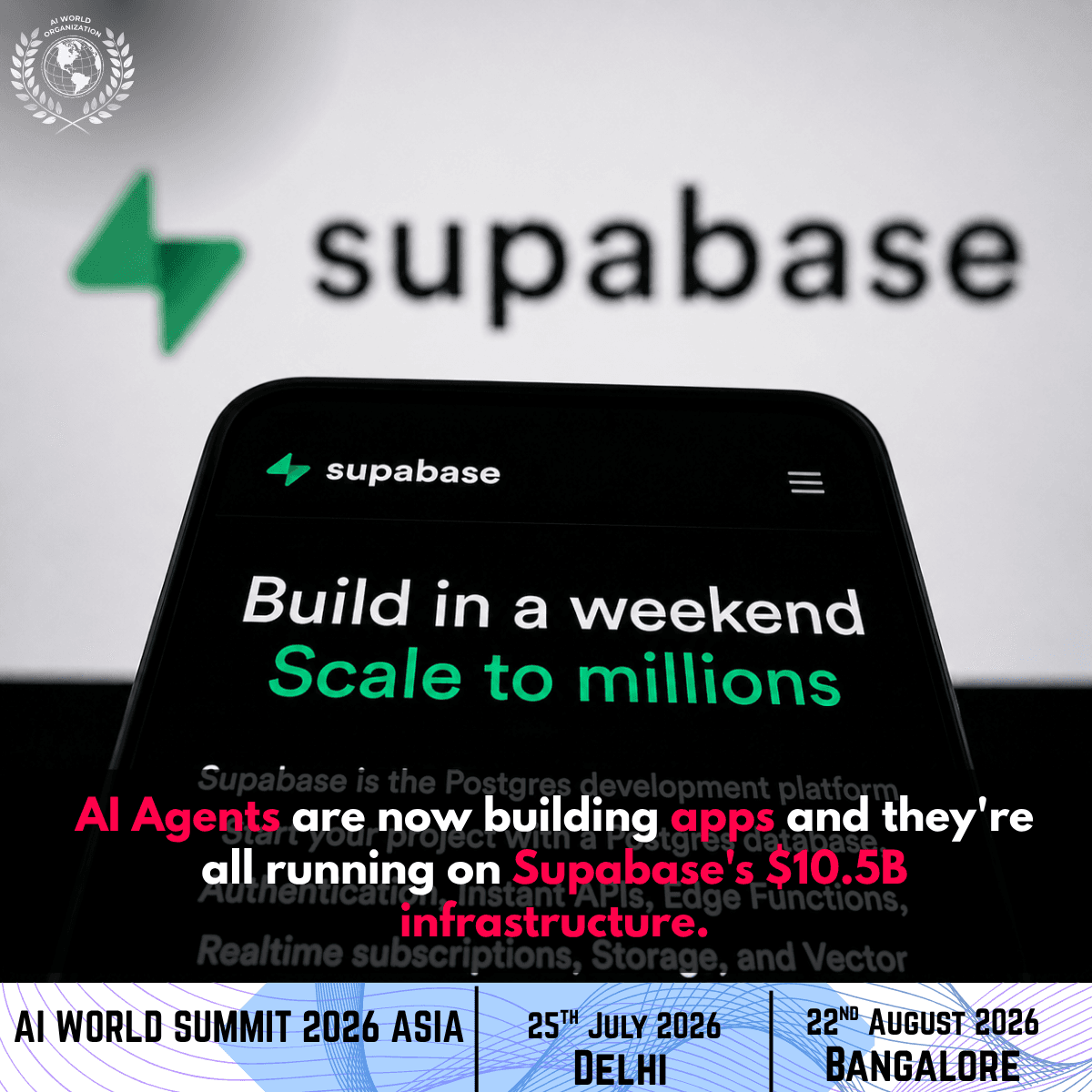
Supabase closes a $500M Series F at $10.5B valuation. Claude Code is now its biggest customer as AI agents deploy the majority of databases on the platform.
TL;DR
Supabase just closed a $500M raise at a $10.5B valuation — up from just $2B fifteen months ago. The standout detail? AI agents, led by Claude Code, are now responsible for deploying the majority of new databases on the platform. With 600% year-over-year database growth and a new open-source scaling tool called Multigres launching, Supabase has quietly become the backbone of the AI app-building wave.
Supabase Raises $500M at $10.5B Valuation — And Claude Code Is Its Biggest Customer
There is a particular kind of stubbornness that separates the founders who end up changing industries from those who simply try to. Paul Copplestone, the New Zealand-born co-founder and CEO of Supabase, has that quality in abundance. Back in 2014, when he was still in Christchurch trying to convince investors that his database idea was worth backing, the doors stayed shut. Nobody wanted it. Not a single investor thought the concept had legs. Most people in that situation would have moved on, pivoted, or quietly shelved the idea and found something easier to sell. Copplestone did not. He spent years working inside another startup instead, watching firsthand how database infrastructure breaks down under the weight of real-world scale, and quietly building up a far sharper understanding of what was actually missing in the market. By 2020, he was ready to build it properly — and this time, instead of pitching it in boardrooms, he simply put it on the internet. It went viral. The rest, as they say, is now a $10.5 billion story.
Supabase, the San Francisco-based open-source Postgres development platform co-founded by Copplestone and Ant Wilson — who serves as CTO and hails from Liverpool in the United Kingdom — has closed a $500 million Series F funding round. The round was led by GIC, Singapore's sovereign wealth fund, and saw participation from every existing investor in the company's cap table, including Accel, Y Combinator, Craft Ventures, Felicis Ventures, Peak XV Partners, and Coatue Management. Stripe, which had already backed Supabase in a previous round, came back in for a second time. Salesforce Ventures joined as a brand-new investor. The round values Supabase at $10.5 billion on a post-money basis, pushing the company's total capital raised beyond the $1 billion mark for the first time in its history.
To appreciate how extraordinary this trajectory is, it helps to look at the numbers in sequence. In March 2025, Supabase was valued at $2 billion. By October 2025, when it closed its Series E, that number had jumped to $5 billion. Now, just seven months later, it has more than doubled again to $10.5 billion. That is a more than fivefold increase in valuation inside fifteen months — a rate of appreciation that is almost unheard of outside of the most extraordinary moments in technology history. And the reason it is happening is not the result of hype cycles or frothy investor sentiment alone. There is a very real, very measurable business story underneath these numbers — one that sits right at the intersection of open-source infrastructure and the explosive rise of AI-powered software development.
A Decade-Long Bet That Finally Paid Off
To understand why Supabase has grown the way it has, it is worth going back to its founding premise. When Copplestone and Wilson launched the company in 2020, they positioned it as an open-source alternative to Google's Firebase — a backend-as-a-service platform that had become widely popular among developers for its ease of use. Their pitch was elegant: build in a weekend, scale to millions. Firebase was fast to get started with, but it ran on a NoSQL architecture that increasingly ran into friction as applications became more complex. Supabase made a different bet — it bet on Postgres, one of the most proven, most loved relational database systems in the world. Instead of building something new from scratch, Supabase wrapped Postgres in a developer-friendly interface and gave teams authentication, storage, edge functions, and real-time capabilities right out of the box, all on top of a foundation that millions of developers already trusted.
That decision — to anchor the entire product on Postgres — turned out to be prescient in a way that even Copplestone might not have fully anticipated at the time. As artificial intelligence moved from research labs into production software, the models and agents doing the work turned out to have a strong structural preference for relational data. They reason better with structured schemas. They query more reliably against relational tables. They build more predictable systems on top of transactional databases. In other words, the AI era turned out to be, quite unexpectedly, a Postgres era — and Supabase was already there waiting for it.
Today, the company employs approximately 350 people and serves more than 250,000 customers across the globe. Its developer community has grown from four million at the time of the Series E in October 2025 to more than nine million as of this announcement — a number that more than doubled in just eight months. That kind of organic community growth is not something you can buy with marketing spend. It reflects a product that developers genuinely reach for when they need to build something quickly and reliably, and a platform that has earned a level of trust that translates into compounding word-of-mouth adoption.
How AI Agents Became Supabase's Biggest Growth Engine
The most striking detail in the Series F announcement is not the valuation figure, impressive as it is. It is the revelation about where the growth is actually coming from. According to Copplestone, AI agents now deploy the majority of new databases on the Supabase platform. And the single largest contributor to those deployments since the start of 2026 has been Claude Code — Anthropic's terminal-based agentic coding tool that allows developers to build full applications through natural language instructions. OpenAI's Codex, another AI coding agent, has also been a major driver of new database creation on the platform.
This is a genuinely significant moment for the AI industry to pay attention to, and at The AI World, we think it deserves careful examination. What we are watching here is not just one company raising a lot of money. We are watching the first concrete, large-scale evidence that agentic AI tools have become primary creators of production software infrastructure — not just helpers or accelerators, but actual autonomous agents that spin up backend systems, configure databases, write schemas, and deploy fully functional applications without a human typing a single line of code in the traditional sense.
The numbers back this up in a concrete way. Supabase has recorded a 600% increase in the number of databases on its platform year over year. Its Supabase for Platforms product — which powers the majority of the top AI app-building tools in the market — has seen 370% customer growth in just the past six months. These are not incremental improvements. These are figures that suggest a structural shift is underway in how software gets made, and who — or more accurately, what — is making it.
Two of the biggest names in the AI app-building space illustrate this dynamic clearly. Lovable, the AI-powered application builder that recently raised $330 million at a $6.6 billion valuation, uses Supabase as its core backend infrastructure. Bolt, another fast-growing platform in the same category, does the same. When a non-technical founder uses Lovable to spin up a web application in an afternoon, that application is almost certainly backed by a Supabase database — created automatically, without any human involvement in the database setup process. Every new AI-generated app is, effectively, a new Supabase customer. This is a flywheel that has no obvious ceiling as long as AI-assisted software development continues to grow.
Copplestone summarised the moment in a statement accompanying the announcement: "Demand for Supabase is exploding. Our user base has more than doubled since the Series E and we've seen a 600% increase in databases year-over-year. Claude Code is the largest contributor since the start of the year. Agents are now deploying the majority of databases on our platform." Those words — agents are now deploying the majority of databases — should be read carefully. This is the CEO of a $10.5 billion infrastructure company saying that the majority of his product's usage is now driven not by human developers but by AI systems acting autonomously.
Multigres: The Open-Source Answer to Postgres Scalability at AI Scale
Alongside the funding announcement, Supabase unveiled a preview of a brand-new open-source project called Multigres. This is arguably as important a development as the funding round itself, though it has received less attention in the broader coverage. To understand why it matters, it is necessary to understand the one genuine limitation that Postgres has always carried: it scales vertically rather than horizontally by default. A single Postgres instance is extraordinarily capable, but when a company grows large enough that a single instance can no longer handle the load, the traditional path has been to migrate to a different database system entirely — sacrificing the Postgres tooling, the ecosystem, and the institutional knowledge that teams have built up over time.
Multigres eliminates that constraint. It is a horizontal scaling layer built natively on top of Postgres, designed to support sharding, zero-downtime migrations, and high availability — all without forcing teams to leave the Postgres ecosystem. Copplestone told CNBC that the goal is to enable companies to scale "up to the size of OpenAI or even larger." That framing is deliberate. OpenAI operates at a database scale that most infrastructure providers cannot match. The fact that Supabase is positioning Multigres as a tool capable of handling that level of throughput signals an ambition to serve not just the long tail of AI app builders, but the very largest players in the AI industry as well. Multigres is available now under the Apache 2.0 open-source licence, meaning any developer or organisation can use, modify, and deploy it without licensing fees.
This move is also strategically significant from a competitive standpoint. Supabase's most notable direct competitor in the serverless Postgres space was Neon — a startup that had raised $130.6 million in total funding before it was acquired by Databricks for approximately $1 billion in May 2025. Neon's acquisition effectively removes the most prominent independent alternative from the market, leaving Supabase with a cleaner run as the dominant open-source Postgres platform for the agentic era. Google's Firebase remains the incumbent in the broader backend-as-a-service category, but its NoSQL foundation creates a genuine architectural mismatch with the relational data preferences of AI agents. Amazon's Aurora Postgres and MongoDB both compete for enterprise database workloads at scale, but neither offers the open-source, developer-first positioning that has made Supabase the default choice for the AI application-building community.
The Investors Behind the Round and What the Market Is Saying
The composition of the Series F investor list is worth examining in detail because it tells a story about which parts of the global capital markets have the highest conviction in Supabase's position. GIC leading the round is a meaningful signal. Singapore's sovereign wealth fund is not a venture capital firm chasing high-risk, high-reward bets on unproven concepts. GIC manages assets for the long-term financial security of Singapore and has a reputation for disciplined, conviction-based investing in companies that are demonstrably reshaping global industries. Its decision to lead a $500 million round at a $10.5 billion valuation is a strong statement that institutional capital at the highest level views Supabase as foundational infrastructure for the AI era — not a speculative bet.
Stripe's second investment in the company is equally notable. Stripe is itself one of the most successful developer-infrastructure companies in the world, with a deep understanding of what it takes to build products that developers choose not because they are told to, but because they genuinely work better. When a company like Stripe backs another company twice, it tends to reflect a real alignment of worldviews about where developer infrastructure is headed. Salesforce Ventures joining as a new investor adds an enterprise-facing dimension to the story, suggesting that Supabase's ambitions extend well beyond the startup developer community and into the world of large-scale enterprise data management.
The broader market context amplifies the significance of this round further. According to research from Grand View Research, the global database management system market was valued at approximately $100.58 billion in 2024 and is projected to reach $285.05 billion by 2030, growing at a compound annual growth rate of 18.9%. Supabase's own 600% year-over-year database growth significantly outpaces even that projection, suggesting the platform is not just riding a rising tide but actively reshaping the competitive landscape within it. The companies that built their positions in the database market for a world where human developers wrote all the code are now facing a fundamental question about whether their architectures and go-to-market strategies are fit for a world where AI agents write the majority of new software.
What Supabase's Rise Tells Us About the Future of AI Infrastructure
At The AI World, we cover the entire spectrum of artificial intelligence — from research breakthroughs and model releases to the infrastructure layers that make AI applications possible at scale. The Supabase story sits squarely at the infrastructure end of that spectrum, and we think it is one of the most important narratives in the AI industry right now, precisely because it is easy to overlook.
Most of the conversation about AI's economic impact focuses on the models themselves — on which large language model is the most capable, on which AI lab is leading the race, on the staggering amounts of capital flowing into frontier model development. But there is a quieter revolution happening in the infrastructure layer, and it may ultimately be just as consequential. If AI agents are going to build and deploy the majority of new software applications — and the evidence from Supabase strongly suggests that process is already well underway — then the infrastructure those agents rely on becomes the true foundation of the AI economy. Whoever controls the database layer that AI agents default to when they spin up new applications is, in a very real sense, controlling a critical piece of the AI stack.
Supabase's position in that picture is remarkably strong. It has the open-source credibility that makes developers trust it. It has the Postgres foundation that AI agents have demonstrated a strong preference for. It has the integrations with the leading AI app-building platforms that make it the default choice for automated deployments. And it now has more than $1 billion in total capital to invest in scaling that position globally, building out Multigres, and extending the platform's capabilities to serve the largest and most demanding workloads in the industry.
The journey from a rejected pitch in Christchurch in 2014 to a $10.5 billion company in 2026 is, on one level, a story about persistence and timing. But it is also a story about a founder who spent a decade developing a precise, well-reasoned view of what the database market actually needed — and who then had the patience to wait for the moment when the world caught up to it. The AI coding revolution did not just validate Supabase. It turned out to be the exact scenario the company's architecture was built to serve. That is not luck. That is conviction.
For the AI industry broadly, the lesson is worth absorbing. The infrastructure choices that AI agents make autonomously — the platforms they default to, the databases they create, the APIs they call — will shape the competitive landscape of the technology industry for the next decade and beyond. The companies building that infrastructure today, the ones that AI agents reach for without being told to, are quietly becoming among the most important businesses in the world.