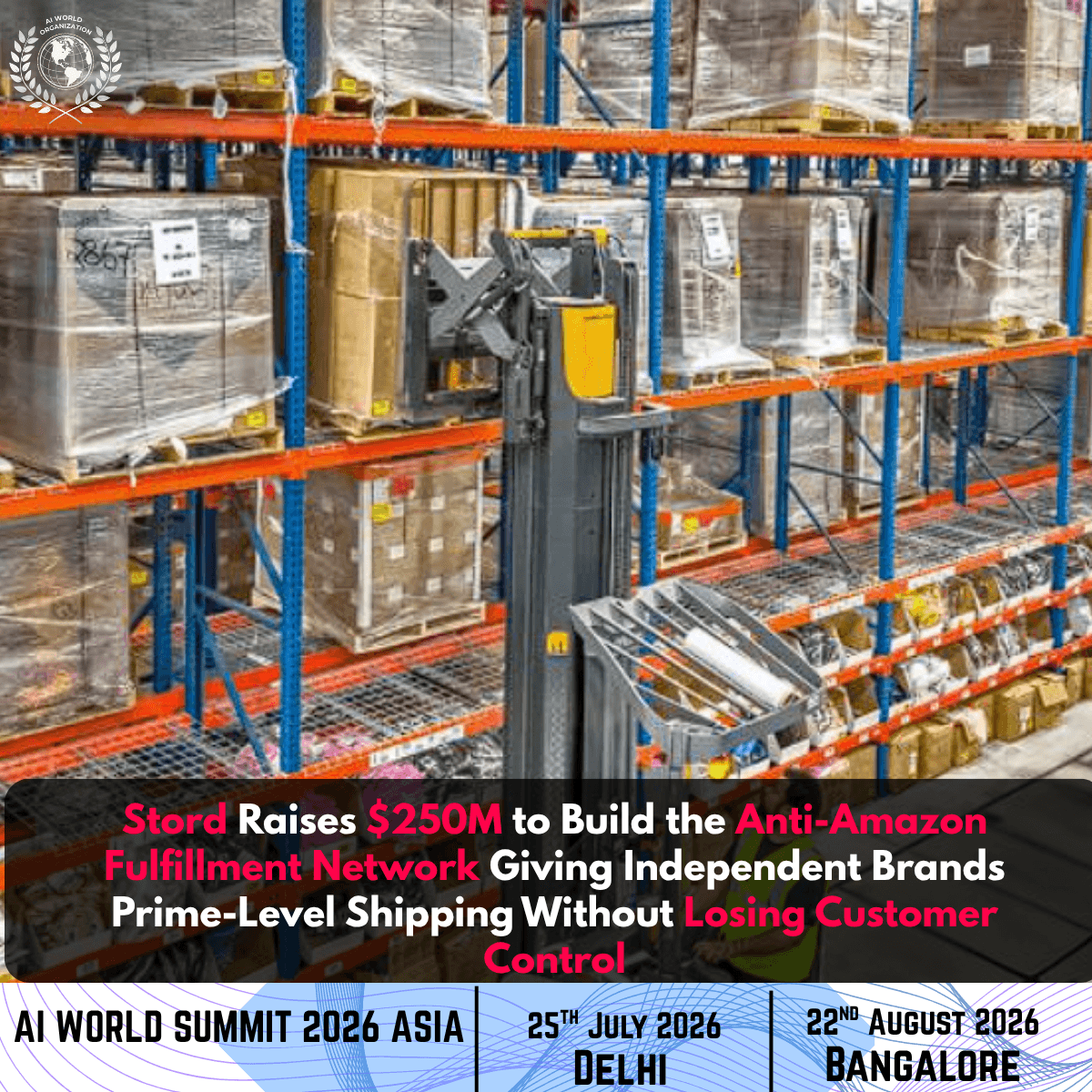
Stord Raises $250M to Rival Amazon at $3B Valuation
Stord secures $250M Series F funding at $3B valuation from Kleiner Perkins and Founders Fund to help independent brands compete with Amazon's infrastructure.
TL;DR
Stord, an Atlanta-based e-commerce fulfillment platform, just raised $250 million at a $3 billion valuation to help independent brands compete with Amazon's delivery network. The company combines warehouses, software, and AI to offer Prime-level shipping without forcing brands to sell on Amazon's marketplace. With over 1,000 brands using the platform and revenue growing 10x in five years, Stord is building what it calls a "physical intelligence layer" for online commerce.
Stord Secures $250 Million in Series F Funding to Challenge Amazon's E-commerce Dominance
Atlanta-based commerce infrastructure platform Stord has successfully closed a massive $250 million Series F funding round, catapulting the company's valuation to an impressive $3 billion. This significant capital injection, led by prominent venture capital firms including Kleiner Perkins, Founders Fund, and Strike Capital, represents a strategic bet on the future of independent e-commerce brands seeking to compete against retail giant Amazon's formidable infrastructure.
The funding announcement comes at a critical juncture in the e-commerce landscape, where independent brands are increasingly struggling to match the consumer experience that Amazon has perfected over decades. Founded in 2015 by CEO Sean Henry, Stord has positioned itself as the antidote to Amazon's market stranglehold by offering smaller brands access to Prime-level fulfillment capabilities without the need to sell through Amazon's marketplace.
Breaking Amazon's Infrastructure Monopoly Through Vertical Integration
What sets Stord apart in an increasingly crowded logistics technology sector is its comprehensive approach to solving the fulfillment challenge. Rather than focusing on isolated components of the supply chain, the company has built what it calls a "physical intelligence layer" that combines three critical elements: a vertically integrated fulfillment network spanning nearly 100 locations worldwide, proprietary software designed specifically for commerce operations, and an advanced AI layer trained on real-time fulfillment data.
This holistic strategy addresses a fundamental problem that has plagued independent brands for years. While Amazon has invested hundreds of billions of dollars and over two decades building an unmatched logistics infrastructure, smaller brands have been forced to cobble together solutions from multiple vendors, resulting in subpar customer experiences and higher operational costs. Sean Henry articulated this challenge succinctly, stating that every independent brand has been left to figure out on their own how to compete against the consumer experience Amazon has meticulously constructed.
The vertical integration model that Stord employs creates what the company describes as compounding advantages. By owning the fulfillment network, software platform, and data layer simultaneously, each order processed through the system improves speed and reduces costs for all subsequent orders. This creates a flywheel effect that becomes more powerful as the network scales, similar to how Amazon's own infrastructure benefits from network effects.
Explosive Growth Signals Market Validation
The numbers behind Stord's recent performance tell a compelling story about market demand for alternatives to Amazon-centric commerce infrastructure. According to the company's disclosures, revenue has grown more than tenfold over the past five years, while the customer base has expanded to serve over 1,000 brands across various sectors. Even more impressive is the acceleration in the software division, which tripled in size during 2025 and saw bookings more than double quarter-over-quarter in the first quarter of 2026.
This growth trajectory aligns with broader market trends in the e-commerce fulfillment services sector. Industry research indicates that the global market for e-commerce fulfillment services reached $123.68 billion in 2024 and is projected to surge to $272.14 billion by 2030. This anticipated growth represents a compound annual growth rate that reflects both the continued expansion of online commerce and the increasing complexity of fulfillment operations that require sophisticated technological solutions.
The impressive revenue growth has been achieved despite operating in a competitive landscape that includes well-funded rivals such as ShipBob and Flexport, both of which have raised substantial venture capital to build their own logistics networks and software platforms. However, Stord's leadership believes the company's differentiator lies in its refusal to compromise on vertical integration, maintaining that true competitive advantage comes from controlling every aspect of the fulfillment experience rather than outsourcing critical components.
AI and Robotics Investment Through Stord Labs Initiative
A substantial portion of the fresh $250 million capital injection will fund the launch of Stord Labs, a dedicated research and development facility in Atlanta focused on advancing what the company terms "physical intelligence" capabilities. This new laboratory will concentrate on developing and validating three key technology areas: agentic AI systems capable of autonomous decision-making in logistics contexts, advanced robotics for warehouse operations, and comprehensive automation solutions that can be deployed across the entire Stord network.
The timing of this AI-focused investment is particularly noteworthy given the broader surge in artificial intelligence adoption across physical logistics and e-commerce operations. Brands are increasingly viewing technology not merely as a cost center to be minimized, but as a competitive advantage that can differentiate them in crowded markets. The ability to leverage AI for demand forecasting, inventory optimization, route planning, and warehouse automation has become a critical factor in determining which brands can profitably compete in direct-to-consumer channels.
John Lagomarsino, co-founder of Strike Capital, emphasized this strategic importance in his comments about the funding round, noting that the rise of agentic purchasing will increasingly favor platforms where software and physical operations are deeply integrated. This observation points to an emerging trend where AI agents, rather than human shoppers, may increasingly handle routine purchasing decisions, creating new requirements for how commerce infrastructure must operate.
The physical intelligence concept that Stord is pursuing represents an evolution beyond traditional warehouse management systems and logistics software. Instead of simply tracking inventory and managing orders, these AI systems are designed to actively optimize the entire fulfillment process in real-time, making autonomous decisions about inventory placement, order routing, and resource allocation based on constantly updating data about demand patterns, transportation costs, and fulfillment capacity.
Strategic Backing from Top-Tier Venture Capital Firms
The composition of Stord's investor syndicate reads like a who's who of Silicon Valley's most influential venture capital firms. Beyond the lead investors Kleiner Perkins, Founders Fund, and Strike Capital, the round attracted participation from Franklin Templeton, Baillie Gifford, G Squared, Bond, and Lux. The decision by existing investors to double down with additional capital in this Series F round signals strong confidence in both Stord's execution to date and its future growth trajectory.
Kleiner Perkins, with its legendary track record of backing transformative technology companies, brings not just capital but strategic guidance on scaling technology platforms. Founders Fund, known for its contrarian investment thesis and willingness to back ambitious visions, has consistently supported companies attempting to rebuild fundamental infrastructure. The participation of Franklin Templeton and Baillie Gifford, both traditional asset managers expanding into venture capital, adds financial firepower and potentially opens doors to public market capital in the future.
This level of investor support is particularly significant given the current venture capital environment, where funding for later-stage companies has become more selective and valuation multiples have compressed across many sectors. The fact that Stord could command a $3 billion valuation in this environment speaks to both the quality of its business fundamentals and the strategic importance of the problem it is solving.
The Broader Battle for E-commerce Infrastructure Independence
Stord's mission extends beyond simply providing fulfillment services to independent brands. The company is fundamentally attempting to rewrite the power dynamics of online commerce by giving brands the ability to own their customer relationships without sacrificing the quality of the shopping experience. For years, many brands faced a difficult choice: either sell through Amazon and benefit from Prime shipping while losing control of customer data and brand presentation, or sell direct-to-consumer and struggle to match Amazon's fulfillment capabilities.
The dominance of Amazon in e-commerce infrastructure has created what many industry observers describe as a structural advantage that becomes self-reinforcing over time. As more customers join Prime for the shipping benefits, more brands feel compelled to sell through Amazon to reach those customers, which in turn funds further investment in Amazon's logistics infrastructure, making it even harder for alternatives to compete. This cycle has contributed to Amazon capturing an outsized share of e-commerce growth over the past decade.
However, the fragmentation of independent fulfillment infrastructure has historically prevented brands from accessing comparable capabilities. While third-party logistics providers (3PLs) have existed for decades, most focused on either the warehouse operations or the technology layer, but rarely both simultaneously. This fragmentation meant that brands working with traditional 3PLs still needed to manage multiple vendor relationships, integrate disparate systems, and troubleshoot problems when different components of their fulfillment stack didn't work together seamlessly.
Stord's integrated approach attempts to collapse these multiple relationships into a single platform that can match or exceed Amazon's capabilities in areas like two-day delivery, real-time inventory visibility, and returns processing. By operating its own warehouse network while also building the software layer, Stord can optimize the entire system in ways that would be impossible when working with third-party warehouses or licensed software.
Scaling the Team to Match Ambitious Growth Plans
Currently employing more than 4,000 people across its warehouse operations, technology development, and customer service functions, Stord is continuing to expand its workforce in line with business growth. This substantial team size reflects the labor-intensive nature of fulfillment operations, where despite increasing automation, human workers remain essential for many warehouse tasks and customer support functions.
The company's hiring strategy will likely focus on several key areas as it deploys the fresh capital. The launch of Stord Labs will require recruiting specialized talent in artificial intelligence, robotics engineering, and automation systems. The continued expansion of the warehouse network will necessitate hiring operations managers, warehouse workers, and logistics coordinators in new geographic markets. Meanwhile, the rapid growth of the software business will drive demand for software engineers, product managers, and solutions architects who can work with brands to implement the Stord platform.
This aggressive hiring approach stands in contrast to broader trends in the technology sector, where many companies have been reducing headcount in response to economic uncertainty and investor pressure to demonstrate profitability. Stord's willingness to continue investing in team growth suggests confidence that the market opportunity is large enough to support rapid expansion without compromising unit economics.
Long-term Vision for Physical Intelligence Leadership
Looking beyond the immediate deployment of the Series F capital, CEO Sean Henry has articulated an ambitious vision for Stord to become the definitive physical intelligence layer for independent online commerce. This goal suggests that the company sees its ultimate addressable market extending beyond traditional fulfillment services to encompass a broader set of physical operations that brands need to compete effectively in digital commerce.
Henry's optimism about the future is rooted in his belief that advances in AI and physical intelligence will create accelerating advantages for Stord's customers. As the company's systems process more orders and collect more data about optimal fulfillment strategies, the AI models become more accurate in their predictions and more effective in their optimizations. This creates a data moat that becomes increasingly difficult for competitors to replicate, even if they have access to similar underlying technologies.
The concept of a physical intelligence layer represents a potentially transformative vision for how commerce infrastructure could evolve. Rather than brands needing to separately contract for warehousing, transportation, inventory management software, and customer service, a comprehensive physical intelligence platform could handle all these functions in an integrated manner, using AI to optimize across the entire system rather than optimizing each component in isolation.
If Stord can successfully execute on this vision, it could fundamentally alter the competitive landscape for e-commerce, shifting power away from marketplace platforms like Amazon and back toward independent brands that own direct relationships with their customers. This would represent a significant shift in an industry that has become increasingly concentrated around a small number of dominant platforms.
The path to achieving this vision will require continued execution on multiple fronts: expanding the warehouse network to ensure comprehensive geographic coverage, advancing the AI and automation capabilities to maintain technological leadership, growing the software business to capture more of the value stack, and most importantly, delivering consistent results for brands that trust Stord with their customer fulfillment. With $250 million in fresh capital and a clear strategic roadmap, Stord appears well-positioned to pursue this ambitious agenda over the coming years.