Sona Raises $45M to Replace Legacy Workforce Tools with AI
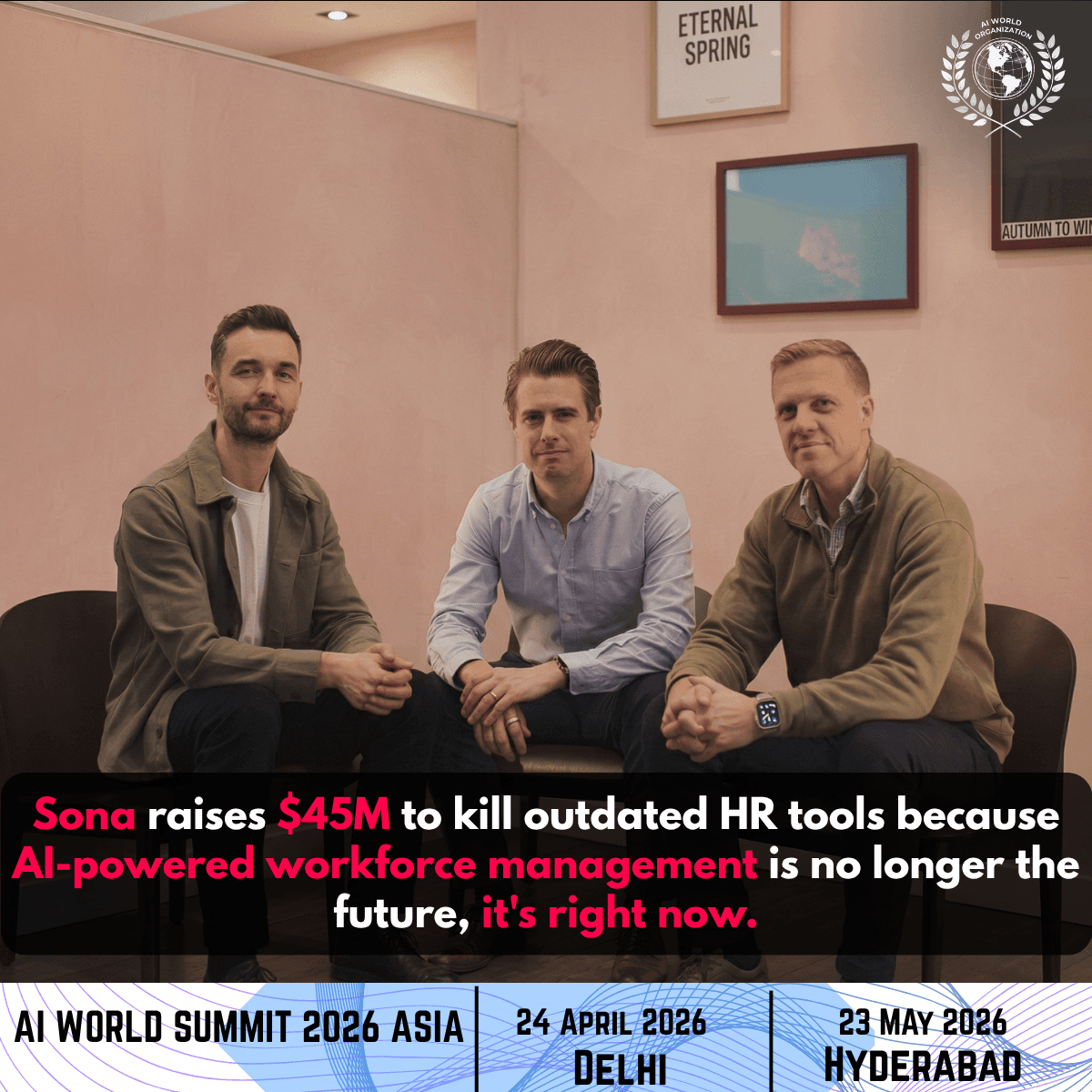
Sona secures $45M Series B led by N47 to build AI-powered workforce management tools for hospitality, retail, and healthcare sectors.
TL;DR
Sona, a London-based startup, has raised $45 million in a Series B round led by N47, pushing its total funding past $100 million. The company builds AI-powered software that replaces outdated scheduling, payroll, and HR tools used in hospitality, retail, and healthcare. Brands like Popeyes already use its platform to cut scheduling time by up to 70%. The fresh capital will fuel its expansion into the US market.
Sona Secures $45 Million in Series B to Disrupt Legacy Workforce Management with AI
The workforce management software industry has long been dominated by platforms built in a different era — systems that were designed for a world that no longer exists. Most of these tools were architected before cloud computing became standard, before mobile-first became a necessity, and certainly before artificial intelligence began reshaping how enterprises approach operations. For years, businesses in shift-heavy industries like hospitality, retail, healthcare, and logistics have had no choice but to rely on outdated processes — spreadsheets stacked beside clunky HR dashboards, manual scheduling that eats up manager hours, and payroll tools that don't talk to each other. That is exactly the problem Sona set out to fix, and the latest AI funding news from the startup world confirms that investors believe it has found the answer.
Sona, a London-based workforce intelligence company, has officially closed a $45 million Series B funding round, led by growth investor N47. The round saw strong participation from the company's existing backers, including Felicis, Northzone, Gradient, and Italian Founders Fund. With this latest injection of capital, Sona's total funding now surpasses $100 million — a figure that places the startup firmly among the most well-backed AI-powered HR technology companies in Europe. This round of AI funding signals more than just investor confidence in a single company; it reflects a broader market conviction that the future of workforce management is intelligent, predictive, and deeply integrated.
A Major AI Funding Milestone for the HR Tech Space
When you look at the history of enterprise software funding, certain moments stand out as genuine turning points. The emergence of cloud-based CRM transformed how sales teams operate. The rise of SaaS payroll platforms changed how finance departments function. And now, the surge in AI funding directed at workforce management platforms is quietly but unmistakably reshaping how businesses handle their most complex and costly operational challenge — managing people.
Sona's Series B is part of this broader wave of AI funding news that has been building momentum across the tech landscape throughout the mid-2020s. But what makes this particular deal notable is the kind of company receiving the capital and the kind of problem it is trying to solve. Unlike many AI-adjacent companies that bolt generative features onto existing software, Sona was purpose-built from the ground up with artificial intelligence at its core. The company was founded in 2021 by Steffen Wulff Petersen, Ben Dixon, and Oli Johnson — three entrepreneurs who saw early on that the workforce management category was structurally broken and that only a ground-up rethinking of the platform could address those structural failures effectively.
The decision by N47 to lead this round is itself a statement of intent. N47 has developed a strong thesis around AI-native enterprise tools, and its backing of Sona reflects a belief that the company has the product maturity, customer traction, and market timing to become a dominant platform in a sector that has historically resisted innovation. For the AI World Organisation, which closely tracks the most consequential AI funding news shaping the global technology ecosystem, Sona's rise represents exactly the kind of story that defines this era — a startup leveraging intelligent systems to solve a problem that incumbents have failed to properly address.
Breaking Down What Sona Actually Does
To understand why this AI funding round matters, you first have to understand the depth of the problem Sona is solving. Workforce management in shift-based industries is enormously complex. A hospital, for example, might have hundreds of employees spread across dozens of departments, working rotating shifts with varying skill requirements, compliance obligations, and pay grades. A restaurant group managing ten locations across a city deals with daily fluctuations in customer demand, last-minute staff cancellations, and labor cost pressures that can make the difference between profitability and loss. For these businesses, getting scheduling wrong isn't just an inconvenience — it is a direct hit to the bottom line.
Traditional workforce management software attempted to address these challenges, but most of the legacy platforms were designed around static rules and manual inputs. A manager would sit down, look at last week's schedule, adjust for known variables, and publish a timetable. It was a time-consuming, error-prone process that depended heavily on individual knowledge and instinct. Time-and-motion studies — a relic of early twentieth-century industrial management — were still being used by many companies to understand how labor should be allocated. These approaches are not just inefficient; in the age of real-time data and machine learning, they are genuinely obsolete.
Sona's platform takes an entirely different approach. Rather than relying on a manager's memory or a static rulebook, Sona ingests real-time operational data — including booking volumes, revenue projections, historical shift patterns, weather forecasts, and local event calendars — and uses that information to generate demand forecasts and staffing recommendations that are both accurate and actionable. The platform brings together scheduling, HR, payroll, compliance management, and workforce analytics into a single unified system. This integrated architecture means that a shift change doesn't just update a schedule — it automatically triggers the relevant payroll adjustments, compliance checks, and communication workflows, all without requiring manual intervention.
For industries where staffing costs can represent sixty to seventy percent of total operating expenses, the ability to optimize labor allocation with this level of precision has transformative financial implications. Sona's customers, which include well-known brands such as Popeyes and Tao Group, have already experienced this firsthand. The platform's generative AI copilots have been shown to reduce the time it takes to build and publish a weekly schedule by as much as seventy percent — a figure that, for a business running dozens of locations, translates into meaningful savings in manager time and, by extension, significant reductions in operational overhead.
The Market Opportunity: A $9.76 Billion Industry in Transition
The scale of what Sona is pursuing becomes clearer when you look at the numbers that define the workforce management software market. According to industry research, the global market for workforce management software is projected to reach $9.76 billion by 2026. This is a market dominated by a handful of established vendors who collectively hold enormous market share but who, by the nature of their legacy architecture, have struggled to deliver the kind of deep AI integration that modern enterprises increasingly demand.
The top ten vendors in the workforce scheduling segment — a list that includes UKG, Ceridian's Dayforce, Workday, Oracle, Deputy, and ADP — together control approximately 55 percent of the global market. These are large, well-funded organizations with extensive enterprise relationships and decades of brand equity. But they also carry the weight of technical debt that comes with building platforms over many years, often through acquisitions that resulted in fragmented architectures and inconsistent user experiences. Adding AI capabilities to these platforms is possible, and most of them are attempting to do so, but there is a significant difference between a platform that was designed for AI and one that has had AI added to it.
This distinction is central to Sona's competitive argument, and it is also part of what makes this latest AI funding news so significant for the broader industry. Steffen Wulff Petersen, Sona's co-founder and CEO, has been direct about the competitive dynamic his company is navigating. In a statement that captures the urgency driving the company's strategy, he noted that every other major enterprise software category has already been transformed by artificial intelligence — but that the tools managing the world's largest workforce are still running on systems that were fundamentally designed two decades ago. He framed AI's arrival not just as an opportunity but as an accelerant, compressing what might have been a decade-long transition into something that can happen in a matter of months.
That framing matters in the context of AI funding strategy because it reveals how Sona thinks about competitive timing. The window during which an AI-native platform can outmaneuver incumbents before those incumbents complete their own AI transformations is real, but it is not unlimited. The $45 million raised in this Series B is, in many respects, fuel for a race — one that Sona believes it is positioned to win, but only if it moves quickly enough to build the customer relationships and enterprise partnerships that will create durable competitive moats before the incumbents catch up.
US Expansion and the North American Competitive Push
One of the most strategically significant aspects of this AI funding announcement is what Sona plans to do with the capital. While product development and platform investment will continue to be priorities, the company has made clear that a substantial portion of the Series B will be directed toward geographic expansion — specifically, an accelerated push into the United States market.
Sona already has a growing presence in New York, and the new funding is designed to dramatically scale that footprint. The company intends to invest heavily in enterprise sales capabilities and to build the kind of deep strategic partnerships with North American businesses that will allow it to compete directly with established players like Deputy and UKG in their home market. This is a bold move, but it is one supported by real evidence of product-market fit. The US market for shift-based workforce management is enormous, and the appetite among enterprise buyers for intelligent, integrated platforms has never been stronger.
The expansion strategy is also underpinned by the launch of Sona's newest product, Forge. This addition to the platform allows businesses to build custom internal software directly on top of Sona's core infrastructure — essentially turning Sona from a specialized workforce management tool into a foundational layer for internal enterprise applications. The implications of this product direction are significant. By positioning itself as a platform rather than a point solution, Sona is making a deliberate play to become deeply embedded in its customers' operations, creating the kind of stickiness that makes enterprise platforms defensible over the long term.
For the North American market specifically, this strategy addresses a key concern that enterprise buyers typically have when evaluating new vendors — the risk of switching costs and integration complexity. By offering not just a better scheduling tool, but an entire ecosystem for building internal operational software, Sona raises the value proposition considerably. Customers who adopt the platform are not just buying a smarter calendar; they are buying into an architectural foundation that can grow with their business. This is the kind of differentiation that makes enterprise sales conversations materially easier and that tends to drive larger deal sizes and longer contract durations.
What This Means for the Future of AI-Driven Work
The Sona funding story is, in many ways, a microcosm of a much larger transformation that is sweeping through the enterprise software world. For years, artificial intelligence in business was largely a marketing term — a label applied to features that were sophisticated but not truly transformative. That is changing rapidly. The AI funding news cycle of the past two years has been dominated by companies that are not just adding AI to existing products, but using it to fundamentally rethink what those products should be able to do.
Workforce management is a particularly compelling domain for this kind of rethinking because the problem space is both high-stakes and data-rich. Every shift that is over- or under-staffed has a direct financial consequence. Every compliance failure carries legal and reputational risk. Every manual process that can be automated is an opportunity to redirect human attention toward higher-value work. When you combine the availability of real-time operational data with the predictive capabilities of modern machine learning models, the potential to dramatically improve workforce outcomes becomes very real — and Sona is one of the companies best positioned to capitalize on that potential.
At the AI World Organisation, we view developments like this not just as business news, but as data points in a larger story about how artificial intelligence is reshaping the structure of industries and the nature of work itself. The AI funding pouring into companies like Sona reflects a collective judgment by sophisticated investors that the era of legacy workforce tools is ending and that the platforms built to replace them will generate enormous value — for the businesses that adopt them, for the workers whose schedules and pay they manage, and for the investors who back them at the right moment.
The $100 million total funding milestone that Sona has now crossed is not just a number. It is a signal that the market believes this company has what it takes to lead a transformation that is long overdue. Whether Sona ultimately becomes the defining platform of the intelligent workforce management era remains to be seen — but the trajectory it is on, backed by credible investors and validated by real enterprise customers, suggests that the legacy systems it is targeting should start taking the competition seriously. The next few years in this space are going to be fascinating to watch, and the AI funding news flowing into companies like Sona will be one of the clearest indicators of where the future of enterprise HR technology is heading.