Solstice Raises $21M to Transform Pharma Marketing with AI
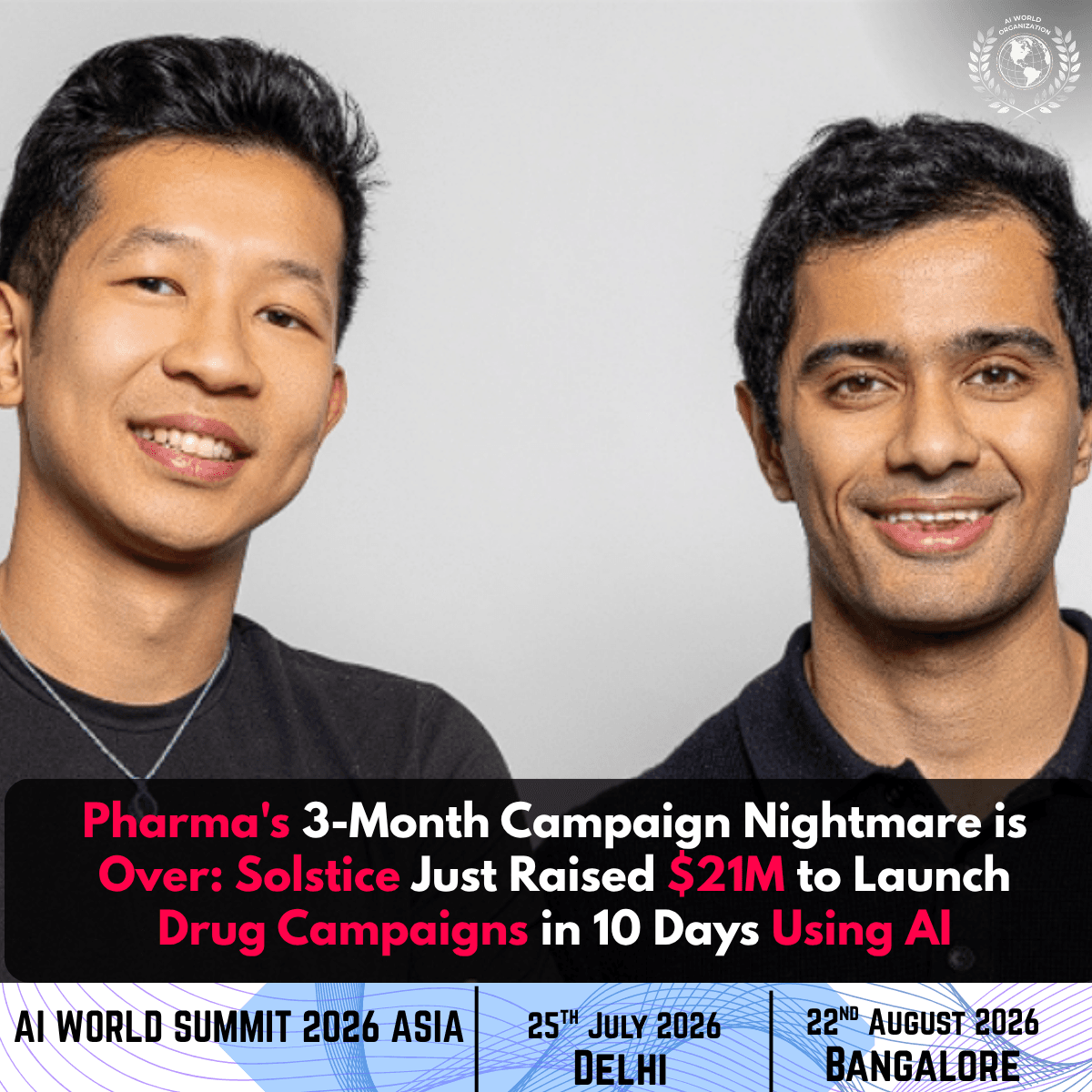
New York startup Solstice has raised $21M in Series A funding to deploy AI in pharmaceutical marketing, cutting campaign timelines from 3 months to just 10 days.
TL;DR
New York-based startup Solstice has raised $21M in Series A funding to fix one of pharma's biggest headaches — slow, manual marketing approvals. Its AI platform cuts drug campaign timelines from three months down to just ten days, reducing regulatory review cycles from over three rounds to barely one. The round was led by Transformation Capital, bringing total funding to nearly $25M.
Solstice Raises $21M to Bring AI Into the Heart of Pharma Marketing — Slashing Campaign Timelines from 3 Months to Just 10 Days
The pharmaceutical industry has long been one of the most complex, highly regulated, and operationally demanding sectors in the world. Between patent cliffs, regulatory reviews, compliance hurdles, and multi-stakeholder marketing approval processes, getting a drug campaign off the ground can feel like navigating a maze blindfolded. For decades, this has been accepted as the cost of doing business in pharma. But a New York-based startup called Solstice thinks that era is coming to an end — and it just raised $21 million to prove it.
Solstice has closed a Series A funding round of $21 million led by Transformation Capital, with continued participation from existing backers Twelve Below and Virtue Ventures. The round brings the company's total funding to approximately $25 million since its inception. The capital will be used to scale its go-to-market operations, deepen its product development capabilities, and grow both its engineering and customer-facing teams as it pushes deeper into one of healthcare's most overlooked inefficiency problems.
At The AI World, we have been closely tracking how artificial intelligence is reshaping industry verticals that have historically resisted technological disruption. Pharmaceutical commercialisation is arguably one of the most significant battlegrounds for AI in 2025 and 2026 — and Solstice is emerging as a formidable player in that space.
The $100 Billion Problem That Nobody Fixed
To understand why Solstice matters, it helps to understand just how broken pharma marketing workflows have been for a very long time. The global pharmaceutical industry spends north of $100 billion every year on commercialisation and marketing efforts. That includes everything from physician outreach and patient communication materials to digital campaigns, programmatic advertisements, and the dense layers of medical, legal, and regulatory review — collectively known as MLR review — that every asset must pass through before it can ever be seen by a doctor or patient.
The problem is not a lack of effort or investment. It is a structural one. Traditional pharma marketing involves a fragmented ecosystem of external agencies, internal marketing teams, compliance departments, medical affairs reviewers, and legal counsels, each operating in relative silos. Every single marketing asset — whether it is a routine email to a physician or a full-scale campaign for a newly approved therapy — typically needs to pass through multiple rounds of review, revision, and re-approval before it can go live. In practice, this means the average asset takes somewhere in the region of three months from inception to launch. During that time, the window to drive awareness, influence prescribing behaviour, and accelerate patient access is quietly shrinking.
For pharmaceutical brands operating on tight patent exclusivity timelines, these delays carry a measurable financial cost. Every week a campaign is stuck in review is a week of potential revenue and patient impact lost. Despite this, the infrastructure supporting pharma marketing had barely changed even as AI transformed nearly every other aspect of healthcare. Drug discovery got faster. Clinical trial design got smarter. Patient monitoring became more sophisticated. But pharma marketing stayed stubbornly analogue in its operations.
That is the gap Solstice was built to close.
How Solstice Is Rewiring the Pharmaceutical Marketing Stack
Solstice was co-founded by Yiwen Li and Aris Saxena, who launched the platform publicly in 2025 after identifying the operational inefficiencies strangling pharmaceutical commercialisation. Rather than building a generic AI tool and applying it to the pharma context as an afterthought, the founders made a deliberate choice to build an AI-native platform designed from the ground up around the unique regulatory and compliance demands of pharmaceutical marketing.
The platform works by ingesting a wide variety of pharmaceutical-specific inputs — clinical trial data, FDA-approved documentation, peer-reviewed literature, brand guidelines, and existing approved materials — to develop a deep, grounded understanding of each product it works with. From that foundation, it can automatically generate compliant digital campaigns, physician-facing communications, patient engagement assets, and programmatic advertising content at scale.
What makes Solstice genuinely different from other content generation tools is its built-in regulatory intelligence. Every asset produced by the platform is evaluated for its likelihood of passing MLR review before it even reaches the regulatory team. In other words, the compliance check is baked into the generation process rather than tacked on as a downstream bottleneck. This fundamentally changes the dynamic. Instead of sending an asset to a regulatory reviewer and waiting weeks for feedback, only to revise and resubmit multiple times, Solstice customers are finding that they need only one or two review cycles before an asset is approved.
The numbers tell a compelling story. According to the company, campaigns that previously took three months to launch are now going live in approximately ten days. The path from content creation to MLR submission has been compressed to under 48 hours. The average number of review cycles has fallen from 3.2 rounds to just 1.2 rounds. And overall campaign launch speed is reportedly 12 times faster compared to traditional agency-led workflows.
"We built Solstice to help life sciences teams bring therapies to market faster with one AI-native system," said co-founder Aris Saxena. "Customers now need only one or two review cycles, and campaigns launch in about 10 days."
This is not incremental improvement. This is a category-level shift in how pharmaceutical commercialisation operates.
Why Investors Are Moving Quickly Into This Space
The broader context behind this funding round is equally important. Transformation Capital, the lead investor in this Series A, operates at the intersection of healthcare and technology. Their decision to back Solstice reflects a broader investment thesis that pharmaceutical commercialisation — the operational machinery that sits between a drug's approval and its actual adoption in clinical practice — is one of the largest and most structurally under-addressed AI opportunities remaining in healthcare today.
Vinay Shah, partner and founding team member at Transformation Capital, was direct about the reasoning behind the investment. "Biopharma commercialisation is one of the largest and most regulated workflows in healthcare, and it has been running on a model built long before AI could change it," he said. "The team at Solstice has the technical depth to solve real compliance problems and the operational judgment to sell into one of the most demanding buyer environments in healthcare."
That last point deserves attention. Selling technology into pharmaceutical companies is notoriously difficult. These are organisations with deeply entrenched processes, significant legal exposure, and a near-zero tolerance for errors in regulatory documentation. The fact that Solstice has already onboarded more than a dozen pharmaceutical companies — including several that rank among the top 20 global pharma brands — across therapeutic areas including oncology, immunology, and metabolic disease, suggests that the platform has cleared a meaningful credibility threshold in a buyer environment where trust is everything.
The competitive landscape in this space is becoming increasingly active. Veeva Systems, through its Vault PromoMats platform, has long dominated the legacy content review infrastructure. Other players including EVERSANA with its AI-powered MLR automation tool and Inizio Evoke with its generative AI capabilities are also pushing into this market. Large independent health agencies like Klick Health are integrating AI into their own workflows. But Solstice's positioning is distinct: it is not a content agency, and it is not a bolt-on AI feature within a broader software suite. It is infrastructure for compliant pharma marketing — a vertical AI system that combines proprietary pharmaceutical marketing models with in-house regulatory, medical, and creative subject-matter expertise to accelerate the entire content production and approval pipeline simultaneously.
A Broader Signal for AI in Regulated Industries
The story of Solstice is, in many ways, representative of a larger trend that The AI World has been tracking closely across sectors: the rise of vertical AI — purpose-built platforms designed not just to use AI, but to deploy it within the specific constraints, compliance requirements, and operational realities of a particular industry.
For years, the dominant narrative around enterprise AI was about horizontal platforms — large language models and workflow tools that could be applied broadly across different contexts. What we are now seeing, increasingly, is that the highest-value AI deployments are the ones that go deep rather than wide. They are the ones built with genuine domain expertise embedded into the model architecture, not just layered on top of it. They are the ones where the AI has been trained to understand not just the general task, but the specific regulatory, legal, and commercial environment in which that task must be performed.
Healthcare, financial services, legal technology, and industrial operations are all experiencing this shift simultaneously. But pharmaceutical commercialisation is an especially striking example because the gap between what AI can do and what the existing infrastructure has been delivering is so enormous. When you consider that a routine physician email — a piece of content that takes minutes to write — has historically required months to approve and deploy, the scale of the inefficiency becomes almost difficult to believe. And yet that has been the reality for most pharmaceutical brands for most of the past few decades.
Solstice is one of a small number of startups positioning itself to fundamentally change that reality. The company's technical approach — grounding its AI models in pharmaceutical-specific data sources rather than general internet training, and building compliance prediction into the generation layer — addresses the two most fundamental objections that pharmaceutical buyers have historically had to AI in their marketing operations: factual accuracy and regulatory safety.
The fact that the platform can reduce review cycles from more than three rounds to just over one is not just a productivity metric. It is evidence that the AI is genuinely learning the compliance requirements of each brand and applying them correctly at the point of content creation, rather than producing content that then needs to be remediated by human reviewers. That is a qualitatively different capability from what most general-purpose AI tools currently deliver.
What Comes Next for Solstice and AI-Powered Pharma Commercialisation
With $21 million in fresh capital, Solstice has the runway to move aggressively on multiple fronts. The company has indicated it will invest in expanding its go-to-market capacity, which suggests a push to bring more pharmaceutical brands and therapeutic categories onto the platform. It will also accelerate product development, likely building out more specialised capabilities for different market segments, communication channels, and regulatory environments across different geographies.
There is also a larger strategic question looming over the entire category. As AI-native platforms like Solstice continue to demonstrate that compliant pharmaceutical marketing content can be generated and approved in days rather than months, the traditional agency model that has long dominated pharma commercialisation will come under real pressure. Agencies have historically derived significant revenue from the labour-intensive work of developing, iterating, and managing the approval of marketing assets. If that work can be largely automated — not just sped up, but genuinely restructured around AI generation and intelligent compliance checking — the economics of pharmaceutical marketing services will shift substantially.
Whether that shift happens gradually or rapidly will depend on several factors: the pace at which pharmaceutical procurement and compliance leadership gains confidence in AI-generated content, the regulatory environment around AI use in healthcare marketing, and how quickly platforms like Solstice can demonstrate sustained accuracy and safety across a broad portfolio of drug types and therapeutic indications. None of these challenges are insurmountable, but they are real, and they will shape how quickly the industry's centre of gravity moves.
What is already clear, however, is that the momentum is building. The combination of a $25 million total capital base, a growing roster of top-tier pharmaceutical clients, and a genuinely differentiated technical approach puts Solstice in a strong position to lead this market as it matures. And for an industry that has been waiting far too long for a genuinely modern approach to commercial operations, that kind of progress is long overdue.
At The AI World, we will continue to watch this space closely as it evolves.