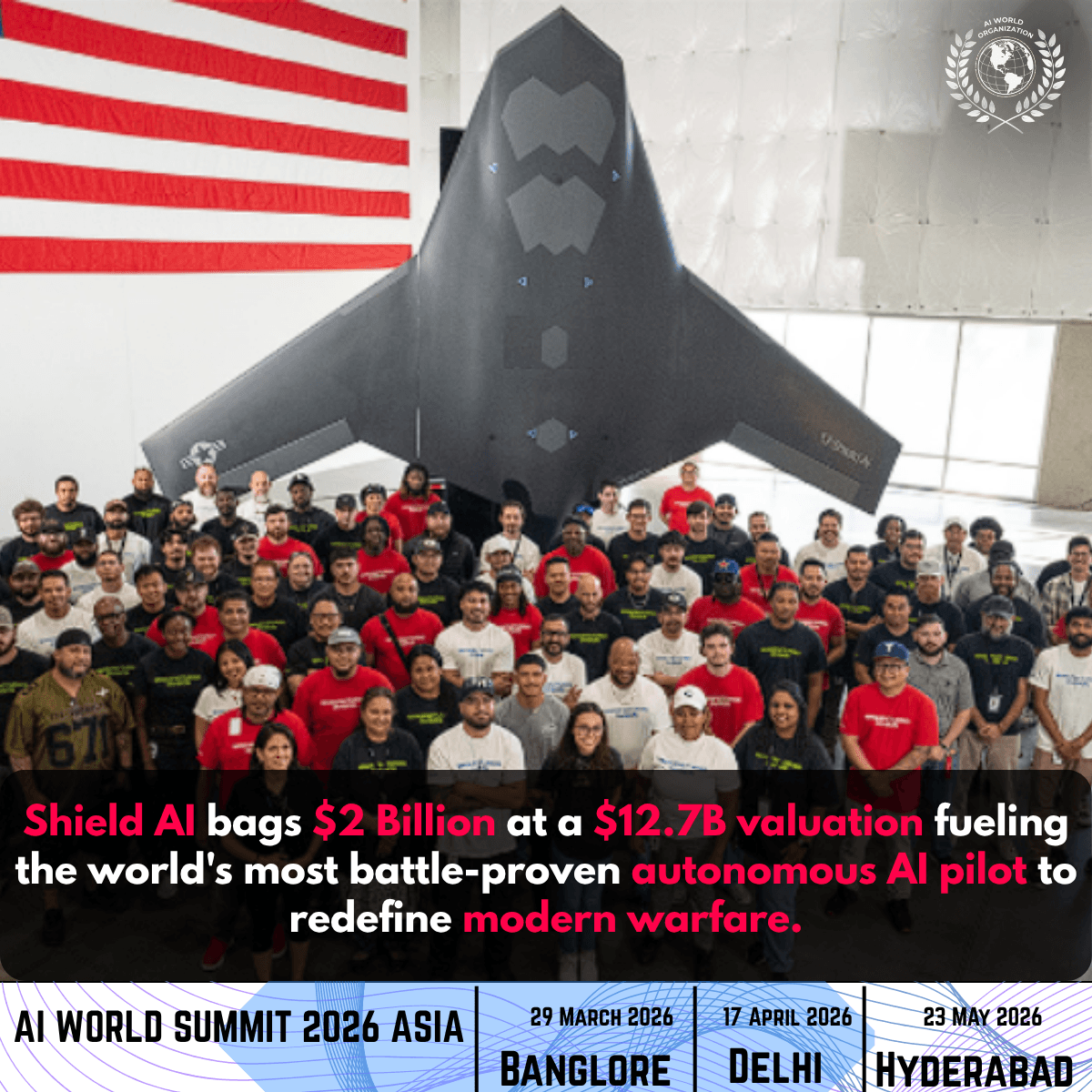
Shield AI Raises $2B to Scale Hivemind AI Pilot
Shield AI secures $2B in AI funding at a $12.7B valuation to expand Hivemind, acquire Aechelon, and develop the X-BAT autonomous fighter drone.
TL;DR
Shield AI just closed a massive $2 billion funding round led by Advent International alongside JPMorgan Chase and Blackstone — pushing its valuation to $12.7 billion. The capital will fuel expansion of Hivemind, its battle-tested autonomous AI pilot, the acquisition of simulation firm Aechelon, and development of the runway-free X-BAT stealth drone.
Shield AI Secures $2 Billion in AI Funding to Scale Hivemind — The World's Most Battle-Tested Autonomous Pilot
The global defence industry is undergoing a fundamental transformation, and nowhere is that shift more visible than in the latest AI funding news making waves across the technology and national security sectors. Shield AI, the San Diego-based defence technology company behind the world's first and most combat-proven autonomous AI pilot, has announced a landmark $2 billion fundraise at a staggering post-money valuation of $12.7 billion. This milestone represents more than just a financial achievement — it is a clear signal that the era of AI-driven autonomous warfare has arrived, and that investors, both institutional and strategic, are placing enormous bets on the companies building the software that will define the battlefield of tomorrow.
For the AI World Organisation, a global apex body connecting more than 5,000 AI leaders across APAC, Europe, and the Americas, this development sits squarely at the intersection of artificial intelligence, national defence, and frontier technology investment. At a time when AI funding news is dominating global headlines, Shield AI's latest round stands out not only for its size but for what it represents: a convergence of applied AI, autonomous systems, and large-scale defence modernisation. The fact that this round more than doubled Shield AI's valuation from $5.3 billion just twelve months ago to $12.7 billion today underscores the exponential pace at which the defence-AI sector is maturing.
This article takes a deep dive into the details of the fundraise, the technology behind Shield AI's rapidly expanding product portfolio, the strategic importance of the Aechelon acquisition, and the long-term implications of this AI funding development for the broader global defence and technology ecosystem.
A $2 Billion Investment That Reshapes the Defence-Tech Landscape
The total $2 billion fundraise is structured across two complementary financial instruments, each bringing heavyweight institutional capital into Shield AI's growth story. The primary component is a $1.5 billion Series G equity round, led by Advent International — one of the world's most prominent global private equity firms — with JPMorgan Chase's Strategic Investment Group, operating under its Security and Resiliency Initiative, serving as a co-lead. Existing investors, including Snowpoint Ventures and Riot Ventures, also participated in the round, reinforcing their long-standing commitment to the company's mission.
The second component consists of $500 million in preferred equity financing from funds managed by Blackstone Inc., one of the world's largest alternative asset managers. Blackstone also committed an additional $250 million in a delayed-draw facility, meaning its total potential investment in Shield AI could reach $750 million depending on the company's capital deployment timelines. When taken together, the full $2 billion round represents one of the largest single fundraises in the history of the defence technology sector, and it positions Shield AI as a dominant force in an increasingly competitive and geopolitically critical industry.
The AI funding news surrounding this round is particularly significant when viewed in the context of recent global conflicts. The coordinated strikes between the United States and Israel against Iran, along with Russia's sustained invasion of Ukraine, have accelerated military demand for autonomous technologies. Conflict zones increasingly feature GPS-denied and communications-degraded environments where traditional human-piloted aircraft face severe operational constraints. These real-world pressures have pushed militaries across the world to seek out software-first solutions that can enable aircraft, drones, and other autonomous systems to operate independently of external communications infrastructure — and Shield AI has been building exactly that since its founding in 2015.
David Mussafer of Advent International offered a pointed explanation for why his firm chose to lead this round: "Shield AI is a rare asset with the potential to deliver strong growth over the coming years. V-BAT is rapidly scaling and delivering outcomes for militaries around the world. X-BAT is a huge opportunity to redefine air power in the fighter jet market. Hivemind is one of the most experienced and proven AI pilots in the world. We couldn't be more excited to partner with the Shield AI team."
Hivemind — A Decade in the Making, Already Proven in Live Combat
At the heart of Shield AI's commercial and technological proposition is Hivemind, an AI-powered software system that functions as a fully autonomous pilot — one designed not merely to follow pre-programmed routes, but to sense, decide, and act in real time under dynamic and hostile conditions. Hivemind has been in continuous combat deployment since 2018, making it not only the world's first autonomous AI pilot but also the most operationally experienced one. It is the product of more than a decade of research, testing, and refinement — and the results speak for themselves in terms of its growing adoption across both government and commercial defence programmes.
Unlike traditional autopilot systems that function as basic route-following mechanisms, Hivemind is built around true artificial intelligence reasoning. It can reroute around no-fly zones, avoid or engage obstacles, respond to unexpected conditions mid-flight, and complete entire missions without any human intervention. What sets it apart technically is its ability to operate effectively in DDIL environments — a military acronym for Disconnected, Degraded, Intermittent, or Low-bandwidth conditions. In practical terms, this means Hivemind continues to function even when GPS signals are jammed, communication links are severed, or electronic warfare systems are actively degrading the surrounding operational environment. For modern defence planners, this capability is not a luxury; it is a necessity.
The breadth of Hivemind's operational track record is staggering. As of the latest AI funding news cycle, the software has successfully piloted 26 distinct classes of vehicles, including F-16 fighter jets, jet-powered unmanned aerial vehicles (UAVs), helicopters, drone boats, and ground-based autonomous platforms. Among its most high-profile achievements, Hivemind was integrated into the United States Air Force's AI-enabled X-62A VISTA — a modified F-16 — which conducted simulated dogfights against crewed fighter aircraft in 2024, a moment widely regarded as a watershed event for AI in aerial combat. More recently, the U.S. Air Force selected Shield AI as a mission autonomy provider for its Collaborative Combat Aircraft (CCA) programme, and Hivemind has since conducted active flight testing aboard the Anduril YFQ-44A — a next-generation uncrewed aircraft designed to fly in formation alongside crewed fighter jets.
Christian Gutierrez, Vice President of Hivemind Solutions at Shield AI, articulated the broader vision behind these milestones: "Across platforms, domains, and environments, Hivemind provides resilient mission autonomy, proving that software is central to the future of airpower. Our collaboration with Anduril reflects a new era of defence acquisition, where autonomy is treated as a foundational warfighting capability on par with the aircraft itself." This statement captures something essential about where AI funding in the defence space is heading — the focus has shifted from hardware to software-first autonomy platforms that can be deployed across an entire ecosystem of vehicles and systems.
Looking ahead, Shield AI is also advancing a product called Hivemind Enterprise, an AI-powered autonomy developer platform designed for OEMs, governments, and commercial companies operating in the broader robotics and drone industrial base. This platform includes prepackaged software building blocks that allow developers to implement autonomous flight features without building everything from scratch, dramatically accelerating the pace at which the defence ecosystem can adopt proven autonomy capabilities.
The Aechelon Acquisition: Supercharging Simulation and Pilot Training
A significant portion of the newly raised capital will be directed towards one of the most strategically important moves in Shield AI's corporate history — the acquisition of Aechelon Technology Inc., a defence software company currently held by private equity firm Sagewind Capital. While the precise financial terms of the transaction have not been publicly disclosed, the strategic rationale is abundantly clear and has been articulated directly by Shield AI's leadership team.
Aechelon is a provider of high-quality flight simulation software and data storage systems, and its product suite is deeply embedded in the way the U.S. military trains both human pilots and autonomous systems before they ever operate in real-world environments. Among its flagship offerings is a highly detailed virtual training environment that mirrors real-world flight conditions with exceptional fidelity. The company also offers Nexus, a line of data storage systems equipped with advanced cybersecurity features, and Project Orbion, a virtual replica of the entire Earth constructed from satellite imagery and radar data — a product that has enormous utility for mission planning, autonomous system training, and intelligence operations.
The most significant application of Aechelon's technology in the context of Shield AI's roadmap is its role in the U.S. Department of Defense's Joint Simulation Environment, commonly known as the JSE. The JSE is the military's most sophisticated virtual combat training ground, used to evaluate aircraft performance, test autonomous systems, and rehearse tactical scenarios against highly realistic threat representations. Shield AI CEO Gary Steele explained the acquisition's strategic value in his own words: "The acquisition of Aechelon will accelerate the work we are doing with Hivemind, particularly in simulation environments like the JSE. It will also help advance our Hivemind Foundation Model for Defense, which is trained in simulation and continuously refined through real-world operations."
This acquisition reflects a broader trend in the latest AI funding news coming out of the defence sector — the growing recognition that simulation infrastructure is not peripheral to autonomous AI development but is, in fact, its core training ground. The ability to train, test, and iterate on AI pilot behaviour within a high-fidelity simulation environment dramatically reduces the cost, time, and risk associated with real-world flight testing. For a company like Shield AI, whose entire value proposition rests on the performance and reliability of Hivemind, owning the simulation stack is a competitive advantage of the highest order. The Aechelon deal is expected to close following the completion of customary regulatory approvals.
The X-BAT: Redefining What an Autonomous Fighter Can Be
Perhaps the most ambitious element of Shield AI's strategic vision — and a key reason why this latest AI funding round was structured at such a significant scale — is the development of the X-BAT, a revolutionary VTOL (Vertical Take-Off and Landing) stealth fighter drone that has the potential to fundamentally redefine the concept of aerial combat power. Unlike conventional fighter aircraft that require long runways and extensive ground support infrastructure, the X-BAT is designed to take off and land without any runway whatsoever, making it deployable from ships, forward operating bases, and other non-traditional launch platforms in contested environments.
The X-BAT is entirely piloted by Hivemind, meaning it operates with zero dependency on human pilots and can continue its mission even in the most extreme DDIL conditions. With a reported flight range of up to 2,300 miles per sortie, the aircraft has been engineered for long-range, deep-penetration missions in environments where both communications and navigation infrastructure may be fully denied. Shield AI has indicated that full-scale production of the X-BAT is planned to begin in 2029, with some of the proceeds from the current $2 billion AI funding round earmarked specifically to fund critical phases of its development programme.
The X-BAT is not operating in isolation. Shield AI's existing V-BAT drone — which takes off vertically like a helicopter before transitioning to fixed-wing flight — has already been deployed by militaries around the world and is currently scaling rapidly. The V-BAT serves as proof that Shield AI's hardware-software integration approach is viable and operationally effective, making the more advanced X-BAT a natural and credible progression. Together, the two platforms represent a complementary family of autonomous aircraft systems capable of addressing a wide spectrum of defence mission profiles, from close-range reconnaissance to long-range strike operations.
The competitive landscape in this space is intensifying. Shield AI faces competition from companies like Anduril Industries, AeroVironment, Skydio, and Helsing — each of which is pursuing its own vision of autonomous defence capability. However, Shield AI's unique differentiator is the depth and maturity of Hivemind, whose decade-long development timeline and proven combat record give it a level of real-world credibility that newer entrants to the space simply cannot match. In the context of the latest AI funding news, it is notable that Hivemind has already completed a joint flight test with Anduril's own drone platform — a development that suggests the defence-AI ecosystem may be moving towards interoperability and collaboration rather than pure head-to-head competition.
What Shield AI's $2B Raise Signals for the Global AI and Defence Investment Ecosystem
The broader significance of this AI funding development extends well beyond Shield AI's own balance sheet and product roadmap. It reflects a structural shift in the way institutional capital is approaching the intersection of artificial intelligence and national security — a shift that has enormous implications for investors, policymakers, defence ministries, and AI technology leaders worldwide. The fact that Advent International, JPMorgan Chase, and Blackstone — three of the most respected names in global finance — have collectively committed $2 billion to a single defence-AI company tells a compelling story about the sector's perceived growth trajectory and strategic importance.
Shield AI's valuation journey is itself a powerful data point. The company raised $240 million at a $5.3 billion valuation in March 2025. Just twelve months later, that valuation has risen to $12.7 billion — an increase of more than 139% in a single year. This kind of valuation acceleration, sustained at scale, is rare even in the most buoyant tech investment cycles, and it signals that investors are not treating this as speculative capital deployment. They are making high-conviction bets on the inevitability of AI-driven autonomy becoming the dominant paradigm in defence operations across the coming decade.
For the AI World Organisation and the global community of AI leaders, innovators, and policymakers it convenes, this is precisely the kind of development that demands attention and informed discussion. Questions about the governance of autonomous weapon systems, the role of AI ethics in defence decision-making, and the economic implications of defence-AI investment on the broader AI funding landscape are all questions that will shape the trajectory of the technology industry for years to come. As AI funding news continues to flow at unprecedented velocity, the challenge for the global AI community is not simply to track these developments, but to understand their deeper implications and to help ensure that the deployment of autonomous AI in high-stakes environments proceeds responsibly and with appropriate oversight.
Shield AI was founded in 2015 with a clear and urgent mission: to protect service members and civilians in the most dangerous and inaccessible environments on earth. Today, with $2 billion in fresh capital, a $12.7 billion valuation, a combat-hardened AI pilot that has already flown 26 classes of vehicles, a newly acquired simulation powerhouse, and a next-generation stealth fighter drone in development, that mission is closer to realisation than ever before. This is not just a story about one company's funding round — it is a story about the future of warfare, the power of artificial intelligence, and the growing belief among the world's most sophisticated investors that the software-defined autonomous battlefield is no longer a distant vision. It is being built right now.


