SatLeo Labs Raises $2.2M Seed Round for AI Thermal Satellite
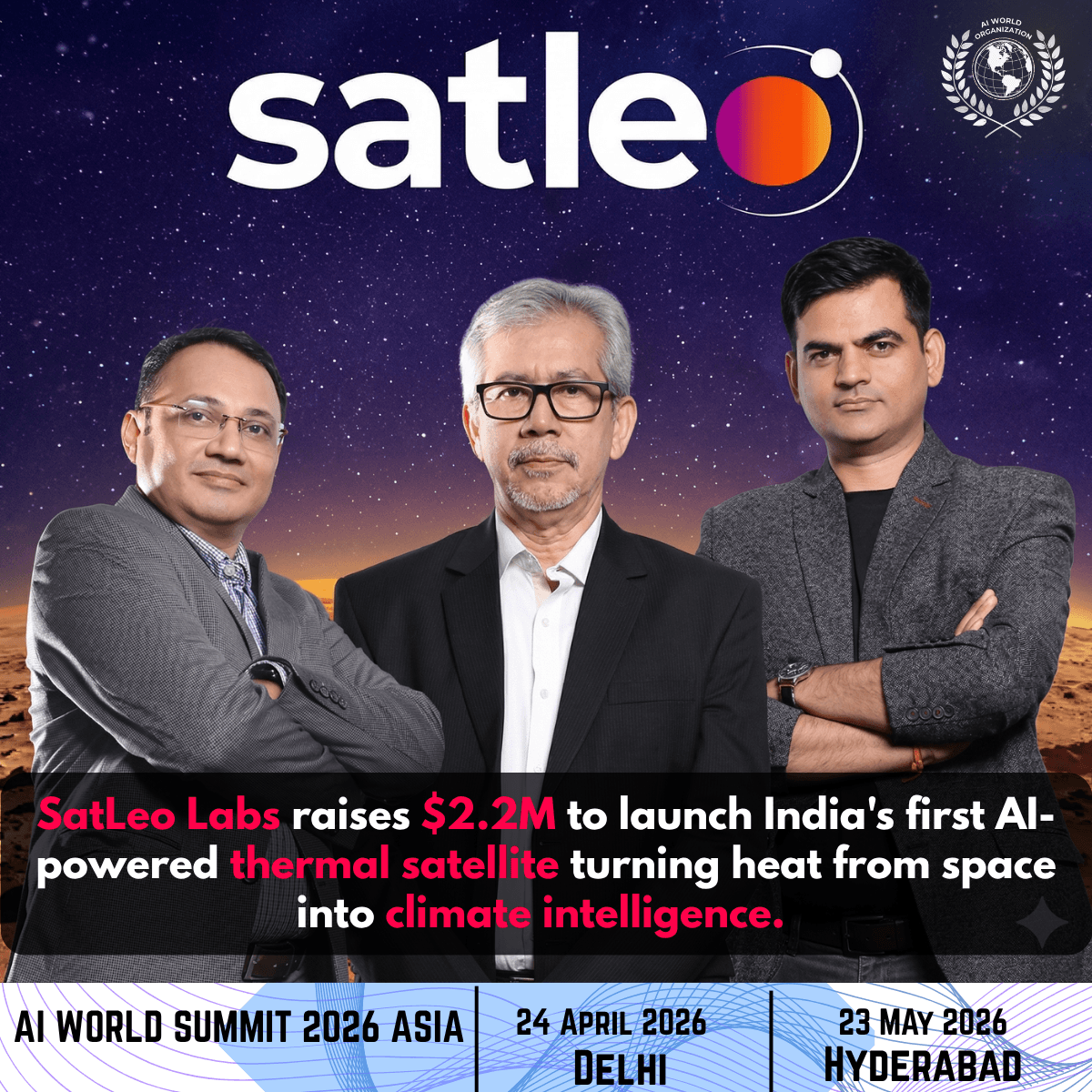
SatLeo Labs secures $2.2M in seed funding led by Unicorn India Ventures to advance its AI-powered thermal satellite platform, TAPAS-1, and climate intelligence solutions.
TL;DR
Ahmedabad-based spacetech startup SatLeo Labs has raised $2.2 million in a seed round led by Unicorn India Ventures, taking its total funding to $5.5 million. The company is building AI-powered thermal imaging microsatellites to track heat patterns across agriculture, urban areas, and defence with its first payload, TAPAS-1, currently in development and set for launch later in 2026.
SatLeo Labs Secures $2.2 Million in Seed Funding to Power AI-Driven Thermal Satellite Intelligence
India's emerging spacetech landscape continues to make headlines in the global AI funding news circuit, and the latest entry comes from Ahmedabad-based SatLeo Labs, which has successfully closed a $2.2 million seed funding round. The round was led by prominent deep-tech-focused venture capital firm Unicorn India Ventures, with additional participation from Merak Ventures, Java Capital, IIMA-CIIE, and individual investor Manish Gandhi. With this latest injection of capital, SatLeo Labs' total funding now stands at an impressive $5.5 million — a clear signal that institutional investors are increasingly backing the convergence of space technology and artificial intelligence for real-world impact. This fresh AI funding round marks a pivotal moment not just for the startup, but also for India's broader ambitions in satellite-based Earth observation and climate intelligence.
The significance of this round extends well beyond the financial figure itself. It reflects a broader shift in investor confidence toward deep-tech ventures that marry hardware innovation with AI-powered software platforms. In a funding environment that has seen ups and downs across the startup ecosystem, SatLeo Labs' ability to raise capital — for the second time in less than a year — underscores the unique value proposition the company has built in the thermal intelligence space. As climate change accelerates, urban heat crises deepen, and food security pressures mount, the demand for granular, actionable temperature data from space has never been higher. SatLeo Labs stands at the precise intersection of all these pressing challenges, and its investors have clearly taken note.
From Ahmedabad to Orbit: The SatLeo Labs Story
SatLeo Labs was founded in 2023 in Ahmedabad, Gujarat, by a team of seasoned technologists and space science experts. The company was co-founded by Shravan Singh Bhati, who serves as CEO and brings over 14 years of techno-commercial experience in space technology, alongside Dr. Ranendu Ghosh, a former ISRO scientist who adds deep scientific credibility to the venture, and Urmil Bakhai, who leads strategy and business development. Together, the founding team brings a rare combination of satellite engineering expertise, Earth observation science, and commercial acumen that is critical for a hardware-heavy, mission-driven startup navigating both technical and market challenges.
The company's core mission is both ambitious and urgent: to build a constellation of microsatellites that can continuously capture thermal and visible data from low Earth orbit (LEO) with sub-10-meter resolution, delivering temperature intelligence at a cadence of twice daily. Unlike conventional optical satellites that capture RGB imagery, SatLeo Labs' satellites are built around dual-band infrared imaging technology — specifically, Mid-Wave Infrared (MWIR) and Long-Wave Infrared (LWIR) sensors — enabling them to detect surface temperature variations with precision up to one degree Kelvin. This level of granularity is largely unavailable from any existing commercial satellite system at scale, which is exactly where SatLeo carves out its competitive advantage.
What makes the platform even more remarkable is the integration of onboard AI and edge computing. Rather than beaming raw data back to ground stations for processing — a slow and bandwidth-intensive process — SatLeo's satellites process data in orbit, drastically reducing the time between data capture and actionable insight. The company delivers this intelligence through an API-first architecture, making it seamlessly accessible to governments, enterprises, researchers, and urban planners who want plug-and-play thermal analytics without investing in satellite infrastructure of their own. As Shravan Singh Bhati has stated, the company is effectively "creating a new layer of climate infrastructure — temperature intelligence from space."
TAPAS-1: India's First Commercial Thermal Satellite Payload
Central to SatLeo Labs' near-term roadmap is the development and deployment of TAPAS-1 — the Thermal Access Platform for Analytics and Solutions — which represents the company's first thermal payload and will serve as its technological demonstrator. TAPAS-1 is currently in advanced stages of development, with the team actively preparing it for satellite integration and launch. The payload is designed to validate the core thermal imaging and onboard AI capabilities that will eventually be replicated across a larger constellation of commercial satellites.
The proceeds from this latest AI funding round will be directly channelled into advancing the TAPAS-1 mission, scaling the company's AI-powered platform, and expanding its commercial pipeline. This is a critical phase for any deep-tech startup — translating a lab-proven concept into an orbital, operational system requires substantial engineering effort, regulatory coordination, and strategic partnerships. SatLeo Labs has already made significant strides on all three fronts. The company has secured backing from IN-SPACe (Indian National Space Promotion and Authorization Center) and ISRO, lending both institutional credibility and regulatory support to its mission.
Beyond the hardware, SatLeo's platform is already generating real-world traction. The company has initiated pilot deployments in partnership with cities like Ahmedabad and Tumakuru, focusing on urban heat island monitoring and air pollution tracking. These pilots not only validate the technology in practical settings but also help the company build a repository of real-world use cases and performance data that can be presented to future customers and investors. With letters of intent already exceeding $42 million, SatLeo Labs is demonstrating a commercial pull that far outpaces where many comparable startups are at a similar stage of development — a fact that is bound to attract further AI funding interest in the months ahead.
Multi-Sector Applications: From Defence to Agriculture
One of the most compelling aspects of SatLeo Labs' platform is its cross-sector applicability. Thermal intelligence from space is not a niche solution limited to a single industry — it has direct, meaningful use cases across multiple verticals, each representing a significant addressable market in its own right.
In the agriculture sector, thermal data from satellites can predict crop yields with up to 35% higher accuracy compared to conventional methods. By detecting soil moisture stress, early signs of crop disease, and irrigation inefficiencies through thermal signatures, the platform helps farmers and agribusinesses make smarter, data-backed decisions. In a country like India where agriculture employs hundreds of millions and faces increasing pressures from climate variability, this capability is not just commercially valuable — it is socially transformative.
In the realm of urban planning and climate resilience, SatLeo's technology is already being used to map urban heat islands — zones within cities where temperature is significantly higher than surrounding areas due to human activity and built infrastructure. Heat islands are a growing public health crisis globally. Research has shown that extreme heat events claim hundreds of thousands of lives each year, and cities are disproportionately vulnerable. With SatLeo's twice-daily thermal maps, urban administrators can identify heat-intensive zones, prioritize green infrastructure investment, and design early warning systems for heat-related health emergencies.
For the defence and national security sector, MWIR imaging provides invaluable intelligence capabilities, enabling detection and monitoring of activities that generate heat signatures — from industrial operations to border surveillance. This application space carries both significant strategic value and commercial scale, particularly as India ramps up its investment in indigenously developed defence technologies. Additionally, SatLeo's thermal data capabilities extend to environmental monitoring, including tracking landfill emissions, detecting illegal industrial activities, and monitoring wildfire hotspots in near real-time — all of which are growing priorities for environmental regulators and governments worldwide.
The disaster management use case is equally powerful. SatLeo's system can provide early detection of forest fires, identify flood-prone thermal anomalies, and support emergency response teams with timely situational intelligence. In regions highly susceptible to natural disasters, having access to real-time thermal intelligence from orbit can mean the difference between timely intervention and irreversible damage. Across all of these use cases, the common thread is the platform's ability to convert raw temperature data into actionable, domain-specific intelligence — which is precisely where the company's AI layer adds exponential value.
Investor Ecosystem and the AI Funding Wave in Indian Spacetech
The participation of Unicorn India Ventures as the lead investor in this round carries significant strategic weight. The venture capital firm recently closed its third fund at ₹1,200 crore — surpassing its initial target of ₹1,000 crore — with a stated focus on deeptech sectors including semiconductors, spacetech, quantum sensing, and AI infrastructure. The fund plans to make approximately 20 investments with average ticket sizes in the range of ₹10–15 crore, and Unicorn India Ventures has already begun deploying capital across promising deeptech startups. Its decision to lead SatLeo Labs' seed round is aligned with the firm's broader thesis that India is on the cusp of a deeptech revolution, and that spacetech in particular holds exceptional potential in the current geopolitical and climate environment.
Merak Ventures, which also participated in this round, is a familiar name on SatLeo Labs' cap table — having led the company's $3.3 million pre-seed round earlier in 2025. The fact that Merak has continued to back the startup through its seed stage signals strong conviction in the founding team and the technology roadmap. Co-investors Java Capital and IIMA-CIIE further add institutional depth, with IIMA-CIIE being the innovation and incubation arm of the prestigious Indian Institute of Management Ahmedabad — an institution that has produced several successful deep-tech ventures from the Gujarat region.
In the broader context of AI funding news, this round is part of a larger trend of institutional capital flowing into AI-enabled hardware and space technology companies in India. As the Indian government continues to open up the space sector to private investment and as IN-SPACe streamlines regulatory pathways for private satellite operators, the ecosystem is rapidly maturing. The combination of government support, institutional VC backing, and a pipeline of commercially validated use cases is creating a highly conducive environment for startups like SatLeo Labs to scale rapidly. It is precisely this confluence of factors that makes the current period a defining moment for India's position in the global commercial space economy.
What's Next: Satellite Launch, Commercial Scale, and the Path to Constellation
With $2.2 million in fresh AI funding secured, SatLeo Labs has outlined a clear set of priorities for the next twelve months. The company's primary focus will be on satellite launch readiness, ensuring that TAPAS-1 is fully integrated, tested, and prepared for its maiden orbital mission. This involves extensive technical coordination with launch service providers, satellite bus manufacturers, and ground station networks — all of which require sustained engineering effort and project management at scale.
In parallel, the company plans to aggressively expand its commercial pipeline, converting the $42 million-plus letters of intent into contracted revenue. This commercial expansion will be supported by the scaling of its thermal data platform, including enhancements to its API layer, data analytics dashboard, and domain-specific application modules for sectors such as agriculture, urban planning, and defence. The company is also actively growing its team — currently standing at approximately 30 members — and plans to bring in additional talent in areas such as satellite operations, AI and machine learning, data science, and enterprise sales.
Looking further ahead, SatLeo Labs has articulated a vision for building a global constellation of microsatellites capable of delivering real-time thermal intelligence to any point on Earth. The company's long-term commercial satellite is expected to follow TAPAS-1, with a planned launch timeline in the latter part of 2026. As more satellites are added to the constellation, the platform's temporal resolution will increase, enabling more frequent data updates and broader geographic coverage. This trajectory, if executed successfully, positions SatLeo Labs to become a foundational piece of the world's climate intelligence infrastructure — a thermal data utility for the planet.
At a time when climate change is no longer a future threat but a present reality, the ability to measure, monitor, and respond to Earth's heat dynamics from space is an extraordinarily valuable capability. SatLeo Labs is building that capability with scientific rigour, commercial discipline, and a genuine commitment to impact. As AI funding continues to flow into ventures that sit at the intersection of technology and climate resilience, SatLeo Labs is well-positioned to emerge as one of India's most consequential deeptech success stories of this decade.