Sarvam AI Hits Unicorn Status With $234M Series B
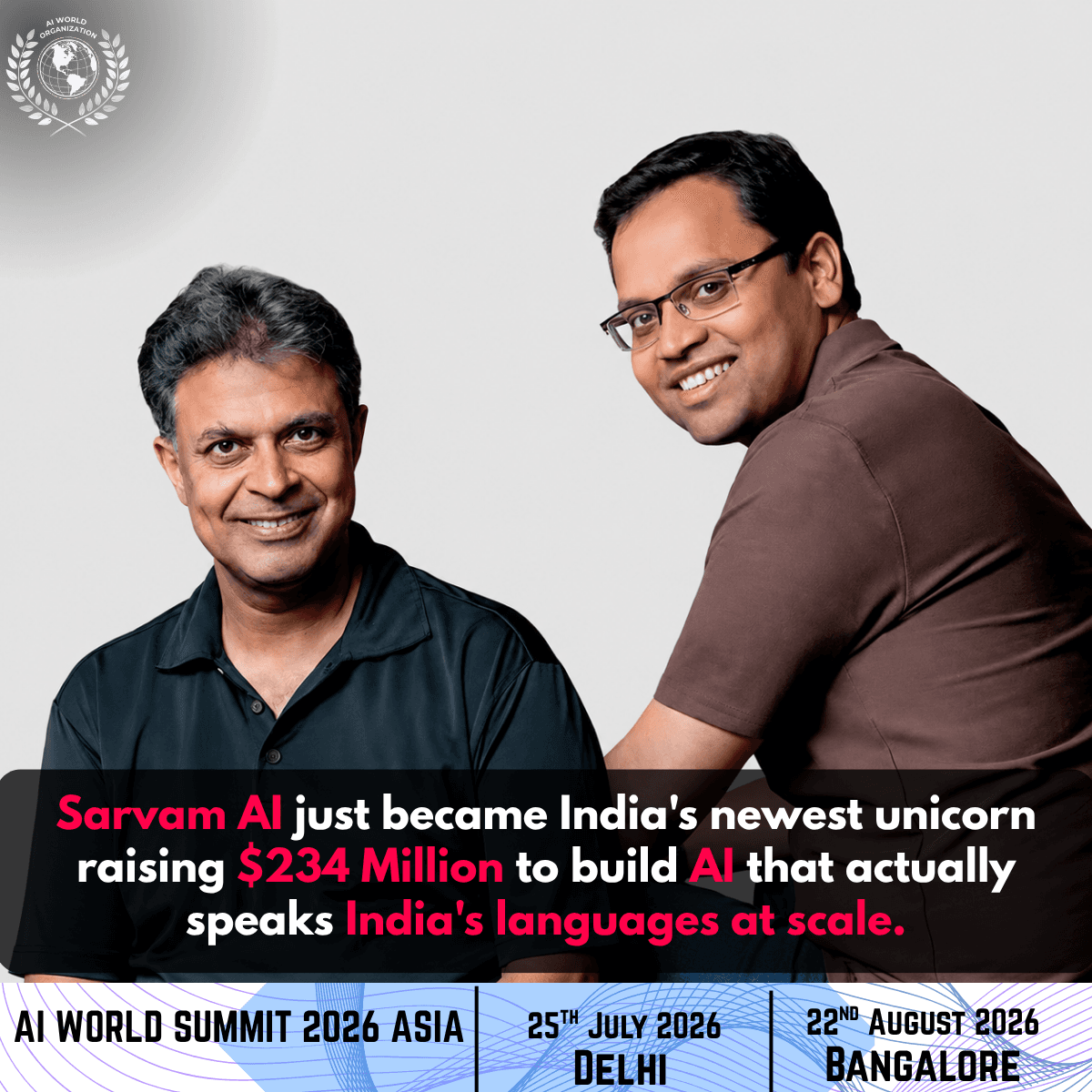
Indian AI startup Sarvam achieves unicorn status after closing $234M in Series B funding led by HCLTech, valuing the company at $1.5 billion.
TL;DR
Sarvam AI, a Bengaluru-based startup building large language models for Indian languages, has raised $234 million in its Series B round led by HCLTech, hitting a $1.5 billion valuation and officially joining India's unicorn club. The company's platforms now handle millions of daily interactions across farming, insurance, banking, and government sectors — making it one of the most commercially grounded AI companies India has produced so far.
Sarvam AI Joins India's Unicorn Club With a $234 Million Series B, Backed by HCLTech
India's artificial intelligence landscape has just produced its newest unicorn, and the timing could not be more significant. Sarvam AI, the Bengaluru-based startup best known for building large language models tailored specifically for Indian languages and enterprise needs, has raised $234 million in the first close of what is set to be a $300 million Series B funding round. With this raise, the company's post-money valuation now stands at $1.5 billion — crossing the threshold that the startup ecosystem has long considered the ultimate stamp of validation. This is not just a funding story. It is a statement about where India wants to go in the global race for artificial intelligence dominance, and it signals a growing conviction among both domestic and international investors that Indian-first AI infrastructure is a bet worth making in a serious way.
The news arrives at a moment when the broader AI sector globally is still grappling with questions around concentration — whether a handful of Western labs will define the boundaries of what AI can do for the rest of the world, or whether homegrown alternatives built on regional language data and local infrastructure will carve out their own lane. Sarvam's unicorn milestone is perhaps the clearest answer India has offered to that question yet.
A Landmark Funding Round That Reshapes India's AI Story
The Series B round, which remains open for a second close to bring the total to its targeted $300 million, is already one of the largest single fundraises in the Indian AI startup ecosystem to date. The capital injection follows a relatively modest Series A of $41 million that the company closed in December 2023, led by Lightspeed Venture Partners with support from Peak XV Partners and Khosla Ventures. The fact that Sarvam has grown its valuation so dramatically in the span of roughly two and a half years is a testament to the pace at which it has executed on its founding vision and the velocity at which enterprise demand for sovereign AI has accelerated.
What makes this round particularly noteworthy is the composition of the investor table. Bessemer Venture Partners, one of the most respected names in global venture capital with a track record of backing generational companies, has come in as a new participant. Long-standing backers Khosla Ventures and Peak XV Partners — two investors who have consistently been among the first to back transformative technology companies in India — have doubled down, a signal of continued conviction in Sarvam's direction. The presence of these institutions in a round of this scale reflects not just confidence in the company but a broader thesis that sovereign, multilingual AI infrastructure is approaching an inflection point in terms of real-world commercial relevance.
The fresh capital is earmarked for multiple strategic priorities. Sarvam has stated that it intends to push its research agenda on next-generation frontier models, with a specific focus on agentic AI — systems that can autonomously plan and execute multi-step tasks — as well as coding and cybersecurity applications. In parallel, the company plans to significantly scale up its access to large compute infrastructure, a perennial bottleneck for AI startups operating outside of the United States. Accelerating enterprise and government deployments is the third pillar of the spending plan, which makes sense given that Sarvam has already established meaningful deployments across some of India's most critical sectors.
HCLTech's $150 Million Commitment — A Corporate Bet on Sovereign AI
The headline investor in this round is HCLTech, the Noida-headquartered IT giant that has committed $150 million for a 10.46% stake in Sarvam. This is a meaningful move from one of India's largest technology services companies, and it deserves to be read carefully. HCLTech's involvement is not a passive financial investment — it is the kind of strategic alignment that shapes product roadmaps, opens enterprise distribution channels, and signals to the broader market that a startup has earned the confidence of an institution with deep exposure to global enterprise technology needs.
For HCLTech, the logic is relatively straightforward. As AI begins to restructure the nature of IT services delivery — automating code generation, enabling intelligent process management, and changing the very basis on which large enterprises consume technology — positioning itself alongside a cutting-edge AI model company makes considerable strategic sense. By anchoring Sarvam's Series B, HCLTech effectively acquires both a financial stake and a front-row seat to the development of AI capabilities that could eventually be woven into its own service offerings and enterprise client engagements.
For Sarvam, the value proposition runs even deeper. Access to HCLTech's vast enterprise network, its existing relationships with multinational corporations across industry verticals, and its understanding of how large organizations actually adopt and deploy technology could accelerate Sarvam's enterprise go-to-market in ways that venture capital alone cannot. It is the kind of partnership that reduces the friction between having a technically superior product and getting that product into production environments at scale. HCLTech's own disclosure that Sarvam posted unaudited revenue of Rs 45.1 crore for FY26 provides an early anchor on commercial traction, though the company has clearly positioned this fundraise as the catalyst for a much more aggressive growth phase in the years ahead.
What this investment also does — and this is worth appreciating from a macro standpoint — is validate the idea that India's largest technology corporations are beginning to invest internally in the AI capabilities of the future rather than simply integrating externally built models from OpenAI or Google into their service stack. That shift, if it continues, has significant long-term implications for how India positions itself in the global technology order.
The Technology Behind Sarvam — Building Foundation Models From Scratch in India
Sarvam was founded by Vivek Raghavan and Pratyush Kumar, both of whom have deep backgrounds in AI research. Raghavan, previously associated with UIDAI's Aadhaar technology team and various AI research initiatives, and Kumar, a prominent researcher in the field of natural language processing for low-resource languages, founded the company with a specific conviction: that India needed AI models built from the ground up on its own data, in its own languages, reflecting its own social and commercial contexts — rather than fine-tuned adaptations of models primarily trained on English-language internet data.
That research orientation has produced a family of foundation models that are genuinely distinctive in the Indian AI landscape. The company has released Sarvam 105B and Sarvam 30B — both trained from scratch in India — as well as Sarvam Vision, a multimodal model designed to handle visual inputs alongside text. Building models at this scale requires not just research talent but access to significant computational infrastructure, and the fact that Sarvam has done this while remaining an independent Indian company is a point of considerable national significance. These are not wrapper products or fine-tuned derivatives. They are original contributions to the global stack of foundation model development.
The company's inference platform is now processing over 10 million API calls every day, a figure that speaks to real-world adoption beyond the pilot phase. Its conversational AI platform, which leverages the company's multilingual capabilities to handle complex spoken and text-based interactions, is handling more than 2 million interactions daily. These are not vanity metrics — they represent genuine enterprise and government workloads running on Sarvam's infrastructure at meaningful scale. The company's roadmap into agentic AI and coding-focused models is particularly interesting given where the broader market is heading; autonomous AI agents that can complete multi-step tasks are increasingly seen as the next major commercial frontier for enterprise AI, and Sarvam's intention to compete in that space positions it well for the next wave of enterprise AI adoption across India and potentially beyond.
From Paddy Fields to Policy Counters — Deployments That Define a Mission
It would be easy to read Sarvam's story purely through a financial lens — a unicorn valuation, a marquee investor, impressive API call volumes — and miss what is arguably the more meaningful dimension of what the company is actually doing. The deployment use cases that Sarvam has publicly highlighted are not just commercially interesting; they are socially significant in a country of India's scale, diversity, and complexity.
Consider the agricultural deployment. Sarvam's multilingual voice platform has been used to engage with 17 million farmers across India for government-led data collection initiatives. In a country where the agricultural sector still accounts for a disproportionate share of the rural population and where access to government schemes has historically been hampered by literacy and language barriers, the ability to conduct meaningful, AI-powered interactions in local languages at scale is genuinely transformative. This is not AI being deployed in the service of premium urban consumers with smartphones and broadband connections — it is AI being used to bridge the gap between state capacity and citizen need in some of the most underserved corners of the country.
Similarly, the company's work in the insurance sector is striking in its scale. AI-powered outreach programs developed on Sarvam's platform have supported policy renewals for 45 million insurance customers nationwide. Insurance penetration in India has historically been low relative to the country's economic profile, and a significant part of that gap is attributable to the challenges of reaching and communicating with customers in their own languages. By enabling insurance companies to conduct intelligent, personalized, multilingual outreach at a scale that would be logistically impossible with human agents alone, Sarvam is helping to shift what Indian financial services can actually accomplish. The company has also established deployments in banking, defence, and other government verticals, giving it a diversified revenue base that spans both the private sector and India's enormous public-sector AI appetite.
Co-founder Pratyush Kumar framed the company's mission clearly when commenting on the fundraise: "Research-led innovation to create AI that works at India's scale is a very large opportunity. Building on this template, we are innovating on a full-stack offering for enterprises to own and operate their own sovereign AI." That language — sovereign AI — is important. It reflects a growing global conversation about the degree to which nations and large enterprises should be building, or at least hosting, their own AI infrastructure rather than relying entirely on a small number of centralized model providers operating under foreign jurisdictions.
What Sarvam's Unicorn Status Means for India's Broader AI Ecosystem
Sarvam's rise to unicorn status is a genuinely significant moment for the Indian AI ecosystem, and it is worth stepping back to appreciate the full texture of what it represents. India has produced plenty of technology unicorns over the past decade, but most of them have been in software-as-a-service, fintech, edtech, or consumer internet — categories where the underlying technology infrastructure was largely imported and the innovation was primarily in business model, distribution, or user experience. A unicorn that is building its own foundation models, its own inference infrastructure, and its own enterprise AI stack from the ground up is a qualitatively different kind of company. It suggests that India is beginning to compete not just at the application layer of the global AI economy but at the infrastructure layer — the harder, more capital-intensive, more technically demanding layer where true long-term leverage is created.
The significance is amplified when viewed in the context of India's stated national AI policy objectives. The government has been vocal about its aspiration to make India a global AI hub, and it has backed that aspiration with compute infrastructure investments, data governance frameworks, and an explicit acknowledgment that sovereign AI capabilities — models trained on Indian data, running on Indian infrastructure, serving Indian use cases — are a national strategic priority. Sarvam's commercial trajectory effectively validates the government's bet, and the company's deployment partnerships across defence and public sector verticals suggest that the relationship between Sarvam's ambitions and India's AI policy direction is more than just rhetorical alignment.
For the broader startup ecosystem, the message is equally important. Sarvam's ability to attract a $234 million raise — and to do so at a valuation that makes it one of the best-capitalized AI companies in the country — demonstrates that deep tech, research-led AI startups can find both the capital and the commercial traction they need to compete seriously. That matters for the pipeline of researchers and engineers in India who are deciding whether to build here or take their talents to established labs abroad. Talent retention and talent creation are among the most consequential long-term inputs to any national AI strategy, and success stories like Sarvam's serve as real, visible proof that staying in India to build ambitious things is not a sacrifice but an opportunity.
The road ahead for Sarvam is not without its challenges. Building and sustaining compute infrastructure at the frontier of AI model development is extraordinarily expensive, and the global competition from well-resourced labs — both commercial and increasingly, state-backed — is relentless. The transition from impressive benchmark performance and strong pilot deployments to durable, scalable enterprise revenue at the kind of scale that justifies a $1.5 billion valuation will require consistent execution on multiple fronts simultaneously. The company's ability to navigate these challenges while also expanding into new domains like agentic AI and cybersecurity will be the real test of its long-term claim on the Indian and global AI market.
But for now, the milestone stands on its own merits. Sarvam AI has done what very few AI startups anywhere in the world outside of the United States and China have managed to do: it has built original foundation model technology, deployed it at scale across consequential real-world applications, attracted serious institutional capital from both strategic and financial investors, and earned a valuation that places it firmly in the conversation about who the meaningful players in global AI are. For India's technology community, and for everyone watching the emergence of non-Western AI infrastructure with serious attention, that is a story worth telling — and a development worth tracking very closely in the months ahead.