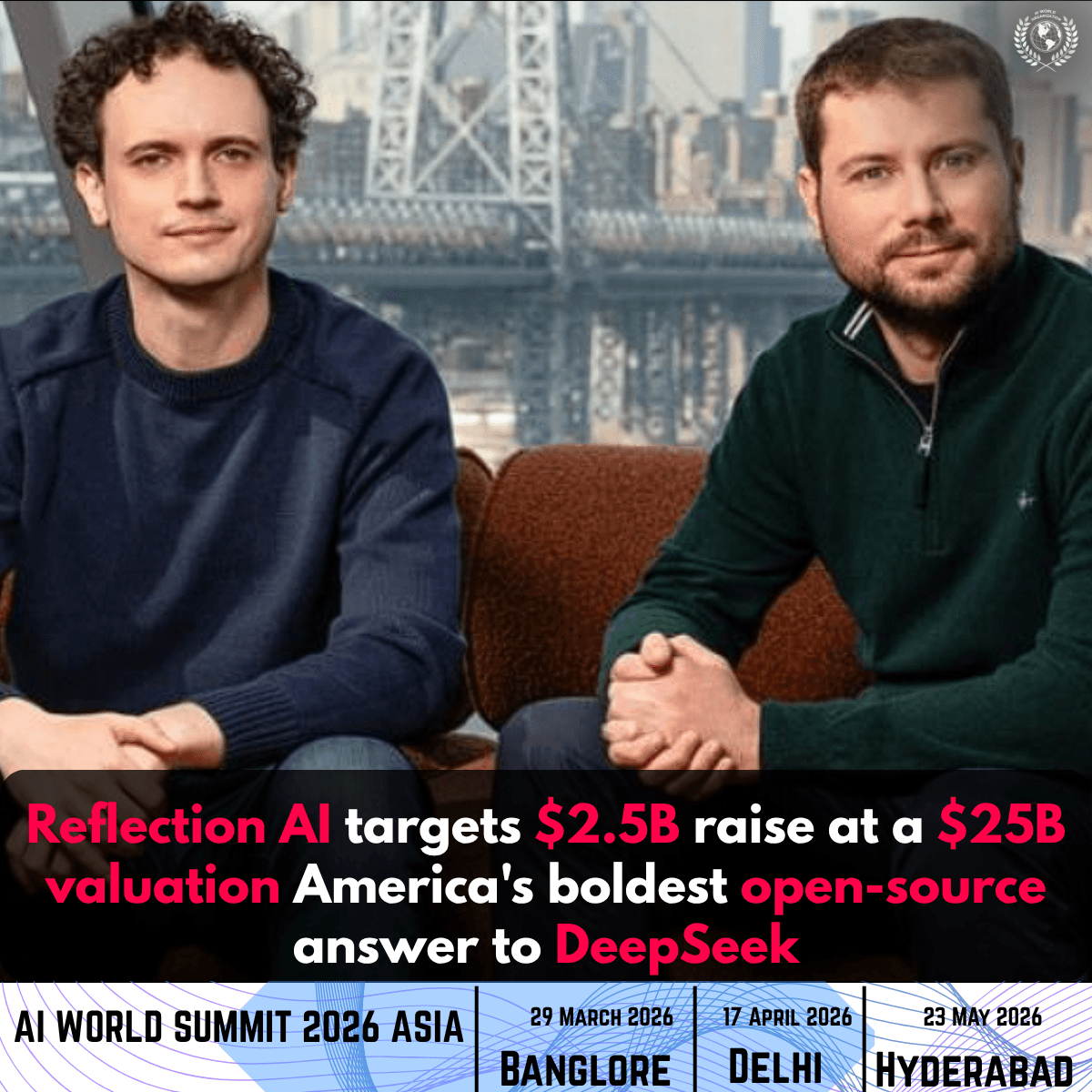
Reflection AI Eyes $2.5B Round at $25B Valuation
Reflection AI targets a $2.5B raise at a $25B valuation backed by NVIDIA and JPMorgan, emerging as America's open-source AI rival to China's DeepSeek.
TL;DR
Reflection AI, founded in 2024, is in talks to raise $2.5 billion at a $25 billion valuation — up from just $545 million a year ago. Backed by NVIDIA, JPMorgan, and Disruptive AI, the company is building open-weight AI models designed as a Western alternative to China's DeepSeek, serving enterprises and governments globally.
Reflection AI Eyes $2.5 Billion Raise at $25 Billion Valuation — America's Open-Source Answer to DeepSeek
There are moments in the technology industry when a single funding announcement signals something far bigger than just one company raising capital. Reflection AI's latest move to secure a $2.5 billion investment round at a staggering $25 billion pre-money valuation is one of those moments. This is not merely another headline in the endless stream of AI funding news. It represents a deliberate, strategically engineered effort to reshape the global AI landscape — one where Western open-source intelligence rivals China's rapidly advancing models, and where the United States reestablishes its dominance in the race for artificial general intelligence.
At The AI World, we track the pulse of the global AI economy, and this particular development is one of the most consequential pieces of AI funding news to emerge in 2026. From the identity of the investors involved to the geopolitical undertones of the deal itself, every detail of this fundraising round demands attention.
From $545 Million to $25 Billion: Reflection AI's Meteoric Valuation Surge
Founded in 2024 by Misha Laskin and Ioannis Antonoglou, two former researchers from Google DeepMind, Reflection AI has had one of the most remarkable valuation trajectories in the history of the artificial intelligence sector. Just under a year ago, the company carried a valuation of approximately $545 million. Today, it is seeking fresh capital that would value the business at $25 billion — a nearly 46-fold increase in under twelve months.
That kind of valuation growth does not happen in a vacuum. It reflects a confluence of powerful forces: extraordinary backing from NVIDIA, a compelling open-source strategy, growing institutional confidence in AI infrastructure plays, and a geopolitical narrative that has captured the imagination of investors spanning venture capital, big tech, and now major financial institutions. For anyone following AI funding and AI funding news, this trajectory is a benchmark for just how quickly the industry has accelerated.
The Wall Street Journal first reported on the fundraising discussions, noting that the $25 billion figure represents the pre-money valuation — meaning the company's worth before the fresh $2.5 billion is factored in. Even at that baseline, the number is breathtaking for a company that has yet to generate substantial revenue. But in today's AI investment climate, where infrastructure and positioning often matter more than near-term profitability, this is increasingly the norm rather than the exception.
Earlier this month, a Financial Times report had suggested Reflection was targeting a valuation north of $20 billion. The upward revision to $25 billion indicates that investor appetite has only grown stronger in a short span of time, further solidifying the sense that this is a company — and a mission — that the market believes in deeply.
JPMorgan, NVIDIA, and the Power Players Behind the Round
When it comes to AI funding of this magnitude, who is writing the cheques matters as much as the amounts themselves. The Reflection AI fundraising round is notable not just for its size but for the calibre and diversity of its investor base.
JPMorgan Chase, one of the largest financial institutions in the world, is reportedly in active discussions to participate in the round through its Security and Resiliency Initiative. This program was launched by JPMorgan in December 2025 with the explicit purpose of backing companies that are integral to United States economic stability and national security. At the time of its launch, JPMorgan stated its intention to deploy up to $10 billion into venture-backed startups through this initiative. The potential participation of JPMorgan in this round is a pivotal signal — it means that mainstream finance is no longer merely observing the AI revolution from the sidelines. Major banks are now embedding themselves into the architecture of the industry's most strategic bets.
Disruptive AI, an existing investor in Reflection, is also expected to participate in the new round, demonstrating continued confidence from those who were earliest to believe in the company's vision. Their anticipated re-investment underscores a vote of sustained institutional faith rather than a one-time speculative punt.
NVIDIA, arguably the most important name in Reflection's story, leads a prior investment round of $1 billion in which the chip giant alone committed approximately $500 million — with NVIDIA's total investment in Reflection now estimated at around $800 million. That earlier round also saw participation from 1789 Capital, an investment fund where Donald Trump Jr. serves as a partner, contributing $100 million. DST Global, the fund managed by Russian-Israeli billionaire Yuri Milner, also came in for $100 million in that same round. Additional institutional backers include Lightspeed Venture Partners, B Capital, Citi, CRV, and Sequoia Capital, painting the picture of a company that has drawn support from virtually every corner of the investment establishment.
This diversity of backers — a chip manufacturer, a sovereign-adjacent financial institution, a politically connected fund, a billionaire's global investment vehicle, and some of Silicon Valley's most storied venture firms — reflects the layered nature of the Reflection opportunity. It is simultaneously a technology bet, a geopolitical wager, and a financial infrastructure play.
America's Open-Source AI Frontier: The Mission Behind the Money
To truly understand the significance of this AI funding round, one must look beyond the dollar figures and understand what Reflection AI is actually trying to build. The company's core mission is to develop open artificial intelligence models — large-scale systems that businesses, research institutions, universities, and governments can access, adapt, and deploy for their own specific purposes. Unlike the dominant closed-source AI systems from companies like OpenAI, Reflection's approach is rooted in openness and accessibility.
However, it would be a mistake to describe Reflection as fully open source in the traditional sense. The company makes its model weights available to researchers and developers at no cost, enabling them to build upon and fine-tune the technology. But the training data and the complete training processes that underpin those models remain proprietary. This hybrid approach — often described as "open weights" rather than full open source — allows Reflection to foster a wide developer ecosystem while retaining a degree of competitive protection over its core intellectual property.
The revenue model, as envisioned by the company, is rooted in serving two major client categories. The first comprises large enterprises seeking to build commercial products on top of Reflection's models. The second, and arguably more strategically significant, segment is governments building what are increasingly being called sovereign AI systems — nationally operated, domestically controlled artificial intelligence infrastructure that reduces dependence on foreign-owned platforms.
Misha Laskin, Reflection's Chief Executive Officer, has described open-source models as a kind of Trojan horse, with their true power lying not in the surface-level accessibility but in the infrastructure and ecosystem they bind users to. That statement offers a glimpse into the long-term commercial logic: give the models away, build the ecosystem, and monetize the infrastructure and services that sit around them. It is a strategy that mirrors how companies like Red Hat built billion-dollar enterprises on top of open-source Linux, and how Android became the dominant mobile operating system through strategic openness.
The broader geopolitical context is impossible to ignore. Investors and government officials alike have been explicit in framing Reflection as the American answer to DeepSeek, the Chinese AI laboratory whose R1 model sent shockwaves through the global technology industry by delivering performance comparable to GPT-4 at a reported training cost of just six million dollars, released under an MIT open licence. DeepSeek's emergence demonstrated that Chinese AI developers were not just catching up — they were, in certain respects, setting the pace. Reflection is being positioned as the Western counterweight to this dynamic, a domestically rooted, strategically aligned open AI lab capable of competing on both performance and accessibility.
NVIDIA's Nemotron Coalition and the Infrastructure Ecosystem Play
One of the defining features of Reflection AI's strategy is its role as a founding member of NVIDIA's Nemotron Coalition. This alliance of AI companies was established by NVIDIA to foster a collaborative ecosystem of organisations committed to developing open frontier models. The coalition includes Mistral AI, Perplexity, Cursor, LangChain, and Black Forest Labs — a collection of companies that, together, represent some of the most dynamic forces in open AI development globally.
The Nemotron Coalition's inaugural project is a base model being co-developed by NVIDIA and Mistral AI, which will be released as open source for global use. This cooperative structure is significant. Rather than competing in isolation, Reflection and its coalition partners are collectively building an open AI stack that is deeply intertwined with NVIDIA's chip ecosystem. For NVIDIA, this strategy serves a dual purpose: it accelerates the adoption of its hardware among a new generation of AI developers, and it creates a network effect that entrenches NVIDIA's GPUs as the de facto computational substrate for open AI development.
For Reflection specifically, membership in the Nemotron Coalition confers credibility, access to cutting-edge chip resources, and a seat at the table for some of the most consequential conversations in AI infrastructure today. It also signals that Reflection is not simply a standalone AI startup but a core node in a broader, NVIDIA-anchored open AI architecture that spans continents and industries.
Researchers and industry observers tracking AI funding news have noted that Reflection's deep ties to NVIDIA distinguish it from many other well-funded AI startups. While others are competing for compute access, Reflection has a structural advantage: its primary backer is also its primary chip supplier, and those two relationships reinforce each other in powerful ways.
The Competitive Landscape: DeepSeek, Meta, and the Race for Open AI Supremacy
The open-source AI space has become one of the most fiercely contested arenas in global technology. Reflection AI is entering its next phase of growth in an environment where the competition is both technically sophisticated and deeply well-resourced.
DeepSeek remains the most disruptive force in this landscape. Its ability to produce high-performance models at dramatically lower cost has forced a reckoning across the industry and accelerated the move towards leaner, more efficient AI architectures. Meta's Llama family of models has also established a formidable open-source presence, with the company's vast resources and distribution channels giving it reach that few can match. In Europe, Mistral AI has carved out a respected position as a high-performance open model developer, particularly among enterprises and governments seeking alternatives to American Big Tech platforms.
For Reflection to justify a $25 billion valuation — and to deliver the returns its investors expect — it must demonstrate that its systems can match or exceed DeepSeek's cost efficiency, keep pace with Meta's community reach, and deliver the security and reliability standards that enterprise and government clients demand. Those are formidable challenges, and the company has openly acknowledged that it operates in a space where the competitive bar is rising with every passing month.
Security is another dimension of the challenge. Researchers at Cisco recently identified vulnerabilities in DeepSeek's R1 model that could be exploited through algorithmic jailbreaking, highlighting one of the core risks inherent in widely distributed open AI systems. Reflection will need to demonstrate that its open-weights approach can be made secure enough for mission-critical enterprise and government deployments — a challenge that will require ongoing investment in red-teaming, adversarial testing, and safety research.
The stakes extend well beyond commercial success. In a world where AI systems are increasingly embedded in critical infrastructure, healthcare, financial systems, and national security apparatus, the question of which country's AI models form the backbone of global digital infrastructure is one of the defining geopolitical questions of the decade. Reflection's funders — including JPMorgan and its Security and Resiliency Initiative — understand this, and their investment is as much a statement of strategic intent as it is a financial calculation.
What This Means for the Global AI Funding Ecosystem
The Reflection AI funding round, if completed, will rank among the largest single capital raises in the AI sector to date. It arrives at a moment when AI funding activity shows no signs of slowing, even as interest rates, macroeconomic uncertainty, and debates about AI safety continue to swirl. The fact that a company with limited current revenue can attract this level of investment is a reflection of how profoundly the market believes in the long-term strategic value of AI infrastructure.
At The AI World, we see this as a defining chapter in the AI funding story of 2026. The involvement of JPMorgan's Security and Resiliency Initiative is particularly notable: it signals that major financial institutions are no longer treating AI investment as a speculative technology bet but as a matter of national economic and security strategy. When a bank of JPMorgan's scale builds a dedicated initiative to deploy $10 billion into AI and related sectors, it changes the nature of AI funding itself — bringing the scale and permanence of institutional finance to what was previously a domain dominated by venture capital.
For startups, researchers, policymakers, and enterprise technology leaders watching these developments, the message is clear. Open AI infrastructure is becoming a cornerstone of national strategy. The companies building it are attracting capital at extraordinary multiples. And the competitive race between American and Chinese AI systems is entering a new, more intense phase — one where open-source models, not just proprietary ones, are central to the outcome.
Reflection AI sits at the intersection of all these forces. Whether it can deliver on the immense expectations embedded in its $25 billion valuation is a question only time will answer. But what is already certain is that the company, its investors, and its mission have placed themselves squarely at the centre of one of the most consequential technological contests of our era.