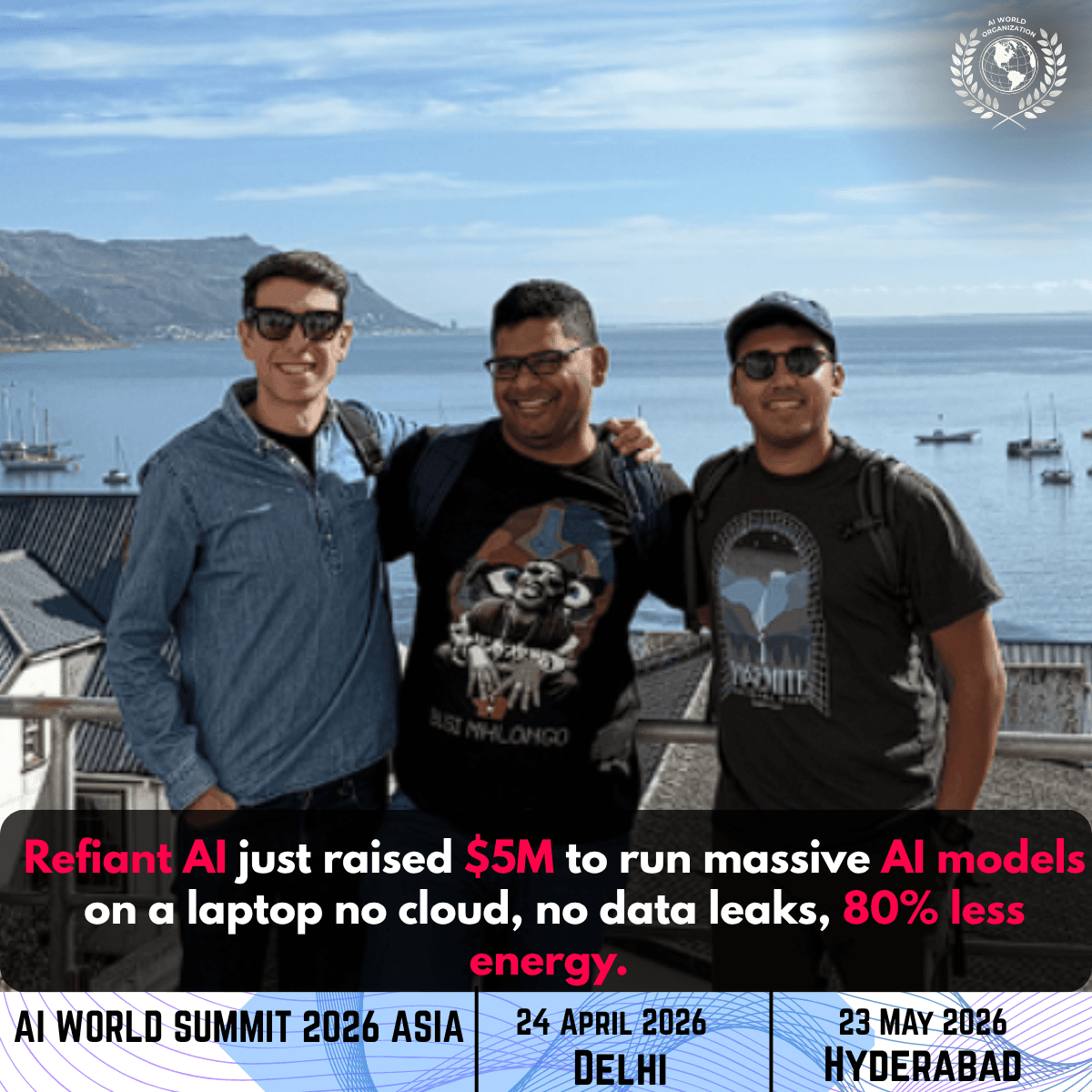
Refiant AI Raises $5M to Cut GPU Energy Use 80%
Refiant AI secures $5M seed funding from VoLo Earth to slash AI energy use by 80% using nature-inspired compression — a data sovereignty game-changer.
TL;DR
Refiant AI, a South African startup, just raised $5M from climate-focused VC VoLo Earth to make AI models run up to 80% more efficiently using nature-inspired compression. Their tech squeezes massive AI models onto a standard laptop — no cloud needed — cutting energy costs dramatically while keeping data fully private and local. A quiet but significant shift in how enterprise AI gets deployed.
Refiant AI Secures $5M Seed Funding to Revolutionize GPU Efficiency and Reclaim Data Sovereignty
The artificial intelligence industry is at a crossroads. While the world's biggest technology companies are on track to collectively spend nearly $700 billion this year on building data centres to power AI systems, a South African-founded startup is quietly challenging that very model — and it just secured the backing it needs to make its case to the world. In the latest round of AI funding news making waves across the global tech ecosystem, Refiant AI has announced a $5 million seed funding round led by VoLo Earth Ventures, a top-decile climate technology fund with $225 million invested across 35 portfolio companies. This is not just another funding announcement — it is a direct statement of intent against the brute-force approach that has dominated AI infrastructure for years.
The Refiant AI funding round represents one of the more strategically significant investments in the AI efficiency space this year. Rather than building another application on top of existing cloud infrastructure, Refiant is targeting the very foundation of how AI models are deployed — and the implications of their work, if it scales, could reshape the economics of artificial intelligence from the ground up. For those tracking AI funding news in 2026, this deal is one that deserves a far deeper look than its headline figure suggests.
The $700 Billion Problem That Refiant Is Solving
To understand why this funding round matters, it is important to first understand the scale of the problem that Refiant AI is attempting to solve. Global data centre energy consumption is expected to double by 2028, with AI workloads driving the majority of that alarming growth. Every time a user sends a prompt to a large language model, that query is typically routed to a cloud data centre filled with power-hungry GPUs, generating carbon emissions and compute costs that are largely invisible to the end user but staggering in aggregate.
Today, deploying AI in any serious capacity means routing sensitive data through cloud providers, absorbing unpredictable compute costs, and having almost no visibility into where your data actually goes or how it is processed. This creates not just an environmental problem but an acute data sovereignty issue — particularly for banks, hospitals, government bodies, and enterprises operating in regions governed by strict data residency laws. The current AI infrastructure model concentrates power — both computational and economic — in the hands of a small number of American hyperscale cloud platforms, leaving organisations in Africa, Europe, and the developing world dependent on infrastructure they neither own nor fully control.
Refiant's founders argue that the more sustainable and strategically sensible path is not to keep building bigger — it is to make what already exists dramatically more efficient. Their work in AI model compression directly confronts the assumption that AI capability requires ever-increasing hardware investment, and their seed funding from VoLo Earth Ventures signals that at least some of the smartest climate-focused investors in the world agree with that premise. This kind of AI funding news is particularly resonant at a time when the environmental costs of AI are drawing increasing scrutiny from regulators and civil society alike.
Nature-Inspired Algorithms: The Science Behind the Breakthrough
What sets Refiant apart from the growing field of AI optimisation startups is the specific mechanism through which it achieves compression. Rather than relying on conventional model pruning or quantisation techniques — which have long been criticised for degrading model intelligence and accuracy — Refiant has developed what it describes as "nature-inspired" compression algorithms based on a novel mathematical approach that mimics biological optimisation processes. The idea is borrowed from how nature itself solves complex problems with extraordinary efficiency, from the neural architecture of biological brains to the structural optimisation found in natural materials.
In practical terms, the results have been striking. Refiant recently demonstrated that it could compress a 120 billion parameter AI model — one of the most powerful open-source models available at the time of the test — to run on a standard MacBook Pro with just 12 gigabytes of RAM. For context, that same model would normally require hardware with at least 80 gigabytes of memory, placing it firmly out of reach for any individual user or small organisation operating without cloud infrastructure. Under Refiant's compression, the model retained between 95% and 99% of its original fidelity, ran alongside a second AI model on the same machine simultaneously, and the entire compression process took just four hours with no cloud computing required at any stage.
The energy efficiency gains recorded in this demonstration were measured with rigorous scientific methodology, conducted inside a Faraday cage to eliminate any external electromagnetic interference and ensure the accuracy of readings. Under these controlled conditions, the compressed model achieved approximately 3,000 tokens per kilowatt-hour — a figure that represents up to 100 times greater energy efficiency than running the same model on conventional data centre hardware. Put another way, the energy required to process a single AI prompt using standard infrastructure could power roughly 100 equivalent prompts using Refiant's technology. It is the kind of data that makes AI funding news headlines, but also the kind of data that makes enterprise CIOs and sustainability officers sit up and pay very close attention.
Data Sovereignty and the Geopolitics of AI Infrastructure
Beyond the environmental case, Refiant's pitch taps into a growing geopolitical anxiety about who controls AI infrastructure and what that means for the organisations and nations that depend on it. The current paradigm, in which most AI workloads are processed by a handful of hyperscale providers operating primarily from US-based data centres, creates meaningful risks for any organisation that handles sensitive data — financial records, health information, proprietary business intelligence, or national security assets. Routing that data through third-party cloud infrastructure is not just a technical inconvenience; in many jurisdictions, it is a legal liability.
Refiant's approach — optimising models for local execution on edge hardware — offers a fundamentally different answer to this problem. By making it possible to run powerful AI models on laptops, on-premises servers, or local devices without cloud connectivity, Refiant essentially returns data sovereignty to the organisations that generate and own the data. Banks in South Africa, telecoms in Europe, and manufacturing firms across Asia can deploy enterprise-grade AI without vendor lock-in, without unpredictable cloud billing cycles, and without routing sensitive customer information through foreign infrastructure. This is a value proposition that goes far beyond cost savings, and it is one that Refiant is actively pursuing through conversations with several multinational technology firms exploring exactly these use cases.
The broader context for AI funding news in this space is important to acknowledge. Global spending on AI infrastructure reached $67 billion in 2023, with projections to exceed $150 billion by 2026. The vast majority of that expenditure is concentrated on hyperscale cloud platforms, leaving a massive underserved market of enterprises that want the benefits of AI without the sovereignty, privacy, and cost risks associated with public cloud deployment. Refiant's seed round positions the startup squarely at the intersection of AI efficiency and data sovereignty — a positioning that resonates particularly strongly in Africa and Europe, where data localisation requirements are strictest and cloud dependency is viewed with the most institutional scepticism.
VoLo Earth Ventures and the Climate Investment Thesis
The choice of lead investor tells its own story about the strategic framing of this deal. VoLo Earth Ventures is not a conventional enterprise software fund — it is a climate technology investor with a portfolio that includes companies building geothermal power plants in partnership with Meta and turning fallen trees into carbon-negative construction materials. Its decision to lead Refiant's seed round reflects a clear thesis: that AI efficiency is inseparable from climate sustainability, and that the most consequential climate investments of this decade may not be in renewable energy generation but in reducing the energy demand of artificial intelligence itself.
Joseph Goodman, Managing Partner at VoLo Earth, articulated the investment rationale with precision. "AI's biggest constraint isn't demand — it's energy," Goodman stated. "What's been missing is a fundamentally more efficient way to compute. Refiant's architecture replaces brute-force scaling with a far more efficient, nature-inspired approach that lowers energy use while increasing capability. That's the kind of breakthrough needed to make AI sustainable on a global scale." For a fund that has deployed $225 million across 35 portfolio companies focused on climate technology, this is a thesis statement — a declaration that AI efficiency is now a climate issue, and that the startups solving it deserve the same attention and capital as solar energy firms or battery manufacturers.
This perspective is increasingly shared across the investment community. As AI funding news from 2025 and 2026 consistently demonstrates, the most sophisticated climate investors are no longer treating AI as simply a tool to be applied to sustainability problems — they are recognising that AI itself is becoming one of the most significant energy consumers on the planet, and that the startups reducing that consumption are among the most impactful investments available. Refiant's $5 million seed round sits firmly in this context, and VoLo Earth's involvement lends it both credibility and strategic weight.
What Comes Next: Team, Platform, and Enterprise Partnerships
With $5 million in fresh capital, Refiant's immediate priorities are clear. The funding will be used to scale the team, which already brings together an unusually strong combination of expertise for a seed-stage company. The current roster includes a former Google Cloud architect, a researcher holding a PhD from the University of Cambridge, and an engineer with experience working on NASA projects. This is not a team built around a single technical insight — it is a team assembled with the explicit intent of translating a scientific breakthrough into enterprise-grade infrastructure.
The product roadmap centres on building out a platform that can deliver Refiant's compression capabilities at scale, enabling enterprise customers to compress and deploy their own AI models on local hardware without requiring deep technical expertise. The company is already in active conversations with several multinational technology firms exploring how Refiant's approach could reduce their AI compute costs while maintaining data and energy sovereignty — a dual value proposition that is difficult to find in any other product currently on the market. As the AI funding news cycle continues to be dominated by announcements about billion-dollar data centre investments and hyperscale GPU procurement, Refiant's story stands out precisely because it points in the opposite direction.
At The AI World, we see Refiant AI's raise as emblematic of a broader shift happening in the AI funding landscape. The era of pure scale as a strategy is giving way to an era in which efficiency, sustainability, and sovereignty are becoming primary design requirements — not afterthoughts. As regulators in Europe, Africa, and Asia tighten data localisation rules and as enterprises grow increasingly concerned about the cost and environmental footprint of cloud-dependent AI, startups like Refiant are positioned at the exact intersection where the next wave of enterprise AI adoption will be decided. The $5 million seed round announced this week is, in many ways, a small number for a very large idea — and for those following AI funding news closely, it is one of the more important signals of where the industry is heading next.