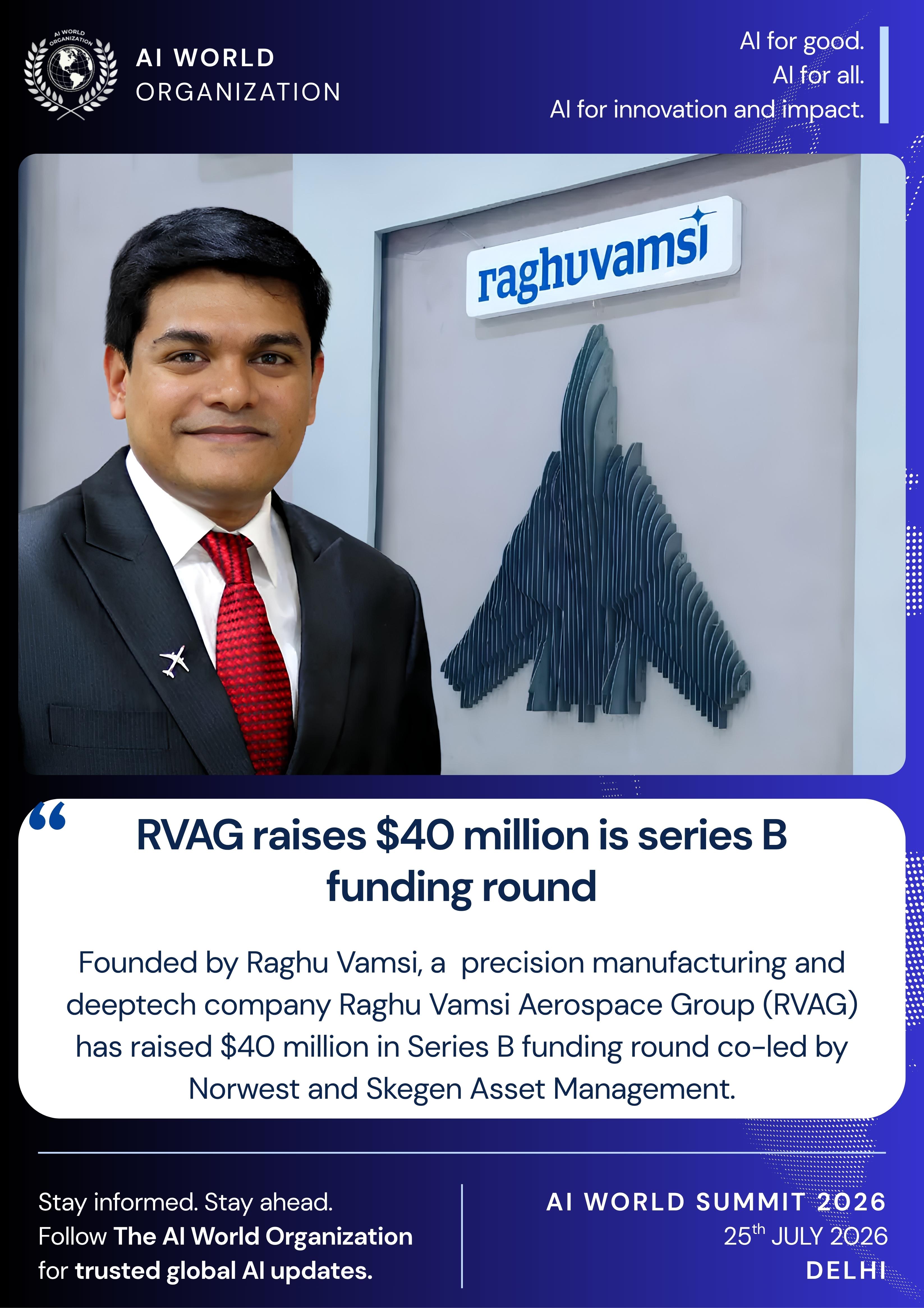
Raghu Vamsi Aerospace Raises $40 Million: What This Means for India’s Deeptech Manufacturing Push
This is not just a capital raise for a single company. It reflects a broader shift in how India is building strategic industrial capability, especially in aerospace, defense, and advanced manufacturing, where long-term competitiveness depends on engineering depth, supply chain resilience, and global execution.
Introduction
Raghu Vamsi Aerospace Group (RVAG) has raised $40 million, or around Rs 400 crore, in a Series B round co-led by Norwest and Skegen Asset Management, with participation from Indus Bridge Ventures, GJNX Ventures, and Ashish Kacholia. The funding is a strong signal that precision manufacturing and deep tech are becoming increasingly attractive to investors looking beyond software to hard-tech infrastructure.
What Raghu Vamsi Does
Raghu Vamsi Aerospace is a Hyderabad-headquartered precision manufacturing and deeptech company serving aerospace, defense, and energy markets. It operates across India, the UK, and the US, and has built a presence that combines manufacturing scale with advanced systems capabilities.
The company’s work spans Mission Systems, Deep-Tech & Autonomous Systems, and precision manufacturing, which puts it in a category of industrial companies that are not merely producing parts but building strategic capability. That distinction matters because the aerospace and defense supply chain rewards reliability, certification, and high technical standards over quick experimentation.
According to recent reporting, RVAG employs more than 1,200 people and operates 10+ facilities across three countries, while also serving global customers such as GE Aerospace, Honeywell, Safran, and Collins Aerospace. It also reportedly has an order book of more than Rs 2,500 crore, providing the company with meaningful operating traction as it expands.
Why This Funding Round Matters
The $40 million round provides RVAG with fresh capital to expand manufacturing capacity across India, the UK, and the US, while also accelerating the construction of its integrated manufacturing campus near Hyderabad International Airport. That is important because aerospace manufacturing is highly capital-intensive and requires long planning cycles, specialized infrastructure, and sustained investment before scale benefits fully show up.
The round was co-led by Norwest and Skegen Asset Management, which is notable because it combines institutional growth capital with an investor base that appears comfortable backing industrial capability rather than only digital platforms. Participation from Indus Bridge Ventures, GJNX Ventures, and Ashish Kacholia adds further conviction to the thesis that Indian deeptech manufacturing is entering a more mature growth phase.
This is also a meaningful moment for India’s industrial startup ecosystem. For years, much of startup capital has flowed into consumer tech, fintech, and SaaS. A large round in aerospace manufacturing shows that investors are increasingly willing to fund companies that build physical infrastructure, complex systems, and long-duration industrial value.
Why Aerospace Is a Strategic Category
Aerospace and defense manufacturing is one of the hardest categories to build in because the bar for quality, compliance, and execution is extremely high. Companies must meet strict standards, maintain manufacturing consistency, and deliver across long time horizons while operating in sectors where failure is expensive.
That challenge is also what makes the category attractive. Once a company earns customer trust and builds credible capability, it can become deeply embedded in the supply chain and harder to displace. RVAG’s customer list and multi-country footprint suggest it is already moving in that direction.
The broader strategic opportunity is clear as well. India is pushing for greater self-reliance in defense and advanced manufacturing, and companies that can combine precision engineering with global quality standards are well-positioned to benefit from this trend.
What the Capital Will Support
RVAG said the funds will go toward capacity expansion, the development of its integrated manufacturing campus, and strengthening its Mission Systems and Deep-Tech & Autonomous Systems businesses. That investment mix points to a company preparing for both near-term growth and long-term capability building.
In practical terms, this likely means:
More manufacturing throughput across existing facilities.
Higher investments in precision systems and specialized engineering.
A stronger base for defense-related and autonomous systems work.
Greater ability to serve global customers at scale.
That kind of reinvestment is especially important in industrial companies because capacity is not just about volume; it is about reliability, certification, and the ability to consistently meet complex customer requirements over time.
The Bigger Signal for Indian Deeptech
Raghu Vamsi’s raise is part of a broader deeptech momentum in India. The country is increasingly producing companies that are not just building software layers but creating real-world manufacturing and systems capability.
That matters for two reasons. First, it expands the definition of what a startup can be in India. Second, it shows that domestic capital and global investors are willing to back businesses with longer gestation periods if the strategic opportunity is strong enough.
For founders in industrial deeptech, this is a useful signal. Investors are no longer looking only for fast software scaling. They are also paying attention to companies that can build defensible infrastructure, serve global customers, and operate in sectors that require deep technical trust.
Final Take
Raghu Vamsi Aerospace Group’s $40 million Series B is more than a funding story. It is a sign that precision manufacturing, aerospace, and deeptech are becoming central to India’s next wave of industrial growth.
The company already has scale, global customer relationships, and a clear expansion roadmap, which makes this round feel like an acceleration moment rather than an early bet.
At The AI World Organization, this is exactly the kind of company worth watching: a business building hard-tech infrastructure with long-term strategic value, backed by investors who appear to believe India’s next industrial champions will be built in precision, not just code.