AI Equity Research Startup Pinegap Raises 8 Million Dollars: What This Signals For Wall Street’s Next Generation Of Research
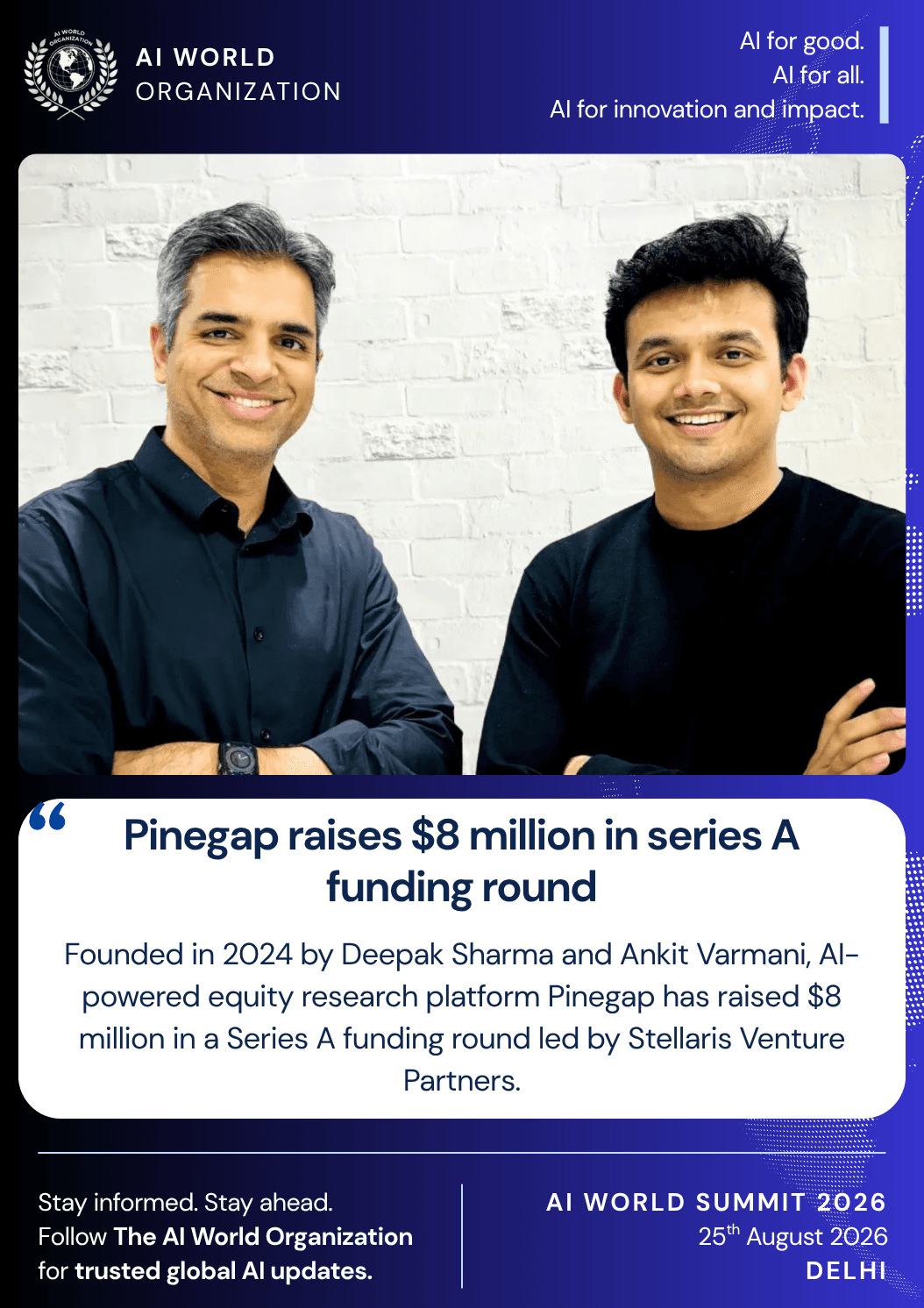
AI is quietly remaking one of finance’s most demanding jobs: equity research. The latest proof comes from Pinegap, an AI-powered equity research startup that has just raised 8 million dollars in Series A funding led by Stellaris Venture Partners, with participation from existing investors Inventus Capital, Silicon Valley Quad, and DeVC. For a company founded in 2024, this round lifts Pinegap’s total funding to more than 13 million dollars across three rounds, and marks its transition from early product build to scale-up mode in institutional finance.
Who Pinegap Serves And What It Automates
Pinegap operates at the intersection of AI agents and equity research workflows. It builds an AI platform designed for buy-side equity analysts and portfolio managers at hedge funds, mutual funds, and investment banks. The platform focuses on automating daily research tasks: ramping up new companies, reading and analyzing earnings documents, tracking investment theses, monitoring news and KPIs, and assembling recurring reports.
Instead of analysts manually searching through filings and data terminals, Pinegap deploys AI agents that behave like junior analysts. These agents continuously parse earnings releases, transcripts, regulatory filings, and news, then produce:
Earnings previews and post-earnings breakdowns
Company ramp-up packs for new coverage
Ongoing thesis tracking for coverage lists
Customized dashboards and alerts tailored to each fund’s internal workflow
The goal is not to replace senior analysts. It is to free them from repetitive data collection so they can focus more time on making investment judgments.
Traction: 100+ Funds, 1,000+ AI Agents, 50,000+ Monthly Reports
The scale of Pinegap’s early traction helped investors build conviction. Within roughly a year of launch, Pinegap is already working with 100+ institutional funds, has deployed over 1,000 AI agents, and generates more than 50,000 personalized research reports every month. This is not a pilot in one corner of the market. It is a broad early footprint across hedge funds and long-only managers.
Many of these clients already have internal data science and AI capabilities. Yet, as Stellaris partner Alok Goyal notes, they still preferred Pinegap’s platform. The reason is not a lack of technical capability. It is Pinegap’s understanding of how research actually flows inside investment teams. The product is built around real workflows, not generic AI features.
That workflow intelligence comes from the founding team’s background. Co-founder Ankit Varmani spent about 15 years in equity research—seven on the sell side and eight on the buy side—living the exact workflow Pinegap now automates. Co-founder Deepak Sharma brings the engineering velocity and technical range needed to turn those insights into scalable software. Together, they sit at the intersection of deep domain experience and AI-native product building.
The Funding Round: Who Backed Pinegap And Why
The 8 million dollar Series A was led by Stellaris Venture Partners, a fund known for backing B2B SaaS and deep-tech companies across India and global markets. Existing backers Inventus Capital, Silicon Valley Quad, and DeVC joined the round, extending their commitment from Pinegap’s 2.5 million dollar seed round in 2024.
Pinegap is headquartered in New York, with a significant engineering center in Bengaluru, India. This dual presence gives it proximity to Wall Street clients and access to India’s deep engineering talent pool. The new capital will be used to:
Strengthen go-to-market and sales operations so the company can reach more funds more quickly.
Expand the engineering team in Bengaluru to build and refine agentic workflows at scale.
Build an in-house team of former equity research analysts, creating a hybrid bench of domain experts and AI engineers.
In practical terms, Pinegap is moving from proving its thesis with early adopters to scaling a standardized equity research automation platform across many more institutions.
Why This Round Matters For AI In Finance
Pinegap’s raise sits inside a larger trend: vertical AI platforms are gaining serious traction in complex, high-stakes domains. Equity research is one of the most intellectually demanding professions in finance. Analysts must interpret quantitative data, qualitative nuance, management signals, macro conditions, and sector dynamics. It is not a field where generic AI tools can simply “replace” humans.
What AI can do, however, is take over the repetitive, structured parts of the workflow:
pulling data from filings and transcripts
tracking recurring KPIs and events
producing standardized summary formats
making sure nothing important is missed
This shift from search and browse tools to agentic, workflow-aware platforms is exactly the kind of AI evolution The AI World Organization tracks. Pinegap is not selling another data dashboard. It is selling a system that understands how research teams operate and inserts AI agents into that workflow without asking analysts to fundamentally change their process.
From an industry perspective, this matters for several reasons:
Labor leverage: With AI agents handling pre- and post-earnings work, a team of analysts can cover more names without sacrificing depth.
Consistency and coverage: Agents can watch for events 24/7, reducing the chance that a fund misses a filing, guidance change, or sector report.
Onboarding and ramp-up: New analysts can lean on agent-generated ramp-up packs and historical coverage, shortening the time it takes to contribute meaningfully.
Institutional memory: AI agents can help preserve thesis history and research rationale, which is often scattered across notes, decks, and emails.
For AI in finance, Pinegap’s traction signals that fund managers are ready to embed AI deeper into daily investment operations, as long as the tools are built around real workflows and trustable outputs.
Risks And Execution Questions
As with any AI platform touching high-stakes decisions, Pinegap faces challenges.
First, it must maintain trust around model outputs. Equity research is sensitive to errors, misinterpretations, and hallucinations. Pinegap’s agents will need strong guardrails, clear provenance of sources, and human oversight to ensure teams treat outputs as structured input rather than unverified conclusions.
Second, it must keep pace with regulatory and compliance requirements. As AI-generated research interacts with existing frameworks for disclosures and suitability, platforms like Pinegap will need to support compliance teams with traceability and audit-friendly designs.
Third, scaling across different fund styles and geographies requires careful abstraction. Not every fund wants the same workflow. Some prioritize fundamental long-horizon analysis; others run event-driven or quant overlays. Pinegap will need to maintain flexibility without diluting its core product.
The Series A round gives Pinegap resources to address these complexities. But the hard work now is execution: proving that AI agents can remain reliable co-pilots inside real investment teams over years, not just in early deployments.
What Pinegap’s Story Tells Us About AI Equity Research
For The AI World Organization, Pinegap’s raise is an instructive case study in AI’s next wave in finance.
It shows:
How agentic AI is moving from generic tools to vertical, workflow-native platforms in complex domains like equity research.
That domain expertise plus AI engineering is a powerful combination: analysts trust systems built by people who have lived their jobs.
Institutional clients are willing to adopt AI agents when those agents are designed to be junior colleagues, not black boxes.
As AI adoption in financial services accelerates, we expect more platforms to follow Pinegap’s model: deep workflow understanding, clear value in time savings and coverage, and a focus on making experts more effective rather than trying to replace them.
For now, Pinegap’s 8 million dollar Series A marks a notable moment in Wall Street’s AI story. Equity research is beginning to share its workload with AI agents, and investors are backing platforms that can make that collaboration real.
If Pinegap continues to scale its 100+ fund footprint, 1,000+ agents, and 50,000+ monthly reports while keeping analysts in the driver’s seat, it will be one of the companies that define how AI and human judgment coexist in institutional investing.