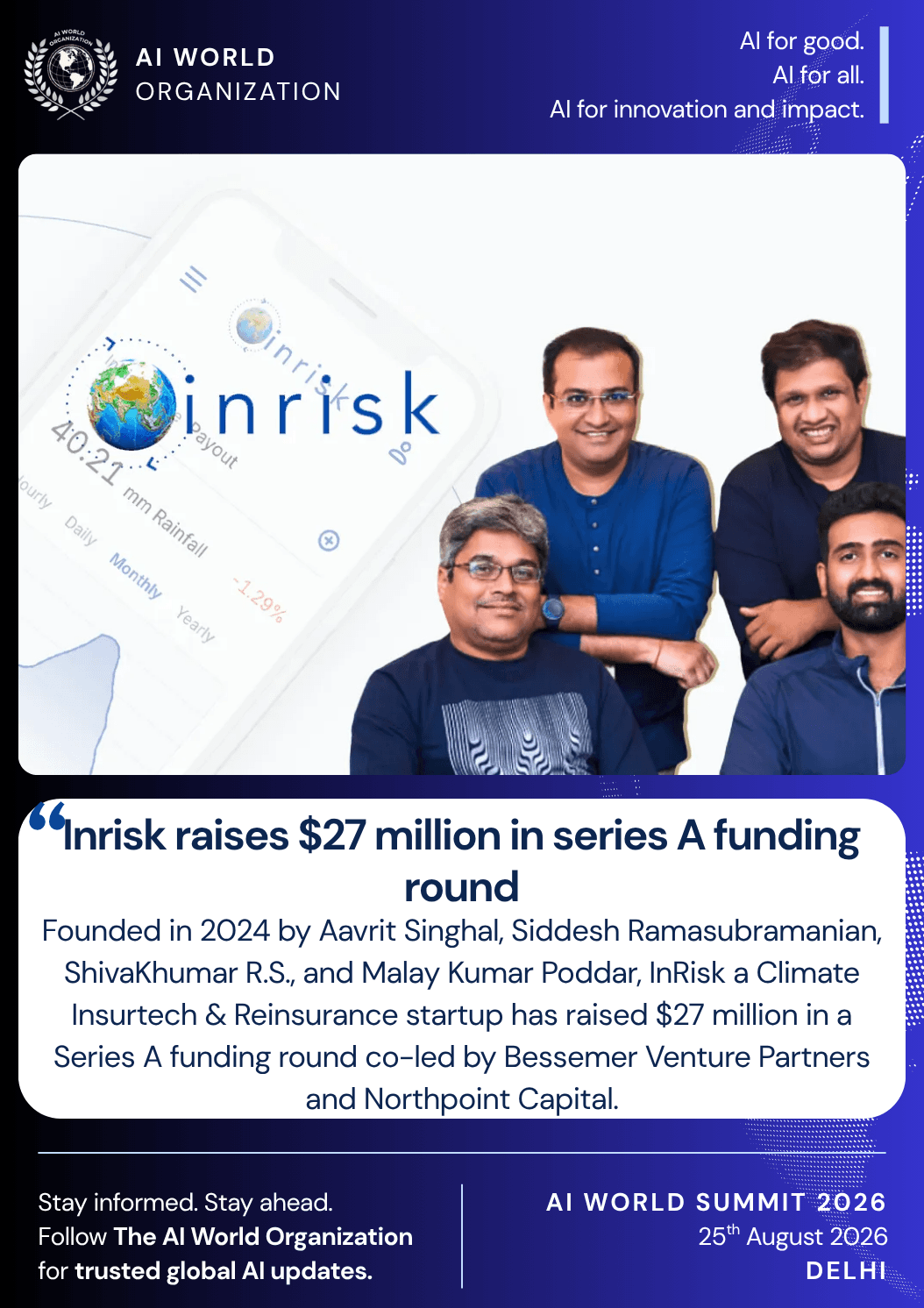
InRisk Labs has just raised 27 million dollars in Series A funding
InRisk Labs has just raised 27 million dollars in Series A funding, and it is not just another headline about a startup closing a round. The story behind the raise says a lot about where climate risk, parametric insurance, and AI-led reinsurance are headed in India and beyond. For a young company founded in 2024, this level of capital, combined with a major regulatory milestone, marks the starting point of a new kind of risk infrastructure company rather than a simple insurtech experiment.
Who is InRisk Labs and what does it do?
InRisk Labs is a technology-led risk and reinsurance platform focused on climate and disaster risk financing. Instead of relying only on historical loss data, the company integrates climate, geospatial, satellite, exposure, and claims data to build smarter underwriting models for natural catastrophe and non-life risks. At its core, InRisk is working on parametric insurance innovation. Parametric products pay out when a predefined index is triggered, for example when rainfall crosses a threshold, wind speeds exceed a certain level, or an earthquake of a given magnitude hits a region.
This approach is particularly important for governments, multilateral agencies, and insurers who need fast, transparent payouts after climate shocks. Traditional indemnity insurance requires long claims processes and detailed damage assessments. Parametric solutions can settle payouts within days because they are tied to objective data points rather than contested estimates. InRisk Labs aims to be one of the companies making this model broadly usable in India and other markets.
The funding round in detail
The 27 million dollar round was co-led by Bessemer Venture Partners and Northpoint Capital, with participation from other undisclosed investors. The transaction values the group at around 70 million dollars, according to cofounder Siddesh Ramasubramanian. For context, this is a significant valuation for a two-year-old climate-tech and insurtech company, especially one playing in reinsurance rather than pure SaaS.
This is InRisk’s first institutional round at meaningful scale. Inc42 data indicates that the company has raised a total of 54 million dollars so far when including additional capital tied to its broader group structure. The new funding is specifically aimed at scaling its AI-led reinsurance platform through EarthRe Insurance IFSC Limited, the regulated subsidiary that will carry underwriting risk on its balance sheet.
The regulatory milestone: EarthRe’s license
The raise sits alongside an equally important development. EarthRe Insurance IFSC Limited, an InRisk Labs subsidiary, has received a final reinsurance license from the International Financial Services Centers Authority (IFSCA) at GIFT City. This makes EarthRe the first incorporated reinsurer licensed to operate from the IFSC in GIFT City, according to the company.
That license changes InRisk’s position in the market. Until now, it operated primarily as a technology-led insurtech platform providing analytics and parametric solutions. With EarthRe’s license, it becomes an integrated reinsurance group with regulated risk-bearing capacity. In practical terms, InRisk can now use its own models to underwrite reinsurance business rather than only selling tools to others.
India’s reinsurance market is estimated to be around 10 billion dollars, with demand growing as climate risk, infrastructure development, and asset complexity increase. Operating from GIFT City’s IFSC gives EarthRe access to a regulatory environment tailored for cross-border financial services, making it easier to support both domestic and international clients.
How the fresh capital will be used
InRisk Labs has stated that the new capital will be used across four main areas.
First, it will strengthen underwriting and actuarial capabilities. Reinsurance is a data-heavy business built on probability and capital discipline. Investing in actuaries and underwriters who can combine traditional models with AI-driven insights is central to InRisk’s promise.
Second, the company will deepen its catastrophe modeling. Cat modeling is the backbone of modern reinsurance. It uses simulations to estimate how often certain events occur and how severe they might be. InRisk’s model integrates climate simulations, geospatial grids, satellite observations, and exposure maps to generate more nuanced views of risk.
Third, InRisk will expand AI capabilities across its platform. AI is applied to pattern recognition, anomaly detection, and portfolio optimization, helping reinsurers move away from generic assumptions toward tailored risk views. The company’s infrastructure is designed to ingest and process large volumes of structured and unstructured data into usable insights for pricing and capital allocation.
Fourth, the funding will support the expansion of EarthRe’s operations across more non-life lines, including natural catastrophe, climate risk, property, crop, marine cargo, and motor. This means moving from a narrower parametric focus into a broader reinsurance portfolio backed by the same data and AI infrastructure.
Why this round matters for climate and insurtech
InRisk’s round lands at a time when climate risk is moving from theoretical concern to tangible balance sheet issue. Global reports have consistently shown that economic losses from weather-related disasters have risen over the past decades, with many losses remaining uninsured. Parametric insurance and smarter reinsurance models are part of the toolkit to close this protection gap.
At the same time, regulators and rating agencies are pushing insurers and reinsurers to strengthen their climate risk frameworks. Tools that can rapidly ingest data and generate scenario-based views are becoming essential. InRisk is one of several players trying to build this capability from the ground up using new technology stacks rather than retrofitting legacy systems.
The round also signals that investors are willing to back deep-tech startups in financial infrastructure sectors beyond consumer fintech. Bessemer and Northpoint Capital are known for their focus on long-term, defensible businesses. Their involvement indicates confidence that climate risk and parametric innovation are a category with durable demand, not merely a trend.
Challenges ahead
Despite the excitement, building a reinsurance group is not a simple task. Capital intensity, regulatory scrutiny, and risk management standards are all significantly higher than in typical software startups. InRisk will need to demonstrate that its AI-led models are robust, transparent, and acceptable to counterparties and regulators. Black-box analytics are unlikely to fly in an industry where trust and conservatism remain core values.
The company will also need to navigate competition from large incumbent reinsurers that are improving their own climate risk capabilities. Winning in this space will require not just better models, but better partnerships, distribution, and client relationships.
Another challenge is balancing innovation with risk appetite. Parametric solutions are powerful, but they must be designed carefully to avoid basis risk, where payouts do not match the actual losses clients experience. Getting that balance right is critical to maintain trust and avoid disputes.
What this means for founders and operators
For founders in climate-tech, insurtech, and risk analytics, InRisk’s raise offers a few lessons.
One, regulatory milestones can be as important as fundraising. EarthRe’s license amplified the round's significance by converting InRisk from a pure technology provider into a risk-bearing institution. Founders building in regulated spaces should consider licenses not just as compliance tasks, but as value-creation events.
Two, deep integration of data and AI in old industries is gaining investor interest. InRisk’s platform does not ignore traditional actuarial thinking but adds layers of geospatial, satellite, and climate data on top of it. That combination of respecting domain expertise and modernizing tools is compelling.
Three, climate risk is now a mainstream capital topic. Reinsurance, especially in emerging markets, will need new tools to price and manage increasingly complex exposures. Startups that can offer clarity here are likely to find receptive investors.
Looking ahead
Over the coming years, InRisk Labs will be judged less by the amount it raised and more by how well it converts capital into durable risk infrastructure. Success will look like a growing portfolio that survives real-world stress, a reputation for fair and fast payouts in parametric programs, and partnerships with insurers, governments, and agencies seeking more predictable climate financing.
If it manages that, the $27 million Series A will be remembered as the moment when a new kind of reinsurance group came into focus within India’s climate-tech ecosystem. If it struggles, the market will still learn from its attempt to blend AI, data, and regulated risk-bearing in a sector that needs innovation but cannot afford recklessness.
For now, InRisk Labs’ Series A stands as one of the more interesting climate and insurtech rounds of 2026. It reflects investors' belief that the way we measure and price risk is overdue for change, and that companies willing to build at the intersection of data, regulation, and capital will play a crucial role in the climate economy.