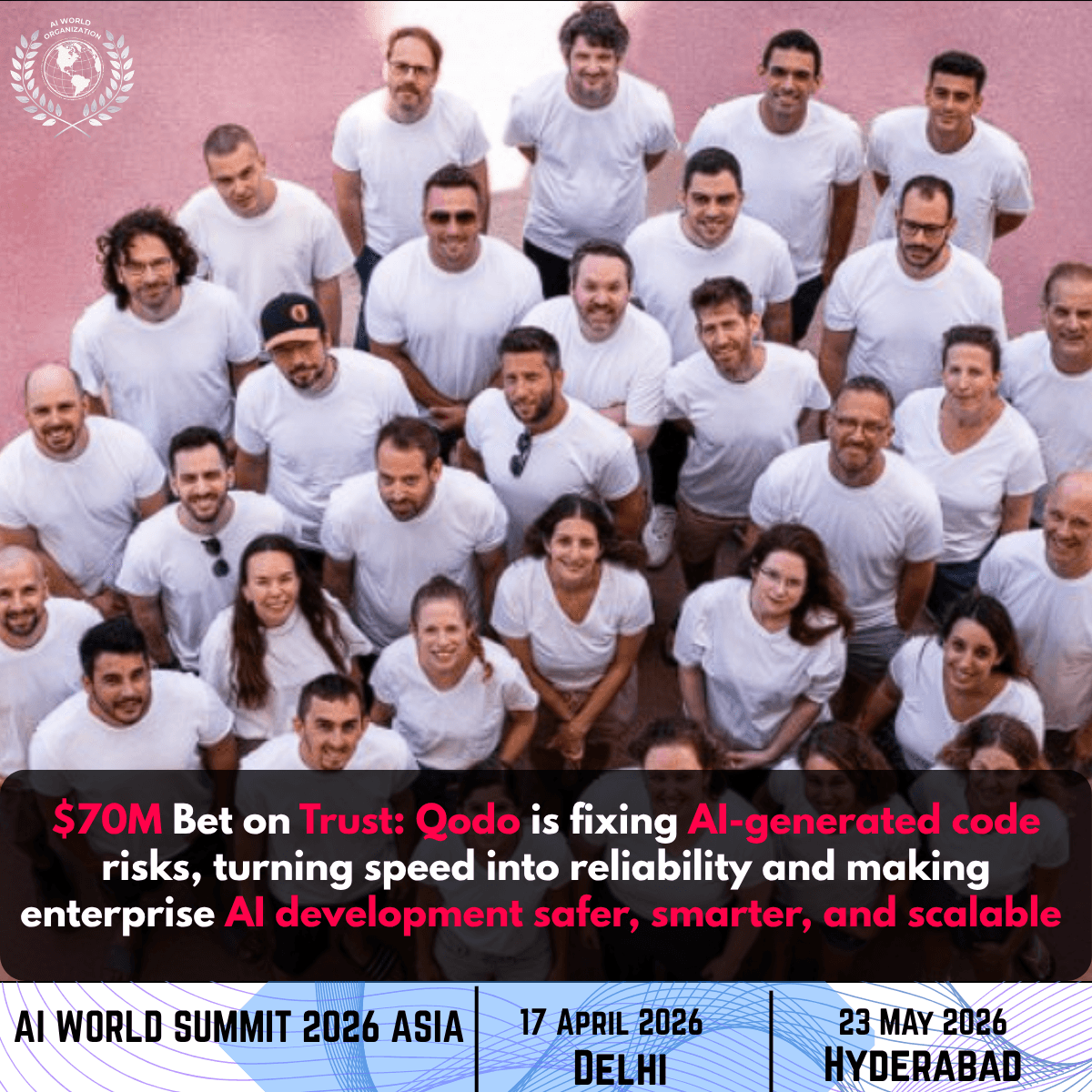
Qodo Raises $70M to Tackle AI Code Risks
Qodo secures $70M in AI funding to solve code reliability challenges as enterprises adopt AI-driven software development at scale.
TL;DR
Qodo has raised $70M in fresh funding to tackle a growing issue in AI-driven development—unreliable code. As companies generate massive amounts of code using AI, ensuring its accuracy and security has become critical. Qodo’s platform focuses on reviewing and validating this code, helping enterprises scale AI adoption without compromising quality or trust.
The Growing Challenge of AI-Generated Code in Modern Software Development
The rapid rise of artificial intelligence in software development has introduced a transformative shift in how code is written, deployed, and scaled. While AI-powered coding tools are now capable of generating massive volumes of code at unprecedented speeds, this surge has created a new and urgent problem — ensuring that this code is accurate, secure, and reliable.
In the latest AI funding news, Qodo, an emerging leader in AI-driven code review and governance, has secured $70 million in a Series B funding round. This funding milestone underscores a growing realization across the tech ecosystem: generating code is no longer the biggest challenge — verifying it is.
As organizations increasingly adopt AI coding tools, billions of lines of code are being produced every month. However, this surge in productivity has also exposed a critical gap. Developers are often unable to keep up with reviewing and validating AI-generated outputs, leading to potential risks such as software bugs, security vulnerabilities, and inconsistent coding standards.
From the perspective of AI World, this marks a pivotal moment in the evolution of artificial intelligence — where governance, trust, and verification are becoming just as important as innovation itself.
Inside Qodo’s $70M Series B Funding Round
The Series B round, led by Qumra Capital, brings Qodo’s total funding to approximately $120 million. The round attracted strong participation from a mix of venture capital firms and high-profile angel investors, reflecting widespread confidence in the company’s vision and technology.
Among the investors backing Qodo are leading venture firms such as Maor Ventures, Square Peg, Susa Ventures, TLV Partners, and Vine Ventures. In addition, notable figures from major tech organizations, including OpenAI and Meta, also joined the round.
This level of investor participation highlights a broader trend in AI Funding — capital is increasingly flowing toward startups that address foundational challenges in AI infrastructure rather than just application-level innovation.
Qodo’s ability to attract this funding is closely tied to its mission: building a robust layer of trust for AI-generated software. As enterprises continue integrating AI into their development workflows, solutions that ensure code quality and compliance are becoming indispensable.
The newly raised capital will be used to expand Qodo’s global footprint, accelerate product innovation, and scale its engineering teams. A significant portion of this expansion will also focus on enhancing enterprise capabilities, allowing organizations to adopt AI at scale without compromising on quality or security.
Why Code Verification is the Next Big AI Battleground
The software industry is entering a new phase where speed alone is no longer enough. While AI tools have made it easier to generate code quickly, they often lack the contextual understanding required to ensure that the code aligns with organizational standards, historical architecture, and long-term system integrity.
This gap has created what many experts now describe as a “code trust crisis.”
Research indicates that while a vast majority of developers recognize the risks associated with AI-generated code, fewer than half consistently review it before deployment. This disconnect between awareness and action is contributing to the growing complexity of maintaining reliable software systems.
Qodo is positioning itself at the center of this challenge by focusing on verification rather than generation. Unlike traditional tools that analyze isolated code changes, Qodo evaluates how those changes impact the entire system. This includes assessing dependencies, historical code patterns, and organizational rules — factors that are often overlooked by standard AI tools.
From an AI World perspective, this shift signals a broader transformation in AI development philosophy. The focus is moving from raw intelligence — the ability to generate outputs — to what can be described as “operational wisdom,” where AI systems must understand context, consequences, and long-term implications.
Qodo’s Technology: A New Approach to AI Code Governance
At the core of Qodo’s platform is a sophisticated approach to code review that goes beyond traditional static analysis. The platform integrates multiple AI agents that work collaboratively to evaluate code quality, detect vulnerabilities, and ensure compliance with predefined standards.
One of Qodo’s defining features is its ability to analyze entire codebases rather than individual snippets. By leveraging historical data, architectural patterns, and organizational rules, the platform provides a more holistic understanding of how code changes affect overall system performance.
This approach is particularly important in large enterprises, where software systems are highly complex and interconnected. Even minor changes can have far-reaching consequences, making comprehensive analysis essential.
Qodo’s platform also incorporates advanced context engineering, enabling it to generate actionable insights that are both accurate and relevant. Developers receive feedback that is not only precise but also aligned with their organization’s coding practices, reducing noise and improving productivity.
In addition, the platform has demonstrated strong performance in independent benchmarks, outperforming several competing tools in identifying subtle errors and inconsistencies. This capability is critical in ensuring that AI-generated code meets enterprise-grade standards.
For AI World, such advancements highlight the growing importance of specialized AI systems that can operate effectively within complex, real-world environments.
Enterprise Adoption and Real-World Impact
Qodo’s technology is already being adopted by major global enterprises across various industries. Companies such as NVIDIA, Walmart, Red Hat, Box, Intuit, Ford, and Monday.com are leveraging the platform to enhance their software development processes.
This widespread adoption reflects a key trend in AI funding news — enterprises are no longer experimenting with AI; they are integrating it deeply into their core operations.
For these organizations, the ability to scale AI-driven development without compromising quality is a critical requirement. Qodo addresses this need by providing a governance layer that ensures every line of code meets strict standards for performance, security, and compliance.
Industry leaders have emphasized the importance of such solutions in maintaining trust while accelerating innovation. As AI continues to play a larger role in software development, tools that enable reliable and consistent outcomes will become essential components of the tech stack.
From the standpoint of AI World, this represents a shift toward more mature AI adoption — where success is measured not just by speed and efficiency, but by reliability and accountability.
The Future of AI Development: From Intelligence to “Artificial Wisdom”
The evolution of AI in software development is moving beyond simple automation. The next phase involves creating systems that can understand context, apply judgment, and make decisions that align with long-term goals.
Qodo’s vision aligns with this trajectory. The company is focused on building what it describes as a system of “artificial wisdom” — an AI framework capable of evaluating code in a way that mirrors experienced human engineers.
This concept emphasizes the importance of context-aware decision-making, where AI systems consider not just immediate outputs but also their broader impact on the system.
As AI-generated code becomes more prevalent, the need for such intelligent governance systems will only increase. Organizations will require tools that can ensure consistency, maintain standards, and prevent errors at scale.
The funding secured by Qodo is a strong indicator that investors recognize this shift. Rather than focusing solely on AI generation capabilities, they are increasingly supporting technologies that enhance trust and reliability.
For AI World, this marks a defining moment in the AI landscape — one where governance and quality assurance are emerging as critical pillars of innovation.
Conclusion: A Defining Moment in AI Funding and Software Evolution
The $70 million Series B funding secured by Qodo is more than just another milestone in AI Funding — it is a reflection of a deeper transformation taking place in the technology industry.
As AI continues to reshape software development, the emphasis is shifting from speed to sustainability. Generating code is no longer the primary challenge; ensuring its reliability and trustworthiness is.
Qodo’s approach to AI-driven code review and governance positions it as a key player in this new era. By addressing the critical gap between code generation and verification, the company is helping organizations navigate the complexities of AI adoption with confidence.
In the broader context of AI funding news, this development signals a growing recognition that the future of AI lies not just in what it can create, but in how effectively it can be controlled, validated, and trusted.
As highlighted by AI World, the next wave of AI innovation will be defined by systems that combine intelligence with accountability — ensuring that technological progress is both rapid and reliable.