Plume Raises €3.3M for Geospatial AI in Renewables
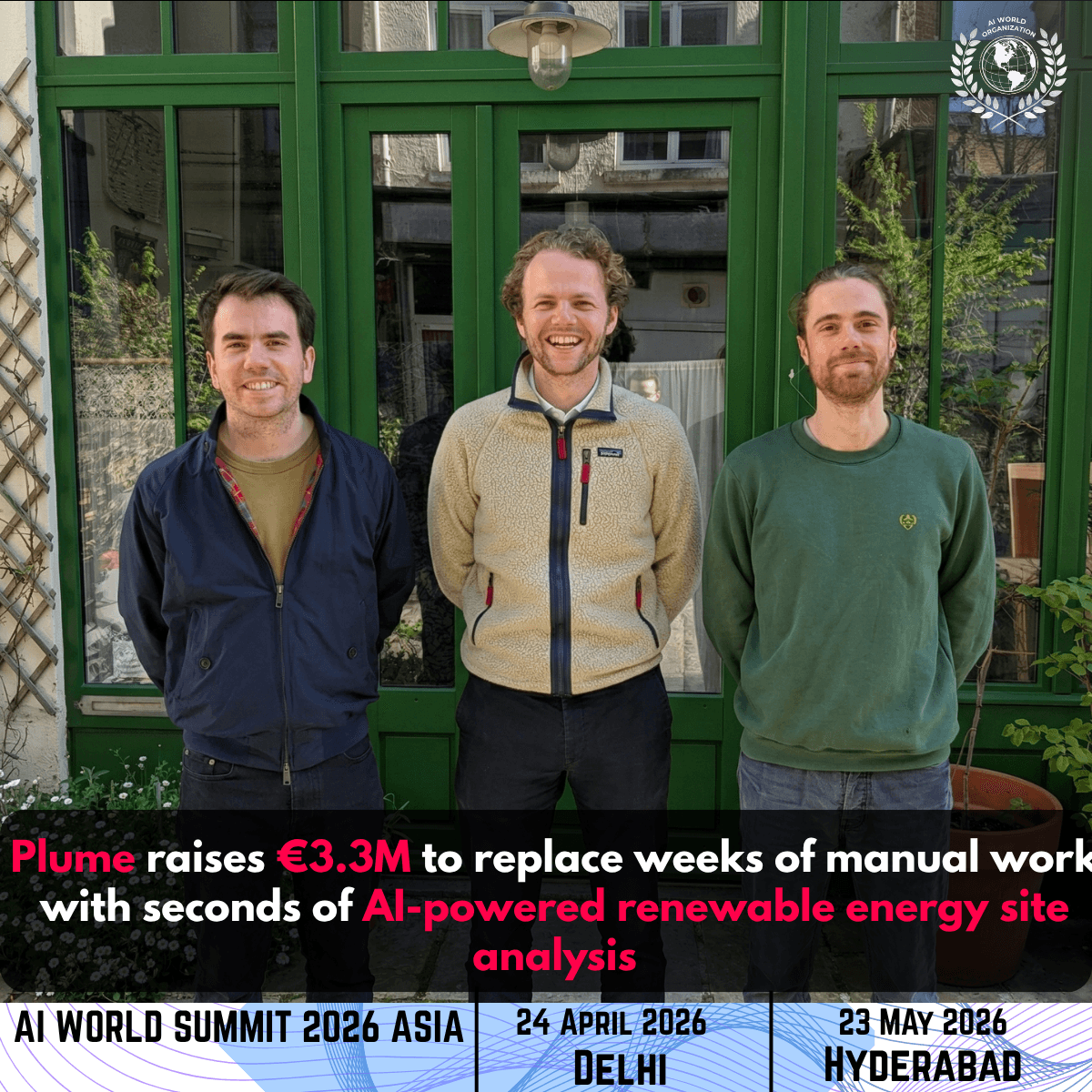
Plume, a Franco-American AI startup, raises €3.3M led by AENU to speed up renewable energy site selection using geospatial AI and smart data agents.
TL;DR
Plume, a Franco-American startup backed by Y Combinator, has raised €3.3M to help renewable energy developers find and qualify project sites up to 20x faster. Its platform pulls together 150+ geographic and regulatory datasets, letting teams run deep site analyses in seconds instead of weeks — cutting years off typical project timelines. The round was led by AENU, with Kima Ventures and Collab Fund also joining in.
Plume Raises €3.3 Million to Transform Renewable Energy Site Selection with Geospatial AI
In a development that carries significant weight for both the AI funding landscape and the global clean energy transition, Franco-American startup Plume has successfully closed a €3.3 million seed funding round to scale its geospatial artificial intelligence platform for renewable energy developers. This round, led by Berlin-based climate-focused venture firm AENU, also saw participation from Y Combinator, Kima Ventures, Raise Phiture, Better Angle, and Collab Fund — a well-rounded group of backers that speaks volumes about the confidence the investor community is placing in Plume's vision and execution. As AI funding news continues to pour in from across the European tech ecosystem, Plume's raise stands apart because it targets one of the most operationally painful and environmentally consequential problems of our time: the painfully slow process of finding, evaluating, and developing viable renewable energy sites.
The timing of this funding round is no coincidence. Europe is in the midst of an urgent push to accelerate its clean energy capacity, driven by policy mandates, carbon neutrality goals, and the geopolitical urgency to reduce dependence on fossil fuel imports. Yet, despite a clear political will and increasing financial commitments from governments and private investors alike, renewable energy projects consistently take years longer than they should — not because of a lack of capital or technology, but because of the staggering complexity involved in identifying and qualifying the right land for development. Plume was purpose-built to dismantle this bottleneck.
The Hidden Complexity Behind Renewable Energy Development
Before a single solar panel is installed or a wind turbine blade begins to rotate, there is an enormous volume of invisible groundwork that must take place. Developing a renewable energy project — whether it involves solar farms, wind installations, or battery storage facilities — requires a meticulous cross-referencing of zoning regulations, grid capacity data, land ownership and parcel records, protected ecological zones, flood risk plans, local municipal deliberations, and a wide range of government-maintained documents that are rarely housed in the same place or in the same format. In France, this means developers must navigate nearly a hundred layers of geographic data, supplemented by urban planning documents, agricultural chamber records, permit archives, and community meeting minutes.
The scale of this challenge becomes even clearer when you understand that the majority of this work is still done manually. Large project development teams dedicate weeks, and often months, to piecing together this information before they can even begin to assess whether a given site is worth pursuing further. And despite that investment of time and talent, many projects end up being abandoned years into the development cycle — not because the energy resource wasn't there, but because a critical regulatory hurdle was missed in the early stages, or because the permitting journey revealed an unforeseen complication that better data could have predicted at the outset. The financial and operational cost of this inefficiency is staggering. The climate cost is arguably worse. The global energy transition demands that renewable projects be approved and constructed in months, not years. Plume's core mission is to make that pace of development a practical reality rather than a distant aspiration.
How Plume's AI Platform Redefines the Site Selection Process
At the heart of Plume's offering is a next-generation, AI-powered geospatial intelligence platform designed specifically for the needs of renewable energy project developers, investment analysts, and regulatory professionals. The platform brings together more than 150 geographical datasets from a diverse range of public and institutional sources, keeping them continuously updated to reflect the latest changes in land classifications, grid developments, and regulatory frameworks. These sources include natural protected areas, electrical grid layouts, PPRi flood risk prevention plans, historical building permits, local authority deliberations, and environmental study repositories. In France alone, the platform synthesises data from over a hundred distinct regulatory and geographic layers.
What sets Plume apart from conventional geographic information system tools is the way it makes this overwhelming volume of data instantly usable. Rather than requiring users to possess deep technical expertise in GIS software or data science, Plume deploys intelligent AI agents that reason over all of this structured geospatial information alongside unstructured documentary data — simultaneously — to generate clear, actionable site intelligence. A project manager with no technical background can simply ask the platform a natural language question about a specific territory and receive a comprehensive site analysis within seconds. Previously, that same level of analysis would have required a dedicated team working for several weeks. According to feedback gathered from its clients, Plume's AI agents enable site analyses to be conducted up to 20 times faster and three times more accurately than conventional manual processes. For an industry where every day of delay translates directly into capital expenditure and opportunity cost, that magnitude of efficiency improvement is genuinely transformational.
Edouard Labarthe, co-founder and CEO of Plume, captured the underlying insight behind the company with remarkable precision: "Renewable energy development is a reasoning problem hidden in maps and documents. Uncertainty regarding risks and timelines remains one of the main obstacles to the deployment of renewables in Europe. We are building the intelligence layer that allows teams to move faster and increase the share of projects that actually succeed. Our AI agents synthesise structured geospatial data and unstructured regulatory information to produce clear territorial intelligence, helping project developers go faster while selecting projects with the highest probability of reaching construction." This vision of AI not as a surface-level productivity tool but as a deep reasoning infrastructure for one of the world's most complex industries is precisely what makes Plume's approach so compelling — and so fundable in the current AI funding environment.
The Founding Team: A Rare Combination of Palantir Grit and Harvard Precision
The founding story of Plume is one where background and timing aligned almost perfectly. Edouard Labarthe, who serves as CEO, spent significant time at Palantir — a company globally recognised for building some of the most sophisticated data intelligence and analytics platforms ever deployed in government and enterprise environments. His experience navigating the complexity of large-scale, heterogeneous datasets and translating raw information into operationally useful intelligence gave him an exceptionally clear view of what a modern AI platform for energy developers should look like. He understood, from first-hand experience, how transformative it can be when an organisation's analysts are freed from manual data assembly and given an intelligent layer that does the heavy lifting for them.
Marc Watine, co-founder and the technical architect behind Plume's geospatial engine, brings an academic pedigree steeped in both geospatial data science and artificial intelligence from Harvard University. His research background translates directly into the kind of nuanced spatial reasoning and regulatory text comprehension that Plume's AI agents perform every day. The combination of Labarthe's enterprise product instincts and Watine's technical depth creates a founding team capable of executing on a vision that sits at the intersection of AI, climate technology, and regulatory complexity — a combination that very few startups can credibly claim. The company was also selected for and incubated by Y Combinator as part of the S24 cohort, one of the most competitive and respected accelerator programs in the world. Being a YC alum not only validates the quality of the team and product thesis but also provides access to a global network of investors and enterprise clients that has meaningfully accelerated Plume's growth trajectory.
The Investors and What This AI Funding Round Signals
This round of AI funding was led by AENU, a European venture firm with a deeply focused mandate around sustainability, climate resilience, and the infrastructure of the energy transition. AENU's decision to anchor the round reflects a growing conviction among impact-oriented investors that the most critical bottleneck in deploying renewable energy at scale is not capital availability — it is the operational speed at which projects can be identified, qualified, and approved. In a world where climate timelines are tightening, every month saved in the development cycle has real-world consequences.
Robert Stoecker, a partner at AENU, laid out the firm's rationale in direct terms: "Plume tackles the most critical bottleneck in the energy transition: the years of friction accumulated from manual site selection and permit processing. By transforming fragmented geospatial layers and unstructured data into an agentic intelligence platform, they allow developers to go 20 times faster. We are delighted to support a team that is not just building a tool, but a new standard for the deployment of global energy infrastructure." That framing — positioning Plume not as a point solution but as a new standard for global energy infrastructure deployment — reflects exactly the kind of ambitious thinking that the best AI funding news tends to celebrate.
The participation of Y Combinator as a financial co-investor alongside its original incubation role is also significant. When one of the world's most rigorous startup accelerators continues to put money into a company beyond the initial cohort stage, it sends a clear signal to the broader investment community. Kima Ventures, known for backing bold early-stage bets, and Collab Fund, which focuses on businesses working toward a more sustainable future, round out a cap table that is strategically aligned around both technological ambition and environmental impact. Together, these investors provide Plume not just with capital, but with the strategic relationships and institutional credibility to pursue its European and international expansion plans at pace.
Expansion Plans and the Road Ahead for Plume
Plume is not simply a platform with potential — it is already a working product generating real results in multiple markets. The company is currently deployed and actively used in France, Spain, Romania, and the Czech Republic, giving it a meaningful multi-country footprint even at this relatively early stage of its development. In France alone, the startup estimates that nearly 500 companies developing renewable energy infrastructure could benefit from the platform's capabilities, indicating a large and immediately accessible addressable market within a single geography.
With the freshly closed €3.3 million round in hand, Plume has outlined a clear and ambitious plan for how the capital will be deployed. A significant portion will go toward team expansion, particularly in the disciplines of AI systems engineering, geospatial data science, and energy sector analysis — three domains that are central to the platform's continued evolution. On the geographic side, Plume is preparing to enter Italy and the United States in 2026, two markets that represent substantial opportunities for a platform capable of navigating dense, locally specific regulatory environments using AI-powered intelligence. Italy's complex land-use regulations and fragmented permit landscape make it a natural fit for Plume's approach, while the United States represents an enormous long-term opportunity given the scale of renewable energy investment occurring across the country.
Beyond market expansion, Plume's product roadmap includes some genuinely exciting next phases. The company is developing advanced stakeholder mapping capabilities that will give developers a clearer picture of the human and institutional landscape around a potential project site. It is also building AI-based competitive intelligence tools that will help developers understand how a given site compares to alternatives in terms of risk-adjusted return potential. Perhaps most significantly, Plume is working on automated drafting of permit applications — a feature that would allow its AI agents to not just identify the best sites but also generate the formal documentation required to begin the approval process. This end-to-end capability would dramatically reduce the administrative burden on development teams and bring projects one significant step closer to construction faster than any current workflow allows.
In the broader context of AI funding news coming out of the European tech ecosystem in 2026, Plume's raise is a reminder that some of the most impactful applications of artificial intelligence are not in consumer-facing products or generative content tools, but in the deep operational infrastructure of industries that are reshaping the physical world. By giving renewable energy developers the intelligence layer they have long been missing — one that turns months of manual analysis into seconds of agentic insight — Plume is doing something quietly remarkable. It is not just accelerating a business process; it is accelerating the pace at which the world builds its clean energy future.